
Interview Thank You Email Examples After a Job Interview
A post-interview thank-you email should be prompt, specific, and thoughtful. These samples help you express genuine gratitude without simply repeating your résumé.
Interview Thank-You Email Samples by Situation and Tone
Before you send an interview thank-you email, remember that being timely and specific is more important than writing a long message. Harvard Law School’s OPIA recommends sending a thank-you note or email within 24 hours after an interview: Harvard Law School.
That doesn’t mean you should send a rushed or generic message. The best follow-ups thank the interviewer for their time, mention a specific point from your conversation, confirm your interest, and avoid turning into a second cover letter.
Standard Thank You Email After a Job Interview
A clean thank-you email after a job interview for the most common situation: one interviewer, one role, and a professional follow-up.
Subject: Thank you for the interview
Dear [Interviewer Name],
Thank you for taking the time to speak with me about the [Job Title] position at [Company Name]. I enjoyed learning more about the role, especially how your team is approaching [Project Name / Team Priority].
Our conversation made the position feel even more aligned with the kind of work I want to do next. The focus on [Specific Responsibility] stood out to me because it connects closely with my experience in [Relevant Skill, Tool, or Previous Role].
I remain very interested in the opportunity and would be happy to provide any additional information as you move forward.
Thank you again for your time and for the thoughtful conversation.
Best regards,
[Your Name]

Reviewed by Grace W., Ghostwriter
I like how this email stays brief but specific. The project detail shows the candidate listened instead of sending a copied follow-up.
Thank You Email Confirming Interest in the Position
Use this interview thank-you email when your conversation made you even more interested in the role, and you want to express that clearly.
Subject: Thank you for your time
Dear [Interviewer Name],
Thank you for meeting with me today to discuss the [Job Title] position. I appreciated our open conversation about the role, the team’s priorities, and the kind of person who would thrive at [Company Name].
Our discussion confirmed my interest in the position. In particular, the work around [Specific Project, Client Need, or Team Goal] fits well with the experience I’ve gained in [Relevant Skill, Industry, or Previous Role].
I also appreciated your explanation of [Detail from the Interview]. It gave me a clearer view of the challenges ahead and made the opportunity feel even more relevant to where I want to grow professionally.
Thank you again for your time and consideration. I’d be glad to continue the conversation and can provide any additional information you may need.
Sincerely,
[Your Name]
Reviewed by Grace W., Ghostwriter
I like that this version confirms interest without sounding needy. It gives one clear reason, which makes the follow-up feel grounded.
Thank You Email After a Panel Interview
Use this panel interview thank-you email when you met with several people and want your follow-up to feel inclusive yet concise.
Subject: Thank you for today’s interview
Dear [Interviewer Name],
Thank you for the opportunity to meet with you and the team today. I enjoyed hearing different perspectives on the [Job Title] role and how the position supports [Department / Team Goal].
My conversation with [Panel Member Name] about [Specific Topic] was especially helpful. It gave me a clearer view of priorities for the first few months, including [Key Challenge or Responsibility].
After meeting the group, I’m even more interested in the opportunity. I believe my experience with [Relevant Experience] would help me contribute quickly while learning how your team works.
Please thank everyone again for their time. I’m happy to answer any follow-up questions.
Kind regards,
[Your Name]
Reviewed by Grace W., Ghostwriter
I like that this message thanks the panel without naming everyone mechanically. One specific discussion point keeps it focused and believable.
Thank You Email After a Second Interview
A focused thank-you email for a second interview, when your conversation has gone beyond first impressions and is now about fit for the role.
Subject: Thank you for the second interview
Dear [Interviewer Name],
Thank you for meeting with me again to discuss the [Job Title] position. I appreciated our deeper conversation about [Specific Project, Challenge, or Team Need] and your expectations for the person stepping into the role.
What stood out to me was the balance between [Responsibility A] and [Responsibility B]. That’s the kind of work I’ve enjoyed most in my previous role, especially when I was responsible for [Relevant Achievement or Process].
This second conversation confirmed my interest in joining [Company Name]. I’d be excited to bring my experience in [Relevant Skill] to the team and contribute to the next stage of [Project / Department Goal].
Thank you again for your time. I look forward to hearing about the next steps.
Best regards,
[Your Name]
Reviewed by Grace W., Ghostwriter
I like the maturity here. The email reflects a deeper interview stage without pushing too hard or repeating the original application.
Thank You Email After a Recruiter Screening Call
A short thank-you email after a recruiter call, meant to confirm your interest, be memorable, and keep the process moving.
Subject: Thank you for the call
Dear [Recruiter Name],
Thank you for speaking with me today about the [Job Title] position at [Company Name]. I appreciated the overview of the role, the hiring process, and the qualities the team is looking for.
The details you shared about [Team Need / Role Priority] helped me see where my experience in [Relevant Skill or Industry] could be useful. The opportunity sounds like a strong match for the kind of role I am looking for.
Please let me know if there’s anything else I can send before the next step.
Thank you again for your time and guidance.
Best,
[Your Name]
Reviewed by Grace W., Ghostwriter
I like that this note respects the recruiter’s role. It confirms interest and keeps the process moving without sounding overeager.
Thank You Email After an Academic Interview
A polished academic interview thank-you email for a graduate program, research position, fellowship, or university interview.
Subject: Thank you for the interview
Dear Professor [Last Name],
Thank you for taking the time to speak with me about the [Program / Research Position / Fellowship] at [University Name]. I appreciated being able to discuss my background in [Research Area] and learn more about the direction of your work on [Topic].
Your comments about [Specific Research Question, Method, or Program Feature] were especially helpful. They helped me see how my interests in [Academic Interest] could develop within the program and contribute to the department’s broader work.
I remain very interested in the opportunity and grateful for our thoughtful conversation. Please let me know if you need any additional materials from me.
Thank you again for your time.
Sincerely,
[Your Name]
Reviewed by Grace W., Ghostwriter
I like how this academic version sounds respectful without becoming stiff. The research detail makes the gratitude feel earned.
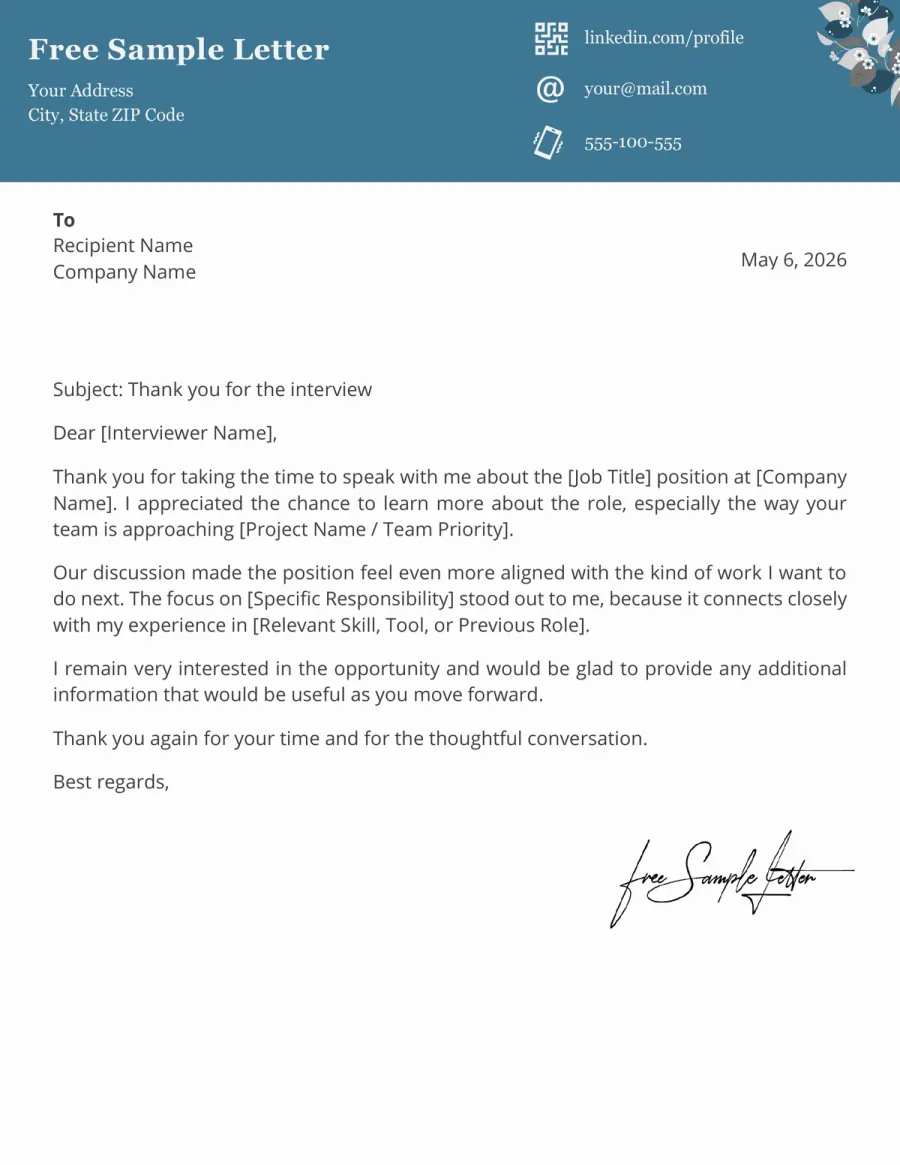
Preview of the Interview Thank You Email Template You Can Download
Below is a preview of the interview thank-you email template you can download and edit. The template is available in Word and PDF formats for a professional follow-up after your interview.
How to Write a Thank-You Email After an Interview
Copying and pasting can make a follow-up feel impersonal. Adapt the timing, interviewer’s name, role details, and one real conversation point so your interview thank-you email feels professional, specific, and genuine.
➡️ More practical writing help in our guide how to write a letter that feels specific, not generic
Send it while the interview is still fresh
A prompt follow-up helps the interviewer connect your message to your conversation. Don’t wait so long that your note feels disconnected from the meeting.
See the timing cue
Thank you for speaking with me today about the [Job Title] position. I appreciated the chance to learn more about [Team Priority].
Name one real discussion point
Generic gratitude is easy to overlook. Mention one specific project, challenge, team need, or role detail that came up naturally during the interview.
See what to mention
Our discussion about [Project Name] helped me understand how the role balances client communication with hands-on delivery.
Confirm interest without repeating your résumé
Your email can remind the interviewer why you’re a good fit, but avoid turning it into another application letter or a list of qualifications.
See the right balance
The role feels closely aligned with my experience in [Relevant Skill], especially the work I have done around [Specific Process].
Keep the tone professional and calm
Gratitude should sound confident, not desperate. Avoid excessive praise or writing as if the job is already yours.
See how it sounds
I remain very interested in the opportunity and would be glad to provide any additional information that would help with the next step.
Close with a clean next step
End with a simple offer to provide more information, or let the process move to the next stage. Don’t pressure the recruiter for an immediate decision.
See the closing
Thank you again for your time. I look forward to hearing about the next steps when they are available.
What Makes an Interview Thank-You Email Easier to Trust
- Thank You
- Specific Interview Detail
- Role Title
- Interviewer Name
- Prompt Follow-Up
- Professional Closing
- Interest Confirmed Without Pressure
- No Résumé Repetition
- One Useful Discussion Point
- Next Step Handled Calmly
- Brief Email Format
- Tone Fits the Hiring Stage
Do & Don’t - Interview Thank-You Emails That Stay Professional
Hiring teams read follow-up emails quickly. A strong note thanks the interviewer, refers to your conversation, and confirms your interest without sounding copied or pushy.
What Weakens the Follow-Up
Red Flags- Sends the same generic note to every interviewer
- Repeats the résumé instead of mentioning the conversation
- Overpraises the company in vague language
- Asks for a decision too soon
- Uses a subject line that feels unclear or casual
- Turns the email into a second cover letter
What Makes the Email Credible
Trust Signals- Thanks the interviewer by name
- Mentions one specific point from the meeting
- Confirms interest in the role calmly
- Keeps the message short enough to scan
- Offers additional information without pressure
- Closes with a professional, natural line
FAQ - Interview Thank You Emails
Should I send a thank-you email after a job interview? Toggle answer
Yes, in most cases it’s a useful follow-up. Keep it brief: thank the interviewer for their time, mention one specific point from your conversation, and confirm your interest without repeating your résumé.
How soon should I send an interview thank-you email? Toggle answer
Send it while the conversation is still fresh, ideally within 24 hours when possible. If you’re late, it’s still better to send a brief, specific note than to skip it entirely.
Should I send a thank-you email to every interviewer? Toggle answer
If you have each person’s email address, a short individual note is usually best. Don’t copy the exact same message to everyone. Change at least one detail from each conversation.
Can a thank-you email help me get the job? Toggle answer
It won’t replace your qualifications, but it can reinforce your professionalism and interest. A specific follow-up helps you stay memorable after a strong interview.
What should I avoid in a post-interview thank-you note? Toggle answer
Avoid long explanations, repeating your résumé, emotional overstatements, salary negotiation, pressure for a quick decision, or generic praise. The note should feel timely, specific, and easy to read.
TL;DR - Interview Thank-You Emails
A thank-you email after an interview works best when it is prompt, specific, and brief. The most common mistake is trying to impress again instead of simply following up.
Mention one real point from your conversation, confirm your interest calmly, and stop before the email turns into another cover letter. That restraint makes your message easier for a hiring team to trust.