
How to Accept a Job Offer: Letter and Email Examples for 2026
Accepting a job offer is exciting, but the details still matter. These examples help you confirm the role, salary, start date, and next steps clearly before you reply.
Before You Send Your Job Offer Acceptance Letter or Email
A job offer acceptance letter is more than a polite yes. It should confirm the position, start date, salary, work location, reporting line, and any conditions already discussed and agreed. The tone can be warm, but the message still needs to stay clear and specific.
Before replying, carefully review the offer letter, contract, benefits summary, and any onboarding instructions. If something important is missing or different from what was discussed, ask for clarification before accepting in writing.
If you are leaving another job, avoid resigning until the offer is clear and final enough for your situation, especially if it depends on background checks, references, right-to-work verification, or final contract approval.
Standard Job Offer Acceptance Email
A straightforward standard job offer acceptance email for confirming the role, salary, start date, and next steps without sounding stiff or overly enthusiastic.
Dear [Hiring Manager Name],
Thank you for offering me the position of [Job Title] at [Company Name]. I am pleased to accept the offer and look forward to joining the team.
I understand that my start date will be [Start Date], with a salary of [Salary Amount], and that the employment terms are as outlined in the offer letter dated [Offer Date]. Please let me know if you need anything further from me before then.
I appreciate the time you and the team have taken throughout the hiring process. Our conversations about [team / project / company goal] made me even more confident that this is the right next step.
I will review and complete any onboarding documents as soon as they are provided. I look forward to starting and contributing to [Company Name].
Kind regards,
[Your Name]

Reviewed by Olivia B., HR Consultant
I like how practical this is. The acceptance is warm, but the start date, salary, and next step are still clear enough for HR to process quickly.
Formal Job Offer Acceptance Letter Confirming Terms
Best when you need a formal job offer acceptance letter. It confirms key terms in writing and gives HR a clean record before your start date.
Dear [HR Contact / Hiring Manager Name],
I am writing to formally accept the offer of employment for the position of [Job Title] at [Company Name]. Thank you for this opportunity and for your confidence in me.
As outlined in the offer letter dated [Offer Date], my employment will begin on [Start Date]. My salary will be [Salary Amount], and the role will be based at [Work Location / Remote / Hybrid Arrangement], reporting to [Manager Name].
Please let me know if any additional forms, identification documents, background check details, or onboarding steps are required before my first day. I will complete them promptly once received.
I am grateful for the offer and look forward to joining [Department / Team Name]. I look forward to contributing to the work ahead and building strong working relationships within the team.
Sincerely,
[Your Name]
Reviewed by Olivia B., HR Consultant
This feels reliable because it confirms the terms without sounding suspicious or cold. It gives the employer a clean written record.
Job Offer Acceptance After Negotiation or Revised Terms
Useful after a revised or negotiated job offer. This version accepts the updated terms while keeping the tone grateful, calm, and precise.
Dear [Hiring Manager Name],
Thank you for sending the revised offer for the [Job Title] position at [Company Name]. I appreciate the time you spent reviewing the details with me.
I am pleased to accept the updated offer. As discussed, my start date will be [Start Date], and the agreed salary will be [Revised Salary Amount], with [benefit / bonus / remote arrangement / schedule detail] included as outlined in your email dated [Date].
I am confirming these details in writing so we have a shared understanding before the onboarding process begins. If there is an updated contract or formal offer document for me to sign, please let me know.
I look forward to joining [Company Name] and contributing to [team / project / business area]. Thank you again for working through the details with me.
Best regards,
[Your Name]
Reviewed by Olivia B., HR Consultant
I trust the restraint here. It accepts the revised offer clearly without reopening negotiation or sounding overly eager after the employer has moved.
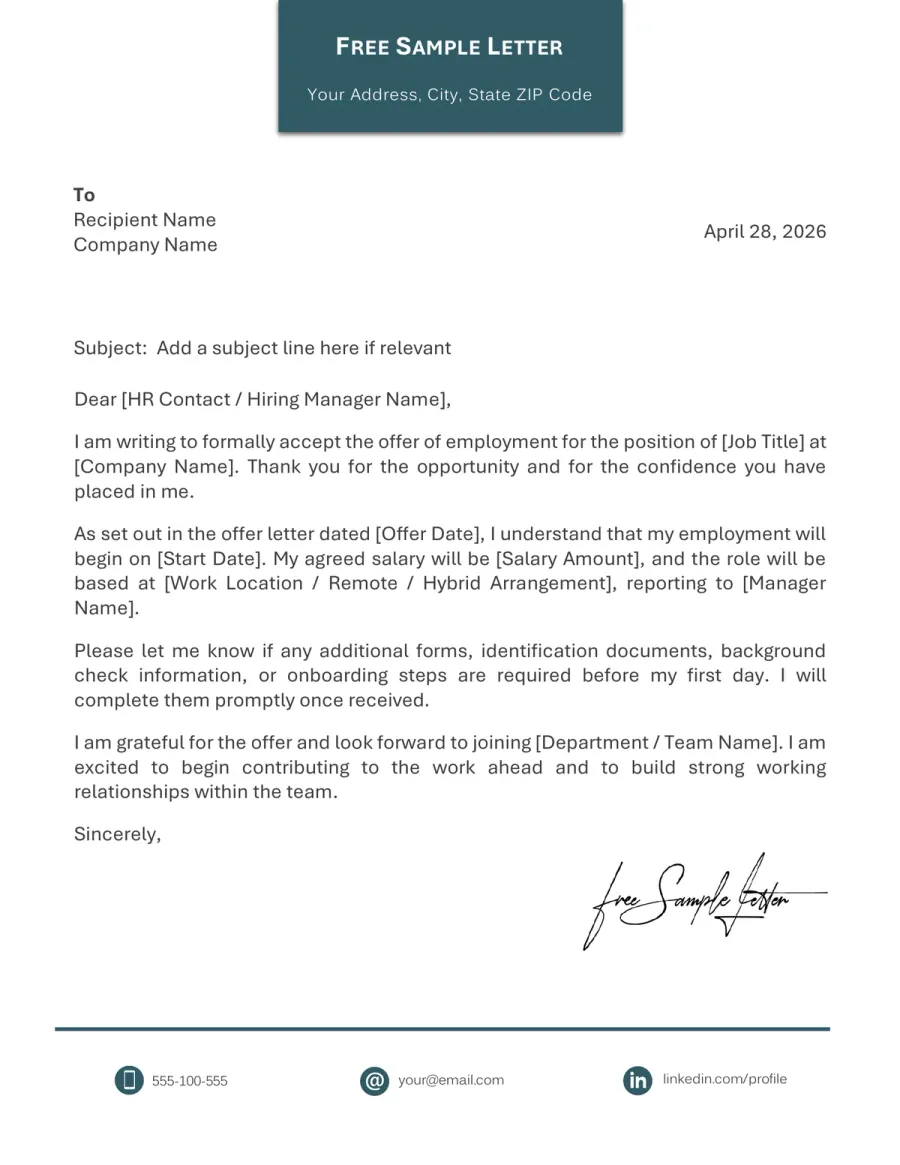
Preview of the Job Offer Acceptance Template You Can Download
Below is a preview of the job offer acceptance letter template you can download and edit. The document is available in Word and PDF formats for workplace use.
Make These Job Offer Acceptance Letters Your Own
Copying and pasting can make an acceptance sound either too cold or too eager. A strong job offer acceptance letter should confirm the key terms, match the employer’s tone, and clearly state your next step.
➡️ More practical writing help in our guide how to write a clear workplace letter or email
Confirm the offer details first
Read the offer carefully before replying. Your acceptance should reflect the written terms, not just what was discussed during the interview or over the phone.
See what to check
Check the job title, salary, start date, location, reporting line, benefits, probation period, and any conditions before you write your acceptance.
Accept the offer clearly
Do not make the employer guess whether you are accepting, asking a question, or still deciding. Put the acceptance near the top of the message.
See an example
Thank you for offering me the position of [Job Title] with [Company Name]. I am pleased to accept the offer.
Repeat the key terms in writing
Briefly confirming the salary, start date, and role details helps prevent confusion later. Keep your message factual and avoid wording that could sound like renegotiation.
See how it sounds
I understand that my start date will be [Start Date], with a salary of [Salary Amount] and the terms outlined in the offer letter dated [Offer Date].
Match the tone to the employer
A startup, public office, school, or corporate HR team may expect different levels of formality. Keep your message warm but professional, not casual.
See the difference
Formal: I am writing to formally accept the offer. Warmer: I am delighted to accept the role and look forward to joining the team.
Ask for the next onboarding step
Close with a practical next step. Ask for any documents, onboarding instructions, or information the employer needs before your first day.
See a natural close
Please let me know if there are any forms, documents, or onboarding steps I should complete before my start date.
What HR Notices First in a Job Offer Acceptance Letter
- Start date
- Salary
- Job title
- Written confirmation
- Offer date
- Onboarding documents
- Warm but clear tone
- Conditions already agreed
- Next step before first day
- No last-minute negotiation language
Do & Don’t - What Makes an Acceptance Easy to Process
HR reviews acceptance letters for confirmation, not a long narrative. A strong reply is warm enough to build goodwill and specific enough to avoid confusion about salary, start date, conditions, paperwork, or next steps.
What Makes the Acceptance Unclear
Red Flags- Thank the employer without clearly accepting the offer
- Leave out the start date or agreed role title
- Reopen negotiation inside the acceptance message
- Use a casual tone when HR needs a written record
- Ignore missing or different contract details
- Send the reply before checking the offer carefully
What Reassures HR Quickly
Trust Signals- Clearly accept the offer in the opening lines
- Confirm the salary, start date, and role title
- Mention revised terms if they were negotiated
- Keep the tone grateful without overdoing it
- Ask for onboarding documents or next steps
- Save a clear written record of the agreement
FAQ - Job Offer Acceptance Letter
Should I accept a job offer by email or formal letter? Toggle answer
Email is usually sufficient if the employer sent the offer digitally. Use a formal letter if the employer requests one, the role is highly formal, or you want a signed written record.
What should I include in a job offer acceptance email? Toggle answer
Include a thank-you, a clear acceptance, the job title, start date, salary or key terms, and a request for next onboarding steps.
Can I accept a job offer after negotiating salary? Toggle answer
Yes. Once the employer confirms the revised terms, accept the updated offer in writing and restate the agreed salary, start date, or benefits so the record is clear.
Should I resign from my current job right after accepting? Toggle answer
Only resign when the offer is clear and final for your situation. Check if the offer is subject to references, background checks, contract approval, or right-to-work documents.
Is it okay to sound excited in an acceptance letter? Toggle answer
Yes, but keep your enthusiasm measured. You can show appreciation while still confirming the terms clearly. Avoid overly emotional language that obscures the acceptance details.
TL;DR - What Makes a Job Offer Acceptance Letter Work
A job offer acceptance letter should do three things clearly: thank the employer, accept the role, and confirm the key terms. The common mistake is writing a warm thank-you note that never properly states the job title, salary, start date, or next step.
Timing matters most. Accept only when the written offer is clear for your situation, especially after negotiation or if conditions still apply. Once you reply, keep the tone positive, save the written record, and make the onboarding process straightforward for HR.