
How to Decline a Job Offer: Letter Examples for 2026
Turning down a job offer can feel awkward, especially if you respect the employer. These examples help you decline clearly, maintain a positive relationship, and leave the door open when appropriate.
Job Offer Rejection Letter and Email Samples
A job offer rejection letter should be clear above all. The employer needs to know that you are declining the offer, not requesting more time or reopening negotiations.
However, your message should not sound cold. Thank the person who made the offer, give a brief reason if it helps, and avoid details that could invite debate. If salary, schedule, location, or role fit is the issue, state it simply.
If you have already accepted the offer, proceed more carefully. Review any signed documents, onboarding steps, background checks, start-date commitments, or previous communications before withdrawing in writing.
Polite Job Offer Rejection Email
A balanced polite job offer rejection email for candidates who want to decline clearly, thank the employer, and maintain a positive relationship.
Dear [Hiring Manager Name],
Thank you for offering me the position of [Job Title] with [Company Name]. I appreciate the time you and the team spent speaking with me and explaining the role in detail.
After careful consideration, I have decided to decline the offer. This was not an easy decision, as I enjoyed learning more about [team / project / company goal] and appreciated our conversations.
At this time, I believe another opportunity is a better fit for my current situation and next step. I wanted to let you know promptly so you can continue your hiring process without unnecessary delay.
Thank you again for your time, confidence, and consideration. I hope our paths cross again in the future, and I wish you and the team continued success.
Kind regards,
[Your Name]

Reviewed by Olivia B., HR Consultant
I like the balance here. The decision is clear, but the note still protects the relationship and avoids overexplaining why the offer is not right.
Declining a Job Offer Because of Salary or Conditions
Useful when the offer is close, but the salary, schedule, or conditions are not right. It declines the role without sounding dismissive.
Dear [Hiring Manager Name],
Thank you for offering me the [Job Title] position at [Company Name]. I appreciate the opportunity and the time you took to discuss the role, team, and expectations with me.
After careful consideration, I have decided not to accept the offer at this time. The position is interesting, and I respect the work your team is doing, but the overall package does not align closely enough with my current needs.
In particular, [salary / schedule / location / remote arrangement / benefits] is the main factor that makes it difficult for me to accept. I wanted to be honest about this rather than take a role where the fit would not be right from the start.
I appreciate the offer and the professionalism you showed throughout the process. If circumstances change in the future, I would be happy to stay in touch.
Best regards,
[Your Name]
Reviewed by Olivia B., HR Consultant
This reads well because it names the issue without sounding transactional. The candidate declines clearly while leaving room for future contact.
Withdrawing After Accepting a Job Offer
Built for the delicate moment when you must withdraw after accepting a job offer. It keeps the record clear and the tone respectful.
Dear [Hiring Manager Name / HR Contact],
I am writing regarding my acceptance of the [Job Title] position at [Company Name]. After careful consideration, I have decided to withdraw my acceptance of the offer.
I understand this may cause inconvenience for you and the team, especially after the time already invested in the hiring and onboarding process. I do not take that lightly. Since accepting, my circumstances have changed because [brief reason if appropriate], and I no longer believe it would be right to proceed with the role.
I wanted to let you know as soon as possible so you can make other arrangements and continue your recruitment plans. Please let me know if there are any formal steps I should complete to confirm the withdrawal in your records.
Thank you again for the offer and for the professionalism you have shown throughout the process. I sincerely wish [Company Name] and the team all the best.
Sincerely,
[Your Name]
Reviewed by Olivia B., HR Consultant
I trust the caution here. Withdrawing after acceptance needs a clean record, and this message stays respectful without hiding the decision.
Short Job Offer Rejection Message
A concise job offer rejection message for email or LinkedIn when you need to decline quickly, politely, and without a lengthy explanation.
Dear [Hiring Manager Name],
Thank you for offering me the [Job Title] position at [Company Name]. I appreciate the opportunity and the time you spent with me during the hiring process.
After careful consideration, I have decided to decline the offer. I wanted to let you know promptly so you can continue your search without unnecessary delay.
Thank you again for your consideration. I wish you and the team every success moving forward.
Best regards,
[Your Name]
Reviewed by Olivia B., HR Consultant
This is useful for a fast reply. It gives the employer a clear answer without padding, defensiveness, or a reason that invites debate.
Preview of the Job Offer Rejection Template You Can Download
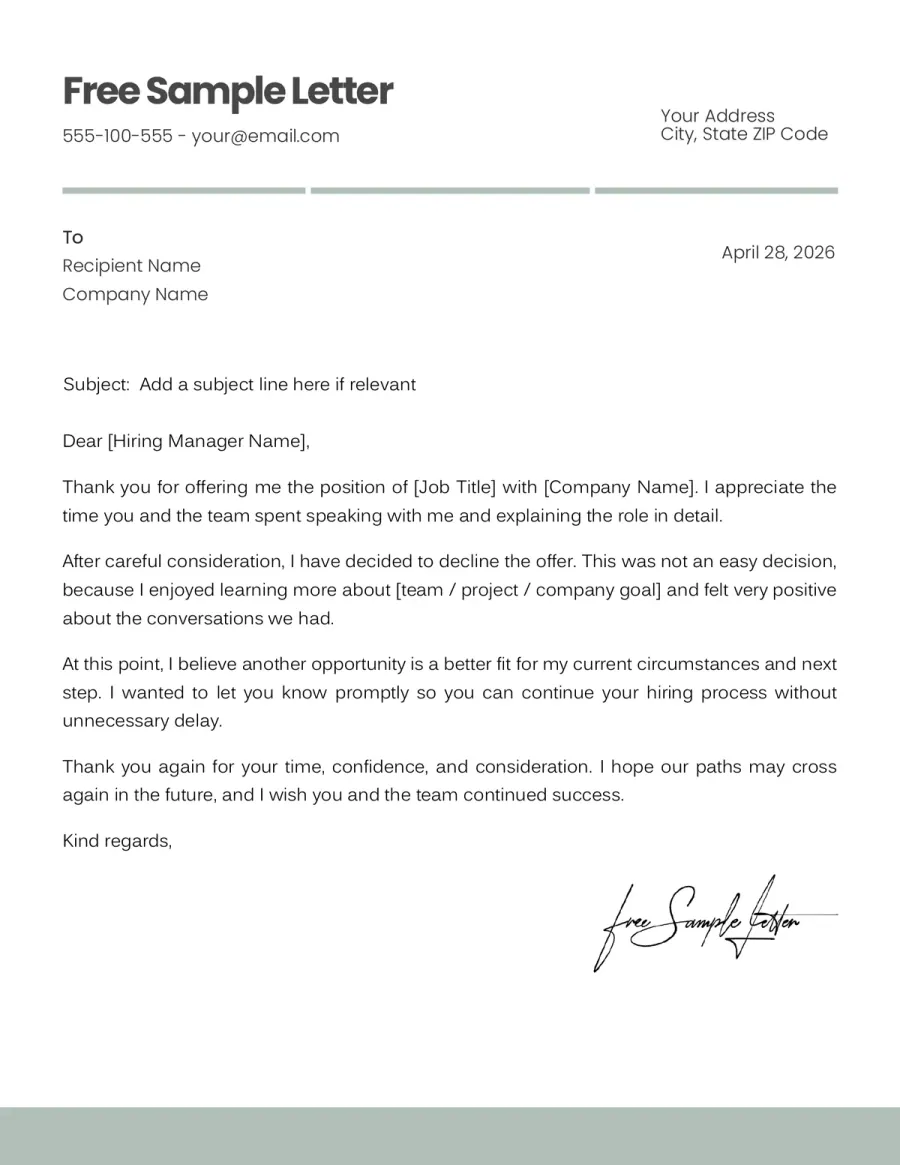
Below is a preview of the job offer rejection letter template you can download and edit. The document is available in Word and PDF formats for workplace use.
Make These Job Offer Rejection Letters Your Own
Copy-pasting can make a refusal sound colder than you intend. A strong job offer rejection letter should give a clear answer, keep the tone gracious, and avoid reasons that might invite unnecessary debate.
➡️ More practical writing help in our guide how to write a clear workplace letter or email
Decide how much reason to give
You do not need to explain everything. Offer a brief, honest reason only if it helps the employer understand your decision without inviting negotiation.
See what to include
After reviewing the offer carefully, I have decided not to accept it because the overall package does not align with my current needs.
Decline near the top
Do not hide your decision under long expressions of thanks or background. Thank the employer, then clearly state that you have decided not to accept the offer.
See an example
Thank you for offering me the position of [Job Title]. After careful consideration, I have decided to decline the offer.
Keep the tone grateful, not guilty
A job offer rejection does not require excessive apologies. Show appreciation for the process, but avoid making the message about your discomfort.
See the difference
Good: I appreciate the time you and the team invested. Too much: several sentences apologizing for making the decision difficult.
Protect the relationship
If you respect the employer, you can leave the door open, but do so lightly. Avoid making promises you do not mean, and keep the final impression calm and professional.
See how it sounds
I hope our paths may cross again in the future, and I wish you and the team continued success.
Check before withdrawing an acceptance
If you have already accepted, proceed carefully. Review signed documents, start-date commitments, onboarding communications, and any formal steps HR may require.
See what to verify
Please let me know if there is any formal step you need me to complete to confirm the withdrawal in your records.
What Employers Notice First in a Job Offer Rejection
- Clear no
- Thank you
- Prompt reply
- Brief reason
- No overexplaining
- Salary or fit handled calmly
- Future contact left open
- Withdrawal after acceptance handled carefully
- Respect for the hiring process
- No negotiation language by accident
Do & Don’t - What Makes a Job Offer Rejection Respectful
Employers read rejection notes quickly. They need a clear answer, a calm tone, and enough courtesy to keep the relationship intact. A weak message sounds vague, guilty, or unnecessarily blunt.
What Makes the Refusal Awkward
Red Flags- Delay the answer when your decision is already made
- Hide the refusal under too much gratitude
- List every private reason for saying no
- Sound as if you are still negotiating by accident
- Criticize the company, salary, or interview process
- Withdraw after accepting without a clear written record
What Keeps the Relationship Professional
Trust Signals- Thank the employer before declining
- State the decision clearly near the top
- Give a short reason only when it helps
- Keep salary or conditions comments neutral
- Reply quickly so the employer can move on
- Close in a way that leaves the door open
FAQ - Job Offer Rejection Letter
How do I politely decline a job offer? Toggle answer
Thank the employer, state clearly that you are declining, give a brief reason if useful, and close with a respectful line. Keep the message short and avoid overexplaining.
Should I give a reason for declining the offer? Toggle answer
You can, but you do not have to. A short reason, such as salary, location, role fit, or another opportunity, is enough. Avoid private details or long explanations.
Can I decline a job offer because of salary? Toggle answer
Yes. Keep your wording neutral. Say the overall package does not align with your current needs rather than criticizing the employer or making the message sound like a negotiation.
Is it bad to reject a job offer after accepting it? Toggle answer
It can create inconvenience, so proceed carefully. Check any signed documents or onboarding steps, inform the employer quickly, and keep the withdrawal respectful and in writing.
Should I decline by phone or email? Toggle answer
Email provides a clear written record. A phone call can be courteous for a senior role or a close final-stage process, but always follow up in writing so the decision is documented.
TL;DR - What Makes a Job Offer Rejection Letter Work
A job offer rejection letter should be clear, appreciative, and brief. The employer should quickly understand that you are declining, why if you choose to include a reason, and whether you want to keep the relationship open.
The main mistake is softening the answer so much that the decision becomes unclear. If the role, salary, timing, or fit is not right, say no with respect. A clear refusal protects your reputation better than a vague message that leaves the employer guessing.