
How to Ask for a Salary Increase: Letter Examples for 2026
Asking for a raise is easier when your request is grounded in facts, not discomfort. These salary increase examples help you present results, timing, and value clearly without sounding entitled.
Before You Send Your Salary Increase Request Letter
A salary increase request is not a complaint about being underpaid. It is a business case. Your manager needs to understand what has changed: results delivered, additional responsibilities, recent performance reviews, market pressure, retention value, or a pay gap that has become difficult to justify.
Before sending your request, review your last performance review date, current salary, bonus or commission terms, job description, recent achievements, your company’s pay process, and any performance data available. If your organization uses a formal compensation cycle, request a salary review instead of pressing for an immediate decision outside that process.
Maintain a professional and measured tone. A competing offer, rising costs, or a lengthy period without a raise may provide context, but these points should not sound like threats. The most effective letters make it easy for a manager to think, “This deserves a serious review.”
Merit-Based Salary Increase Request Letter
A focused merit-based salary increase request for employees who can point to measurable results, strong performance, and clear value delivered.
Dear [Manager Name],
I would like to request a meeting to discuss a salary increase for my role as [Job Title].
Over the past [period], I have taken on several responsibilities that have directly impacted the team’s results. For example, I have [specific achievement], helped deliver [project / target], and contributed to [measurable outcome, such as revenue, savings, client retention, speed, quality, or team performance].
My current salary is [Current Salary], and it has been [period] since my last salary review. Given my increased responsibilities and the results I have delivered, I would like to discuss an adjustment to [Requested Salary / Range], or a salary review that reflects my current contribution.
I enjoy my work at [Company Name] and look forward to continuing to grow with the company. My goal is to have a constructive conversation about compensation, expectations, and the next level of contribution you would like to see from me.
Please let me know a suitable time to discuss this.
Kind regards,
[Your Name]

Reviewed by Olivia B., HR Consultant
I like the way this makes the raise feel connected to results. The request is clear, but it leaves room for a real manager conversation.
Salary Increase Request After Taking on More Responsibilities
Useful when your role has grown beyond the original job. This expanded responsibilities salary request connects the raise to actual workload changes.
Dear [Manager Name],
I would like to request a salary review based on the changes to my role over the past [period].
Since [date / project / team change], my responsibilities have expanded beyond my original position. I now regularly handle [new responsibility], support [team / client / process], and take ownership of [additional task / reporting / training / coordination]. These duties have become a consistent part of my role, not just temporary support.
I appreciate the trust you have placed in me and have been happy to take on these additional responsibilities. At the same time, I believe it is now appropriate to review whether my compensation reflects the role I am currently performing.
I would welcome the opportunity to discuss a salary adjustment to [Requested Salary / Range], or to understand the criteria and timeline for bringing my pay in line with the expanded scope of my position.
Please let me know when we could schedule a conversation. I am happy to prepare a short summary of my responsibilities and results ahead of the meeting.
Best regards,
[Your Name]
Reviewed by Olivia B., HR Consultant
This is a strong angle because it avoids vague claims. The employee shows that the job has changed, which is often easier to review than a general raise request.
Salary Review Request Based on Market Rate
Built for a market-based salary review request. It uses external salary context carefully without sounding like an ultimatum or a complaint.
Dear [Manager Name],
I would like to request a salary review for my position as [Job Title].
I have reviewed the current market range for similar roles in [industry / location / level], and my current salary of [Current Salary] appears to be below what is typically offered for comparable responsibilities. I understand that salary decisions depend on both internal structures and market data, so I would like to discuss this in the context of my role, performance, and contributions to [Company Name].
In the past [period], I have delivered [achievement], supported [business area], and taken responsibility for [task / project / process]. I believe these contributions support a review of my current compensation.
I would appreciate the opportunity to discuss whether an adjustment to [Requested Salary / Range] is possible, or to understand the steps required to reach that level within a reasonable timeframe.
Thank you for considering this request. Please let me know when it would be convenient to discuss it.
Sincerely,
[Your Name]
Reviewed by Olivia B., HR Consultant
I trust the restraint here. It uses market data without sounding like a threat, and it ties the discussion back to performance and role value.
Short Email Asking for a Salary Review Meeting
A concise salary review meeting request for employees who prefer to start with a conversation before sending a detailed raise proposal.
Dear [Manager Name],
I would like to schedule a meeting to discuss my current salary and the possibility of a salary review.
Over the past [period], my role has developed in several ways, including [new responsibility / project / result]. Given these changes and my ongoing contributions to [team / department / company], I believe it would be useful to review my current compensation.
I am not expecting an immediate decision by email. I would simply appreciate the opportunity to discuss my performance, current role expectations, and the salary review process.
Please let me know a convenient time for us to speak. If helpful, I can send a brief summary of my recent achievements ahead of our meeting.
Kind regards,
[Your Name]
Reviewed by Olivia B., HR Consultant
This is a good first step when the workplace prefers live discussion. It opens the salary topic without overloading the email.
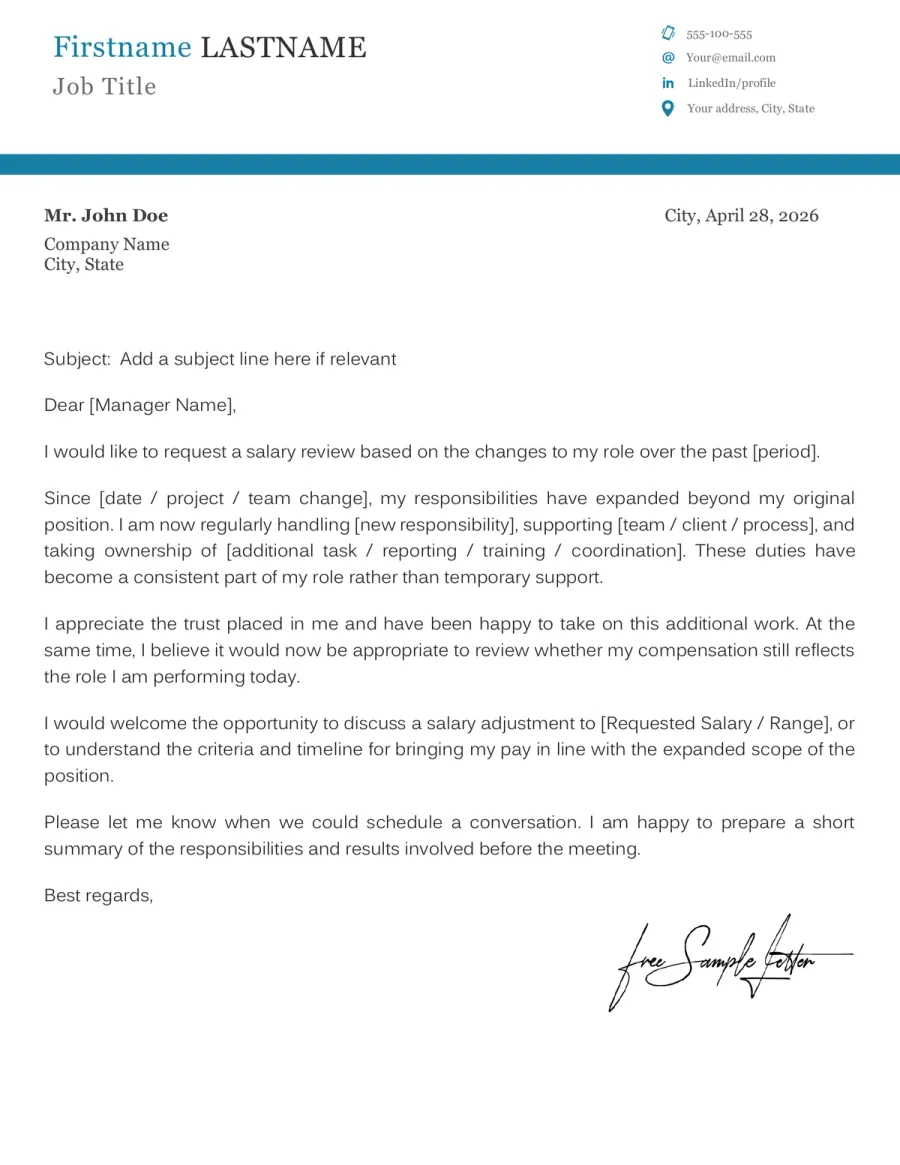
Preview of the Salary Increase Request Template You Can Download
Below is a preview of the salary increase request template you can download and edit. The document is available in Word and PDF formats for workplace use.
How to Write a Salary Increase Request Before You Ask
Copy-pasting a pay raise request can weaken your case because the supporting evidence should be specific to you. A strong salary increase letter connects timing, results, responsibilities, and a realistic next step.
➡️ More practical writing help in our guide how to write a clear workplace letter or email
Choose the right timing
A raise request is best made after delivering results, taking on new duties, receiving a positive review, or experiencing a clear change in your role’s scope. Avoid sending a request if your only reason is frustration.
See what to check
Good timing: after completing [project], taking on [responsibility], or reaching [target]. Weak timing: right after a difficult week with no evidence prepared.
Lead with the business reason
Begin with your request and then explain why it is reasonable. Your manager should see that the raise is tied to your value, not just personal need.
See how it sounds
I would like to request a salary review based on the responsibilities I have taken on and the results delivered over the past [period].
Use proof, not adjectives
Avoid broad claims about dedication or hard work. Instead, use specific examples such as projects, revenue, cost savings, workload, client impact, targets achieved, quality improvements, speed, or team support.
See what to include
In the past [period], I have delivered [result], reduced [problem], supported [team], and taken ownership of [responsibility].
Ask for a range or review path
If you specify an amount, make sure it is realistic. If your company uses fixed review cycles, ask what steps or timeline could lead to an adjustment.
See an example
I would like to discuss an adjustment to [Requested Salary / Range], or the criteria and timeframe needed to reach that level.
Keep pressure out of the letter
A competing offer or market gap can provide useful context, but threats usually damage trust. Keep your tone firm, factual, and open to discussion.
See the difference
Better: I would like to discuss whether my compensation reflects the current scope of the role. Avoid: I will leave unless this is matched.
What Managers Notice First in a Salary Increase Request
- Results
- Timing
- Current salary
- Requested range
- Expanded duties
- Market context
- Recent performance review
- Value beyond normal duties
- Specific achievements with impact
- Clear meeting or review request
Do & Don’t - What Makes a Raise Request Credible
Managers review salary requests by focusing on timing, supporting evidence, role scope, and tone. A strong request feels prepared and reasonable; a weak one sounds emotional, vague, or difficult to support internally.
What Weakens the Request
Red Flags- Ask for more pay without naming recent results
- Use loyalty as the only argument for a raise
- Compare salaries without credible context
- Threaten to leave before opening the discussion
- Make the request sound like a personal complaint
- Avoid naming the next step you want
What Makes the Case Easier to Support
Trust Signals- Connect the raise to measurable contribution
- Show how the role has expanded over time
- Use a realistic salary range or review path
- Keep market data calm and factual
- Ask for a meeting or written review timeline
- Leave room for criteria, feedback, or negotiation
FAQ - Salary Increase Request Letter
Should I ask for a raise by email or in person? Toggle answer
Use email to request a meeting or summarize your case. The actual discussion often works better live, because salary decisions usually involve questions, timing, budget, and manager feedback.
Should I mention a competing job offer? Toggle answer
Only if you are prepared for the consequences. A competing offer can be relevant, but it should not sound like a threat. Keep the focus on your role, value, and future with the company.
How much salary increase should I ask for? Toggle answer
Use a realistic range based on your role, market data, performance, and internal context. Avoid choosing random numbers. If you are unsure, request a salary review and discuss the appropriate adjustment with your manager.
What if my manager says there is no budget? Toggle answer
Ask about the timeline, criteria, or next review point that would make a raise possible. You can also discuss title, responsibilities, bonus, flexibility, training opportunities, or a written development path.
Should I include personal financial reasons? Toggle answer
Usually, no. While rent, bills, or cost of living may be real concerns, a salary increase request is stronger when focused on your contribution, responsibility, performance, and market context.
TL;DR - What Makes a Salary Increase Request Work
A salary increase request letter is effective when it turns discomfort into a clear business case. Show what has changed, what you have delivered, what you are asking for, and why the timing makes sense. The mistake is asking for more money without supporting evidence beyond effort or loyalty.
The most important factor is making your request easy for your manager to support internally. Provide enough evidence, such as results, expanded responsibilities, market context, and a realistic next step, to justify a review. Keep your tone calm, leave room for discussion, and make the raise feel justifiable, not emotional.