
How to Write a Resignation Letter: Examples for 2026
Resigning can seem straightforward until notice periods, final pay, handover responsibilities, and timing become important. These resignation letter examples help you leave on clear terms, protect your employment record, and avoid unclear or problematic wording.
Before You Send Your Resignation Letter or Email
A resignation letter is a formal record, not the place to explain every detail or dispute. In the UK, Gov.uk states that employees must give at least one week’s notice if they have worked for more than one month, and your contract may require that notice be in writing (Gov.uk). Acas advises not to use a standard resignation template if you feel forced to resign due to a serious issue caused by your employer, such as a breach of contract (Acas).
In Australia, Fair Work explains that an award, enterprise agreement, or employment contract may specify how much notice an employee must give, and that the notice period starts the day after the employee gives notice (Fair Work Ombudsman). For federally regulated employees in Canada, Canada.ca notes that the Canada Labour Code does not require employees to give notice, although an employment contract may require it (Canada.ca).
Before sending your resignation, review your contract, notice period, employee handbook, final pay rules, unused leave status, and any post-employment restrictions. If your resignation relates to workplace pressure, discrimination, harassment, unpaid wages, or a serious breach by your employer, seek advice before using a standard resignation letter.
Standard Resignation Letter with Notice Period
A straightforward standard resignation letter with notice for employees who want to clearly confirm their last working day, maintain a calm tone, and provide a clear record.
Dear [Manager Name],
Please accept this letter as formal notice of my resignation from my position as [Job Title] at [Company Name].
In line with my notice period of [Notice Period], my final working day will be [Last Working Day]. Please let me know if this date does not match your understanding of my contract or company policy.
I appreciate the opportunities I have had at [Company Name], especially [brief reference to team / project / experience]. I have learned a great deal and am grateful for the support from you and the team.
During my notice period, I will do my best to support a smooth transition. I can prepare handover notes for [key task / client / project], update [system / tracker], and brief [Colleague Name] on any outstanding items after I leave.
Please confirm receipt of this resignation and advise on the next steps for final pay, remaining leave, equipment return, and any exit procedures.
Kind regards,
[Your Name]

Reviewed by Olivia B., HR Consultant
This example is direct. The notice period and final day are clear, and the tone avoids unnecessary debate.
Resignation Letter After Accepting a New Job Offer
Useful after accepting a new job offer before resigning. This version keeps the reason simple and focuses on notice, handover, and final working day.
Dear [Manager Name],
I am writing to formally resign from my position as [Job Title] at [Company Name]. I have accepted a new professional opportunity, and my final working day will be [Last Working Day], based on my notice period of [Notice Period].
This decision was not made lightly. I have valued my time here, especially the chance to work on [project / responsibility / team experience], and I appreciate the guidance and support I have received throughout my employment.
Before I leave, I want to help ensure a smooth transition. I will complete [priority task] where possible, document the status of [project / account / process], and share any relevant files or handover notes with [Manager Name / Colleague Name].
Please let me know how you would like to handle the handover and whether there are any exit steps I should complete before my final day.
Thank you again for the opportunity to be part of [Company Name]. I wish you and the team continued success.
Best regards,
[Your Name]
Reviewed by Olivia B., HR Consultant
This version strikes the right balance after accepting another offer. It provides a reason without turning the resignation into a personal story.
Short Notice Resignation Letter for Urgent Personal Reasons
Designed for short-notice or urgent resignations when timing is challenging. It gives the employer a clear record without unnecessary explanations that could raise more questions.
Dear [Manager Name],
I am writing to resign from my position as [Job Title] at [Company Name]. Due to urgent personal circumstances, I am requesting that my final working day be [Last Working Day].
I understand this is shorter than my usual notice period of [Notice Period], and I appreciate it may create challenges for the team. I am sorry for the limited notice and wanted to inform you as soon as possible.
Where possible, I will help reduce any disruption before I leave. I can prepare a handover note for [project / task / client], provide the current status of [work item], and ensure any files or access details are easy for the team to locate.
Please let me know if this shortened notice can be agreed and if you need any further information from me to process the resignation correctly.
Thank you for your understanding.
Sincerely,
[Your Name]
Reviewed by Olivia B., HR Consultant
This version shows restraint. Short notice can sound abrupt, but this letter provides a clear final date and keeps the explanation focused.
Resignation Letter with Handover Details
A detailed resignation letter with handover information, designed for roles where projects, clients, systems, or team responsibilities require a careful transition before the final day.
Dear [Manager Name],
Please accept this letter as formal notice of my resignation from my role as [Job Title] at [Company Name]. My final working day will be [Last Working Day], subject to confirmation of my notice period.
Since several items are still active, I would like to ensure the handover is clear before I leave. The main areas needing attention are [project / client / process], [system / report / deadline], and [team responsibility].
I will prepare a brief handover document covering the current status, outstanding actions, key contacts, access points, and any deadlines that fall after my final day. I am also available to meet with [Manager Name / Colleague Name] during my notice period to review the work if that would be helpful.
Please confirm whether my final working day is correct, and let me know who should receive the handover notes. I would also appreciate guidance on final pay, remaining leave, company equipment, and any exit documentation.
Thank you for the opportunities I have had at [Company Name]. I am committed to ensuring the work is left in a clear and manageable state.
Kind regards,
[Your Name]
Reviewed by Olivia B., HR Consultant
This version is helpful for managers. It makes it clear the employee is leaving, but focuses on a practical, not ceremonial, handover.
Preview of the Resignation Letter Template You Can Download
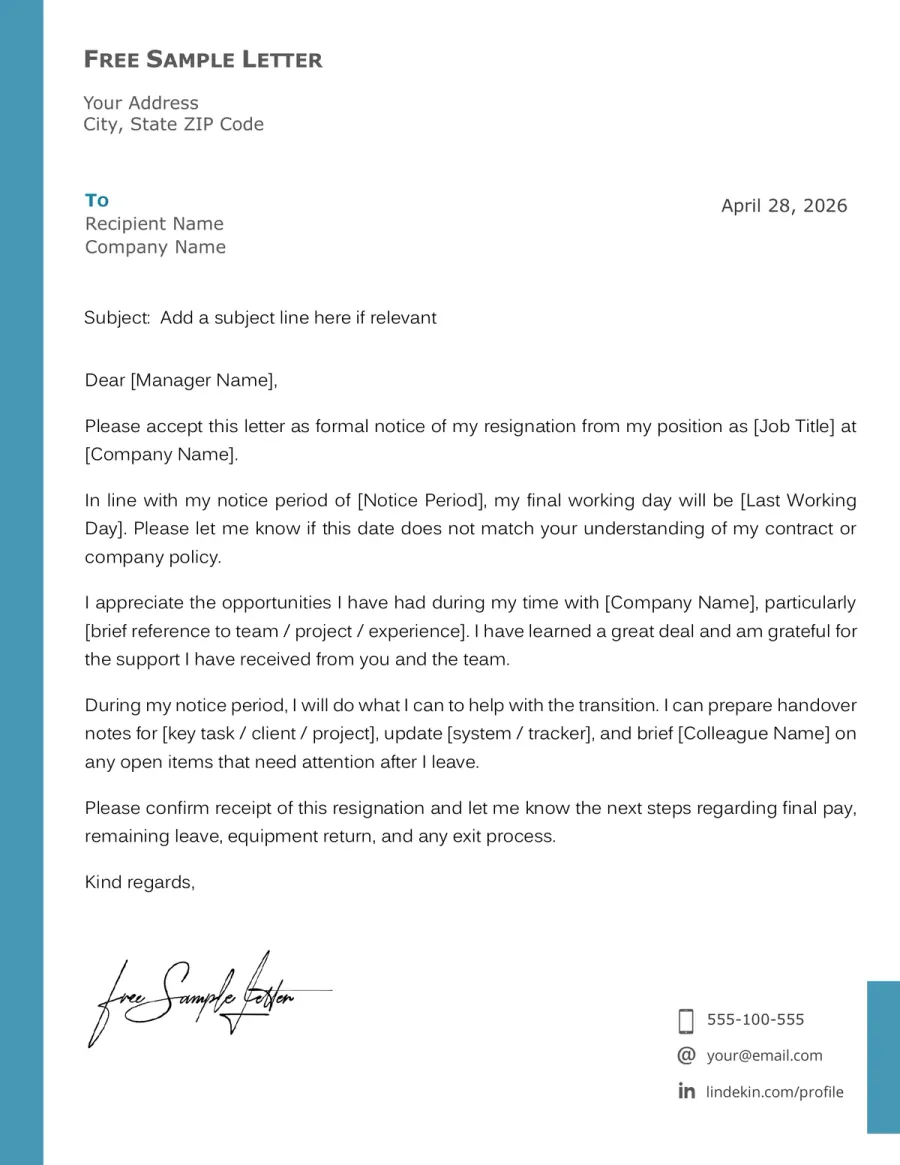
Below is a preview of the resignation letter template you can download and edit. The document is available in Word and PDF formats for workplace use.
How to Write a Resignation Letter Before You Send It
Copying and pasting can make a resignation sound careless if the dates are incorrect. A strong resignation letter should confirm your notice period, final working day, handover plan, and next steps without providing unnecessary detail.
➡️ More practical writing help in our guide how to write a clear workplace letter or email
Check your notice period first
Before writing, check your contract, written statement, handbook, award, agreement, or local rules. The letter should reflect the notice you are required to give.
See what to verify
My notice period is [Notice Period], so I understand that my final working day will be [Last Working Day]. Please let me know if that is incorrect.
Put the resignation and date near the top
Make it easy for your manager to see your decision. State that you are resigning, specify your role, and include your final working day in the first lines.
See an example
Please accept this letter as formal notice of my resignation from my position as [Job Title]. My final working day will be [Last Working Day].
Keep the reason brief or leave it out
You usually do not need a long explanation. If you mention a new opportunity or personal reason, keep it brief and avoid opening a debate.
See the difference
Good: I have accepted a new professional opportunity. Too much: several paragraphs explaining why the role no longer works for you.
Offer a realistic handover
A resignation letter should not promise more than you can deliver. Offer specific handover help that fits the time available before your final day.
See how it sounds
I can prepare handover notes for [project], update [system], and brief [Colleague Name] on any open items before I leave.
Ask for confirmation in writing
End by asking your employer to confirm receipt, your final working day, and any exit steps. This protects your record and helps avoid confusion later.
See a natural close
Please confirm receipt of this resignation and let me know the next steps regarding final pay, remaining leave, and equipment return.
What HR Notices First in a Resignation Letter
- Notice period
- Final day
- Job title
- Written notice
- Handover plan
- Company equipment
- Remaining leave
- Final pay questions
- Reason kept brief
- Receipt confirmation requested
Do & Don’t - What Makes a Resignation Letter Safe to Send
HR and managers review resignation letters for dates, notice period, tone, and transition details. A strong letter is clear enough to act on and calm enough to maintain a good working relationship.
What Makes a Resignation Problematic
Red Flags- Resign without checking the notice period
- Hide the final working day in the middle of the letter
- Use the letter to complain about the whole job
- Give short notice without asking whether it can be agreed
- Promise a handover you cannot deliver
- Forget to ask for written confirmation of receipt
What Helps HR Process It Efficiently
Trust Signals- State the resignation in the first lines
- Clearly state the role and final working day
- Ensure the letter matches your contract or company policy
- Keep the reason short if you include one
- Offer a practical handover, not vague assurances
- Ask about final pay, leave, equipment, and exit steps
FAQ - Resignation Letter
Do I have to give a resignation letter in writing? Toggle answer
It depends on your contract, company policy, and country. Even if verbal notice is permitted, written notice is safer because it confirms the date, role, notice period, and final working day.
Should I explain why I am resigning? Toggle answer
Only if you feel it is helpful. A brief reason, such as a new opportunity or personal circumstances, is enough. Avoid lengthy explanations, criticism, or anything likely to cause conflict.
Can I resign with immediate effect? Toggle answer
Sometimes, but it may create contractual or practical issues. Always check your notice period first. If you need to leave urgently, ask in writing whether a shorter notice period can be agreed.
What should I include in a resignation letter? Toggle answer
Include your role, a clear resignation statement, notice period, final working day, a brief thank you if appropriate, a handover offer, and a request for written confirmation of exit steps.
What if I feel forced to resign? Toggle answer
Do not use a standard resignation template without seeking advice. If you are resigning due to workplace pressure, breach of contract, discrimination, harassment, unpaid wages, or constructive dismissal, get professional guidance first.
TL;DR - What Makes a Resignation Letter Work
A resignation letter is effective when your employer can process it without uncertainty. Clearly state that you are resigning, specify your role, notice period, and final working day, then offer a practical handover. The mistake to avoid is turning the letter into a lengthy explanation or sending it before checking your contract requirements.
The most important detail is the written record. A calm resignation letter protects your final date, reduces confusion about pay and leave, and helps preserve a professional relationship after you leave. If your resignation is linked to workplace pressure, a serious issue, or unpaid wages, pause before sending a standard notice letter.