
How to Write an Annual Leave Request Letter: Examples for 2026
Requesting time off can sound simple until dates, team cover, and company policy start to matter. These annual leave request examples help you ask clearly, sound credible, and avoid wording that can delay approval.
Before You Send Your Annual Leave Request Email or Letter
Annual leave is not framed the same way everywhere. In the UK, most workers are entitled to 5.6 weeks’ paid holiday, and the default notice for booking time off is at least twice the leave requested plus 1 day (Gov.uk).
In Australia, full-time and part-time employees get 4 weeks of annual leave; requests usually follow the award, agreement, policy, or contract, and refusal must be reasonable (Fair Work Ombudsman). In the US, federal law does not require paid vacation leave (U.S. Department of Labor). In federally regulated Canada, annual vacation starts at 2 weeks after 1 year, rises to 3 weeks after 5 years, then 4 weeks after 10 years (Canada.ca).
Before submitting your request, review your leave balance, employment contract, and company policy. If anything is unclear, contact HR or your personnel department before booking travel or finalizing personal plans.
Standard Annual Leave Request Email
A clean routine annual leave request for the most common work situation: clear dates, calm tone, and just enough context for a manager to approve it without chasing details.
Dear [Manager Name],
I would like to request annual leave from [Start Date] to [End Date], with my return to work on [Return Date].
I have reviewed my remaining annual leave balance and, based on the current schedule, these dates should not affect any fixed commitments that require my presence. To keep things moving, I will complete [task/project] before I leave and provide a brief handover note for any ongoing work.
If you would like to discuss alternative dates to ensure team coverage, I am open to that. I am submitting this request early so we have enough time to plan it properly.
Please let me know if you would like me to record this request in the HR system, or if you need any additional information from my side.
Best regards,
[Your Name]

Reviewed by Olivia B., HR Consultant
I like this one because it makes the dates, the coverage, and the ask visible at once. HR can approve or discuss it without chasing missing details.
Annual Leave Request Letter with Work Cover Plan
Useful when your leave falls near a busy period, deadline, or team handover. This version shows that you are thinking about cover, not just time off.
Dear [Manager Name],
I am requesting annual leave from [Start Date] to [End Date], and I will return to work on [Return Date].
I am submitting this request now because this period is close to [project deadline / busy season / team event], and I want to make the timing as manageable as possible. Before my leave begins, I will finalize [task], brief [Colleague Name] on [ongoing item], and leave clear notes on any items that may require attention during my absence.
At this stage, I do not anticipate any urgent deadlines will be missed during my requested leave. If there are concerns about coverage, I am happy to adjust my start or return date slightly so the team is properly supported.
Please let me know if you approve these dates or would like to discuss them before I finalize any travel arrangements.
Kind regards,
[Your Name]
Reviewed by Olivia B., HR Consultant
I would move this forward fast. The tone is polite, the dates are usable, and the writer shows they have thought about workload, not just time off.
Policy-Aware Annual Leave Request in Writing
Built for cases where you need a clear written record for HR or management. It confirms dates, leave balance, and next steps without sounding heavy.
Dear [HR Contact / Manager Name],
Following our conversation on [Date], I am writing to confirm my request for annual leave from [Start Date] to [End Date]. My planned return date is [Return Date].
According to my current balance, I have enough annual leave / vacation time to cover this period. I am submitting the request in writing to ensure the dates are clear and can be recorded accurately in line with company policy.
To help with planning, I will complete [priority task] before I leave, update [system / tracker], and ensure [Colleague Name] has all necessary information for routine follow-up. If formal approval is also required through the HR portal, I am happy to submit it promptly.
Please confirm whether these dates are approved, or let me know if any adjustments are needed.
Sincerely,
[Your Name]
Reviewed by Olivia B., HR Consultant
I trust this version because it sounds like a real employee note, not a template dump. The request is specific, calm, and easy for a manager to act on.
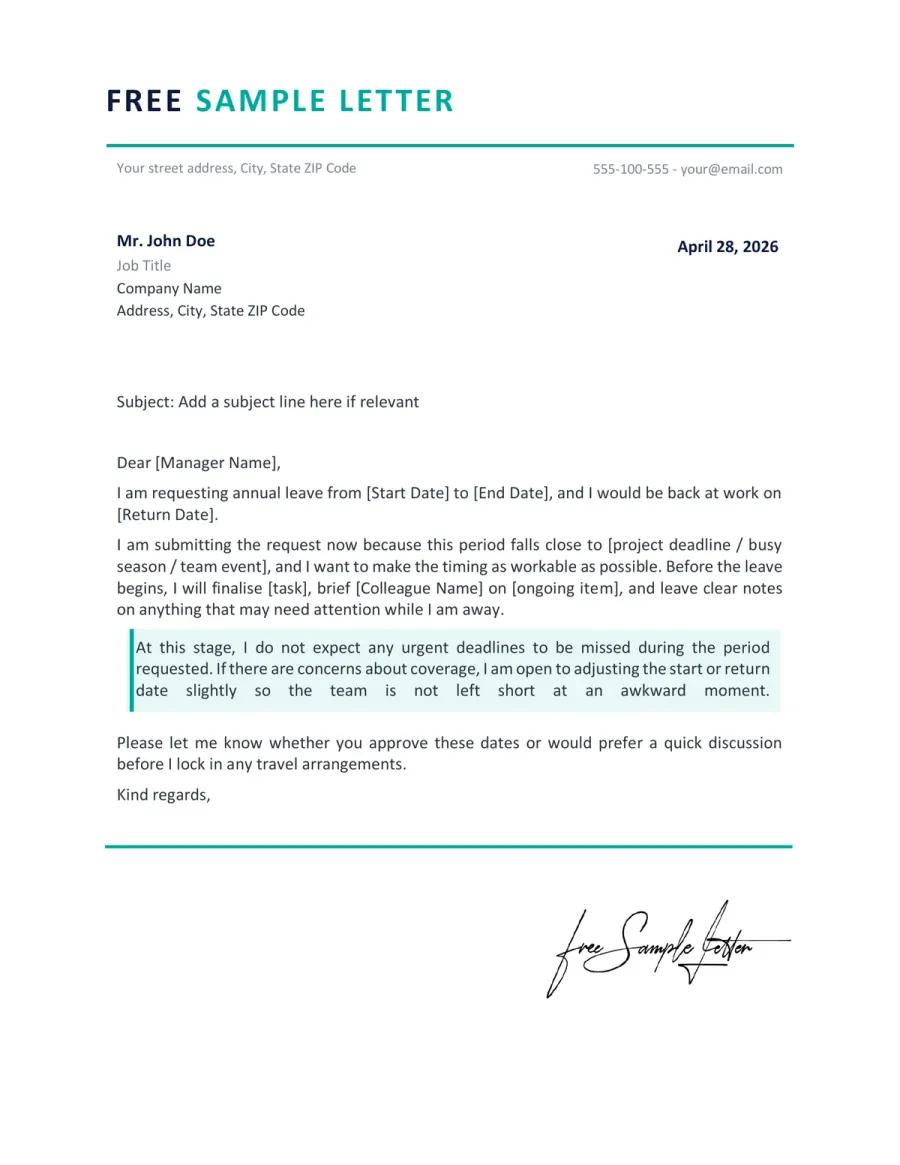
Preview of the Annual Leave Request Template You Can Download
Below is a preview of the annual leave request template you can download and edit. The document is available in Word and PDF formats for quick workplace use.
Make These Annual Leave Request Letters Your Own
Simply copying and pasting a template often weakens your request. Dates, workload, approval rules, and tone vary from one workplace to another, so a believable annual leave request should reflect your actual situation, not just a generic office script.
➡️ More practical writing help in our guide how to write a clear workplace letter or email
Check the real rule before you write
Start by checking your policy, contract, or HR system. A good request may sound simple, but it should follow the approval process your workplace actually uses.
See what to include
I would like to request annual leave from [Start Date] to [End Date]. If required, I can also submit these dates through the HR portal today.
Lock the dates early
Do not make your manager guess what you want. State the start date, end date, and return date in the opening lines so your request can be reviewed quickly.
See an example
I would like to be away from [Start Date] to [End Date], with my return to work on [Return Date].
Show the team impact in one paragraph
You do not need a lengthy explanation. A brief section about deadlines, handover, or coverage is enough to show you are considering the wider team.
See what to include
Before I leave, I will complete [task], update [tracker], and brief [Colleague Name] on any open items that may need attention.
Keep the reason light unless policy requires more
Most annual leave requests do not require a personal story. A brief reason is sufficient. Providing too much detail can weaken your message and cause unnecessary distraction.
See the difference
Good: I am planning to take annual leave during this period for personal travel. Too much: a long paragraph explaining every booking, family plan, and private detail.
End with a clear approval step
Do not end with just a vague thank-you. Ask for confirmation, or invite a brief discussion if the dates need to be adjusted.
See a natural close
Please let me know whether these dates are approved, or if a slight adjustment would be easier for team cover.
What HR Notices First in an Annual Leave Request
- Leave dates
- Return date
- Team cover
- PTO balance
- Handover note
- Busy-period awareness
- Approval requested in one line
- HR portal or policy route
- Flexible dates if business needs shift
- Written confirmation requested
Do & Don’t - What Makes This Request Easy to Approve
Managers and HR teams review annual leave requests quickly. They want to see the dates, understand the impact, and know the next step right away. Vague, overly detailed, or poorly timed messages can delay approval, even if the leave is otherwise possible.
What Weakens the Request Fast
Red Flags- Bury the dates in the middle of the email
- Sound as if the leave is already decided
- Explain your private plans in too much detail
- Ignore deadlines, cover, or team timing
- Ask for approval without stating your return date
- Send a vague note with no clear next step
What Reassures HR and Managers Quickly
Trust Signals- State the leave period in the first lines
- Add the return date clearly
- Show you checked your balance or policy route
- Mention handover or cover in one short block
- Stay flexible if the timing is awkward
- Ask for clear confirmation in writing
FAQ - Annual Leave Request Letter
Should I call it annual leave or vacation leave? Toggle answer
Use the language your workplace uses. In the UK and Australia, “annual leave” is standard. In the US, “vacation leave” or “PTO” is more common. In federally regulated Canada, “vacation” or “annual vacation” is usually used.
Do I need to explain why I want time off? Toggle answer
Usually, a long explanation is not needed. For standard annual leave, the key details are the dates, your return date, and how your work will be covered, not the personal story. Keep your reason brief unless your workplace specifically asks for more information.
Can my manager refuse my annual leave request? Toggle answer
Sometimes, yes. In the UK, employers can refuse leave requests if they give the required counter-notice. In Australia, an employer can refuse an annual leave request only if the refusal is reasonable. In the US, approval is often determined by employer policy.
How much notice should I give? Toggle answer
Give as much notice as your workplace policy requires, and more if the dates are sensitive. In the UK, the default rule is at least twice the length of the leave requested, plus one day, unless your contract specifies otherwise.
Should I send an email or a formal letter? Toggle answer
In most workplaces, a clear email is sufficient. A more formal written letter is appropriate if the leave is long, the timing is sensitive, or HR policy requires a formal record.
TL;DR - What Makes an Annual Leave Request Easy to Approve
A strong annual leave request letter does not need to be clever. It needs to be usable. List the dates at the top, include your return date, show you have considered coverage, and ask for a clear approval step. The biggest mistake is sending a vague message that leaves your manager guessing what you want.
Tone is often underestimated. A good annual leave request sounds calm, planned, and easy to process. It should not come across as entitled, overexplained, or already decided. That is the difference between a request that is quickly approved and one that leads to unnecessary back-and-forth.