
How to Request Funeral or Bereavement Leave: Examples for 2026
Requesting time off after a loss can be difficult, but work still needs a clear, concise message. These funeral and bereavement leave examples help you communicate essential details, provide dates, and make your request with sensitivity.
Before You Send Your Funeral or Bereavement Leave Request
Bereavement leave is not framed the same way everywhere. In the UK, Gov.uk says an employer may allow compassionate leave, which can be paid or unpaid, and employees should check their contract, company handbook, or intranet for details (Gov.uk). Acas also advises employees to tell their employer as soon as they can and check any workplace bereavement policy (Acas).
In Australia, Fair Work explains that employees, including casual employees, are entitled to compassionate leave, also known as bereavement leave, and its fact sheet sets out the minimum entitlement for this type of leave (Fair Work Ombudsman). In the US, the Department of Labor states that the FLSA does not require payment for time not worked, including attending a funeral, so funeral leave is generally handled by agreement or employer policy (U.S. Department of Labor). For federally regulated employees in Canada, Canada.ca states that bereavement leave may be available for the death of an immediate family member (Canada.ca).
Before sending your request, check which terms your workplace uses: funeral leave, bereavement leave, compassionate leave, emergency leave, annual leave, or unpaid leave. Keep your message brief, provide the dates you know, and avoid sharing private details unless HR policy requires them.
Standard Funeral Leave Request Email
A straightforward standard funeral leave request for employees who need to ask for time off, provide clear dates, and keep personal details to a minimum.
Dear [Manager Name],
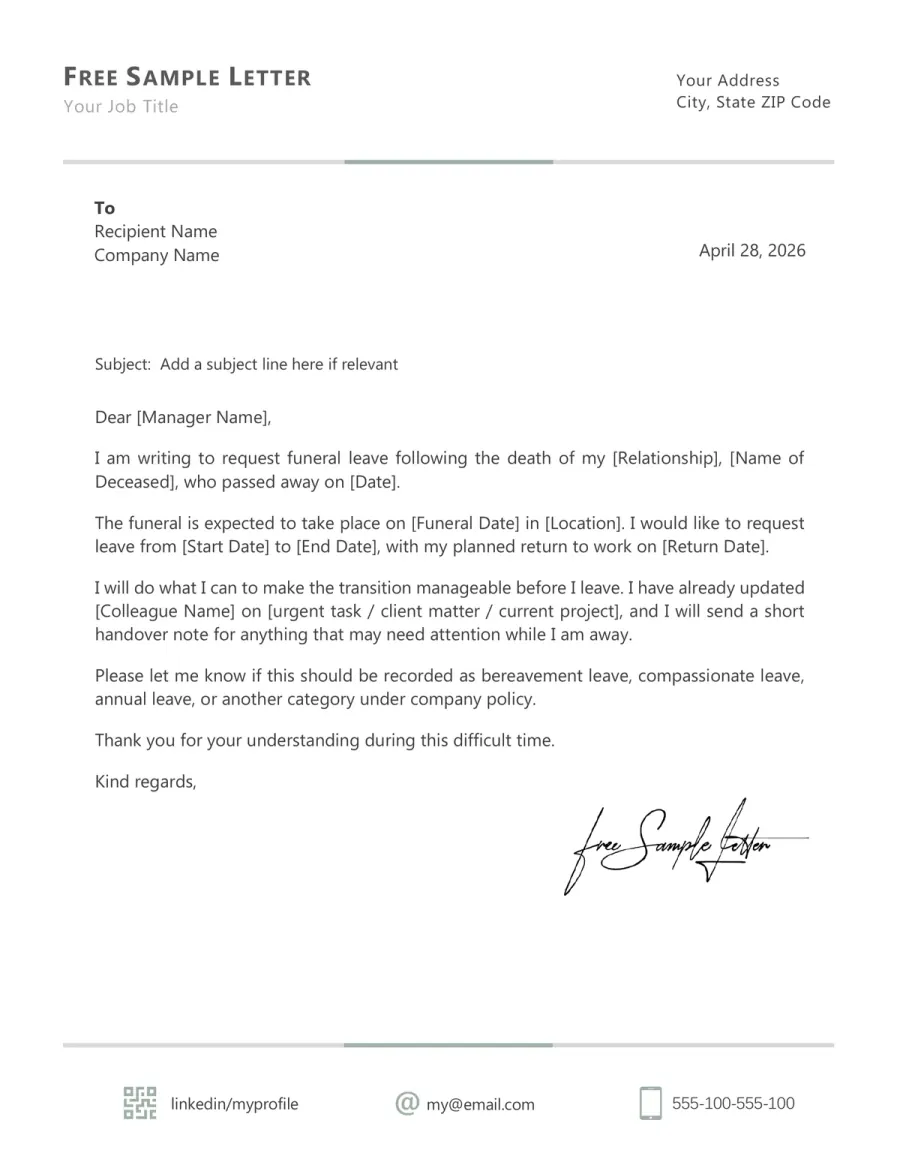
I am writing to request funeral leave following the death of my [Relationship], [Name of Deceased], who passed away on [Date].
The funeral is expected to take place on [Funeral Date] in [Location]. I would like to request leave from [Start Date] to [End Date], with my planned return to work on [Return Date].
I will do my best to make the transition as smooth as possible before I leave. I have already updated [Colleague Name] on [urgent task / client matter / current project] and will send a brief handover note for anything requiring attention during my absence.
Please let me know if this should be recorded as bereavement leave, compassionate leave, annual leave, or another category under company policy.
Thank you for your understanding during this difficult time.
Kind regards,
[Your Name]

Reviewed by Olivia B., HR Consultant
I like the restraint here. The message gives the dates and reason clearly without forcing the employee to share more grief than needed.
Short Bereavement Leave Message for an Urgent Absence
Useful when the situation is sudden and you need a short bereavement leave message. It gives the essentials without forcing a long explanation.
Hi [Manager Name],
I am sorry to share that my [Relationship] has passed away. I need to take bereavement leave starting [Start Date] and expect to return on [Return Date], unless arrangements change.
I may have limited access to email during this time. I have asked [Colleague Name] to keep an eye on [urgent task / client item / rota issue]. I will update you if my return date changes.
Please let me know if there is any form or HR process I should complete when I am able.
Thank you for your understanding.
[Your Name]
Reviewed by Olivia B., HR Consultant
This is useful when the employee cannot write much. It is short, human, and still gives the manager enough to plan the absence properly.
Policy-Aware Bereavement Leave Request to HR
Built for a bereavement leave request to HR when the absence must be recorded properly under company policy or an employee handbook.
Dear [HR Contact],
I am writing to formally request bereavement leave following the passing of my [Relationship], [Name of Deceased], on [Date].
I have informed my manager, [Manager Name], and I am requesting leave from [Start Date] to [End Date], with my planned return on [Return Date]. Please advise whether this should be recorded as bereavement leave, compassionate leave, annual leave, or unpaid leave under [Company Name] policy.
If documentation is required, please let me know what is needed and when it should be provided. I would appreciate your guidance on any forms or HR system entries required.
Thank you for your help and understanding. I will provide any required information as soon as I am able.
Kind regards,
[Your Name]
[Employee ID]
Reviewed by Olivia B., HR Consultant
I trust this version because it separates the human situation from the policy details. HR can record the leave without chasing basics.
Extended Funeral Leave Request for Travel or Family Arrangements
Best when you need extended funeral or bereavement leave for travel, family responsibilities, memorial arrangements, or time beyond the standard policy.
Dear [Manager Name],
I am writing to request additional time away from work following the passing of my [Relationship], [Name of Deceased].
The funeral and related family arrangements will take place in [Location], and I need to travel there to attend the service and assist with immediate responsibilities. For these reasons, I would like to request leave from [Start Date] to [End Date], returning to work on [Return Date].
I understand this may exceed the standard bereavement leave allowance. If needed, I am open to discussing whether the additional time should be recorded as annual leave, unpaid leave, or another category under company policy.
Before I leave, I will complete [urgent task], update [system / tracker], and brief [Colleague Name] on anything requiring attention while I am away.
Thank you for considering my request and for your understanding during this difficult time.
Sincerely,
[Your Name]
Reviewed by Olivia B., HR Consultant
This one handles the harder request well. It explains why extra time is needed without turning a private family matter into a long story.
Preview of the Funeral Leave Request Template You Can Download
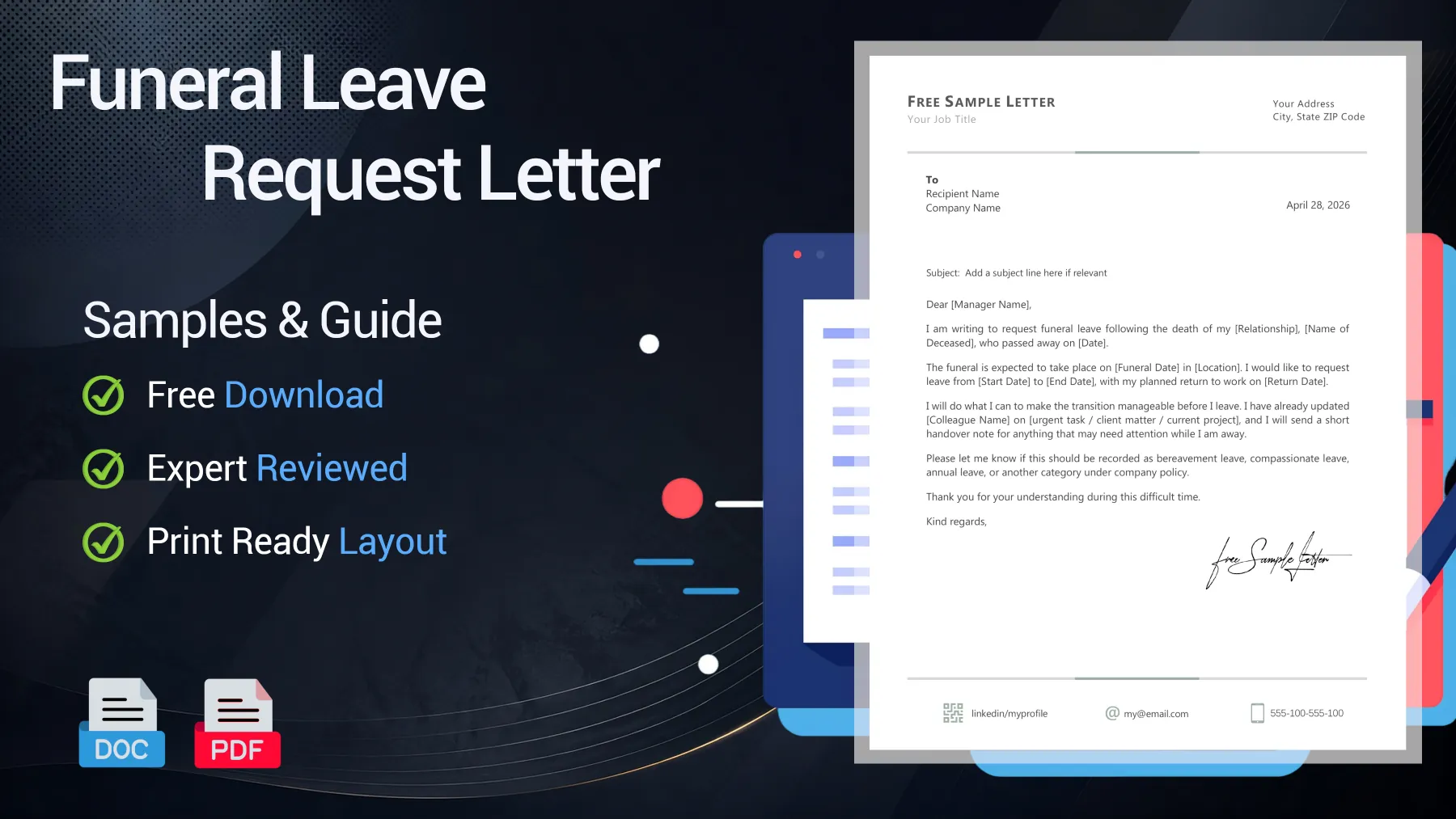
Below is a preview of the funeral leave request template you can download and edit. The document is available in Word and PDF formats for use in sensitive workplace situations.
How to Write a Funeral or Bereavement Leave Request
Copying and pasting can make a bereavement message sound colder than intended. A strong funeral leave request should provide dates, explain your absence, respect your privacy, and allow for HR policy requirements.
➡️ More practical writing help in our guide how to write a clear workplace letter or email
Use the right leave wording
Check whether your workplace uses the terms funeral leave, bereavement leave, compassionate leave, emergency leave, annual leave, or unpaid leave before you write.
See what to include
Please let me know if this should be recorded as bereavement leave, compassionate leave, annual leave, or unpaid leave according to company policy.
Give the dates you know
State the start date, expected end date, and return date as clearly as possible. If arrangements could change, mention this briefly without overexplaining.
See an example
I would like to request leave from [Start Date] to [End Date], with my planned return on [Return Date].
Keep the personal details limited
You do not need to describe the circumstances of the death. In most workplaces, simply stating the relationship, dates, and leave needed is sufficient.
See the difference
Good: I am requesting bereavement leave following the death of my [Relationship]. Too much: a long explanation of private family circumstances.
Mention coverage only briefly
A short handover line helps your manager plan, but this is not the time for a full project report. Keep your work update brief and focused.
See how it sounds
I have updated [Colleague Name] on [urgent task] and will send a short note about anything that may need attention while I am away.
Ask HR what they need
If your workplace requires documentation, let HR guide you on what is needed. Avoid promising documents you do not yet have, especially in the early days of bereavement.
See a natural close
If documentation is needed, please let me know what is required and when it should be provided.
What HR Notices First in a Funeral Leave Request
- Leave dates
- Return date
- Relationship stated simply
- Funeral date if known
- Bereavement leave
- Compassionate leave
- Limited personal details
- Policy category left open
- Handover note for urgent work
- Documentation requested only if needed
Do & Don’t - What Makes a Bereavement Leave Request Easier to Handle
Managers and HR teams read bereavement leave requests with two priorities: compassion and planning. A strong message states the dates, keeps the tone simple, and avoids unnecessary personal details.
What Makes the Request Harder to Process
Red Flags- Bury the leave dates under a long personal explanation
- Share private details the workplace does not need
- Forget to mention an expected return date
- Assume the leave category without checking policy
- Promise documentation before you know what HR requires
- Write like a normal holiday request with no sensitivity
What Helps HR and Managers Respond Well
Trust Signals- State the absence dates clearly
- Use bereavement or compassionate leave wording if appropriate
- Keep the reason brief and human
- Mention urgent handover only in one short line
- Ask what policy or documentation is required
- Leave room to update the return date if arrangements change
FAQ - Funeral and Bereavement Leave Request
Should I call it funeral leave, bereavement leave, or compassionate leave? Toggle answer
Use the terms your workplace uses. If you are unsure, write your request plainly and ask HR whether it should be recorded as funeral, bereavement, compassionate, annual, or unpaid leave.
Do I need to explain who died? Toggle answer
Usually, you only need to state the relationship, such as parent, grandparent, spouse, partner, sibling, or close family member. You do not need to share private details about the death.
Can I request extra time beyond the funeral? Toggle answer
Yes, but briefly explain the practical reason, such as travel, family arrangements, memorial plans, or immediate responsibilities. Ask whether the extra days should be treated as paid leave, annual leave, or unpaid leave.
Should I attach proof to a bereavement leave request? Toggle answer
Only if your workplace policy requires it. You can ask HR what documentation is needed and when it should be provided, especially if your request is urgent or recent.
Is a short email enough for funeral leave? Toggle answer
Often, yes. A short email is usually sufficient if it gives the reason, leave dates, expected return date, and any urgent handover information. HR can then advise you on the formal process.
TL;DR - What Makes a Funeral Leave Request Work
A funeral leave request should be clear, brief, and human. State your relationship to the deceased, the dates, your expected return, and the leave category if known. The mistake is either providing too little information for HR to act or sharing more private grief than the workplace needs.
The key is finding the right balance. Your message should help your manager plan without turning a bereavement into unnecessary paperwork. Keep your tone calm, ask HR what policy requires, and update your return date if funeral or family arrangements change.