
Condolence Messages and Sympathy Notes for a Grieving Friend
A condolence message should not try to fix grief or explain the loss. These sympathy notes help you say something gentle, clear and personal when a friend has lost someone close.
Condolence Message Samples by Relationship and Type of Loss
Before writing a condolence message, remember that your role is not to make the loss easier, explain it, or find the perfect words. Your role is more modest and human: acknowledge what happened, show care, and offer the grieving person words they can truly receive.
Short is often kinder than polished. A simple note can feel more respectful than a long message filled with borrowed comfort. Avoid giving advice, comparing their loss to your own, or using phrases that urge the person to feel better too soon.
Religious wording can be comforting when you know it will be welcomed. For someone who shares your faith, a short prayer or faith-aware line may feel right. If you are unsure, neutral sympathy is usually kinder.
Short Condolence Messages for a Grieving Friend
A set of short condolence messages for a grieving friend for when a full letter feels like too much. The wording is simple, steady and easy to send.
I am so sorry about [Name]. I know there’s no right thing to say at a time like this, but I wanted you to know I’m thinking of you.
I heard about [Name], and my heart is with you. Please don’t feel you have to reply. I just wanted you to know you’re not alone today.
I’m deeply sorry for your loss. I’ll remember [Name] with real affection, and I’m holding you and your family in my thoughts.
I can’t make this easier, but I’m here for you. I’ll check in again soon, and you don’t need to reply until you feel ready.

Reviewed by Grace W., Ghostwriter
I like the quiet wording here. Each note is short enough to send quickly, but none of them tries to rush the friend through grief.
Condolence Message After the Loss of a Parent
A thoughtful condolence message after the loss of a parent. It acknowledges the grief without trying to explain what a mother or father meant.
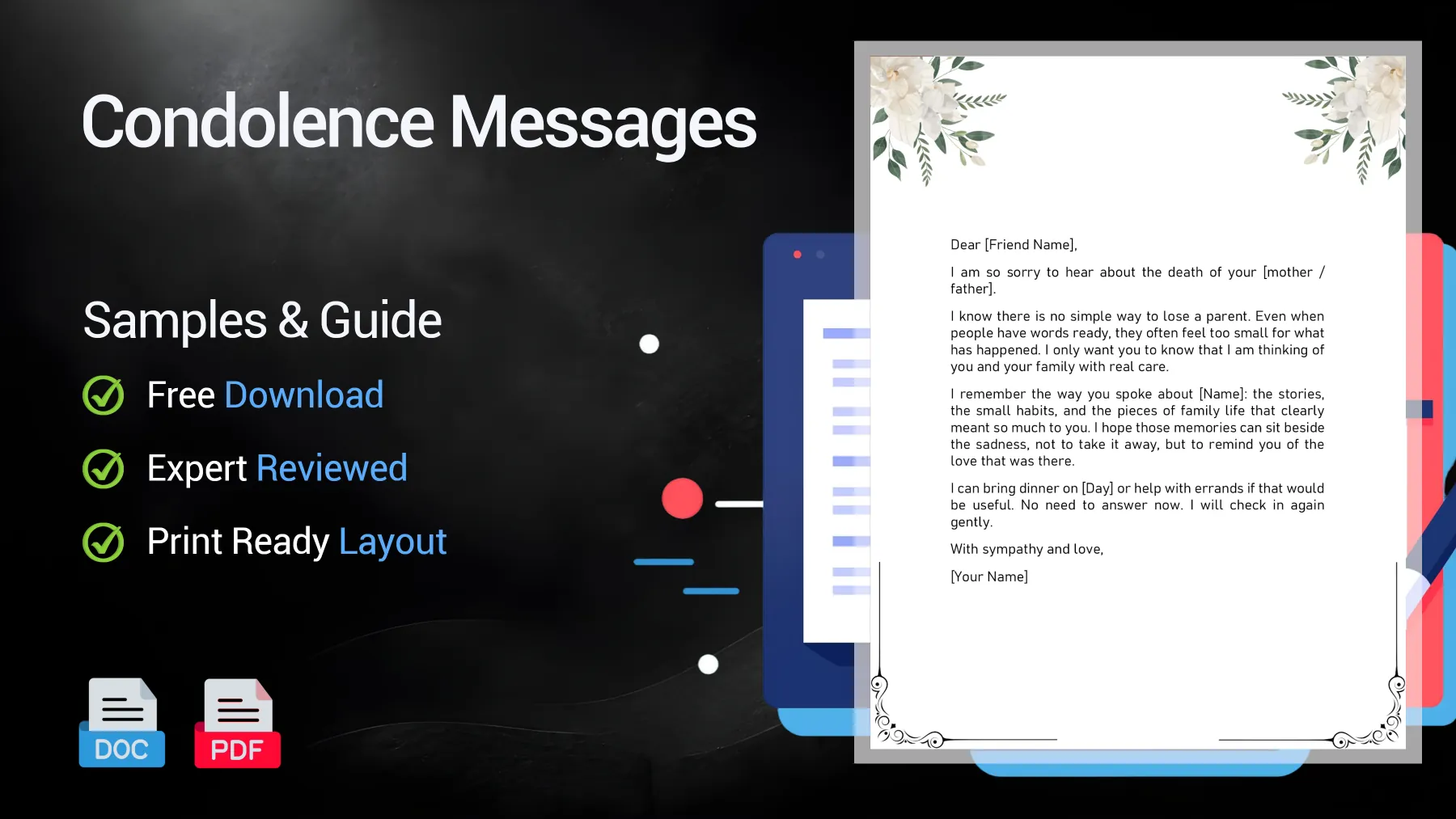
Dear [Friend Name],
I’m so sorry to hear about the death of your [mother / father].
I know there’s no simple way to lose a parent. Even when people have words ready, they often feel too small for what has happened. I just want you to know I’m thinking of you and your family with real care.
I remember how you spoke about [Name]: the stories, the small habits, and the pieces of family life that meant so much to you. I hope those memories can sit beside the sadness, not to take it away, but to remind you of the love that was there.
I can bring dinner on [Day] or help with errands if that would be useful. No need to answer now. I’ll check in again gently.
With sympathy and love,
[Your Name]
Reviewed by Grace W., Ghostwriter
I like the directness of this parent-loss message. It names the pain without explaining it, then offers one small, believable form of support.
Sympathy Letter After the Loss of a Spouse or Partner
A gentle sympathy letter after the loss of a spouse or partner, written for a friend whose daily life has changed in ways no short line can cover.
Dear [Friend Name],
I’m so very sorry about [Partner Name].
I keep thinking about the life you built together: the ordinary routines, the private jokes, the plans, and all the quiet pieces of a relationship that others only see from the outside. I know this loss isn’t just about one day. It changes the shape of everything around it.
I don’t want to fill this letter with big words or easy comfort. I just want you to know that [Partner Name] will be remembered with love, and that your love for them was clear to anyone who saw you together.
When you’re ready, I can come by for a quiet visit, help with paperwork, or just sit with you for a while. If silence is easier, that’s fine too.
You’re in my thoughts today and in the weeks ahead.
With love,
[Your Name]
Reviewed by Grace W., Ghostwriter
I like how this letter respects the size of the loss. It avoids borrowed comfort and keeps the support specific enough to feel real.
Condolence Message After the Loss of a Child
A restrained condolence message after the loss of a child. It keeps the words quiet and avoids comfort that could feel too large or false.
Dear [Friend Name],
I’m heartbroken for you and your family after the death of [Child Name].
There’s no sentence that can meet a loss like this. I won’t try to explain it, soften it, or say anything that asks you to be strong before you’re ready.
I just want to say that [Child Name] mattered. I’ll remember [his / her / their] [kind smile / curiosity / laughter / gentle way of being], and I know many people will carry those memories with love.
If it helps, I can bring food on [Day], drive [Sibling Name] to [Activity], or help with [specific task]. If you need quiet instead, I’ll respect that too.
I’m holding you close in my thoughts.
With deepest sympathy,
[Your Name]
Reviewed by Grace W., Ghostwriter
I like the restraint here. The note does not try to make a child’s death bearable; it simply stays close, gentle, careful and human.
Condolence Note After a Sudden Death
A steady condolence note after a sudden death, helpful when your friend is still in shock and needs a message that is clear, calm and present.
Dear [Friend Name],
I was so sorry to hear about [Name]. I can only imagine how shocking and unreal this must feel.
I won’t pretend to know what you need right now. I just want you to know I’m here, and you don’t have to answer messages, explain anything, or make anyone else feel comfortable.
If it would help, I can take care of [specific task] on [Day], bring food, make calls, or help with transport. If none of that is helpful yet, I’ll simply keep checking in without expecting a reply.
I’m thinking of you and your family with so much care.
With sympathy,
[Your Name]
Reviewed by Grace W., Ghostwriter
I like that the shock is acknowledged without dramatic language. The offer of help is practical, not a vague line added at the end.
Condolence Message for a Colleague or Work Friend
A respectful condolence message for a colleague, helpful when you want to show care without making the work relationship feel too personal.
Dear [Colleague Name],
I was very sorry to hear about the loss of your [family member / loved one]. Please accept my sincere condolences.
I know work messages can feel small at a time like this, but I wanted to let you know that you and your family are in my thoughts.
Please don’t worry about replying. I hope you have the time and space you need, and I’ll be thinking of you in the days ahead.
With sympathy,
[Your Name]
Reviewed by Grace W., Ghostwriter
I like the professional boundary here. It gives sympathy to a colleague without becoming too personal or turning into a formal HR note.
Condolence Letter When You Cannot Attend the Funeral
A warm condolence letter from far away when you cannot attend the funeral or visit soon. It offers presence without making distance the focus.
Dear [Friend Name],
I’m so sorry about [Name]. I wish I could be there with you in person, especially now, but I didn’t want distance to keep me from writing.
Please know I’m thinking of you and remembering [Name] with care. I keep coming back to [small memory / quality / moment], and I hope it’s all right for me to share that memory with you when you feel ready.
I know a letter can’t replace being beside you. Still, I hope it brings a small reminder that you’re loved from here too.
I’ll call or message again after [Day], not to ask you to talk, but just to remind you I’m still here.
With love and sympathy,
[Your Name]
Reviewed by Grace W., Ghostwriter
I like how distance is handled here. The message does not apologize for being away too much; it still gives the friend a clear kind presence.
Faith-Based Condolence Message for a Believer
A gentle faith-based condolence message for a believer. It offers prayer and spiritual comfort without trying to explain the loss.
Dear [Friend Name],
I’m so sorry for your loss.
I know there are no words that can make this grief lighter right now, but I’m praying for you and your family with all my heart.
May God give you strength for the days that feel too heavy, peace in the moments when everything feels quiet, and the comfort of knowing that [Name] was deeply loved.
I will remember [Name] with gratitude, especially [his / her / their] [kindness / smile / faith / gentle way of caring for others]. I hope those memories remain close to you, not as pressure to feel better, but as small reminders of the love that was shared.
Please don’t feel you need to reply. I’ll keep praying for you and checking in gently.
With sympathy and prayers,
[Your Name]
Reviewed by Grace W., Ghostwriter
I like the faith-aware tone here. It offers prayer and comfort without explaining the loss or suggesting grief should feel easier.
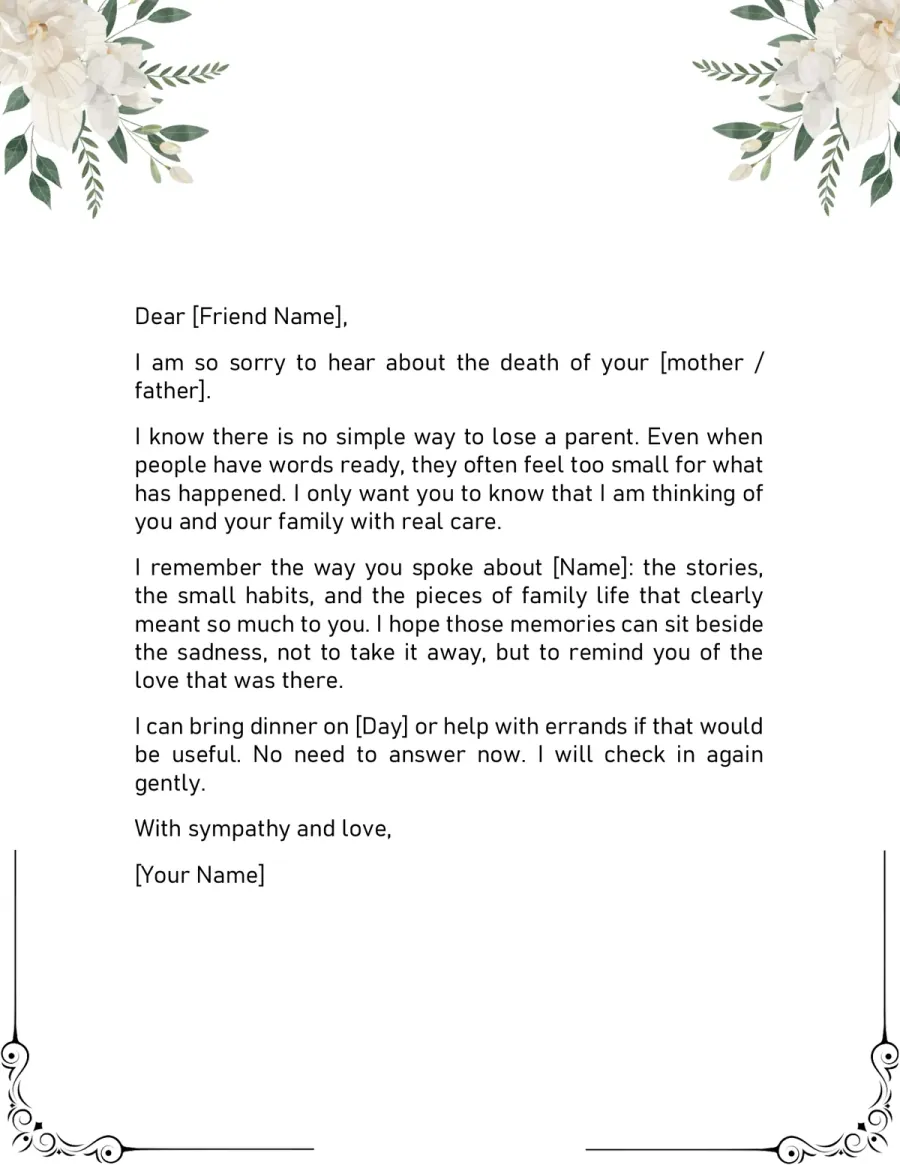
Preview of the Condolence Message Template You Can Download
Below is a preview of the condolence message template you can download and adapt. The document is available in Word and PDF formats for sympathy cards, notes or personal letters.
How to Write a Condolence Message Without Saying Too Much
A condolence message can become painful when it tries to explain grief, fix the loss or sound perfectly wise. Start with the relationship, name the loss gently and keep your sympathy note simple enough to receive.
➡️ More practical writing help in our guide how to write a personal letter that still sounds natural
Name the loss gently
Do not hide the reason for your message, but avoid making the first line harsh. A simple acknowledgement gives your friend something clear and steady to receive.
See how it starts
“I was so sorry to hear about [Name]. I know there is no sentence that can make this easier, but I wanted you to know I am thinking of you today and will keep checking in.”
Match your closeness
Write only as close as the relationship truly is. A best friend can receive more warmth, while a colleague or distant friend may need quieter, simpler wording.
See the tone shift
For a close friend: “I wish I could sit beside you tonight.” For a colleague: “Please accept my sincere condolences to you and your family. I am thinking of you.”
Add one memory if it is safe
A small memory can bring comfort if you knew the person who died. Keep it brief, specific and kind. Do not force a story if you did not know them well.
See a memory line
“I will always remember how [Name] made people feel included, even in a crowded room. That kindness is the first thing I think of today, and I know I am not the only one.”
Offer support you can actually give
Avoid making your grieving friend decide what to ask for. Offer one realistic action, or simply promise to check in if you cannot help in a practical way right now.
See a practical offer
“I can bring dinner on Thursday and leave it at the door if you do not feel like talking. No need to answer now; I will text first and keep it simple.”
Remove borrowed comfort
Before sending, remove phrases that explain, compare or rush grief. Your message does not need to be profound. It just needs to be honest, gentle and not too heavy.
See what to replace
Replace “Everything happens for a reason” with “I cannot make sense of this, but I am here, and I will keep checking in when the first rush of messages has passed.”
What Makes a Condolence Message Feel Gentle
- Simple opening
- Quiet close
- Names the loss
- No forced comfort
- Specific support
- Memory if appropriate
- Does not explain grief
- No religious assumption
- Short enough to receive
- Keeps advice out of the note
- Care without emotional pressure
- Lets silence remain possible
- Does not ask for a reply
- Relationship-aware sympathy wording
Do & Don’t - Condolence Messages That Avoid Hurtful Comfort
A grieving friend may only be able to read a few lines at a time. The right message is gentle, specific and easy to receive; the wrong one tries to explain, advise or make grief move faster.
What Can Make Sympathy Wording Hurt
Red Flags- Explains the loss with a lesson or reason
- Compares their grief to your own story
- Uses religious wording without knowing their beliefs
- Promises that time will heal everything
- Asks them to be strong before they are ready
- Offers vague help that puts the work back on them
What Makes the Message Easier to Receive
Trust Signals- Names the loss gently and directly
- Keeps the first message short
- Adds one memory only when it fits
- Offers one practical action you can keep
- Respects silence and delayed replies
- Closes with steady care, not big promises
FAQ - Condolence Messages and Sympathy Notes
What should I write to a grieving friend? Toggle answer
Start with a simple expression of sorrow, name the loss if you can, and add one gentle line of support. Do not try to explain the death or make the person feel better right away.
Is a short condolence message enough? Toggle answer
Yes. Short can be kinder when grief is fresh. A few sincere lines are often easier to receive than a long letter filled with phrases the person has already heard.
Should I share a memory of the person who died? Toggle answer
Share a memory if you knew the person and the memory is kind, simple and appropriate. Do not force a story if you did not know them well.
Can I send condolences by text? Toggle answer
Yes, especially if your friend is close to you or needs quick support. Keep it gentle, do not expect a reply, and consider sending a card or longer note later.
What should I avoid in a sympathy note? Toggle answer
Avoid advice, comparisons, explanations, forced positivity and religious wording unless you know it will be welcome. Do not tell someone to be strong or that everything happens for a reason.
TL;DR - Keep the Sympathy Note Quiet and Real
A condolence message works best when it does not try to solve grief. The most common mistake is reaching for phrases that sound comforting in theory but feel distant, rushed or borrowed to the person receiving them.
Name the loss gently, keep the wording simple, and offer one form of care you can truly give. If you knew the person who died, one small memory can mean more than a long attempt to say something profound.