
Apology Letter Examples for a Friend or Family Member
A real apology should not seek comfort from the person you hurt. These samples are designed to help you take responsibility, acknowledge the impact, and create space for the relationship to heal with care.
Personal Apology Letter Samples You Can Adapt
Before writing a personal apology letter, separate remorse from repair. Remorse expresses that you feel bad; repair demonstrates that you understand what happened, why it hurt, and what you will do differently moving forward.
A good apology should never shift the burden of comfort onto the other person. Stay focused on your actions, their impact, and what comes next. Harvard Health offers a simple example of an effective apology: it names the mistake, accepts responsibility, and asks how to avoid the issue in the future through clear repair-focused wording.
If the other person has also apologized, your next message may need a different tone. You can compare the other side of the exchange with this apology acceptance letter after a dispute.
Apology Letter to a Close Friend After a Disagreement
A sincere apology letter to a close friend after harsh words, tension, or a disagreement that should not define the friendship.
Dear [Friend Name],
I’ve been thinking about our disagreement and want to apologize for how I spoke to you. I was frustrated, but that doesn’t excuse the words I used or how I dismissed what you were trying to say.
You deserved a calmer conversation from me. Instead, I acted like being right mattered more than listening to someone who’s been important in my life for a long time. I can see now that my tone made the argument sharper than it needed to be, and I’m sorry for that.
What bothers me most isn’t just that we disagreed. Friends do. It’s that I let the disagreement turn careless. I know I hurt you, and I don’t want to pretend a quick apology makes that go away.
I also don’t want this letter to pressure you to respond before you’re ready. I’m writing because I needed to take responsibility clearly. If you want to talk later, I’ll listen without trying to defend every part of what happened.
Our friendship matters to me, and I’d like to repair this in a way that feels honest, not rushed. I’m sorry for hurting you, and I’ll be more careful with my words when things feel tense between us.
Take care,
[Your Name]

Reviewed by Grace W., Ghostwriter
I like how this apology names the hurt without making the friend manage the sender’s guilt. The repair feels gentle and believable.
Apology Letter to a Family Member After Hurtful Words
Use this apology letter to a family member when you share a close relationship, the words were hurtful, and repairing things may take patience.
Dear [Family Member],
I am sorry for what I said during our conversation on [Date]. I’ve replayed it in my mind, and I know I spoke in a way that was unfair and hurtful.
Being upset did not give me the right to make you feel small. I let my frustration turn into criticism, and I can see why that lingered with you after our conversation. You shouldn’t have had to carry that from me.
I also realize that saying, “I didn’t mean it that way,” isn’t enough. What matters is how my words landed, and the fact that I didn’t slow down when I saw the conversation becoming painful. I’m sorry for that.
I care about our relationship, but I know caring isn’t the same as repairing. I’ll make a real effort to pause before responding when I feel defensive, and I won’t use our family closeness as an excuse to speak more harshly than I would to anyone else.
You don’t have to respond right away. I wanted you to have this apology in writing because I mean it, and because I don’t want silence to grow between us around something I should have owned sooner.
With love,
[Your Name]
Reviewed by Grace W., Ghostwriter
I like the family tone here. It takes responsibility without replaying the whole conflict, and the closing leaves real room for time.
Serious Apology Letter After Hurting Someone You Care About
A more complete serious apology letter for moments that need responsibility, impact, and repair without turning the message into self-defense.
Dear [Name],
I owe you a real apology, not a quick sentence that asks you to move past what happened before I have fully owned it.
I was wrong to [describe what you did]. I understand that my choice affected you in ways that went beyond that one moment. It put you in a position where you had to question my care, my judgment, and whether you could trust me with something that mattered to you.
I’ve wanted to explain myself many times, but I know an explanation can easily become a way to soften responsibility. The truth is simple: I handled it badly. Even if I was tired, upset, or overwhelmed, I still had a choice in how I acted. I didn’t choose well, and you were the one who had to feel the result of that.
I’m sorry for the hurt, and also for the extra weight I created afterward. You shouldn’t have had to wonder whether I understood the damage or whether you’d need to convince me that your reaction was valid.
What I can do now is be specific about change. I’ve already started [specific action you are taking], and I’ll keep doing it whether or not you’re ready to talk soon. I don’t want this apology to depend on you making me feel forgiven.
If you’re open to speaking at some point, I’ll listen. If you need more time, I’ll respect that too. I’m sorry for what I did, and I hope my actions from here show I understand this more clearly than I did before.
Sincerely,
[Your Name]
Reviewed by Grace W., Ghostwriter
I like how this longer apology earns its length. Each paragraph adds responsibility, impact, or repair instead of repeating regret.
Long Apology Letter to Rebuild a Friendship After a Dispute
A longer apology letter to rebuild a friendship after a serious disagreement, when you want to take responsibility and suggest a calm conversation.
Dear [Friend Name],
I’ve been thinking about our disagreement, and I wanted to write instead of trying to fix everything too quickly in a call. What happened between us was difficult, and I don’t want my first response to make it feel sharper than it already is.
I want to apologize for the way I spoke to you. My words were too harsh, and I know they hurt you. Even if the subject was sensitive and we both had strong feelings about it, I’m responsible for the way I chose to respond.
Our friendship matters too much to me to let one argument sit between us without trying to understand it properly. We’ve been there for each other through ordinary weeks and hard ones, and I don’t want this dispute to erase the good history we’ve built.
I also know that repairing this can’t just mean pretending it never happened. I think we may need to talk calmly, face to face if that feels right, and try to understand what hurt each of us most. We don’t have to agree on every point, but I’d like us both to feel heard.
For my part, I’ll try to listen without interrupting or defending myself too quickly. I don’t want another conversation where we both leave feeling more misunderstood than before.
If you’re open to it, I’d like us to meet when we both feel ready. If you need more time, I’ll respect that. I hope we can find our way back to each other with more care than we managed in that moment.
I’m sorry for hurting you, and I hope we can talk soon.
Warmly,
[Your Name]
Reviewed by Grace W., Ghostwriter
I like how this longer apology earns its space. It takes responsibility, values the friendship, and suggests a talk without forcing repair.
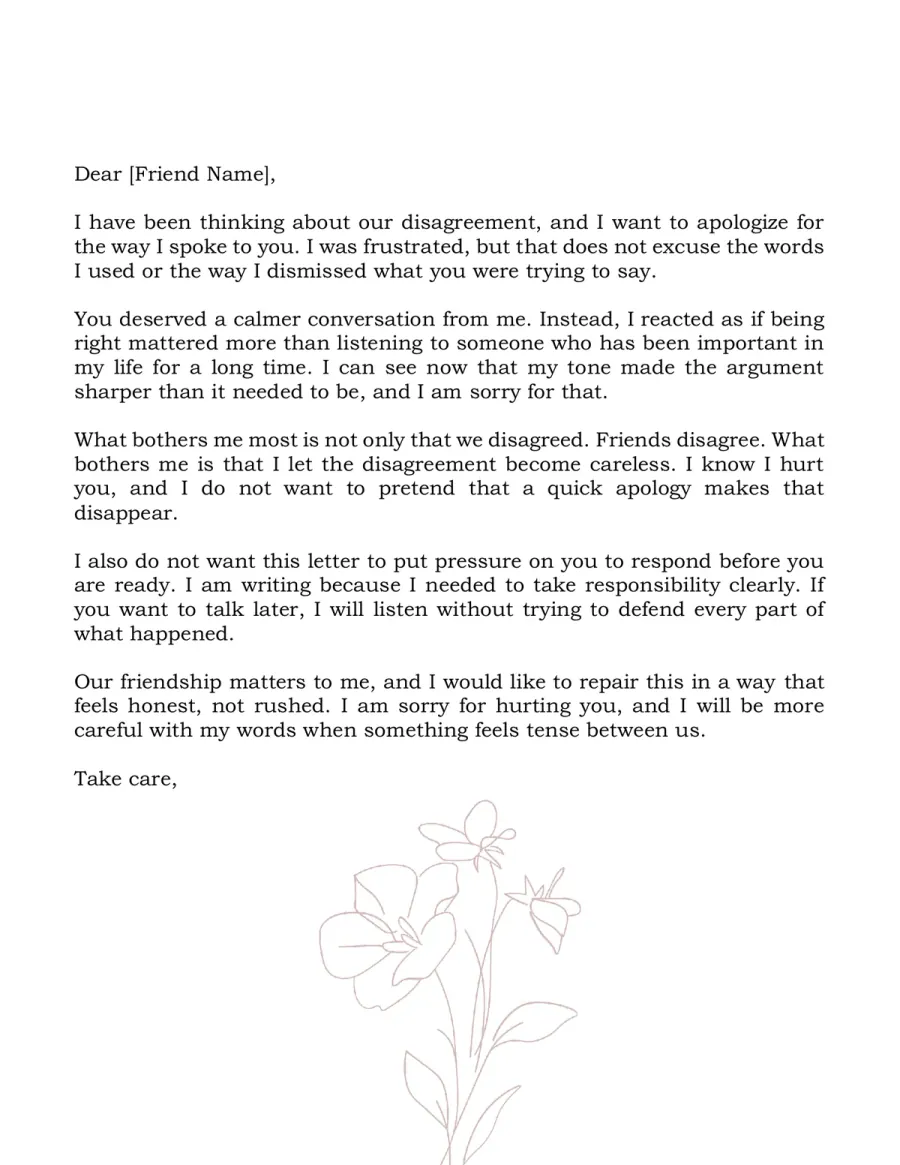
Preview of the Personal Apology Letter Template You Can Download
Below is a preview of the personal apology letter template you can download and adapt. The document is available in Word and PDF formats for a friend, family member, or loved one.
How to Write an Apology Letter That Takes Responsibility
A copied apology can sound polite while avoiding the real issue. Start with the action, name the impact, and let the other person respond in their own time. ➡️ More help in our guide how to write a personal letter that sounds natural.
Name the exact reason for the apology
Avoid vague phrases like “whatever happened.” Say what you did or said, even if it feels uncomfortable. Being specific makes your apology believable.
See the wording
I am sorry for raising my voice and cutting you off when you were trying to explain how you felt.
Take responsibility before explaining context
Context can help, but it shouldn’t come before responsibility. If your first paragraph sounds defensive, rewrite it to focus on the harm first.
See the order
I was stressed that day, but I still chose words that hurt you. That part is mine to own.
Acknowledge the impact
The other person needs to know you understand more than just your own regret. Name what your actions may have made them feel, question, or carry.
See the impact
I can understand why it made you feel dismissed, especially after you had trusted me with something personal.
Offer repair without asking for instant forgiveness
A good apology can include change, but it shouldn’t pressure the recipient to reassure you. Let your offer of repair stand on its own.
See the repair
I am going to pause before answering when I feel defensive, and I will not ask you to move past this before you are ready.
Close with room for the other person
The closing should fit the situation. Invite a conversation if it feels right, but make it clear their timing and comfort matter too.
See the close
If you want to talk later, I will listen. If you need time, I will respect that too.
What Makes a Personal Apology Easier to Receive
- Specific Action
- Clear Responsibility
- No Pressure
- Friendship
- Family Trust
- Impact Named
- Repair Offered
- No Self-Defense
- Room To Respond
- Honest Remorse
- Changed Behavior
- Gentle Closing
Do & Don’t - Writing a Personal Apology Letter
A personal apology is measured first by responsibility. The reader will notice whether you name the hurt, avoid excuses, and give them room to decide what repair should look like.
What Makes the Apology Hard to Trust
Red Flags- Start with how guilty or upset you feel
- Say “if I hurt you” when the hurt is already clear
- Explain the context before taking responsibility
- Ask for forgiveness before naming the impact
- Turn the letter into a long defense
- Pressure the person to answer or move on
What Makes the Apology Feel Accountable
Trust Signals- Name the action or words you regret
- Acknowledge how it affected the other person
- Keep the focus on repair, not self-comfort
- Mention one concrete change you can control
- Let the person respond in their own time
- Use a closing that feels calm and honest
FAQ - Personal Apology Letters
How do I start an apology letter to a friend? Toggle answer
Start with the reason for writing and the action you regret. A simple opening, such as “I am sorry for what I said during our argument,” is stronger than a long emotional introduction.
Should I ask for forgiveness in an apology letter? Toggle answer
You can, but do not rush it. First, take responsibility and acknowledge the impact. If you ask for forgiveness, make it clear that the other person is free to need time.
How long should a personal apology letter be? Toggle answer
A simple apology may only need a few paragraphs. A more serious apology can be longer if every paragraph adds responsibility, impact, or repair. Avoid repeating regret just to make the letter seem deeper.
What should I avoid in an apology letter? Toggle answer
Avoid vague apologies, self-pity, pressure, and excuses. Don’t say “I’m sorry you felt that way” when you need to own what you did. The letter should make repair easier to receive.
Can I send an apology by email or text? Toggle answer
Yes, if the format fits the relationship and situation. A text may work for a small misunderstanding. A letter or email is better when the hurt needs more care, clarity, or space.
TL;DR - Make the Apology Specific Before Making It Emotional
A strong personal apology letter starts with responsibility, not guilt. Name what happened, acknowledge the impact, and give the other person space to decide what comes next.
Before sending your letter, remove any sentence that asks them to comfort you. If the apology is serious, let it be longer, but only if the extra space adds clarity, repair, or real change.