
How to Write a Personal or Business Letter That Sounds Right
A good letter does not start with fancy wording. It starts with the right purpose, the right format and the right tone for the person reading it. This guide shows you how to write personal, administrative and business letters without sounding stiff, vague or copied.
What Kind of Letter Are You Writing?
Before choosing a greeting or adopting a format, decide what the letter needs to accomplish. A personal letter, a formal request, and a business letter may all use paragraphs and a closing, but their purposes are different.
A personal letter is shaped by the relationship. It may require warmth, apology, gratitude, affection, support, or closure. The reader should feel that the message is meant for them, not just copied from a template.
A formal or administrative letter is built around a clear record. It needs dates, facts, references, supporting documents, and a specific request. The tone should remain calm, since the letter may be read later by someone unfamiliar with the original situation.
A business or professional letter is focused on action. State the purpose early, provide enough context for a response, and maintain the relationship when it is important.
| Letter type | Best for | Tone | Main risk |
|---|---|---|---|
| Personal letter | Friends, family, partners, private relationships | Warm, honest, and proportionate | Sounding too generic or too intense |
| Formal letter | Requests, complaints, confirmations, and records | Clear, factual, restrained | Missing dates, evidence, or a specific request |
| Administrative letter | Services, institutions, accounts, procedures | Precise, documented, and calm | Using emotion where facts are needed |
| Business letter | Clients, suppliers, partners, and companies | Professional, useful, direct | Sounding vague, inflated or overly legal |
| Workplace letter | Managers, HR, payroll, employers | Respectful, specific, policy-aware | Ignoring contract, policy or timing details |
If you are unsure, start with the reader. Who will open this letter, what do they need to understand, and what should they be able to do after reading it? That answer usually tells you which format to use.
The Basic Letter Format That Works in Most Situations
Most letters follow the same basic structure: identify the sender, address the recipient, explain the purpose, provide necessary details, and close with the appropriate next step. The level of formality may change, but the underlying logic remains consistent.
A formal letter format usually includes your contact information, the date, the recipient’s name and address, a subject line if useful, a greeting, the body, a closing phrase, and your signature.
- Sender details - your name, address, email, or phone number, as needed for identification.
- Date - useful for records, deadlines, formal requests, and follow-ups.
- Recipient details - the person, department, company, or institution receiving the letter.
- Subject line - optional, but very helpful for formal, administrative, and business letters.
- Greeting - formal, professional, or personal, depending on the relationship.
- Opening paragraph - states the reason for writing early.
- Body paragraphs - provide context, facts, explanation, evidence, feeling, or a request.
- Closing paragraph - the next step, thanks, a final thought, or a clear ending.
- Sign-off and signature - matched to the letter’s tone.
- Attachments or enclosures - receipts, documents, references, photos, or forms as needed.
Do not force every letter into the same layout. A love letter does not need a full inside address. A complaint letter usually does. A professional email may not need a postal-style header, but it still requires a clear subject, opening, body, and closing.
The format should make the message easier to trust. If a section does not help the reader identify the sender, understand the situation, or act on the request, remove it.
How to Write a Letter Step by Step
Use these steps before filling in a template. They help you decide on purpose, tone, and structure before focusing on the wording.
Define the purpose in one sentence
Write down what the letter needs to accomplish: thank, request, complain, apologize, confirm, apply, recommend, explain, notify, or reconnect. If the purpose is unclear, the letter will lose focus.
See Try this pattern
I am writing to [Purpose] about [Situation] so that [Desired Outcome].
Identify the reader and relationship
The recipient determines the tone. A friend, customer service agent, hiring manager, supplier, HR contact, professor, and family member should not all receive the same style of letter.
Choose the right format
Decide whether the letter should be a formal letter, an email, a handwritten note, a PDF attachment, or an editable Word document. The format should support the situation, not make it more complicated than necessary.
Open with the real reason
Begin close to the point. A personal letter can start with context or feeling, but a formal or business letter should usually state the reason early.
See Useful pattern
I am writing about [Reference, Event or Topic] because [Reason].
Add only the details the reader needs
Use facts, dates, examples, proof, or memories that help the reader understand the message. Remove anything included only because it is emotionally tempting or sounds formal.
Ask for the next step or close naturally
A formal letter often needs a reply, action, or confirmation. A personal letter may require gratitude, space, affection, or closure. Match the ending to the purpose.
Read it once for facts, once for tone
Check names, dates, amounts, references, attachments, and spelling first. Then read the letter aloud. If it sounds stiff, vague, exaggerated, or copied, simplify it.
How to Start a Letter Without Sounding Generic
The first lines should tell the reader why you are writing. That sounds simple, but many weak letters delay the point with polite filler, vague emotion, or a copied phrase that does not fit the situation.
A good opening does one of three things: states the purpose, names the context, or reconnects the relationship. Choose the approach that matches your letter.
❌ Weak I am writing this letter to inform you about an important matter.
✅ Better I am writing about my order #[Order Number], delivered on [Date], because the item arrived damaged.
❌ Weak I hope this letter finds you well.
✅ Better I have been thinking about our last conversation, and I wanted to write properly rather than send a rushed message.
❌ Weak Please accept this correspondence regarding our business relationship.
✅ Better I am following up on our meeting of [Date] to confirm the next steps for [Project Name].
A polite opening is fine when it feels natural. The issue is not politeness, but hiding the real message behind a sentence that could fit any letter ever written.
How to Write the Body of the Letter
The body is where the letter either succeeds or becomes difficult to read. Organize it around what the reader needs: facts, context, a decision, a response, reassurance, or a clear boundary. Write toward that need.
For most letters, a three-part body works well: explain the reason, provide the necessary context, then state what should happen next. This structure can be warm, formal, or professional depending on the topic.
For a personal letter, the body should make the feeling specific. Instead of adding more emotion, include one memory, one honest sentence, one regret, one reason for gratitude, or one detail unique to this relationship.
For an administrative or complaint letter, the body should make the situation easy to verify. Include dates, account numbers, order references, previous contact, attached documents, and the remedy or answer you are requesting.
For a business letter, the body should make action easy. State the purpose, provide enough context, then specify the response, confirmation, payment, meeting, correction, or decision you need.
The body should not become a diary, a legal argument, or a sales pitch unless the situation truly calls for it. A useful letter gives the reader enough information to act, not everything the sender remembers.
How to End a Letter Cleanly
The ending should match the letter’s purpose. A complaint may need a response deadline. A personal apology may need to give the other person space to decide. A business follow-up may need a clear next step. A warm note may simply need a genuine final line.
Do not end every letter with the same formula. The sign-off may be brief, but it helps set the tone for how the message is received.
| Situation | Closing that fits | Why it works |
|---|---|---|
| Formal request | Sincerely / Yours sincerely / Respectfully | Clean and neutral without sounding cold |
| Business follow-up | Best regards / Kind regards / Sincerely | Professional but not inflated |
| Complaint or refund request | I look forward to your response by [Date]. | Gives the recipient a clear action point |
| Personal apology | I understand if you need time before replying. | Shows responsibility without pressure |
| Thank-you note | With thanks / Warmly / With appreciation | Keeps gratitude simple and proportionate |
| Love or family letter | With love / Always thinking of you / Take care | Fits the relationship better than formal wording |
A clean ending does not need to be dramatic. It should leave the reader with the right feeling or a clear next step.
Personal Letters: Write for the Relationship
A personal letter should feel written for one person. That does not mean it must be long, emotional, or poetic. The wording should reflect the relationship, the reason for writing, and the level of closeness the recipient is comfortable with.
If you are writing to a friend, family member, partner, or someone you have not spoken to in a long time, avoid over-polishing the letter until it loses its human shape. A simple sentence can feel more genuine than a perfect one.
Start with the reason you are writing, then add one real detail. A memory, a shared habit, a quiet apology, a specific thank-you, or a clear goodbye will do more than a paragraph of broad emotion.
For example, a personal opening can stay simple: I wanted to write properly because a quick message did not feel like enough. I have been thinking about [Shared Moment], and I did not want to leave that unsaid. This works because it gives the letter a specific reason before adding emotion.
Use the personal letter examples for real relationships when the purpose is private, emotional, affectionate, apologetic, or relationship-based. These are better than formal templates when the letter must sound personal first.
The main danger is overwriting. If the letter asks for forgiveness, do not pressure the recipient. If it declares love, do not let intensity replace specificity. If it says goodbye, be clear without being harsh.
Administrative and Formal Letters: Write for the Record
Administrative letters are usually more about record-keeping than style. The reader may need to identify an account, check a date, review a document, forward the letter to another department, or respond as part of a process.
This is where many letters fail. The sender expresses frustration before giving the facts, or asks for help without stating the exact request. Keep the tone calm. Make the record easy to follow.
A useful opening might be: I am writing about [Reference Number], dated [Date], because [brief factual problem]. I am requesting [Specific Action] and have attached [Document] for review. The sentence is not decorative, but it gives the reader what is needed right away.
- Identify yourself and the relevant account, order, booking, file or reference.
- State what happened and when.
- Include previous contact if relevant.
- Attach proof when needed.
- Ask for one clear action, correction, refund, confirmation or reply.
- Include a deadline only when it is reasonable and relevant.
For service problems, refunds, cancellations, warranty issues, or written complaints, use the complaint, refund, and cancellation letter samples rather than turning a general letter format into a legal-sounding demand.
Rules, rights and deadlines vary by country, contract, company policy, sector and procedure. If the letter depends on a legal right, official deadline or regulated process, check the relevant official source before sending it.
Business and Professional Letters: Write for Action
A business letter should help the reader act without guessing. It may be formal, but it should not sound inflated. Clear business writing usually works better than ceremonial wording.
State the purpose early. If the letter concerns an invoice, delivery, meeting, proposal, customer issue, partnership, HR notice, or supplier relationship, give that context before adding background.
For example: I am following up on our discussion of [Date] about [Project Name]. Please confirm whether the attached summary matches your understanding before we move ahead with [Next Step]. It is brief, but it gives context, action, and a reason to reply.
A strong business letter usually does five things: identifies the sender or company, states the purpose, gives enough context, asks for a specific response, and keeps the tone in line with the relationship.
Use the business and professional letter examples for company-to-customer, supplier, partner, payment, proposal, and employer-side letters. Use work and career letter examples when the sender is an employee writing to a manager, employer, HR, or payroll contact.
A common mistake is trying to sound professional by adding abstract language. Words like regarding, aforementioned, or mutually beneficial are not wrong, but they should earn their place. If a simpler sentence is clearer, use it.
Email, Printed Letter or Downloadable Template?
The best format depends on speed, formality, evidence, and record-keeping. A letter is not always better because it is longer, and an email is not always casual just because it is digital.
Use email when speed matters, when the recipient expects a quick reply, or when the message is part of an ongoing professional exchange. Keep the subject line specific and make the first paragraph useful.
Use a printed or PDF letter when the matter is formal, documented, attached to evidence, or likely to be forwarded. This works well for complaints, cancellation notices, formal requests, business records, and administrative correspondence.
Use a handwritten note when the personal relationship matters more than speed or structure. It can work for gratitude, sympathy, friendship, family messages, or private affection, as long as the handwriting is readable.
Use a Word template when the layout matters and you need to adapt the content safely. A template can help with spacing, header, signature, and structure, but the message still needs your facts, tone, and judgment.
Letter Examples by Situation
A general guide teaches the method. A dedicated sample helps when the situation has its own tone, stakes, or format. Use the right page when you need more than a blank structure.
- How to write a strong cover letter: use this when the letter is part of a job application and must explain fit, proof and motivation without repeating a résumé.
- How to write a CV or resume: useful when the written document is not a letter, but the goal is still career communication and recruiter readability.
- How to write a recommendation letter: best when the sender is endorsing a candidate, student, employee or applicant and needs credible proof.
- How to write a speech or toast: choose this when the text will be spoken aloud rather than sent as a letter, note or email.
- Thank-you letter and appreciation examples: use these when gratitude is the main purpose and the challenge is sounding sincere without overdoing it.
Do not choose a sample only because the title looks close. Choose it because the sender, recipient, format, and emotional or professional stakes match your situation.
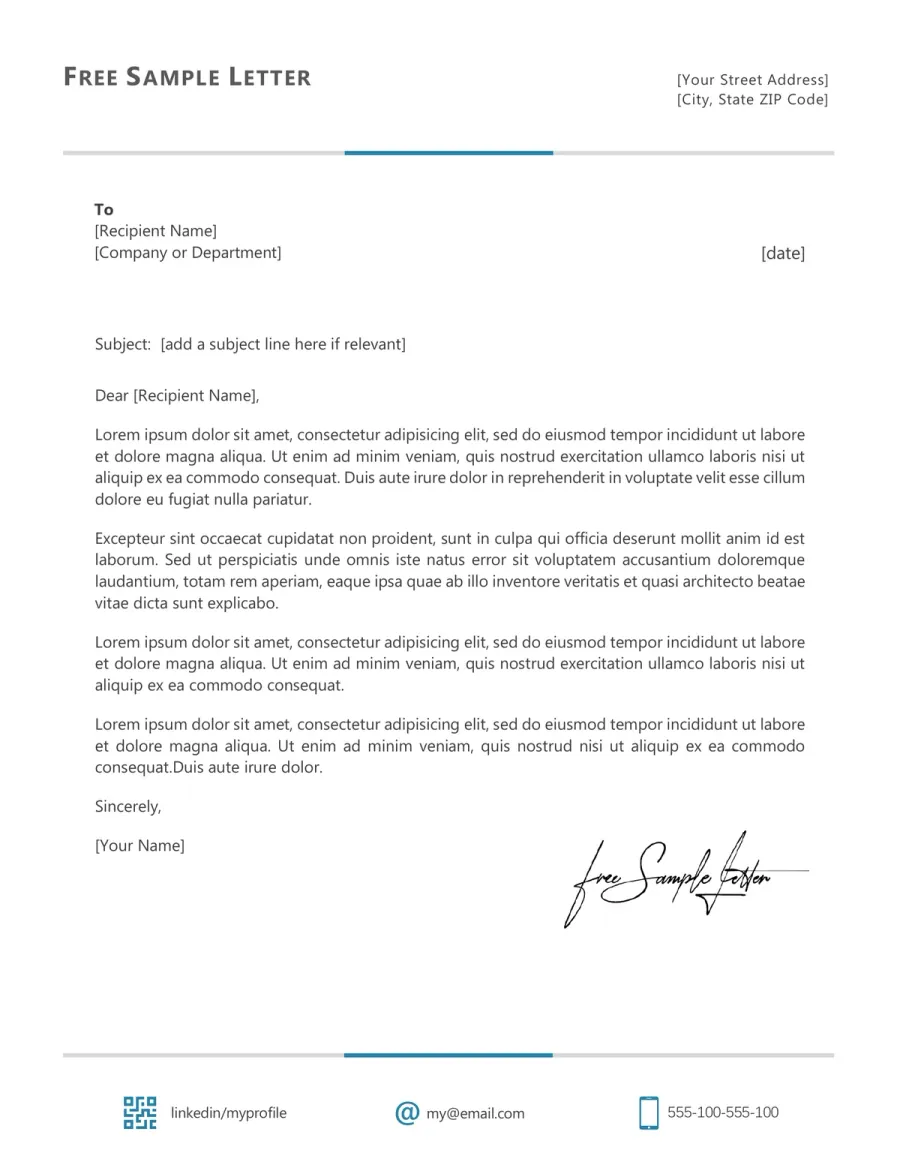
Preview of a Classic Letter Example
Below is a preview of a classic letter layout you can use as a visual reference when drafting a personal, formal, administrative, or business letter.
What Every Good Letter Needs Before You Send It
- Clear purpose
- Right recipient
- Useful subject line
- Correct date
- Reader-aware tone
- Specific opening
- Necessary context
- Relevant facts or details
- One clear request or message
- Natural closing
- Signature
- Attachments when needed
- Checked names and references
- No copied filler
- Final read-aloud check
Do & Don’t - What Makes a Letter Easier to Trust
A trustworthy letter is not always formal. It is clear about its purpose, honest about its tone and careful with the details the reader needs to believe or act on the message.
What Weakens a Letter
Red Flags- Start with a copied formula that delays the real point
- Use the same tone for a friend, a company and an official department
- Hide the request until the last paragraph
- Add legal or corporate wording you do not fully understand
- Include too many background details before the reader knows why they matter
- Send a complaint without dates, references or proof
- Use emotional pressure in an apology, breakup or reconciliation letter
- Forget to attach the document, receipt, form or evidence mentioned in the text
What Makes a Letter Stronger
Trust Signals- Name the purpose early
- Match the format to the situation
- Use facts when the letter creates a record
- Add specific details when the letter is personal
- Ask for one clear next step when action is needed
- Keep the closing aligned with the relationship
- Read the letter aloud before sending
FAQ - Writing Personal, Formal and Business Letters
What is the difference between a personal letter and a business letter? Toggle answer
A personal letter is mainly shaped by the relationship between sender and recipient. It may express gratitude, affection, apology, support, news, or closure. A business letter is shaped by purpose and action. It usually needs a clear subject, context, professional tone, and a next step the recipient can respond to.
What is the correct format for a formal letter? Toggle answer
A formal letter usually includes sender details, date, recipient details, a subject line, greeting, opening paragraph, body, closing paragraph, sign-off, and signature. If the letter supports a request, complaint, or administrative file, include references and attachments when relevant.
How do I start a letter politely? Toggle answer
Start politely by being clear. For a formal letter, state the reason for writing early. For a personal letter, begin with the relationship, context, or feeling behind the message. Avoid long filler if it does not fit the situation.
How do I end a letter professionally? Toggle answer
End with the right next step. A business letter may close with a request for confirmation, a response deadline, or an invitation to discuss the matter further. Use sign-offs such as Sincerely, Best regards, or Kind regards depending on the level of formality.
Should I send a letter by email or as an attachment? Toggle answer
Use email when speed and conversation matter. Use an attachment, PDF, or printed letter when the document needs a formal layout, supporting evidence, a signature, or a clearer record. For many business and administrative situations, a short email with a formal letter attached can work well.
How long should a letter be? Toggle answer
A simple letter can be short if the purpose is clear. A formal complaint, administrative request, recommendation, apology, or business proposal may need more space because the reader needs context, facts, or proof. Length should follow the task, not a fixed rule.
Can I use the same letter template for different situations? Toggle answer
You can reuse the structure, but not the message blindly. Change the opening, facts, tone, request, and closing so they match the recipient and purpose. A template helps with format; it cannot replace judgment.
What should I avoid in a formal letter? Toggle answer
Avoid vague complaints, missing dates, emotional accusations, unclear requests, unnecessary legal threats, and phrases that sound formal but add no meaning. The reader should understand what happened, why it matters, and what response you expect.
Is a handwritten letter still appropriate? Toggle answer
Yes, when the relationship matters more than speed or record-keeping. Handwritten letters can work for personal thanks, sympathy, affection, family messages, and private notes. They are usually not ideal for complaints, formal requests, or business records unless a typed copy is also needed.
What is the difference between a letter, a note and an email? Toggle answer
A letter is usually more structured and may create a formal or personal record. A note is shorter and often more intimate or informal. An email is a delivery channel, not a tone by itself: it can be casual, formal, professional, or administrative depending on how it is written.
Download the Guide and Browse Free Letter Templates
Want the structure close while you write? Download this letter writing guide as a PDF, then browse editable templates for personal, formal and business letters.
TL;DR - A Good Letter Fits the Reader Before It Fits the Template
A strong letter is about more than correct formatting. It has a clear purpose, a reader-aware tone, and enough detail for the recipient to understand what matters. The format supports the message, but it should never make the writing sound more complicated than the situation requires.
Before sending, ask three questions: Why am I writing? What does the reader need to know? What should happen after they finish reading? If the answers are clear, the letter will usually feel more natural, more useful, and easier to trust.