
Eulogy for a Friend: Funeral Speech Examples and Tributes
A eulogy for a friend should honor the person without trying to sum up an entire life. These samples help you share one memory, highlight one quality, and offer a few words of comfort with care.
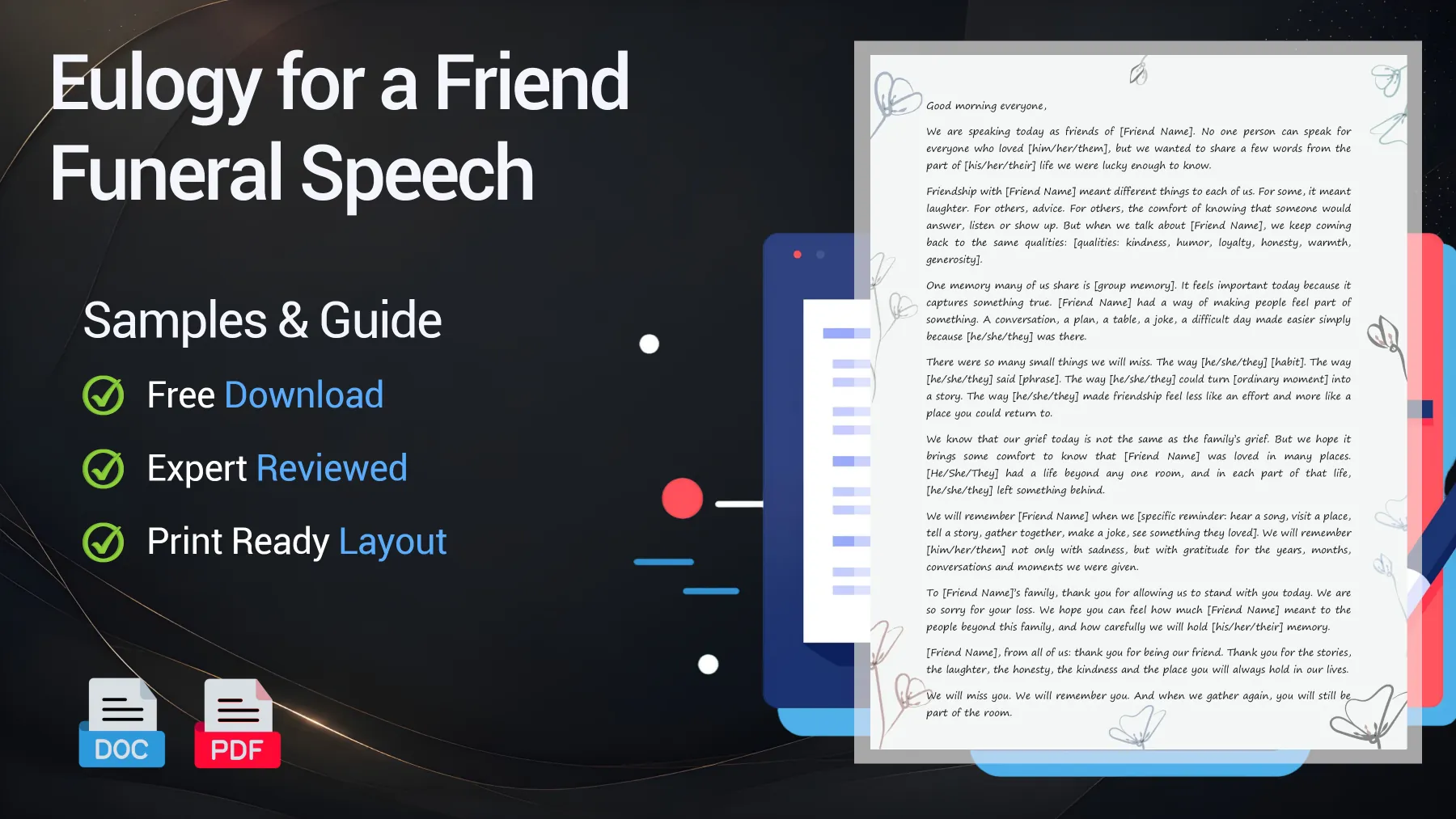
Eulogy Speech Samples for a Friend You Can Adapt
Before you write a eulogy for a friend, allow yourself to keep it simple. The goal is not to find perfect words, explain the loss, or make everyone feel better. The purpose is more human: to help the room remember your friend honestly and with care.
Choose one memory, one quality, and one way your friend made a difference to those around them. Avoid turning the speech into a biography, a dramatic performance of grief, or a list of achievements. If you prefer to write privately to the family rather than speak at the service, this condolence letter or sympathy note may be a better fit.
Eulogy for a Close Friend
A complete eulogy for a close friend, written for a funeral or memorial service where the speaker wants to honor a friendship with warmth and restraint.
Good morning, everyone.
My name is [Your Name], and I was lucky enough to call [Friend Name] my friend.
I say “lucky” because that’s what friendship with [Friend Name] felt like. Not loud luck, not the kind that announces itself, but the kind you notice in small moments: a message at just the right time, a laugh on a hard day, or a quiet act of help that never asked for praise.
It’s hard to stand here and speak about [Friend Name] in the past tense. Many of us are still getting used to that. There are people here who knew [him/her/them] as family, as a colleague, a neighbor, a companion, or simply someone who crossed their path at the right moment. I can only speak from my own place, as a friend.
What I’ll remember most about [Friend Name] is [quality: kindness, humor, honesty, loyalty, patience, generosity]. Not just as a word that sounds good in a speech, but as something real.
I think of [shared memory]. It might seem small from the outside, but to me it says so much about who [Friend Name] was. In that moment, [he/she/they] showed [quality or action]. That was [Friend Name]: not trying to impress anyone, not asking for attention, just being present in a way that made things better.
That’s what friendship with [Friend Name] gave many of us: presence. The sense that someone truly noticed you. The feeling that ordinary conversations mattered. The kind of humor that didn’t erase hard times but made it possible to breathe through them.
[Friend Name] wasn’t perfect—none of us are. And I don’t think [he/she/they] would want to be remembered as some polished version of [himself/herself/themselves]. What made [Friend Name] so loved was the real person: the habits we recognized, the phrases we can still hear, the way [he/she/they] reacted to little things, the opinions, the laughter, the care, the stubbornness, and the tenderness.
There’s grief in this room because there was love in this room. There’s silence because a voice we knew is missing. But something remains.
It remains in the stories we’ll keep telling. In the way we’ll hear a song, pass a place, see something funny, or remember a sentence and think, “[Friend Name] would have loved that.” It remains in the way [he/she/they] shaped us, even in small ways we may only understand later.
To [Friend Name]’s family, thank you for sharing [him/her/them] with us. I know nothing I say can take away the weight of this day. But I hope you can feel, in this room, how widely [Friend Name] was loved and how deeply [he/she/they] will be missed.
And to [Friend Name], I want to say thank you. Thank you for the friendship, the laughter, the honesty, the memories, and the part of your life you allowed me to share.
We will miss you. We will speak your name. We will carry what you gave us—not perfectly, but lovingly.
Rest gently, my friend.

Reviewed by Martin D., Speechwriter
The restraint in this eulogy feels right. It honors the friend through one memory and one recognizable quality instead of trying to summarize a whole life.
Eulogy for a Best Friend
A more personal eulogy for a best friend, suitable when the speaker shared many years, private memories, and a close bond with the person who died.
Good morning, everyone.
I’m [Your Name], and [Friend Name] was my best friend.
That’s a hard sentence to say. The word “was” feels too small for a friendship that’s still present in so many places: in my phone, in my memories, in the jokes I still want to send, and in the quiet moments when I forget, just for a second, that I can’t call [him/her/them].
I know many people here loved [Friend Name], and each of us knew a different side of [him/her/them]. That’s one of the strange things about grief: we’re all missing the same person, but not in exactly the same way.
For me, [Friend Name] was the one who [specific friendship detail: answered late-night calls, made ordinary errands funny, gave honest advice, remembered small things, showed up without being asked]. [He/She/They] made friendship feel simple—not because life was easy, but because [he/she/they] knew how to be there.
One memory keeps coming back to me: [shared memory]. I’ve thought about it many times since [Friend Name] died. At first, it made me cry. Then it made me smile. Now it does both.
That memory matters because it shows who [Friend Name] was when nobody was trying to make a speech about [him/her/them]. It shows the [quality: humor, loyalty, courage, generosity, softness, stubborn hope] so many of us recognized. It shows the person I’ll carry with me.
I could tell you [Friend Name] was kind, funny, and loved. All of that is true. But those words are too broad for someone so specific.
[Friend Name] was the person who [concrete habit]. The one who said [phrase or expression]. The one who could make [ordinary situation] feel like a story. The one who knew when to tease you and when to stop. The person whose presence changed the room—sometimes quietly, sometimes not quietly at all.
I’ll miss the big things, of course. But I think I’ll miss the small things most: the messages, the plans we thought we’d make later, the unfinished conversations, and the simple comfort of knowing someone like [Friend Name] was in the world.
There’s no way to make this loss feel fair. No sentence can tidy it up, so I won’t try.
What I can say is that being [Friend Name]’s friend changed my life for the better. [He/She/They] taught me [lesson or influence]. [He/She/They] gave me memories I wouldn’t trade, even though they hurt today. [He/She/They] made life warmer, funnier, and more honest.
To [Friend Name]’s family, I am so sorry. Thank you for the love you gave [him/her/them] and for the person that love helped shape. Please know that [he/she/they] mattered deeply outside the family too—to friends, to rooms, to days, and to lives that will continue to feel [his/her/their] absence.
[Friend Name], I don’t know how to say goodbye the right way. Maybe a friendship like ours doesn’t end in just one goodbye. Maybe it continues in stories, in the laughter that slips through tears, and in the choices we make because we knew you.
I love you. I miss you. And I’ll be grateful for you for the rest of my life.
Reviewed by Martin D., Speechwriter
This best-friend eulogy allows grief to be honest without becoming theatrical. The concrete details keep the tribute grounded.
Short Eulogy for a Friend
A shorter funeral speech for a friend, suited to a service with several speakers or when the speaker wants something brief, steady, and respectful.
Good morning, everyone.
My name is [Your Name], and I knew [Friend Name] as a friend.
I’ll keep my words simple. Today doesn’t need perfect language. It needs truth.
[Friend Name] made people feel [quality: welcome, noticed, safe, understood, lighter, less alone]. That’s what I’ll remember most. Not just the big memories, but the small ones: [small memory or habit].
There’s one moment I keep thinking about: [shared memory]. It stays with me because it shows [Friend Name] clearly. It shows [his/her/their] [quality: kindness, humor, loyalty, patience, generosity]. It reminds me why so many people here are grieving today.
We all carry different memories of [Friend Name]. Some will make us cry. Some will make us laugh at the worst possible time. Some will arrive in the middle of an ordinary day and remind us how much [he/she/they] mattered.
To [Friend Name]’s family, I am deeply sorry for your loss. I hope it brings some comfort to see how many people loved [him/her/them] and how many lives [he/she/they] touched.
[Friend Name], thank you for your friendship, your presence, and the memories we’ll keep.
You will be missed, and you will be remembered.
Reviewed by Martin D., Speechwriter
This short eulogy gives the speaker a safe structure. It is brief, but it still includes memory, character, and comfort.
Eulogy from a Group of Friends
A collective memorial tribute from friends, useful when several friends want one shared speech that speaks for the group.
Good morning, everyone.
We’re speaking today as friends of [Friend Name]. No one person can speak for everyone who loved [him/her/them], but we want to share a few words from the part of [his/her/their] life we were lucky enough to know.
Friendship with [Friend Name] meant something different to each of us. For some, it meant laughter. For others, advice. For others, the comfort of knowing someone would answer, listen, or show up. But when we talk about [Friend Name], we keep coming back to the same qualities: [qualities: kindness, humor, loyalty, honesty, warmth, generosity].
One memory many of us share is [group memory]. It feels important today because it captures something true. [Friend Name] made people feel part of something—a conversation, a plan, a table, a joke, or a difficult day made easier simply by [his/her/their] presence.
There are so many small things we’ll miss: the way [he/she/they] [habit], the way [he/she/they] said [phrase], and the way [he/she/they] could turn [ordinary moment] into a story. [He/She/They] made friendship feel less like an effort and more like a place you could return to.
We know our grief today isn’t the same as the family’s. But we hope it brings some comfort to know that [Friend Name] was loved in many places. [He/She/They] had a life beyond any one room, and in each part of that life, [he/she/they] left something behind.
We’ll remember [Friend Name] when we [specific reminder: hear a song, visit a place, tell a story, gather together, make a joke, see something they loved]. We’ll remember [him/her/them] not only with sadness, but with gratitude for the years, months, conversations, and moments we were given.
To [Friend Name]’s family, thank you for letting us stand with you today. We’re so sorry for your loss. We hope you can feel how much [Friend Name] meant to people beyond this family, and how carefully we will hold [his/her/their] memory.
[Friend Name], from all of us: thank you for being our friend. Thank you for the stories, the laughter, the honesty, the kindness, and the place you’ll always hold in our lives.
We’ll miss you. We’ll remember you. And when we gather again, you’ll still be part of the room.
Reviewed by Martin D., Speechwriter
The group voice respects the family while still showing the friend’s wider impact. It feels collective without becoming vague.
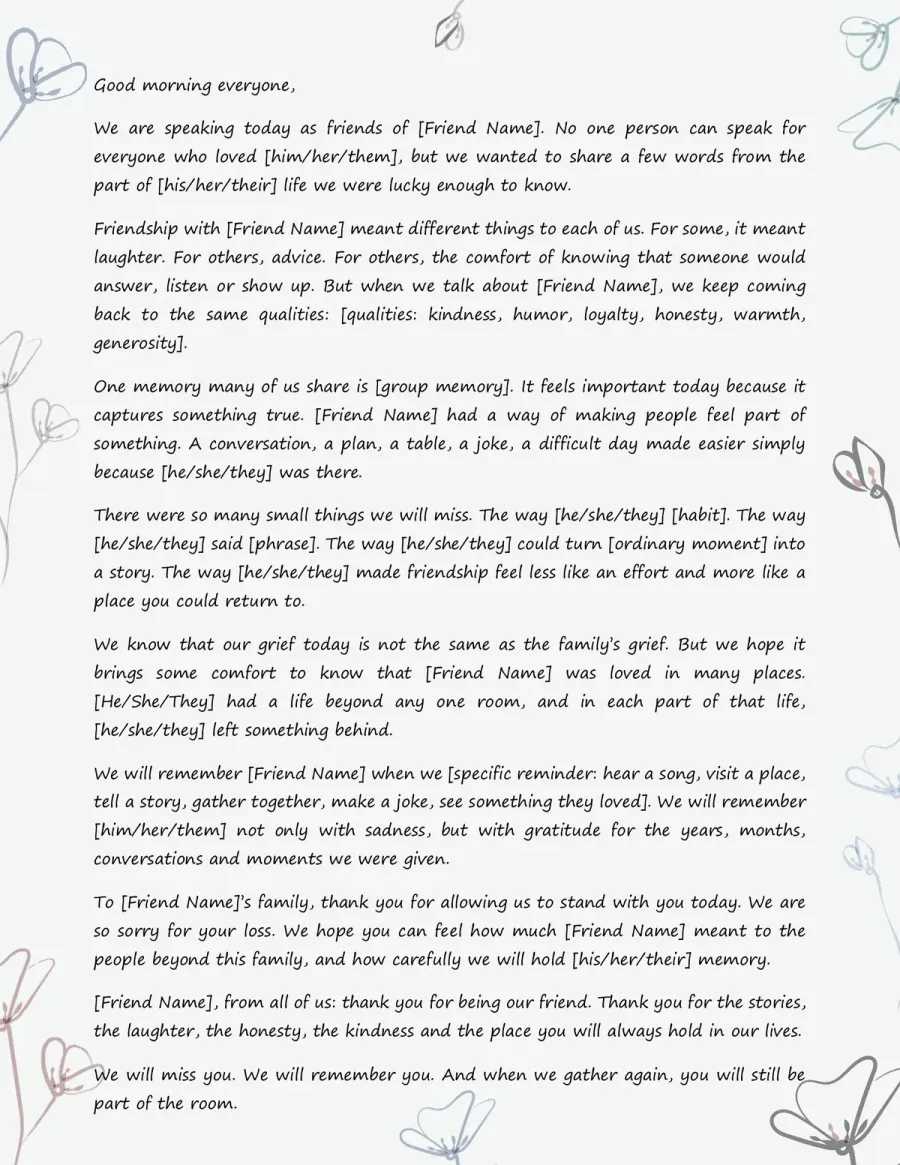
Preview of the Eulogy for a Friend Template You Can Download
Below is a preview of the eulogy for a friend template you can download and personalize. The document is available in Word and PDF formats for printing, rehearsing, or reading at a funeral or memorial service.
How to Personalize a Eulogy for a Friend Before the Service
A eulogy for a friend works best when it doesn’t try to say everything. Choose one memory, one quality, and one final line of gratitude or farewell that you can say aloud without feeling forced.
Ask what the service needs from you
A eulogy at a funeral, memorial, or celebration of life may need a different tone. Check the expected length, the order of speakers, and whether the family wants a religious, secular, or neutral tribute.
See Why it matters
If several people are speaking, a shorter tribute may be kinder to the room. If you’re the main speaker, you may have more space for one story and a fuller goodbye.
Choose one quality before choosing a story
Start with the part of your friend you most want the room to recognize: kindness, humor, loyalty, courage, patience, generosity, or the way they made people feel.
See an example
If the quality is loyalty, choose a memory where [Friend Name] showed up for someone, kept a promise, or stayed close during a difficult time.
Use one memory, not a whole timeline
A friend’s eulogy does not need to cover every stage of their life. One specific memory can make the person feel present in the room more than a long list of facts.
See Better angle
Instead of saying “[Friend Name] was funny,” tell a short story that lets the room hear their humor again for a moment.
Keep humor gentle and recognizable
Humor can belong in a eulogy if it reflects the person and the family will receive it well. It should bring warmth, not shock or discomfort.
See Avoid
Don’t use private jokes, painful family history, embarrassing stories, old conflicts, or anything that would make the funeral feel unsafe for those closest to the person.
Leave space for grief
You don’t have to make the speech uplifting all the way through. A eulogy can admit that the loss hurts while still giving the room something loving to hold.
Practise aloud, but do not chase perfection
Read the eulogy aloud before the service. Mark places to pause, breathe, or look up. If you become emotional, that is not failure.
See Practical tip
Print the speech in large type, leave line breaks between paragraphs, and ask someone you trust to be ready to continue if you can’t finish.
What Makes a Friend’s Eulogy Easier to Hear
- Eulogy for a Friend
- Funeral Speech
- Memorial Tribute
- One Memory
- One Quality
- Gentle Humor
- Family-Aware Tone
- Not a Biography
- Spoken Rhythm
- Short Paragraphs
- Grief Allowed
- Simple Farewell
- Respectful Closing
- Word and PDF
Do & Don’t - Writing a Eulogy for a Friend
A funeral speech does not need to be perfect to be meaningful. The strongest version helps the room recognize the person, gives the family comfort, and keeps the tone respectful.
What Can Make a Eulogy Feel Wrong
Red Flags- Try to summarize the friend’s entire life
- Use private jokes the family cannot share
- Turn grief into a dramatic performance
- Say the loss happened for a reason
- Give advice to mourners about how they should feel
- Use religious language unless you know it will be welcomed
What Makes the Tribute Feel Careful
Trust Signals- Introduce your relationship to your friend briefly
- Choose one memory that shows who they were
- Name one quality the room can recognize
- Keep humor gentle and family-safe
- Acknowledge grief without trying to fix it
- Close with gratitude, remembrance or a simple goodbye
FAQ - Eulogies for a Friend
How long should a eulogy for a friend be? Toggle answer
A friend’s eulogy is often strongest at around three to five minutes, or roughly 500 to 750 words. It can be longer if you’re the main speaker, but the speech should still stay focused on a few memories and qualities.
What should I say in a eulogy for a friend? Toggle answer
Introduce your relationship, share one memory, name one quality you loved, acknowledge the loss, and close with gratitude or farewell. You don’t need to tell every story or explain the whole friendship.
Can a eulogy for a friend be funny? Toggle answer
Yes, if the humor is gentle, true to the person, and safe for the family. A warm memory that makes people smile can help the room remember the friend as they were. Avoid private or embarrassing stories.
What should I avoid in a funeral speech for a friend? Toggle answer
Avoid private conflicts, old secrets, shocking humor, family tension, religious assumptions, clichés about grief, and anything that tells mourners how they should feel. The speech should protect the room.
What if I cry while giving the eulogy? Toggle answer
It’s okay to become emotional. Print the speech clearly, mark pauses, and ask someone you trust to stand nearby or continue if needed. A eulogy doesn’t have to be perfectly delivered to be meaningful.
How do I end a eulogy for a friend? Toggle answer
End simply. Thank your friend, name what you’ll carry forward, or offer a quiet goodbye. A final line such as “We will miss you, and we will remember you” is enough when it’s true.
TL;DR - Say Less, But Make It True
A strong eulogy for a friend doesn’t need perfect language. It needs one real memory, one recognizable quality, and a few words that help the room feel the person’s presence again, even briefly.
Before delivering it, read the speech aloud and remove anything too private, too dramatic, or too heavy for the family to hear. The best tribute should sound like care, not performance.