
How to Request Sabbatical Leave: Letter Examples for 2026
A sabbatical may affect your pay, benefits, workload, and right to return. The examples below show how to make a request with clear dates, a specific purpose, and a practical handover plan to support approval.
Before You Send Your Sabbatical Leave Request
Sabbatical leave policies vary widely between countries and employers. In the UK, Gov.uk states there are no specific laws covering career breaks; instead, a career break is an agreement between employer and employee (Gov.uk). This makes your employer’s policy, staff handbook, contract, eligibility rules, and notice requirements central to your request.
In Australia, Fair Work explains that unpaid leave may be available when an employee is absent without pay, but only certain types of unpaid leave are covered by National Employment Standards (Fair Work Ombudsman). In the US, the Department of Labor describes FMLA leave as unpaid, job-protected leave for specific family and medical reasons. A personal sabbatical or career break should not be presented as FMLA unless the reason fits the qualifying criteria (U.S. Department of Labor). In the Canadian federal public service, Canada.ca notes that leave without pay for personal needs may be requested for up to three months, or for more than three months but up to one year, subject to the relevant rules (Canada.ca).
Some countries have a more formal statutory framework. In France, for example, Service-Public explains that a private-sector employee must inform their employer at least three months before the planned departure date, and the employer’s response is subject to specific rules (Service-Public.fr).
Before sending your sabbatical request, check whether your workplace treats it as sabbatical leave, career break, unpaid leave, leave of absence, study leave, or another HR category. Do not assume approval, pay, benefits, pension treatment, continuous service, or a right to return to the same role unless this is clearly stated in the policy or agreement.
Standard Sabbatical Leave Request Letter
A clear standard sabbatical leave request for employees who need to ask formally, name the dates, and show they understand policy approval matters.
Dear [Manager Name],
I am writing to formally request sabbatical leave from my position as [Job Title] at [Company Name].
I would like to take leave from [Start Date] to [End Date], with my planned return to work on [Return Date]. Before submitting my request to HR, I wanted to confirm whether these dates and the proposed length of leave could be considered under [Company Name]’s sabbatical, career break, or unpaid leave policy.
The purpose of this leave is [brief reason: study / professional development / family responsibilities / personal project / travel / recovery period]. I understand that approval depends on company policy, business needs, and how my responsibilities will be covered during my absence.
To make the transition manageable, I can prepare a handover plan for [project / client / responsibility], update [system / tracker], and brief [Colleague Name] before my leave begins. I am also happy to discuss whether limited contact during the leave would be appropriate or if a complete break is preferred.
Please let me know if you are open to discussing this request and what information HR would need from me.
Kind regards,
[Your Name]

Reviewed by Olivia B., HR Consultant
I like how this starts with policy and dates, not emotion. The manager can see the request, the period, and the planning problem quickly.
Sabbatical Request for Study or Professional Development
Useful for a study or professional development sabbatical. It explains the purpose of the break and connects it to future value for the employer.
Dear [Manager Name],
I would like to request a sabbatical leave from [Start Date] to [End Date] to complete [course / research project / professional qualification / training program].
This request supports my long-term development in [field / role area]. The program would allow me to build deeper knowledge in [skill / subject / technical area], which is directly relevant to my current work on [project / business area / team responsibility].
I understand that a sabbatical is a significant request and would need to be reviewed against company policy and operational needs. For this reason, I am submitting my request early and am happy to provide a brief proposal outlining the purpose, timing, expected outcomes, and how the learning could support my role upon return.
Before the leave begins, I can complete [priority task], prepare handover notes for [project / client / process], and support [Colleague Name] with any transition work needed. I am also available to discuss a realistic return plan so the team can prepare for my return.
Please let me know if this request can be considered and what supporting information you would like me to provide.
Sincerely,
[Your Name]
Reviewed by Olivia B., HR Consultant
This works because the employee explains the value of the break without making it sound like the employer owes them the time away.
Unpaid Career Break or Personal Sabbatical Request
Built for an unpaid career break or personal sabbatical. It keeps the reason brief while asking clearly about approval, benefits, and return terms.
Dear [HR Contact / Manager Name],
I am writing to ask whether [Company Name] would consider my request for an unpaid career break from [Start Date] to [End Date].
The reason for my request is [brief personal reason]. I would prefer to keep further personal details private, but I am raising this early as the proposed period will require proper planning for the team and written confirmation from HR.
Before I decide whether to submit a formal request, I would appreciate guidance on the company’s policy for unpaid leave or career breaks. Specifically, I would like to understand how the leave would affect pay, benefits, pension or retirement contributions, continuous service, access to systems, annual leave, and my expected return to work.
If the request can be considered, I will prepare a handover plan covering [projects / files / clients / deadlines] and work with [Manager Name] to minimize disruption before my leave begins.
Please let me know the correct process and any documents I should review before submitting a formal application.
Kind regards,
[Your Name]
[Employee ID]
Reviewed by Olivia B., HR Consultant
I trust the caution here. The employee asks for unpaid leave without pretending it is automatically protected, paid, or guaranteed by policy.
Academic or Research Sabbatical Application Letter
Designed for an academic or research sabbatical application. It gives space for a project plan, outputs, institutional value, and return expectations.
Dear [Dean / Department Head / Committee Name],
I am writing to request sabbatical leave from [Start Date] to [End Date] to complete [research project / publication / fieldwork / course development / academic program].
I have served as [Position] in [Department] for [Number] years, and I believe this sabbatical would allow me to advance work closely connected to my teaching, research, and contributions to [Institution Name]. The main objective of the leave is to [describe project objective], with expected outputs including [publication / report / curriculum development / conference paper / research dataset].
I have attached a proposal outlining the project plan, timeline, expected outcomes, and how this work could benefit the department after my return. I am also including details of any external collaboration, funding applications, or institutional requirements that may affect the request.
To support continuity, I can work with [Colleague Name / Program Lead] to plan course coverage, student supervision, committee commitments, and any administrative duties that need to be managed during my absence.
Please let me know if this request can be considered under the applicable sabbatical policy and whether any further documentation is required.
Sincerely,
[Your Name]
[Title / Department]
Reviewed by Olivia B., HR Consultant
This feels credible for academic settings. It gives the purpose, duration, outputs, and return point without drifting into a vague life goal.
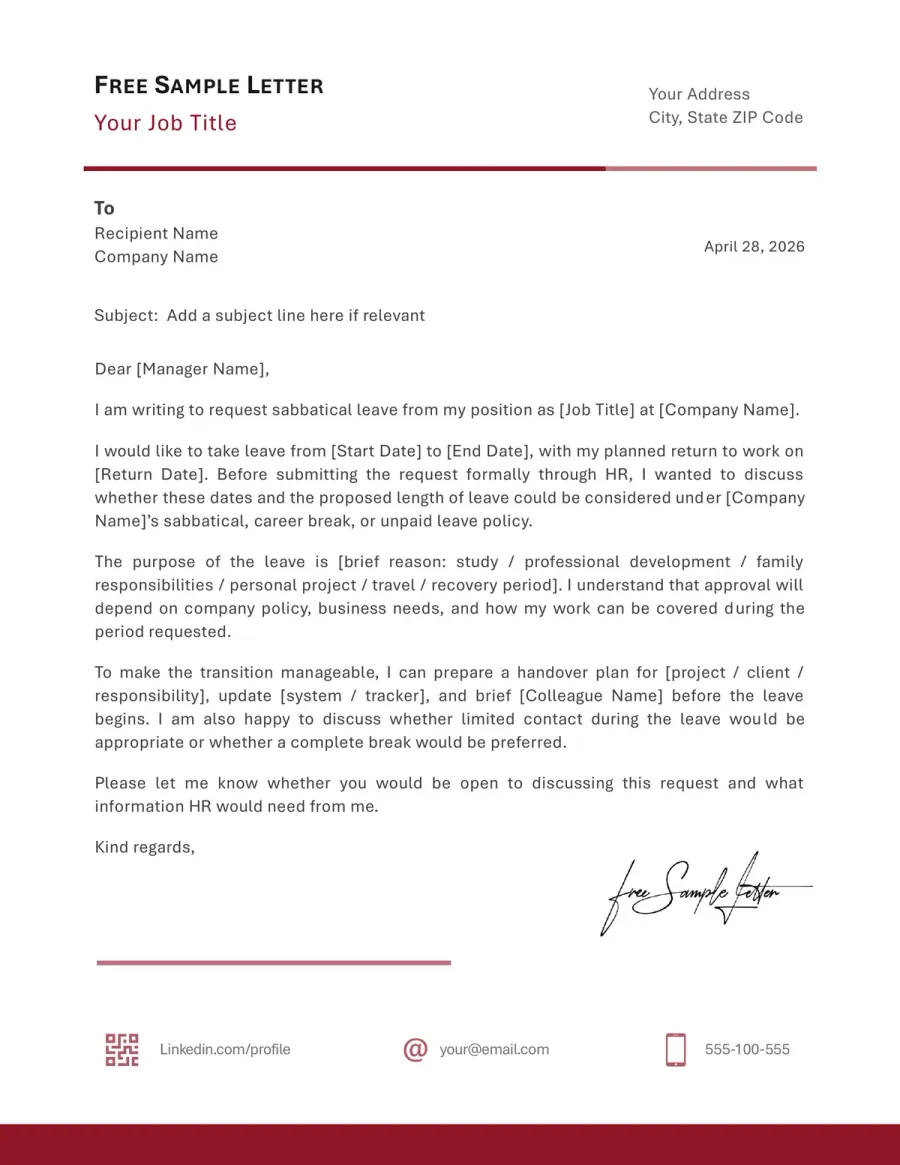
Preview of the Sabbatical Leave Request Template You Can Download
Below is a preview of the sabbatical leave request template you can download and edit. The document is available in Word and PDF formats for workplace use.
How to Write a Sabbatical Leave Request Before You Apply
Copy-paste does not work well for sabbatical requests because approval depends on policy, timing, workload, pay, and return terms. A strong sabbatical leave request should be well planned, not improvised.
➡️ More practical writing help in our guide how to write a clear workplace letter or email
Check the exact leave category
Start by identifying the policy name. A sabbatical may be treated as a career break, unpaid leave, leave of absence, study leave, or another HR category.
See what to verify
Before submitting the request, confirm whether it falls under the sabbatical, career break, or unpaid leave policy.
Give dates and return plans early
A long absence should not remain vague. State the start date, end date, expected return date, and whether the timing is flexible before explaining the purpose.
See an example
I would like to take leave from [Start Date] to [End Date], with my planned return to work on [Return Date].
Explain the purpose without overselling it
The reason should be clear and concise. For study or research, mention the intended outcome. For personal leave, provide enough context without sharing unnecessary private details.
See the difference
Good: The leave would allow me to complete [course/project]. Too much: a long personal story that HR does not need to approve the request.
Make the handover real
Approval often depends on coverage. Name the projects, deadlines, colleagues, systems, or clients that would need a handover before your leave begins.
See how it sounds
I can prepare handover notes for [project], update [system], and brief [Colleague Name] on work that may need attention.
Ask for written terms before relying on approval
For an extended leave, verbal agreement is not enough. Ask HR to confirm pay status, benefits, continuous service, return date, and any conditions in writing.
See a natural close
Please confirm the correct process and any terms that would apply to pay, benefits, continuous service, and return-to-work arrangements.
What HR Notices First in a Sabbatical Leave Request
- Leave dates
- Return date
- Policy name
- Unpaid leave
- Career break
- Handover plan
- Business coverage
- Study or research purpose
- Benefits and pay status
- Written return terms requested
Do & Don’t - What Makes a Sabbatical Request Easier to Approve
Managers and HR teams review sabbatical requests for timing, policy compliance, coverage, and return terms. A strong letter feels planned and realistic, not like a sudden wish for time away.
What Weakens the Request
Red Flags- Ask for months away without checking the policy
- Give dates that sound fixed before approval
- Oversell the personal benefit and ignore team cover
- Assume pay, benefits, or job return terms are protected
- Use vague language about being available during leave
- Submit a long emotional explanation instead of a plan
What Reassures HR and Managers
Trust Signals- Name the exact leave period and return date
- Connect the request to policy or HR process
- Explain the purpose in one controlled paragraph
- Show how work can be covered before you leave
- Ask for written terms before relying on approval
- Offer a realistic handover and return plan
FAQ - Sabbatical Leave Request Letter
Is sabbatical leave a legal right? Toggle answer
It depends on the country and employer. In many places, sabbatical leave is mainly a company policy or agreement. Some countries or sectors have formal rules, so check your contract, handbook, award, agreement, or official guidance.
Should I call it sabbatical leave or a career break? Toggle answer
Use the wording your employer uses. Some policies say sabbatical leave, career break, unpaid leave, leave of absence, or study leave. Matching the policy language makes the request easier for HR to process.
Should I mention whether the sabbatical is paid or unpaid? Toggle answer
Yes, but avoid assuming. If the policy is unclear, ask whether the leave would be paid, unpaid, partly paid, covered by accrued leave, or subject to a separate agreement.
How much notice should I give for a sabbatical request? Toggle answer
Give as much notice as the policy requires, and more if the leave is long. Sabbaticals often need planning for handover, temporary cover, benefits, pay status, and return arrangements.
Can my employer refuse a sabbatical request? Toggle answer
Often, yes. Unless a specific law, contract, or policy gives you a defined entitlement, approval usually depends on eligibility, timing, business needs, staffing, and the quality of your plan.
TL;DR - What Makes a Sabbatical Request Work
A sabbatical leave request letter is effective when it demonstrates planning. Clearly state the dates, purpose, policy basis, handover plan, and expectations for your return. The common mistake is writing as if a long break is automatically approved simply because the reason feels important.
The most important detail is the agreement behind the leave. Sabbatical, career break, unpaid leave, and leave of absence can have different implications for pay, benefits, continuous service, and return rights. Ask early, keep your tone practical, and get all terms confirmed in writing before relying on the approval.