
Unfair Dismissal & Wrongful Termination Letter Examples in 2026
Being dismissed unfairly can leave you feeling angry, rushed, and unsure what to write next. These unfair dismissal and wrongful termination examples help you respond with clear facts, dates, and a specific request.
Before You Send Your Unfair Dismissal Complaint Letter
Unfair dismissal and wrongful termination rules change fast from one country to another. In the UK, Acas says a fair dismissal normally needs a valid reason and a balanced, consistent, fair decision, usually with a full and fair procedure (Acas). For unfair dismissal claims, Acas also warns that strict time limits apply, usually 3 months minus 1 day from the date employment ended (Acas unfair dismissal).
In Australia, employees who think they have been unfairly dismissed usually need to apply to the Fair Work Commission within 21 days of dismissal (Fair Work Ombudsman). For federally regulated employees in Canada, an unjust dismissal complaint generally must be filed within 90 days from the date of dismissal (Canada.ca). In the US, many termination disputes depend on state law, contract terms, or specific protections such as discrimination or retaliation; the EEOC gives filing deadlines for discrimination charges (EEOC).
Before sending your complaint, gather your dismissal letter, employment contract, staff handbook, any warnings, relevant emails, meeting notes, payslips, and any written explanation already provided. If a deadline, discrimination issue, retaliation concern, union process, settlement agreement, or tribunal claim may apply, seek qualified advice before relying solely on a template.
Formal Unfair Dismissal Complaint Letter After Termination
A controlled formal unfair dismissal complaint for employees who want to challenge a termination decision clearly and professionally, without sounding emotional or vague.
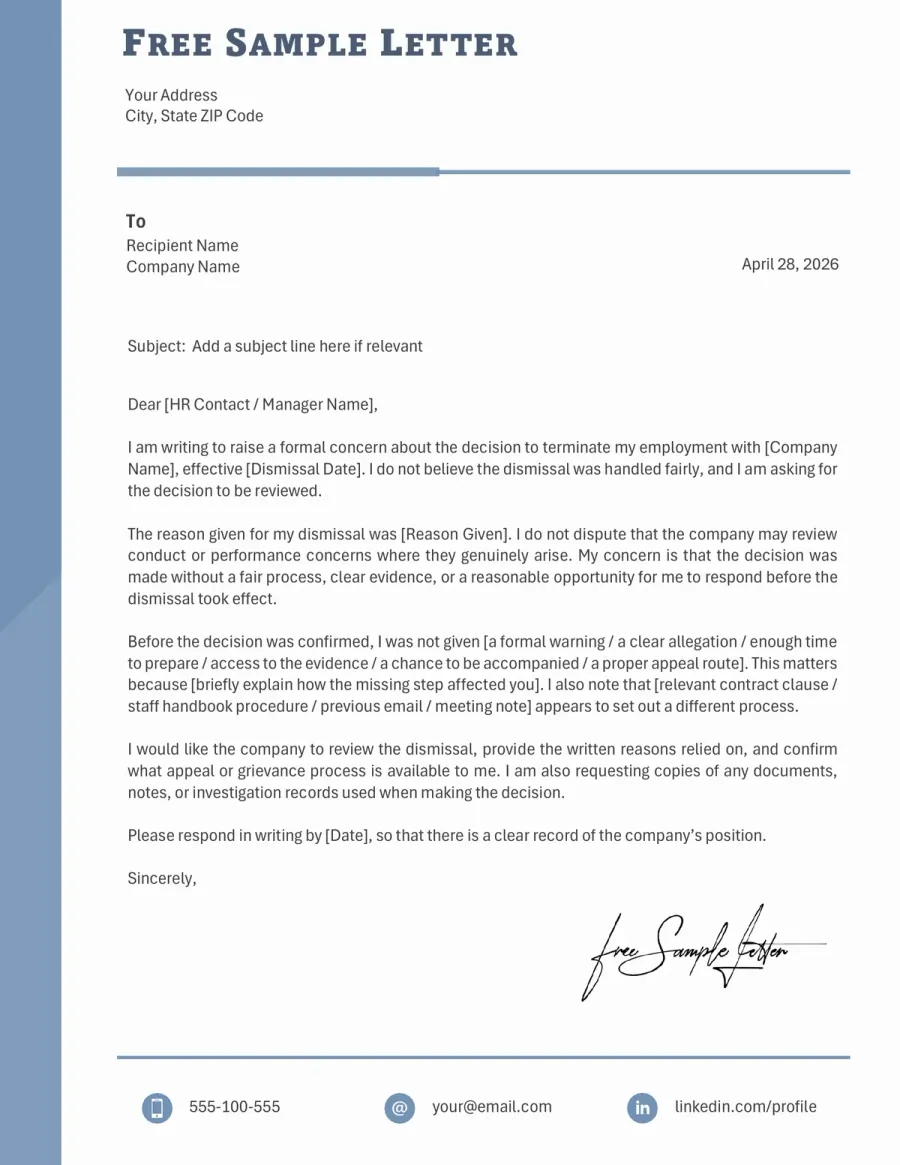
Dear [HR Contact / Manager Name],
I am writing to raise a formal concern about the decision to terminate my employment with [Company Name], effective [Dismissal Date]. I do not believe the dismissal was handled fairly, and I ask for the decision to be reviewed.
The reason given for my dismissal was [Reason Given]. I do not dispute that the company may review conduct or performance concerns where they genuinely arise. My concern is that the decision was made without a fair process, clear evidence, or a reasonable opportunity for me to respond before the dismissal took effect.
Before the decision was confirmed, I was not given [a formal warning / a clear allegation / enough time to prepare / access to the evidence / a chance to be accompanied / a proper appeal route]. This matters because [briefly explain how the missing step affected you]. I also note that [relevant contract clause / staff handbook procedure / previous email / meeting note] appears to set out a different process.
I would like the company to review the dismissal, provide the written reasons relied on, and confirm what appeal or grievance process is available to me. I would also appreciate copies of any documents, notes, or investigation records used when making the decision.
Please respond in writing by [Date] so there is a clear record of the company’s position.
Sincerely,
[Your Name]

Reviewed by Olivia B., HR Consultant
I trust the control here: the letter challenges the dismissal without sounding emotional, and the requested outcome is easy to identify.
Unfair Dismissal Letter Requesting Written Reasons and Records
Useful when the dismissal reason is unclear or incomplete. This version creates a written record before escalation and asks for the key documents.
Dear [HR Contact / Manager Name],
Following the termination of my employment on [Dismissal Date], I am writing to request a clear written explanation of the reasons for this decision.
At the time of dismissal, I was told that the reason was [Reason Given / no detailed reason was given]. I need the company’s position to be set out in writing so I can properly understand the decision and review it against my contract, company policy, and any procedure that applies.
Please also provide copies of any documents relied on when reaching the decision, including investigation notes, meeting records, warnings, performance records, disciplinary correspondence, or witness statements where relevant. If any documents cannot be shared, please explain the reason.
I am not asking for an informal conversation to replace the written record. Given the seriousness of the dismissal, I would like the response to confirm the reason for termination, the effective dismissal date, whether an appeal is available, and the deadline for starting that process.
Please send your written response by [Date]. I will review it carefully before deciding what steps, if any, I need to take next.
Kind regards,
[Your Name]
Reviewed by Olivia B., HR Consultant
This reads like a proper written record. The dates, documents, and request for reasons make it easier for HR to review without guessing.
Wrongful Termination Complaint Letter for Retaliation Concerns
Built for a serious retaliation or protected complaint concern. The wording stays factual and avoids making claims it cannot prove.
Dear [HR Contact / Manager Name],
I am writing to raise a formal concern about the termination of my employment on [Dismissal Date]. I believe the timing and circumstances of the dismissal should be reviewed because the decision followed my earlier complaint about [issue raised].
On [Date], I reported [brief description of complaint, safety concern, discrimination concern, wage issue, harassment report, or other protected matter] to [Person / Department]. Following this, [describe change: reduced hours, exclusion from meetings, warning, shift change, disciplinary action, or other treatment]. I was then dismissed on [Dismissal Date].
I understand that the company may have its own position on the reason for termination. However, I am requesting a review because the sequence of events raises a serious concern that my dismissal may have been connected to the issue I raised rather than to a fair and independent assessment of my work or conduct.
Please provide the written reasons for my dismissal, copies of any documents relied on, and details of the appeal or grievance process available to me. I also ask that the company preserve all relevant records, including emails, meeting notes, HR files, rota changes, performance records, and messages connected to this matter.
Please respond in writing by [Date].
Sincerely,
[Your Name]
Reviewed by Olivia B., HR Consultant
The strongest part is restraint. It raises a serious retaliation concern without turning the letter into an accusation-only complaint.
Preview of the Unfair Dismissal Complaint Template You Can Download
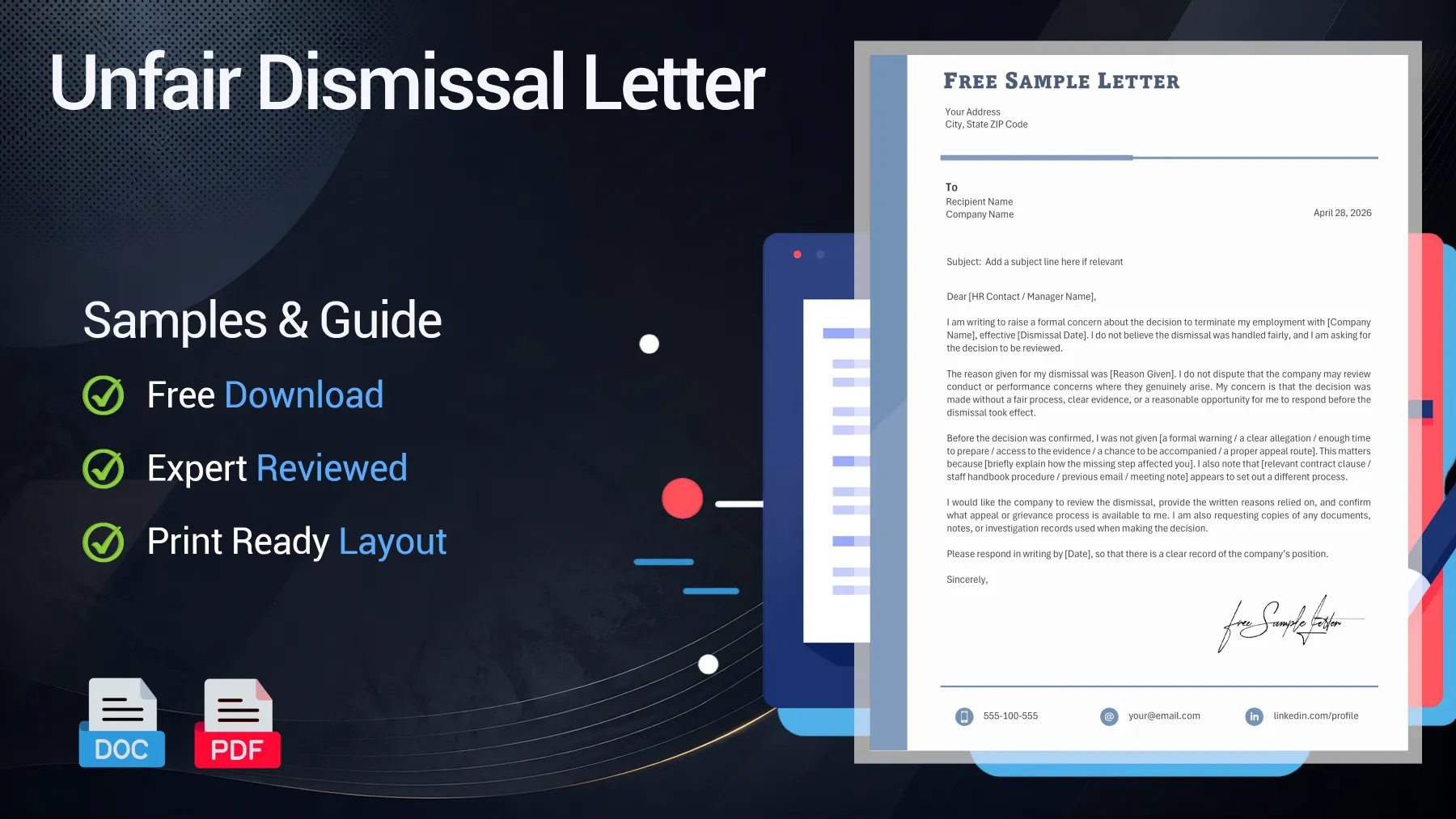
Below is a preview of the unfair dismissal complaint template you can download and edit. The document is available in Word and PDF formats for careful workplace use.
How to Write an Unfair Dismissal or Wrongful Termination Letter
Copy-pasting can quickly weaken this kind of complaint. Dates, dismissal reasons, warnings, appeal routes, evidence, and country-specific rules all matter. A credible unfair dismissal complaint letter should be factual, controlled, and specific to your situation.
➡️ More practical writing help in our guide how to write a clear workplace letter or email
Start with the dismissal decision
State the dismissal date, the reason you were given, and who communicated the decision. HR should not have to reconstruct the basic timeline.
See what to include
My employment was terminated on [Dismissal Date]. The reason given was [Reason Given], and the decision was communicated by [Manager Name].
Separate facts from conclusions
Do not lead with anger or broad accusations. Build your complaint around specific events, documents, meetings, warnings, emails, and any process steps that were missed.
See an example
Before the dismissal, I was not given a copy of the allegation, access to the evidence, or a chance to respond in a formal meeting.
Identify the process problem
The strongest complaints explain what was unfair: lack of warning, unclear evidence, a rushed decision, unequal treatment, no appeal, or an ignored policy.
See how it sounds
My concern is not only the outcome. It is that the decision was made before I had a reasonable opportunity to answer the allegation.
Ask for a specific next step
Do not finish with a vague request for fairness. Instead, ask for written reasons, relevant documents, an appeal route, a review, reinstatement, correction, or a discussion about settlement.
See the difference
Please confirm whether I can appeal the dismissal, who will review it, and what deadline applies to the appeal process.
Check deadlines before sending
Writing a letter to your employer can help create a record, but it usually does not pause legal deadlines. Check official guidance, union support, or seek qualified advice as early as possible.
See what to verify
Before sending, check the relevant tribunal, commission, agency, or complaint deadline that applies in your country or state.
What HR Notices First in an Unfair Dismissal Complaint
- Dismissal date
- Written reasons
- Appeal route
- Contract clause if known
- Prior warning record
- Timeline of events
- Documents requested in writing
- Missing investigation or hearing step
- Retaliation or discrimination concern
- Clear review request
Do & Don’t - What Makes This Complaint Credible
HR and managers review dismissal complaints for dates, records, process gaps, and tone. A strong letter makes the issue reviewable without turning the complaint into a personal attack.
What Weakens the Complaint Fast
Red Flags- Open with anger before stating the dismissal date
- Make legal claims without facts or documents
- Accuse individuals without describing what happened
- Leave out the reason you were given
- Ask for fairness without naming a next step
- Ignore appeal or grievance deadlines
What Makes HR Take It Seriously
Trust Signals- State the dismissal date and reason clearly
- Show the exact process step that was missed
- Refer to emails, meetings, warnings, or policy
- Ask for written reasons and relevant records
- Keep the tone firm without sounding reckless
- Request one clear review or appeal step
FAQ - Unfair Dismissal Complaint Letter
Is an unfair dismissal letter the same as a legal claim? Toggle answer
No. A letter to your employer can create a written record, request reasons, or ask for a review. A legal claim is a separate process with strict deadlines that vary by country.
Should I ask for reinstatement or compensation? Toggle answer
Only ask for what fits your situation. Some employees request reinstatement, others ask for a review, written reasons, a compensation discussion, or an appeal. Keep your request clear and realistic.
Can I mention discrimination or retaliation in the letter? Toggle answer
Yes, but remain factual. Give dates, describe the complaint or protected issue you raised, and note the treatment that followed. Avoid broad accusations unless you have supporting evidence.
Should I send the complaint by email or registered mail? Toggle answer
Email is often enough to create a timestamped record. For serious or disputed matters, consider tracked, recorded, certified, or registered delivery if these options are available in your country.
What documents should I gather before writing? Toggle answer
Gather your dismissal letter, contract, staff handbook, warnings, emails, meeting notes, rota or timesheet records, payslips, appeal information, and any messages related to the dismissal.
TL;DR - What Makes an Unfair Dismissal Complaint Stronger
A strong unfair dismissal complaint letter is controlled, dated, and supported by evidence. It explains what happened, why the process appears unfair, and what response you want next. The mistake to avoid is writing from anger before you have documented the facts.
Timing is critical. A letter can help document your position, but it may not protect you from short appeal, tribunal, commission, or agency deadlines. Keep your wording calm, preserve evidence, request written reasons, and confirm the formal process that applies before time runs out.