
Candidate Rejection Letter and Email Examples for Employers
A candidate rejection letter or email should close the hiring process respectfully and clearly. These examples help employers thank applicants, communicate the decision and avoid unnecessary or risky detail.
Before You Send a Candidate Rejection Letter
A candidate rejection letter is an employer-side HR record. Before sending it, confirm the candidate’s name, role title, hiring stage, interview date, decision status and whether your company provides feedback, retains candidate details or invites future applications.
Keep the message respectful and precise. You do not need to explain every reason for the decision, compare candidates, mention internal scoring or include anything that could be misunderstood as discriminatory, inconsistent or overly personal. The U.S. EEOC reminds employers that recruitment and hiring decisions must not be based on protected characteristics such as race, color, religion, sex, national origin, disability, age or genetic information: EEOC hiring guidance.
If you recruit in the UK, Acas also states that employers must follow discrimination law when advertising, interviewing and making hiring decisions: Acas recruitment guidance. When in doubt, keep the rejection brief, neutral and consistent with your recruitment policy.
Candidate Rejection Email After Reviewing an Application
A concise candidate rejection email after application review for applicants who were not selected for interview.
Subject: Update on your application for [Job Title]
Dear [Candidate Name],
Thank you for applying for the [Job Title] position at [Company Name]. We appreciate the effort you put into your application and the opportunity to learn more about your experience.
After reviewing the applications received, we have decided not to move your application forward to the interview stage at this time.
This decision was based on the requirements of the role and the overall candidate pool for this recruitment process. We appreciate your interest in [Company Name] and encourage you to consider future openings that may better match your background.
Thank you again for your time. We wish you success in your job search.
Kind regards,
[Your Name]
[Your Position] [Company Name]

Reviewed by Michael T., Business Communications Consultant
This email works well for early-stage rejection because it provides closure without unnecessary detail or sounding impersonal.
Rejection Letter After a Job Interview
A respectful rejection letter after a job interview for candidates who invested time in a conversation with the hiring team.
Dear [Candidate Name],
Thank you for taking the time to interview for the [Job Title] position at [Company Name] on [Interview Date]. We appreciated the opportunity to learn more about your experience and interest in the role.
After careful consideration, we have decided to move forward with another candidate for this position.
We recognize the time and effort you invested in the interview process and are grateful for the preparation you brought to the conversation. While we will not be progressing with your application for this role, we appreciate your interest in our team.
We wish you every success with your job search and future career plans.
Sincerely,
[Your Name]
[Your Position] [Company Name]
Reviewed by Michael T., Business Communications Consultant
This version is appropriate after an interview because it acknowledges the candidate’s time and effort without overexplaining the hiring decision.
Final Round Candidate Rejection Email
A more considered final round candidate rejection email for someone who reached the last stage of the hiring process.
Subject: Thank you for interviewing with [Company Name]
Dear [Candidate Name],
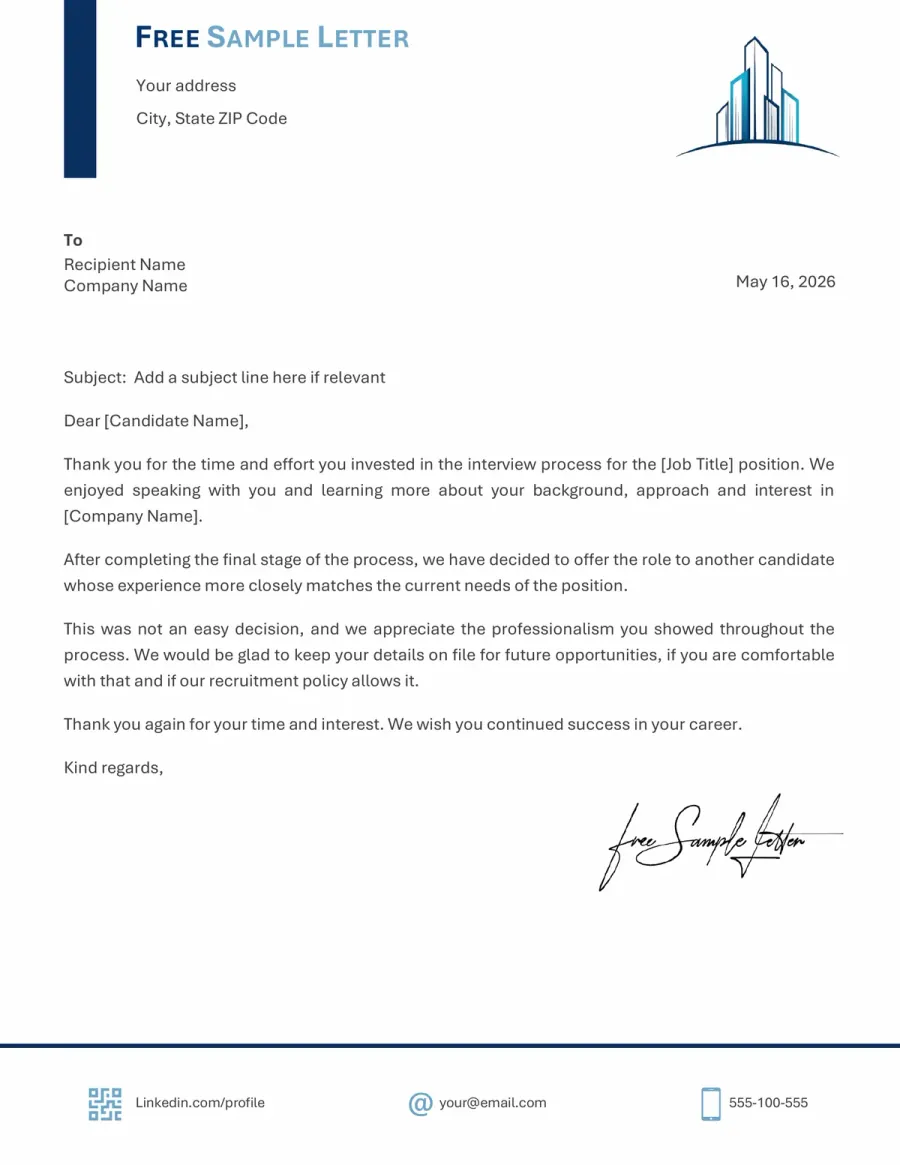
Thank you for the time and effort you invested in the interview process for the [Job Title] position. We enjoyed speaking with you and learning more about your background, approach and interest in [Company Name].
After completing the final stage of the process, we have decided to offer the role to another candidate whose experience more closely matches the current needs of the position.
This was not an easy decision, and we appreciate the professionalism you showed throughout the process. If you are comfortable with it and our recruitment policy allows, we would be glad to keep your details on file for future opportunities.
Thank you again for your time and interest. We wish you continued success in your career.
Kind regards,
[Your Name]
[Your Position] [Company Name]
Reviewed by Michael T., Business Communications Consultant
This final-round version gives the candidate more recognition while keeping the reason neutral, brief and aligned with company policy.
Polite Rejection Email Keeping a Candidate in Mind
A positive candidate rejection email for future opportunities when the applicant was strong but not selected for the current role.
Subject: Update on your application for [Job Title]
Dear [Candidate Name],
Thank you for your interest in the [Job Title] role at [Company Name] and for the time you spent speaking with our team.
We have decided to proceed with another candidate for this position. However, we were impressed by [brief neutral strength: your experience in [Area] / your background in [Field] / your interest in our work] and, with your consent, would like to keep your details on file for future opportunities.
If you would prefer not to have your information retained, please let us know and we will follow our normal data-handling process.
Thank you again for your interest in [Company Name]. We wish you success in your job search and hope our paths may cross again.
Best regards,
[Your Name]
[Your Position] [Company Name]
Reviewed by Michael T., Business Communications Consultant
This email is useful for strong candidates because it avoids promising a future role and leaves room for data-handling preferences.
Preview of the Free Candidate Rejection Letter Template
Use this preview to check the structure before downloading the editable version. The template keeps the thank-you, hiring decision, tone and closing clear for employer-side HR use.
How to Write a Candidate Rejection Letter
A strong candidate rejection letter should close the hiring process respectfully without sharing unnecessary detail. Thank the applicant, state the decision clearly and keep the wording consistent with your recruitment policy.
➡️ More practical help in our guide how to write a professional letter with a clear HR message
Match the message to the hiring stage
A candidate rejected after application review usually needs a shorter email than someone who attended an interview. If the candidate is being invited to the next step instead, use an interview invitation email to a candidate.
See the difference
Application stage: We have decided not to move your application forward. Interview stage: Thank you for taking the time to meet with our team.
Thank the candidate before sharing the decision
A short thank-you line shows respect for the time spent applying or interviewing. Keep it sincere and avoid exaggeration.
See a respectful opening
Thank you for applying for the [Job Title] position and for the time you took to share your experience with us.
State the decision without unnecessary detail
State that the company is not moving forward or has selected another candidate. Avoid comparing candidates, disclosing internal scoring or giving personal comments.
See safer wording
After careful consideration, we have decided to move forward with another candidate for this position.
Be careful with feedback and future contact
Only offer feedback if your company has a clear process for it. If you plan to keep the candidate in mind, make sure your wording aligns with your data and recruitment policy. For employment references, use a reference check response letter rather than adding reference information to a rejection email.
See Why this matters
We would be glad to keep your details on file for future opportunities, if you are comfortable with that and if our recruitment policy allows it.
Close with a professional wish
End politely without adding unnecessary emotion. The candidate should feel respected, even when the answer is no.
See a clean closing
Thank you again for your interest in [Company Name]. We wish you success in your job search.
What to Include in a Candidate Rejection Letter
- Candidate Name
- Job Title
- Application or Interview Stage
- Thank-You Line
- Clear Hiring Decision
- Neutral Reason If Needed
- Future Opportunity Wording If Appropriate
- Data Retention Note If Relevant
- Sender Name and Title
- Professional Closing
Do & Don’t - Candidate Rejection Letter
A rejection email should be respectful, brief and consistent with your hiring process. The goal is to close the loop without creating confusion or unnecessary risk.
What Weakens the Rejection
Red Flags- Leave candidates with no response after an interview
- Give vague feedback that sounds personal or inconsistent
- Compare the candidate directly with the person selected
- Mention protected characteristics, assumptions or personal circumstances
- Promise future contact if you do not have a process for it
- Share internal scoring, interview disagreements or confidential hiring notes
What Makes the Message More Professional
Trust Signals- Thank the candidate for applying or interviewing
- State the decision clearly and respectfully
- Keep the reason neutral and role-focused if you include one
- Use a warmer tone for final-round candidates
- Follow company policy on feedback and data retention
- Send the message promptly once the decision is final
FAQ - Candidate Rejection Letter
What should a candidate rejection letter say? Toggle answer
It should thank the candidate, identify the role, state that the company is not moving forward and close respectfully. After an interview, it is also appropriate to acknowledge the time the candidate invested in the process.
Should I explain why a candidate was rejected? Toggle answer
Usually, keep the reason brief or neutral unless your company has a clear feedback policy. Avoid detailed comparisons, personal judgments or comments that could be misunderstood. A simple, role-focused explanation is often safer.
Can I reject a candidate by email? Toggle answer
Yes. Email is the most common format for applicant and interview rejection messages. A formal letter may be used for senior roles, internal recruitment, public-sector processes or situations where a stronger written record is required.
Should I encourage the candidate to apply again? Toggle answer
Only if it is genuine. Encourage future applications when the candidate may be a good fit for another role. Avoid empty promises or wording that suggests future contact if your company does not intend to keep in touch.
What should I avoid in a rejection email? Toggle answer
Avoid personal comments, references to protected characteristics, internal scoring, interview-team disagreements, confidential details or statements that are inconsistent with the job criteria. Keep the message respectful and role-focused.
Should I keep the candidate’s details on file? Toggle answer
Only if your recruitment policy and applicable data rules allow it. If you mention retaining candidate details, give the candidate a clear way to object or request information about how their data will be handled.
TL;DR - Close the Hiring Loop With Respect and Restraint
A strong candidate rejection letter thanks the applicant, states the hiring decision clearly and avoids unnecessary explanations. It should sound respectful without promising more than the company can deliver.
Before sending it, check the role title, hiring stage and company policy on feedback, data retention and future applications. Keep the wording neutral, consistent and non-discriminatory, especially when the candidate has already interviewed.