
Industrial Manager Cover Letter Examples for Plant Operations in 2026
Industrial managers are evaluated on proof: safety, quality, and output. These cover letter examples show you how to translate your KPIs and process improvements into an application that secures interviews faster.
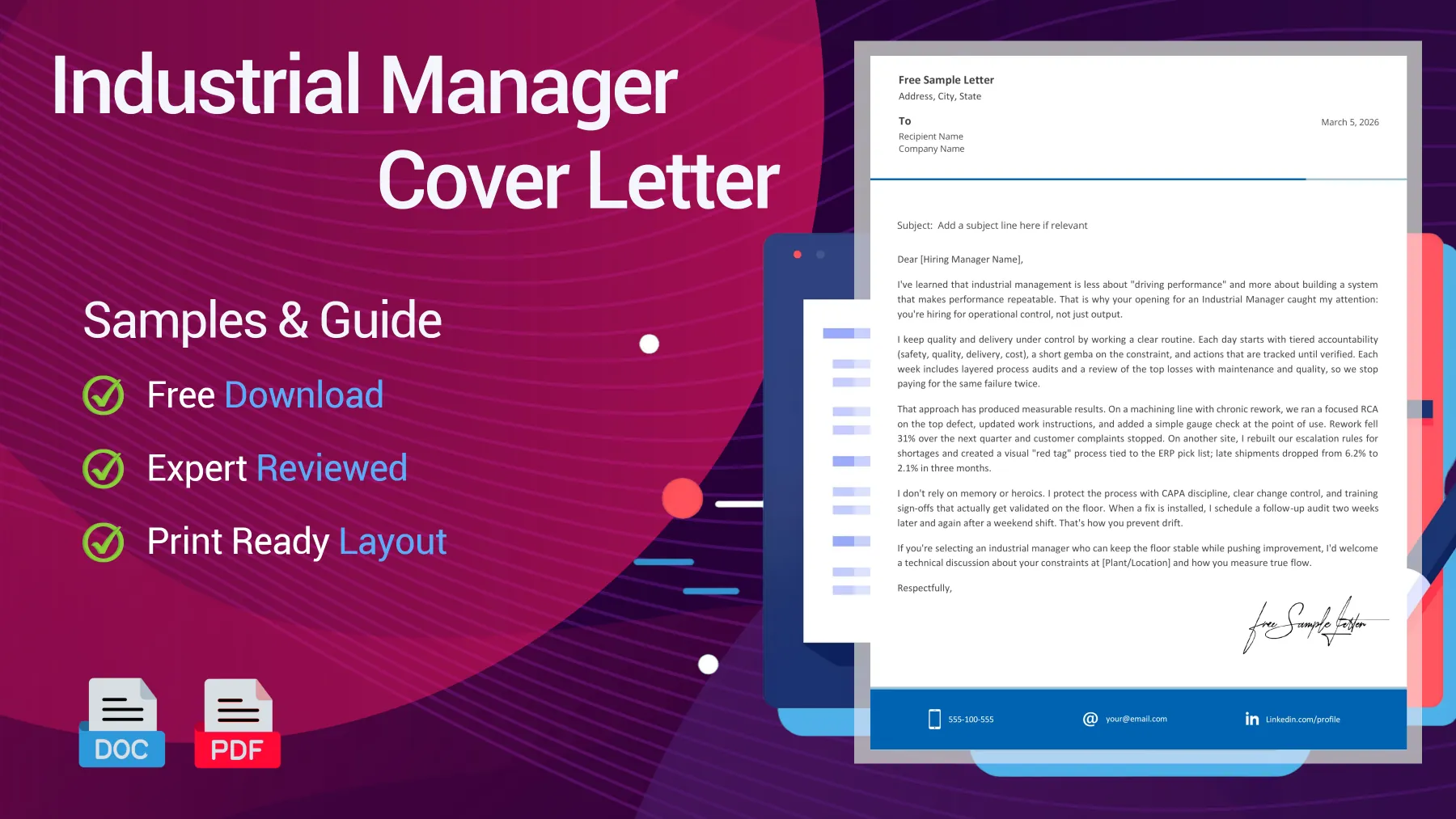
Free Samples of Industrial Manager Application Letters
BLS expects about 17,100 openings a year for industrial production managers (2024-34), even with only 2% growth. BLS Expert interpretation: Your letter must prove measurable output gains without slipping on safety or quality.
Junior New Graduate Industrial Manager Cover Letter Sample
Use this junior entry-level cover letter if your experience comes mostly from projects or placements. It translates those experiences into shop-floor value: safety habits, data discipline, and practical problem-solving.
Dear [Hiring Manager Name],
Your production floor doesn’t need another "strong communicator." It needs someone who can identify constraints, protect safety, and translate messy data into clear next steps. I’ve developed these skills through my final-year operations projects and a short placement in a manufacturing environment.
One moment stands out to me. During a training-cell run, the line stalled every 20 minutes and the operator was blamed. I reviewed the log, traced the route, and observed the material handler’s routine. It turned out that a mislabeled kanban bin and a mismatched reorder trigger were causing the problem. After we fixed the labels and adjusted the trigger, the stoppages stopped for the rest of the shift.
For my capstone project, I led a small team building a simple OEE dashboard in Excel and Power BI for a simulated assembly cell. We defined downtime codes, ensured data accuracy, and used Pareto charts to target the biggest losses. As a result, "unknown downtime" fell from 38% to 9%, and our weekly reviews made it easier to identify the next improvement.
I’m also disciplined about the fundamentals that keep output sustainable: 5S audits, lockout/tagout awareness, standard work, and clear escalation. When someone proposes a process change, I’m the one who asks, “What’s the control plan?” and “How will we know it’s still working two weeks later?”
If you’re open to it, I’d like to show you how I would run a first-week gemba routine at [Plant/Location] and which KPIs I’d display for supervisors. This would give you a clear sense of my approach and how quickly I can contribute.
Sincerely,
[Your Name]

Reviewed by Olivia B., HR Consultant
This reads like someone who will document actions and verify fixes, not chase hero moments - that’s what I want in a first-time manager.
Senior Industrial Manager Application Letter
Use this senior application letter if your strength lies in process discipline. It highlights your management system: layered process audits, CAPA, and daily KPI routines that prevent recurring failures.
Dear [Hiring Manager Name],
I’ve learned that industrial management is less about "driving performance" and more about building systems that make performance sustainable. That’s why your opening for an Industrial Manager stood out to me: you’re seeking operational control, not just output.
I maintain quality and delivery by following a clear routine. Each day starts with tiered accountability for safety, quality, delivery, and cost, followed by a short gemba walk focused on the main constraint and action items tracked to closure. Each week includes layered process audits and a review of top losses with maintenance and quality teams, so we don’t repeat the same mistakes.
That approach has delivered measurable results. On a machining line with persistent rework, we conducted a focused RCA on the main defect, updated work instructions, and added a simple gauge check at the point of use. Rework fell by 31% over the next quarter, and customer complaints stopped. At another site, I rebuilt escalation procedures for shortages and introduced a visual "red tag" process linked to the ERP pick list; late shipments decreased from 6.2% to 2.1% in three months.
I don’t depend on memory or heroics. I safeguard the process through CAPA discipline, clear change control, and training sign-offs that are actually validated on the floor. When a fix is implemented, I schedule a follow-up audit two weeks later and again after a weekend shift. That’s how I prevent drift.
If you’re looking for an industrial manager who can keep the floor stable while driving improvement, I’d welcome a technical discussion about your constraints at [Plant/Location] and how you measure real flow.
Respectfully,
[Your Name]
Reviewed by Olivia B., HR Consultant
I notice the candidate protects change control and training validation; it reads like an audit-ready manager, not a reactive fire-fighter.
Internal Promotion Industrial Manager Cover Letter Sample
Designed for internal promotion, this sample shows the step up from supervisor to industrial manager. It builds your credibility around systems: staffing, standards, and cross-shift performance.
Dear [Hiring Manager Name],
You can always tell the difference between a shift that’s busy and one that’s truly controlled. I’m interested in the Industrial Manager role because I see how much performance is lost when priorities shift based on rumor rather than data.
Two months ago, we began a night shift with a late truck and a backlog at the bottleneck cell. The easy choice would have been to push output and hope quality caught up. Instead, I brought the team leads together for five minutes, reset the production sequence, and asked quality to add an extra check where defects were slipping through. We cleared the backlog by mid-shift and shipped on time, with zero rework carried over to the next day.
That’s the approach I bring: quick decisions, clear ownership, and no surprises during shift handovers. As [Current Title], I’ve been running daily tier meetings that end with a written action list, not a debate. When we saw a spike in scrap on [Line/Area], I led a quick 5 Whys with operators, confirmed the suspected cause with maintenance, and added a simple check to the standard work. Scrap on that SKU dropped by 14% the next month.
I’m ready to scale that approach plant-wide: aligning production, maintenance, quality, and supply chain to a single plan; protecting safety routines; and ensuring the KPI story is consistent from the floor board to leadership reviews.
If you’re open to it, I’d like to sit down with you to discuss a real recurring issue at [Plant/Location]. I’ll show how I’d approach the problem as an industrial manager, then you can decide if the step up is a good fit.
Respectfully,
[Your Name]
Reviewed by Olivia B., HR Consultant
The tone is confident without bragging, and the 5 Whys example feels like something that actually happened on a real shift with real constraints.
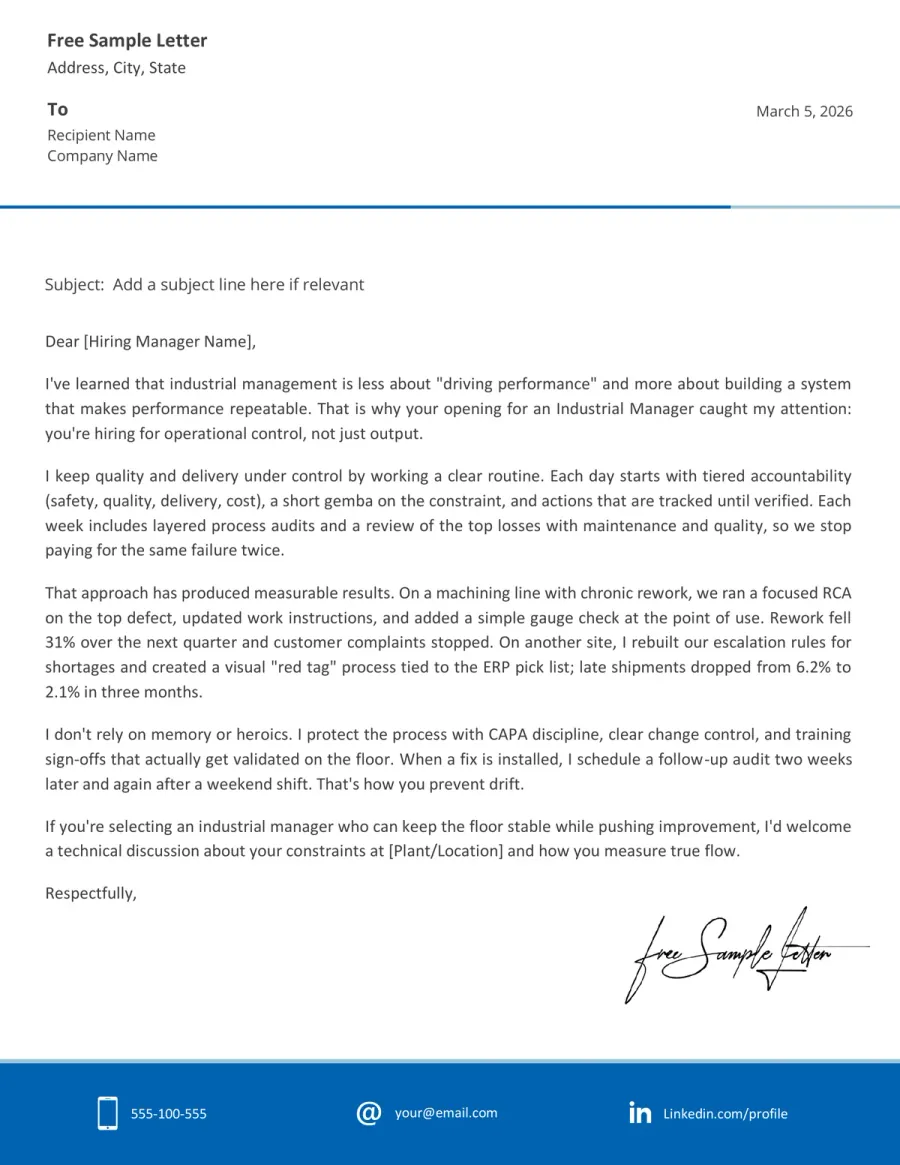
Industrial Manager Cover Letter Template Preview Before Download (Word/PDF)
Preview the industrial manager cover letter template below before downloading the editable Word file or ready-to-print PDF. Use the template to align your plant KPIs and leadership responsibilities to the job requirements.
Make These Industrial Manager Cover Letter Templates Yours in 5 Steps
Copy-paste applications get industrial manager letters rejected: your numbers must match the job. Replace the template’s KPIs with your plant data, mention lean tools you’ve actually used, and include one real incident. Make sure your keywords are clear so both ATS and hiring managers see the same story.
➡️ More expert tips in our article how to write a cover letter that passes ATS and still sounds human
Map the posting to plant KPIs
Pull 6-8 keywords from the job posting (OEE, scrap, safety, downtime). Use these keywords in your opening and again when providing proof, so your letter clearly matches the role.
See what to include
On [Line/Area], I tracked OEE daily, flagged the top loss, and closed actions with maintenance so minor stops didn’t hide inside other downtime.
Pick two proof stories recruiters trust
Choose two accomplishments that demonstrate control, not heroics: one stability fix, such as downtime or quality hold, and one improvement, like SMED, 5S, or TPM. Make sure the cause-action-result chain is clear and direct.
See a quick example
A chronic changeover overrun was killing schedule. I timed the steps, removed two internal tasks, and cut changeover by [number] minutes without skipping checks.
Scale the scope to your profile
Match the scope of your examples to your experience. Junior candidates should highlight learning systems, seniors should show plant-level trade-offs, and internal applicants should prove cross-shift ownership. Adjust your verbs and the scale of achievements, not just the dates.
See Show a scope shift example
Example: As a supervisor, I standardized tier meetings and escalation practices. As an industrial manager, I’ll extend those routines plant-wide and ensure KPIs align to a single daily plan.
Seed ATS keywords without sounding robotic
Include the ATS keywords that matter for this role: lean tools, EHS/LOTO, ISO standards, ERP/MES. Integrate them naturally into your phrasing, don’t list them all at once, and avoid repeating the same terms.
See the phrasing
I use SAP and a CMMS to plan work, then verify on the floor with layered audits to ensure the control plan matches actual operator practices.
Close with a next step that fits a plant
End with a next step specific to the plant: offer a 30-60-90 day outline, a constraint walk, or a KPI board review. This shows you approach operations practically, not with empty slogans.
See an example closing
If helpful, I can bring a one-page plan for stabilizing [Line/Area] in the first 45 days, along with the KPIs I’d review daily with supervisors.
ATS Tag Cloud for Industrial Manager Cover Letters
- OEE
- Shift handoff control
- SAP / ERP routines
- Root cause analysis (5 Whys)
- TPM basic care checks
- ISO 9001
- Constraint-first daily management
- CMMS work order follow-up
- Visual KPI board
- First-pass yield gains without extra headcount
- SMED
- CAPA ownership and verification
- Supplier delays escalation routine
- Standard work adherence
- Coaching team leads
- Safety observations follow-up
- EHS
- Cost of poor quality (COPQ)
- Production scheduling and capacity reality
Do & Don’t for Industrial Manager Cover Letters: What Hiring Teams Trust Fast
In six seconds, recruiters look for signs of operational control: clear KPIs, a disciplined approach to safety, and a realistic scope. If your letter feels generic or exaggerated, they move on. But if it reads like a real plant routine, they pay attention.
Common red flags in industrial manager applications
Red Flags- Hide your scope behind vague leadership claims
- Copy a generic hook that could fit any manager job
- Overstate plant-wide ownership when you ran one area
- Write one long paragraph that feels like a résumé rewrite
- Promise “efficiency” without naming a KPI or constraint
Trust cues recruiters look for in plant leaders
Trust Signals- Name one KPI you moved and the lever you pulled
- Describe your daily rhythm: tier meetings, gemba, action closure
- Mention EHS discipline as part of how you protect throughput
- Use one lean method and add how you verified it held
- State your scope plainly: line, shift, site, or multi-site
FAQ - Industrial Manager Cover Letter
How do I prove I can improve OEE without sounding like I’m padding numbers? Toggle answer
Connect your KPI to a specific action. Explain what you changed, such as downtime codes, SMED steps, or audit cadence, then share a realistic improvement. A clear cause-action-result is more convincing than a large number with no explanation.
What’s the best way to show I can protect safety and still hit output targets? Toggle answer
Describe a specific trade-off decision: pausing, rerouting, adding an extra check, or escalating an issue. Hiring teams want to see that you don’t risk EHS or quality just to chase throughput.
Which lean tools should I mention without looking like I’m name-dropping? Toggle answer
Mention only the lean tool you actually used, and link it to a concrete result. For example, “SMED reduced changeover by [number] minutes” is effective. A list of terms like “Six Sigma, Lean, Kaizen” without context will be ignored.
I’m applying internally - how do I show plant-level scope, not just shift supervision? Toggle answer
Show that you’ve built systems that work across shifts, such as handoff controls, escalation rules, layered audits, or a KPI board. Then explain what you would scale as Industrial Manager, like cross-functional ownership, verification, or plant-wide routines.
What should I write if my wins were cross-functional? Toggle answer
Name your cross-functional partners and your role in the decision-making process. For example: “I aligned maintenance on PM compliance, quality on top defect modes, and production on a daily constraint routine.” This shows real plant collaboration, not just generic teamwork.
TL;DR - Industrial Manager Cover Letter: Win on KPIs, Safety and Scope
Bring two proof points that smell like a real plant: one stability fix (downtime, changeover, scrap) and one system win (daily cadence, audits, escalation). Name the levers, not adjectives. Fatal mistake for this role: a generic “manager” letter that claims leadership but never touches OEE, safety routines, or measurable control.
The quiet credibility signal is verification. Industrial leaders get hired when they show how fixes stick (follow-up after weekends, consistent downtime coding, control plan discipline) and how they trade off speed vs quality vs EHS. That’s what separates a clean industrial manager application letter from a résumé in paragraph form.