
Logistics & Supply Chain Manager Cover Letter Examples You Can Adapt in 2026
Every day in logistics is about managing KPIs, handling exceptions, and making trade-offs. Your cover letter should reflect that operational control. Use these logistics and supply chain examples to highlight OTIF, cost-to-serve, and your ability to follow through.
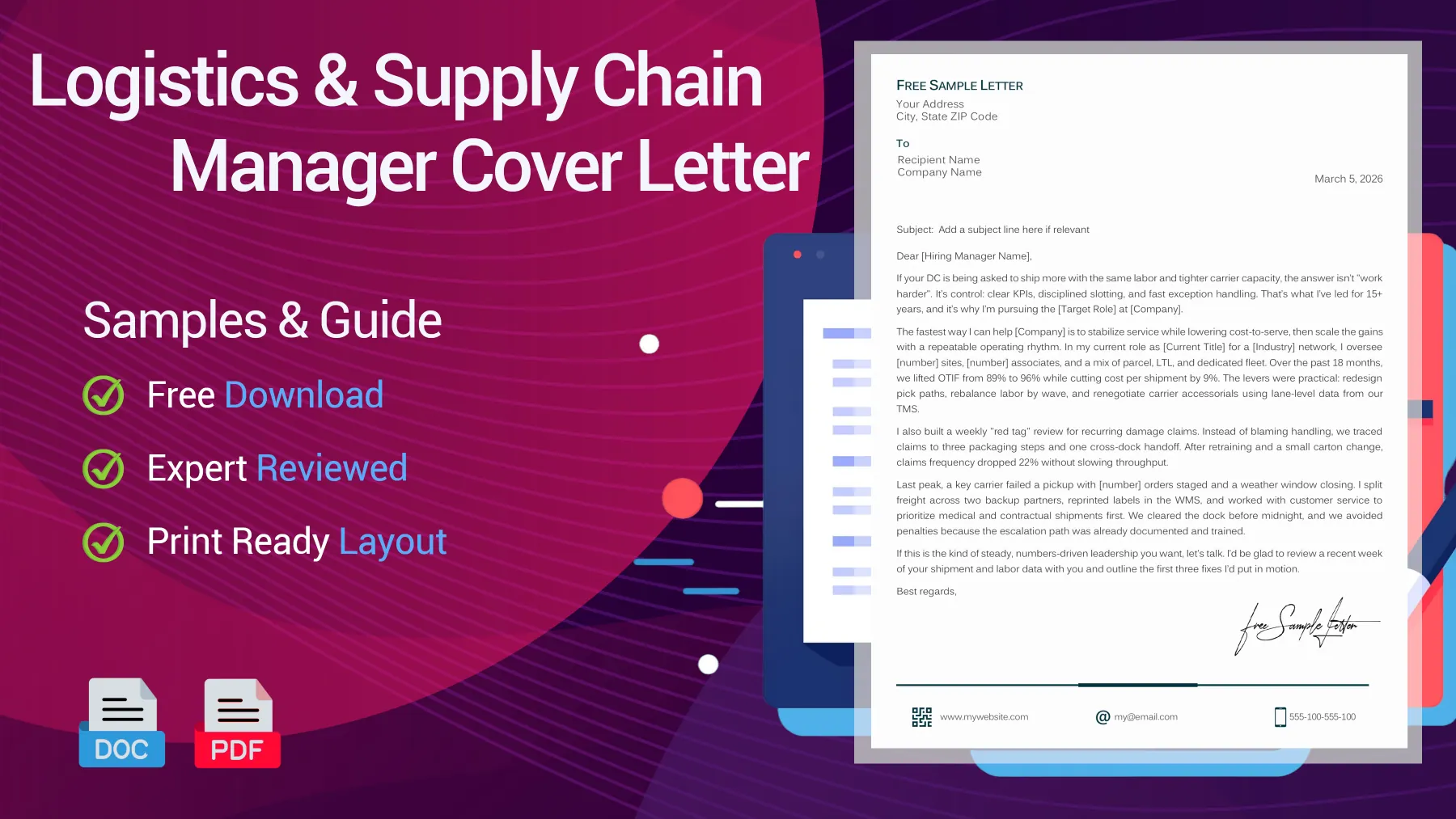
Free Samples of Logistics Applications and Supply Chain Cover Letters
The BLS projects logisticians will grow 17% from 2024-2034 and lists a 2024 median pay of $80,880. Expert interpretation: open with KPIs (OTIF, cost-to-serve, inventory turns), not tasks.
Entry-Level Logistics Manager Cover Letter Sample (Recent Graduate)
This junior logistics manager sample turns coursework and internship moments into proof: basic WMS work, inventory accuracy, and a real dock problem solved without drama.
Dear [Hiring Manager Name],
When a carrier calls with a two-hour delay and the dock is already full, there’s no time for drama - just a plan to keep orders moving and people safe. That’s the type of situation I learned to manage during my [Logistics Internship/Capstone Project], which is why I’m applying for the [Target Role] at [Company].
In my final semester, I led a hands-on project for a local distributor: I mapped the inbound-to-putaway flow, timed each handoff, and identified the main bottlenecks. The solution was straightforward but disciplined: slot fast movers closer, standardize scan points, and align pick waves with carrier cut-offs. Within three weeks, our test area reduced staging congestion and increased on-time departures from 82% to 93% using basic WMS reports and a clear Excel tracker.
I also know how quickly one exception can snowball into ten. During my internship at [Company/3PL Name], a pallet arrived with mixed SKUs and no clear labels five minutes before receiving closed. I pulled the ASN, verified quantities with a quick cycle count, and worked with the floor lead to re-label and re-pack before the next shift. That prevented a same-day stockout of a top item and kept the inventory file accurate for replenishment.
If you’re looking for someone early in their career who can learn quickly, follow SOPs, and understand OTIF, safety stock, and carrier performance, I believe I’d be a good fit. I’d welcome the chance to walk you through how I’d approach my first 30 days: setting up a daily exception log, providing a weekly KPI snapshot, and outlining a short list of initial “friction points” to address.
Best regards,
[Your Name]

Reviewed by Olivia B., HR Consultant
The internship proof is specific and the numbers are modest but believable. I like the calm tone and the clear 30-day plan at the end.
Senior Supply Chain Manager Cover Letter Sample
Pick this senior supply chain manager cover letter when you need to show technical judgment, not buzzwords. It anchors your application in checks, parameters, and a real constraint solved.
Dear [Hiring Manager Name],
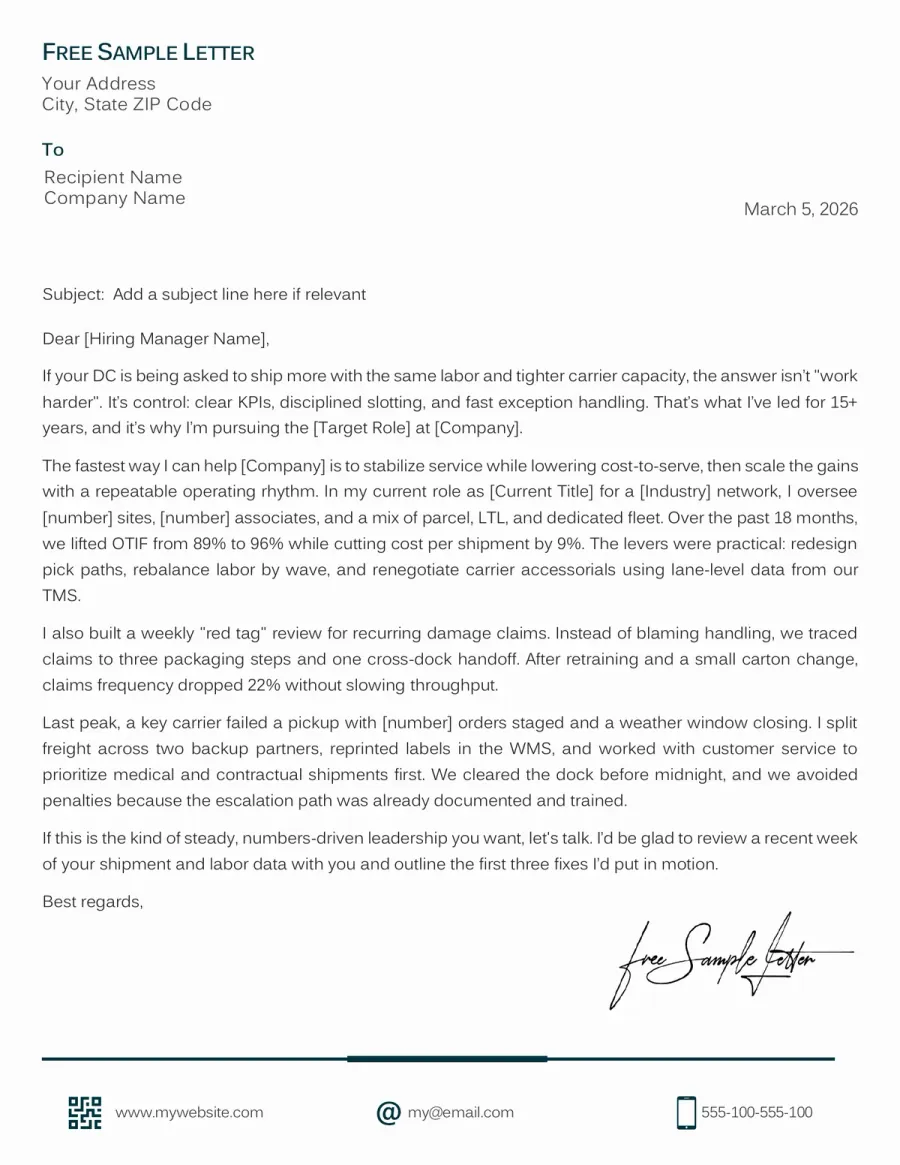
If your DC is being asked to ship more with the same labor and tighter carrier capacity, the answer isn’t “work harder.” It’s control: clear KPIs, disciplined slotting, and fast exception handling. That’s what I’ve led for 15+ years, and it’s why I’m pursuing the [Target Role] at [Company].
The fastest way I can help [Company] is to stabilize service while lowering cost-to-serve, then scale the gains with a repeatable operating rhythm. In my current role as [Current Title] for a [Industry] network, I oversee [number] sites, [number] associates, and a mix of parcel, LTL, and dedicated fleet. Over the past 18 months, we lifted OTIF from 89% to 96% while cutting cost per shipment by 9%. The levers were practical: redesign pick paths, rebalance labor by wave, and renegotiate carrier accessorials using lane-level data from our TMS.
I also built a weekly “red tag” review for recurring damage claims. Instead of blaming handling, we traced claims to three packaging steps and one cross-dock handoff. After retraining and a small carton change, claims frequency dropped 22% without slowing throughput.
Last peak, a key carrier failed a pickup with [number] orders staged and a weather window closing. I split freight across two backup partners, reprinted labels in the WMS, and worked with customer service to prioritize medical and contractual shipments first. We cleared the dock before midnight, and we avoided penalties because the escalation path was already documented and trained.
If this is the kind of steady, numbers-driven leadership you want, let’s talk. I’d be glad to review a recent week of your shipment and labor data with you and outline the first three fixes I’d put in motion.
Best regards,
[Your Name]
Reviewed by Olivia B., HR Consultant
I trust this candidate because the KPIs are tied to levers, not slogans. The peak-season recovery scene also shows leadership under pressure.
Logistics Internship Cover Letter Sample (Warehouse Operations)
This logistics intern sample proves you can be useful on the floor: receiving checks, barcode work, simple KPI tracking, and a small staging mistake fixed before it became a late truck.
Dear [Hiring Manager Name],
A logistics internship is only valuable if the intern contributes by day three, not week six. I’m applying for the [Internship Title] with your logistics team because I enjoy the mix of shop-floor reality and accurate data that keeps a warehouse running well.
I have trained on the operational basics: receiving checks, barcode scanning, location discipline, and cycle counts. In a recent placement at [Company/School Lab], I used a demo WMS to process inbound ASNs, flag discrepancies, and update putaway locations. To keep my work reliable, I always take two steps before closing a task: reconcile the physical count with the system, then log exceptions with a photo, timestamp, and SKU so the next shift has the information they need.
I’m also diligent about the small tasks that maintain service levels. I built an Excel tracker to monitor late inbound deliveries against expected dates and shared a daily list with my supervisor so we could re-sequence picks and avoid last-minute surprises. On a busy afternoon, a shipment for [Customer/Store] was missing two cartons. Instead of sending it through, I checked the packing list, traced the carton ID in the scan history, and found it staged in the wrong lane. We corrected the label, and the truck left on time.
If you need an intern who can support WMS work, handle basic KPI reporting (on-time shipping, picking accuracy), and communicate clearly with floor leads, I’m ready to contribute. I’d appreciate the chance to discuss what your team considers a “good week” in this role, and then align my first tasks to meet that standard.
Kind regards,
[Your Name]
Reviewed by Olivia B., HR Consultant
The tone is simple and practical, and the proof is specific. It’s a solid internship application because it focuses on reliable execution.
Logistics Manager Template Preview (Word/PDF Download)
This preview of the logistics and supply chain manager cover letter template lets you review the layout and wording before downloading the Word or PDF version. Use it to select the sample that best matches your role, responsibilities, and KPIs.
Turn the Samples Into Your Own Application Letters
Copy-pasting leads to rejected logistics cover letters. Personalize the template by adding your scope, KPIs, systems, and a real exception you’ve handled. That way, the letter will reflect your actual operation - not just a generic supply chain summary.
➡️ More expert guidance in our article how to write a cover letter recruiters actually skim
Lock the target role and scope
Expert tip: Mirror the job posting, then define your scope in a single line - mention sites, volume, lanes, or SKU count. Hiring managers want to see the scale you manage before evaluating the rest of your experience.
See an example
At [Company], I supported a [number]-dock site shipping [number] orders/day across parcel and LTL, coordinating daily cut-offs with [Carrier/TMS].
Replace duties with KPI-backed proof
Choose two KPIs that matter in logistics, such as OTIF, cost per shipment, or inventory accuracy, and connect each to a specific action you took. If you can’t show measurable improvement, refine your claim to what you can genuinely support.
See Reveal a KPI rewrite
Improved OTIF from [number]% to [number]% by resetting pick waves, tightening scan compliance in [WMS], and running a daily exception log for late inbound.
Add one real exception-handling scene
Add a brief two-sentence example: what went wrong, what you did, and what stayed on track. Logistics leaders look for calm operators who can manage issues under pressure, not just flawless planners.
See Picture it
A trailer arrived short-labeled at 4:45 p.m. I cross-checked the ASN, quarantined the pallet, and re-slotted picks so the truck still left on time.
Name the tools and handoffs you run
Be specific about the systems and handoffs you manage: name the WMS, TMS, or ERP, mention carrier portals, cycle counts, and who you coordinate with daily. Specific tools carry more weight than broad claims and help ATS systems match your resume quickly.
See Try this line
I work daily in [WMS] and [TMS], pull lane reports for carrier scorecards, and sync with [Procurement/Customer Service] on ETAs and backorders.
Close with a next step tied to ops
Close with a practical next step instead of a generic closing. For example, offer to walk through your first-week metrics or suggest reviewing a real lane or KPI challenge from their network.
See Open a stronger closing
If useful, I can bring a one-page KPI snapshot (OTIF, claims, cost-to-serve) and map the first three friction points I’d tackle at [Company].
Keyword Radar: Logistics & Supply Chain Signals Recruiters Spot Fast
- TMS
- Inventory turns
- Cycle counting
- Slotting plan
- 3PL coordination
- Carrier scorecards
- Cost-to-serve
- Wave planning
- OTIF
- ASN reconciliation
- Safety stock logic
- Lead time drift
- S&OP cadence with bias and constraints
- Dock
- Lane-level cost analysis
- Damage claims triage
- Accessorial fees control
- Incoterms basics
- Customs documentation
- Cold chain handling
- Pick/pack accuracy
Do & Don’t: What Makes a Logistics Cover Letter Instantly Credible
Recruiters look for operational substance: your scope, the KPIs you’ve improved, and the systems you truly use. They also pay attention to how you discuss late trucks, shortages, and trade-offs. Use concrete examples, not polished generalities.
Why a supply chain application gets skipped fast
Red Flags- Hide your scope (sites, volume, lanes, SKU count) and expect trust
- List responsibilities without outcomes or a KPI shift
- Name-drop WMS/TMS/ERP you can’t actually operate
- Overclaim “optimized the supply chain” with no lever or constraint
- Write like a project summary and ignore dock/dispatch realities
What recruiters trust in supply chain cover letters
Trust Signals- State your footprint clearly: people, sites, throughput, or network type
- Tie each win to a lever: slotting, waves, scan discipline, carrier terms, SOPs
- Name the systems you use daily and what you pull from them (reports, scorecards)
- Use plain operational language that matches how the floor talks
- Close with a next step: review one lane issue, one KPI trend, one weekly cadence
FAQ - Logistics Manager Cover Letter
How do I mention OTIF or savings if I can’t share exact numbers? Toggle answer
Use ranges, percentages, or “direction + lever.” Example: “Raised OTIF by high single digits by tightening wave planning and scan compliance.” It reads real without exposing confidential data.
Should I describe a late delivery or shortage issue? Toggle answer
Yes, if you frame it as control. One short scene is enough: what broke, what you prioritized, what stayed on track. Don’t blame partners. Show decisions and communication.
Which tools matter most (WMS, TMS, ERP) and how do I avoid stuffing? Toggle answer
Name only what you actually touch, then state the output: “pulled carrier scorecards,” “closed cycle count variances,” “tracked exception log.” One tool line beats a shopping list.
Coordinator to manager: how do I prove leadership without inflating my title? Toggle answer
Anchor leadership in behaviors: running the daily cut-off huddle, setting priorities, tightening an SOP, training a new hire, owning the exception log. That’s management in real life.
Vendor/carrier negotiation without disclosing rates? Toggle answer
Talk in outcomes and constraints: reduced accessorials, improved tender acceptance, stabilized lead times, protected service during peak. Mention the method (lane-level review, bid refresh, claim dispute process).
Build a Logistics Manager Cover Letter that Sounds Operational
Start by stating your footprint (sites, volume, lanes, SKU count), then prove impact with 2 KPI moves (OTIF, cost-to-serve, inventory accuracy) and one short exception-handling moment. Fatal mistake: listing “responsibilities” with no levers, no numbers and no real-world constraint.
Hiring teams also assess your decision-making. A strong supply chain manager cover letter demonstrates real trade-offs (such as service versus cost), clear handoffs (with ops, procurement, or customer service), and a straightforward operating rhythm you’d introduce in your first week. Quiet credibility always outweighs big claims.