
Restaurant Manager Cover Letter Examples Recruiters Trust in 2026
Turn your busiest shifts into proof points. Use these restaurant manager cover letter examples to highlight your control over staffing, cost management, and guest recovery, then close with a next step that feels natural to recruiters.
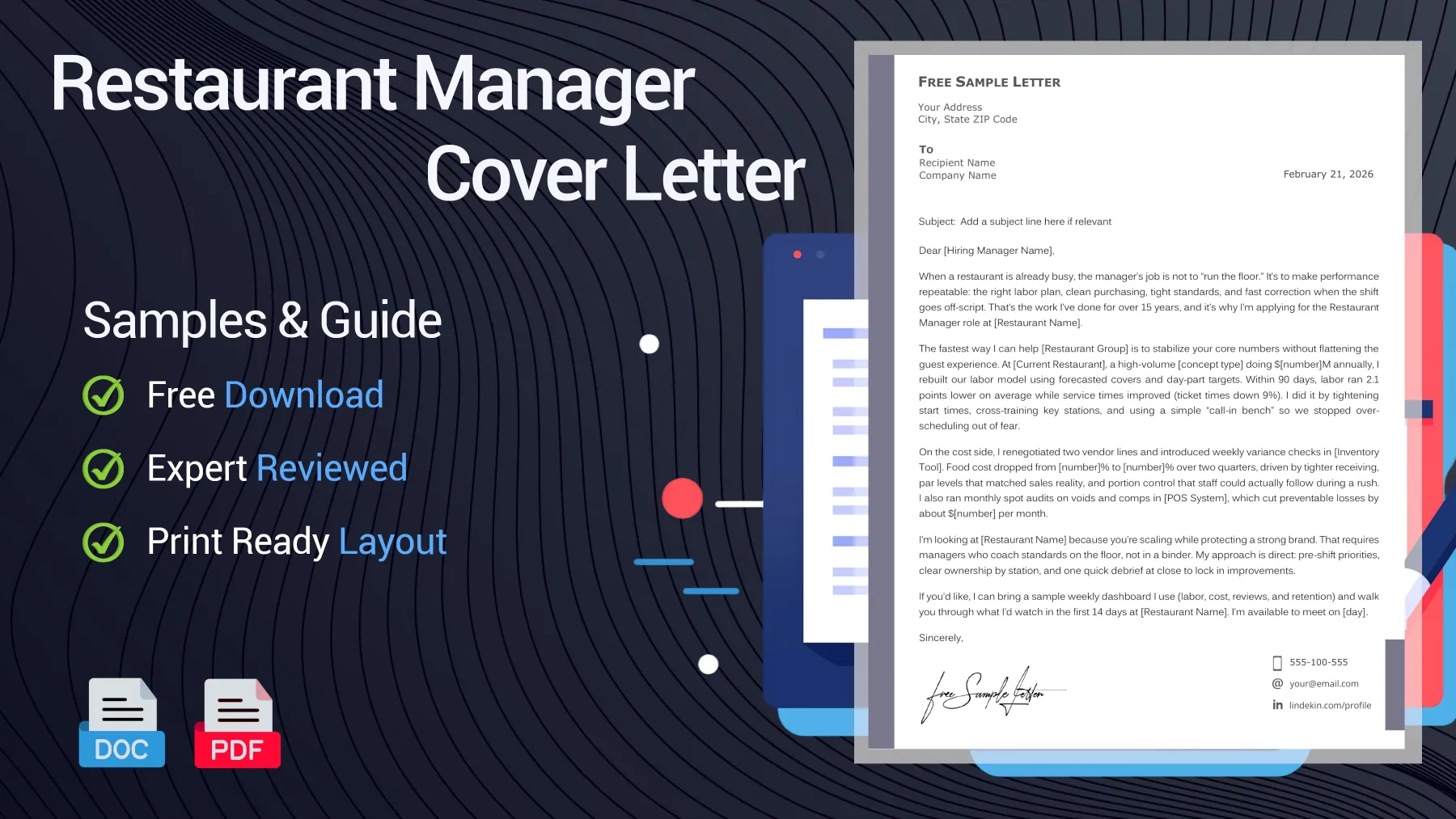
Free Samples of Food Service Manager Application Letters
BLS reports a $65,310 median wage for food service managers (May 2024) and about 42,000 openings per year projected for 2024-2034. BLS OOH. Expert interpretation: prove you can stabilize labor, food cost, and guest recovery under pressure.
First-Time Restaurant Manager Cover Letter Sample (Internal Promotion)
Use this sample if you’re stepping into your first restaurant manager title. It turns day-to-day assistant manager wins into evidence on staffing, costs, and service recovery.
Dear [Hiring Manager Name],
The best restaurant managers I’ve worked with do three things well: they protect the guest experience, support their team’s energy, and keep the numbers on track. I’ve practiced all three as an assistant manager, and I’m ready to take full responsibility as Restaurant Manager for [Restaurant Name].
At [Current Restaurant], I’m the person servers turn to when a shift starts to drift. I monitor service flow in [POS System], adjust the floor plan when walk-ins spike, and step in early on complaints to keep tables from walking. Last quarter, I launched a simple “two-touch” recovery - greet the guest within two minutes, then follow up after the replacement dish arrives. Negative reviews fell from [number] to [number] per month, and more guests began mentioning staff by name in their feedback.
I also built a training rhythm that doesn’t depend on who’s available. New hires follow a three-day map - menu basics, steps of service, and safety - plus a short close-out checklist for consistent cash-outs and side work. This reduced missed side duties and cut re-training time for new servers by about [number] hours per person.
If you’re looking for a manager with ten years in the title, that isn’t me yet. What I bring is the habit of running each shift like a system: pre-shift notes, line checks, clear call-outs, and a schedule based on forecasted covers - not guesswork. I’m comfortable enforcing standards, but just as willing to jump in when the dining room needs hands-on help.
I’d welcome a conversation about your busiest service windows and how you approach staffing gaps. If you have 15 minutes, I’m available [day] morning or [day] afternoon.
Sincerely,
[Your Name]

Reviewed by James R., Hiring Manager
I like that it admits the candidate isn’t a ten-year manager yet, then backs readiness with shift controls and a guest recovery method I can actually measure.
Senior Restaurant Manager Cover Letter Sample
Use this sample if you’re an experienced restaurant manager moving to a new group. It highlights repeatable results: labor points, food cost variance, and tighter loss control.
Dear [Hiring Manager Name],
When a restaurant is already busy, the manager’s job isn’t just to “run the floor” - it’s to make strong performance repeatable: setting the right labor plan, keeping purchasing clean, holding tight standards, and making fast corrections when the shift goes off-script. That’s what I’ve done for over 15 years, and it’s why I’m applying for the Restaurant Manager role at [Restaurant Name].
The fastest way I can help [Restaurant Group] is by stabilizing your core numbers without sacrificing the guest experience. At [Current Restaurant], a high-volume [concept type] with $[number]M in annual sales, I rebuilt our labor model around forecasted covers and day-part targets. Within 90 days, labor ran 2.1 points lower on average and service times improved (ticket times down 9%). I achieved this by tightening start times, cross-training key stations, and introducing a simple “call-in bench” to avoid over-scheduling.
On the cost side, I renegotiated two vendor contracts and added weekly variance checks in [Inventory Tool]. Food cost dropped from [number]% to [number]% over two quarters, thanks to tighter receiving, realistic par levels, and portion control that worked even during peak hours. I also ran monthly spot audits on voids and comps in [POS System], which cut preventable losses by about $[number] each month.
I’m interested in [Restaurant Name] because you’re growing while maintaining a strong brand. That calls for managers who coach standards on the floor - not just from a binder. My approach is straightforward: set pre-shift priorities, assign clear ownership by station, and lead a quick debrief at close to lock in improvements.
If you’re interested, I can share a sample weekly dashboard I use - covering labor, cost, reviews, and retention - and walk you through what I’d monitor in my first 14 days at [Restaurant Name]. I’m available to meet on [day] or [day].
Sincerely,
[Your Name]
Reviewed by James R., Hiring Manager
What stands out is the balance: tighter costs and better service timing, plus a clear coaching approach on the floor. That’s the mix I want to test in interview.
Career Change Restaurant Manager Cover Letter Sample
For a mid-career professional switching into restaurant management. This application letter explains the break, then proves readiness with FOH pacing, safety, and a clean process.
Dear [Hiring Manager Name],
You can usually spot a well-managed operation before the first plate hits the table: stations are set, roles are clear, and the manager is already watching ticket times and pacing. I’m moving into restaurant leadership after a mid-career reset, and I’m applying for the Restaurant Manager role at [Restaurant Name] because I build repeatable systems that hold up under real pressure.
For the past [number] years, I managed a [Retail Brand] location with [number]+ employees, weekly inventory cycles, and strict compliance checks. I left that sector intentionally - I wanted a service business where the product is delivered live, in front of the guest, every night. Over the last [number] months, I completed [Food Safety Certification] and a hands-on practicum at [Training Restaurant/Program], focusing on FOH pacing, bar controls, and kitchen-floor communication during shifts.
I ensure quality by running a simple operating cadence: pre-shift priorities in writing, quick line checks (temps, labels, pars), two table-touch rounds per service, and a close-out review of voids, comps, and cash handling in [POS System]. On my practicum team, this routine reduced missed side work and improved close accuracy, while giving staff clearer support during the rush.
My strongest transferable skill is staffing discipline. In retail, I reduced last-minute call-outs by building a fair rotation and keeping a trained “coverage list.” In restaurants, I use the same approach - day-part forecasts and cross-training - so one absence doesn’t disrupt the entire service. I’m comfortable with difficult conversations, because standards only stick when they’re coached consistently.
If you’re open to it, I’d like to discuss how you handle your busiest windows and where you feel the most pressure - whether it’s labor, ticket times, or guest recovery. I’m available on [day] or [day], and can meet at [Restaurant Name] outside of service hours.
Sincerely,
[Your Name]
Reviewed by James R., Hiring Manager
I respect how clearly the career change is framed, then backed with restaurant-specific routines and training. It reduces my risk without overselling the jump.
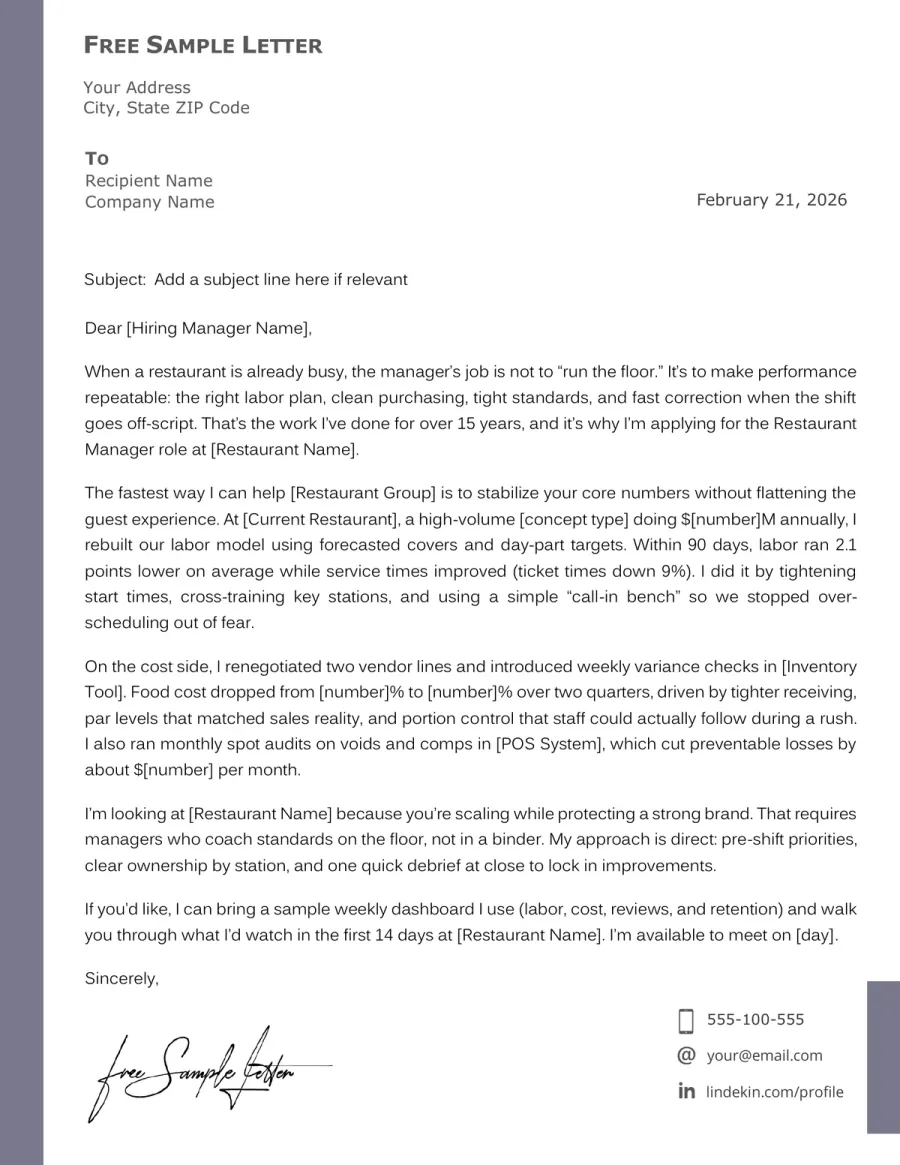
Preview the Restaurant Manager Cover Letter Template Before Download (Word/ PDF)
Preview this restaurant manager cover letter template before downloading the editable Word or PDF version. This makes it faster to tailor your application letter for your needs.
Customize the Restaurant Manager Cover Letter Samples, Step by Step
Copy-paste letters sound like background noise in restaurant hiring. Keep the structure, but replace every generic line with your actual shift achievements: covers, labor percentages, food cost solutions, POS pacing decisions, and one guest recovery moment that shows your judgment.
➡️ More expert guidance in our practical method to tailor a cover letter to the job posting
Match the concept and volume
Before editing, name the concept, service style, and volume you manage. Connect your opening to a real pressure point you solve - like weekend staffing gaps, ticket-time delays, or guest recovery moments.
See Open a mini example
At [Restaurant Name], your Friday rush is the test. I keep pace by forecasting covers, adjusting sections in [POS], and fixing issues at the table before they hit reviews.
Prove labor and scheduling control
Swap out broad leadership claims for a concrete scheduling win. Show how you forecast covers, manage call-outs, and protect labor percentages without overworking your team. One clear number is enough if you can explain it.
See a staffing snippet
I rebuilt the rota in [Scheduling Tool] around daypart targets and a small on-call bench. In six weeks, overtime fell 18% and weekends ran fully covered without panic hires.
Show cost control without sounding corporate
Include a cost-control action that fits real restaurant operations: portion checks, disciplined receiving, reviewing voids/comps, or managing vendor credits. Hiring managers want someone who spots losses during service - not after.
See Show a cost line
Using [Inventory Tool], I tracked high-variance items and tightened portion steps on steaks and spirits. Waste dropped by $[number]/month, and supplier credits became routine, not a fight.
Add a micro-scene, not a slogan
Skip generic claims like “great customer service.” Instead, share a two-line moment from a rush - such as a complaint, a quick refire, pacing, or a table touch. Recruiters remember these scenes because they reveal your judgment under pressure.
See Show a 2-line scene
When a VIP party arrived early, I paused seating, rebalanced sections, and ran food for ten minutes. The room never felt the squeeze, and ticket times stabilized.
Close with a next step that fits restaurants
Avoid ending with a polite cliché. Offer a practical next step: suggest sharing a 30-day plan, a quick overview of your labor model, or how you train shift leads. This feels genuine and signals confidence.
See Open a closing line
If helpful, I can share a one-page 30-day plan for [Restaurant Name] covering staffing coverage, service rhythm, and the two numbers I track daily. Can we talk on [day]?
Restaurant Manager Keyword Radar - What Gets Picked Up Fast
- High-volume weekend pacing decisions
- HACCP
- Coach side work without drama
- Service recovery on the floor
- Health inspection readiness
- Cut waste
- Food cost variance
- P&L
- Cash handling and close accuracy
- Void and comp audits
- Cross-train FOH to cover call-outs
- Toast/MICROS POS
- Inventory cycle counts (MarginEdge/xtraCHEF)
- Labor
- Pre-shift huddle and station ownership
- Guest complaints
Do & Don't - What Restaurant Manager Cover Letters Signal to Recruiters
Recruiters read restaurant manager letters like shift reports: they look for evidence of control, good judgment, and reliable routines. Vague leadership phrases get ignored; concrete actions on staffing, costs, POS pacing, and hygiene standards build trust.
Signs Your Application Letter Reads Generic
Red Flags- Lead with generic leadership claims and no shift reality
- Copy duties from the job ad without adding outcomes
- Drop big numbers you cannot explain in one sentence
- Skip labor, scheduling, or call-out coverage entirely
- Name tools you have never used on a real shift
- Sound corporate and distant from the dining room
Proof Points Recruiters Actually Believe
Trust Signals- Open with one pressure point you control during service
- Tie labor decisions to forecasted covers and dayparts
- Show one cost habit that prevents leaks every week
- Include a tight guest recovery moment with the outcome
- Describe how you train and hold standards on the floor
- Signal calm authority by naming what you do first in chaos
FAQ - Restaurant Manager Cover Letter
Should I mention labor % and food cost? Toggle answer
Yes, but keep it focused: use one number plus the action that drove the result. Example: “Cut overtime 18% by rebuilding schedules around forecasted covers and cross-training closers.” Don’t just list KPIs - show how you protect margins while maintaining smooth service.
I didn’t own the full P&L - what metrics can I use? Toggle answer
Use metrics you actually influenced: overtime hours, voids/comps you audited, waste logs, ticket-time improvements, review rating changes, table turns, turnover reduction, or training hours saved. One credible metric is better than five vague ones.
How do I prove guest recovery without sounding like I give away comps? Toggle answer
Show judgment, not just generosity. Describe a brief scene: what went wrong, how you fixed it, your follow-up, and what you changed to prevent it from happening again. Mention comps only if they’re part of a standard and a real correction.
Should I mention ServSafe/HACCP or inspection readiness? Toggle answer
If the job mentions compliance or safety, include it. Frame it as a daily habit - checking temperatures, labeling, keeping logs, doing line checks, and following receiving standards. Certifications help, but your routines count more. Make it sound like part of your shift rhythm, not just a credential.
Short tenures are common - how do I address them? Toggle answer
State the reason briefly (seasonal closure, ownership change, relocation), then focus on the results you delivered during that time. Your restaurant manager cover letter should read like you stabilize things: “Here’s what I fixed fast, here’s what stayed fixed.”
TL;DR - Restaurant manager cover letter move that gets interviews
Your restaurant manager cover letter has one job: prove you can control a shift and protect the numbers without hurting the guest experience. Lead with one real pressure moment, back it with staffing or cost discipline, and show a clean service-recovery judgment call. Fatal mistake: hiding behind “leadership” language with zero operational proof.
The best signal is repeatability. Recruiters trust managers who describe routines: forecasted scheduling, comps/void audits, line checks, and coaching on the floor. One credible metric plus one micro-scene beats ten polished adjectives, because it reads like someone who’s already running the room.