
Restaurant Hostess Cover Letter Examples That Work in 2026
A strong restaurant hostess cover letter should read like a shift plan. These samples show how to reference the tools you use (like OpenTable or waitlist systems), the pace you can manage, and the handoffs that keep service running smoothly - all backed by concrete proof, not just adjectives.
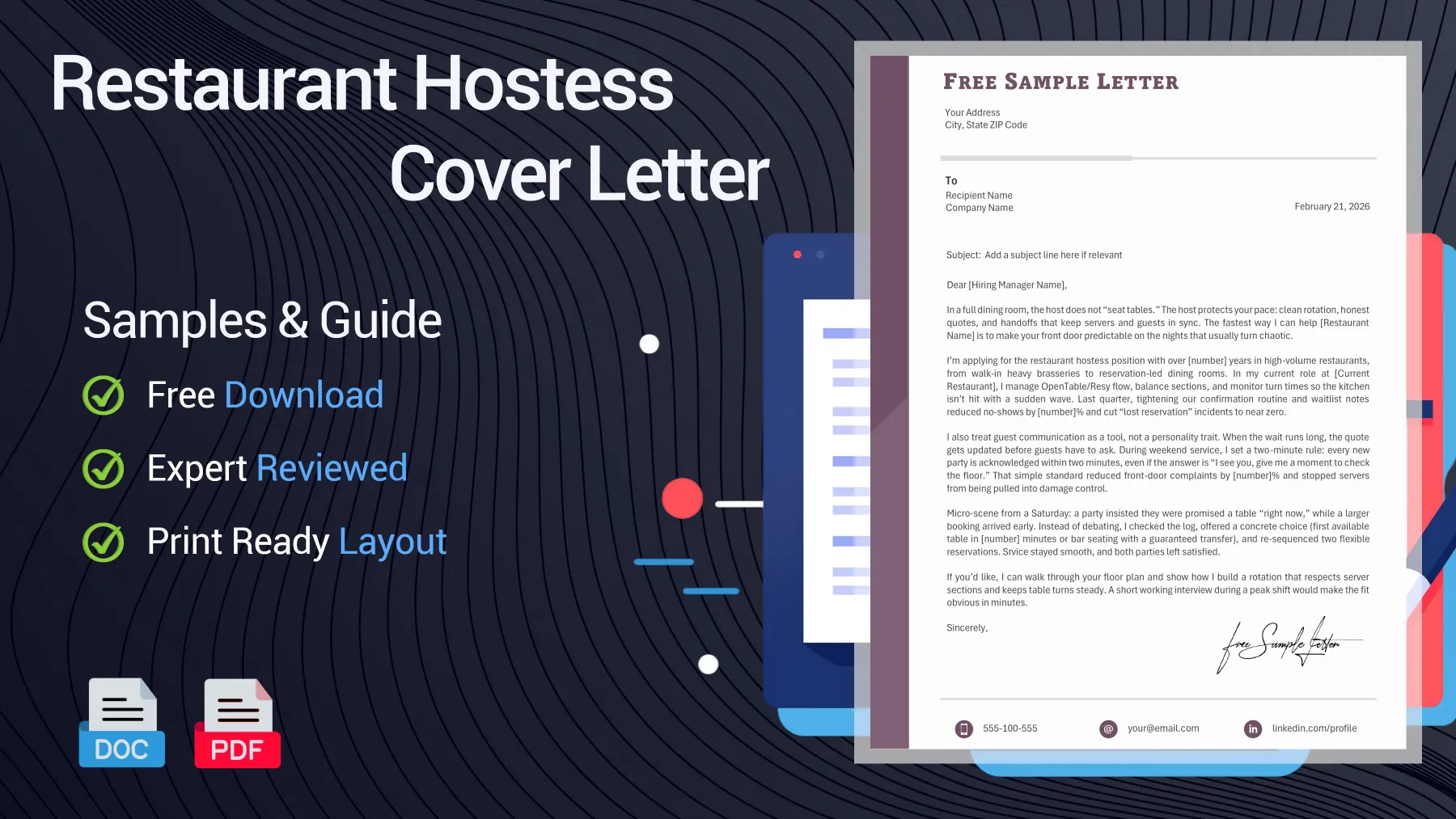
Free Samples of Restaurant Hostess Application Letters
BLS counts 429,900 host/hostess jobs in 2024 and a $14.61 median hourly wage (May 2024). BLS OOH Expert interpretation: your cover letter must prove waitlist control and clean reservation handoffs, not just a friendly vibe.
Entry-Level Restaurant Hostess Cover Letter (No Experience)
Ideal if you have no direct hostess job yet: it shows how to manage a queue, answer phones, and protect the waitlist while sounding human and grounded in a busy restaurant setting.
Dear [Hiring Manager Name],
On a busy night, the host stand becomes the control tower. When the line grows and the phone keeps ringing, guests judge the restaurant by how calm and clear the welcome is. That’s the part of the job I’m ready to take on at [Restaurant Name].
I’m applying for the restaurant hostess position as an entry-level candidate. Although I haven’t held this exact title, I’ve faced the same pressure points in customer-facing roles where timing and tone matter. At [Current Workplace], I handle walk-ins, manage phone requests, and keep the queue moving even when teammates are busy elsewhere. I introduced a consistent “next up” script and started tracking peak times on a notepad. That simple routine reduced repeat questions and kept the line steady.
Quick example: a group of [number] arrived early for a reservation, already frustrated. I acknowledged them, provided a clear time estimate, and offered two options - bar seating right away or a table in [number] minutes. While they decided, I checked the floor with the shift lead and adjusted two flexible parties. No one felt skipped, and the group ended up staying for dessert.
I also treat reservations as a commitment. At [School/Volunteer Event], I managed check-in for about [number] guests and prevented double-seating by confirming names, party size, and special notes before sending anyone to the room. If [Restaurant Name] uses OpenTable or Resy, I’ll adapt quickly - the process is the same: accurate notes, clean handoffs, and steady pacing.
If helpful, I’m available to stop by before service this week for a quick hello and a walk-through of your seating flow, or to do a short trial shift so you can see how I manage a waitlist under pressure.
Sincerely,
[Your Name]

Reviewed by James R., Hiring Manager
The ending feels real: a quick pre-service walk-through or trial shift, tied to the seating flow and waitlist. That’s how I’d validate a new host fast in a busy room.
Senior Restaurant Hostess Cover Letter
Designed for a senior restaurant hostess: it leads with results, uses a clear pivot line, and proves control of OpenTable/Resy flow, rotations, and guest communication in rush hours.
Dear [Hiring Manager Name],
In a full dining room, the host does not “seat tables.” The host protects your pace: clean rotation, honest quotes, and handoffs that keep servers and guests in sync. The fastest way I can help [Restaurant Name] is to make your front door predictable on the nights that usually turn chaotic.
I’m applying for the restaurant hostess position with over [number] years in high-volume restaurants, from walk-in-heavy brasseries to reservation-led dining rooms. In my current role at [Current Restaurant], I manage OpenTable/Resy flow, balance sections, and monitor turn times so the kitchen isn’t hit with a sudden wave. Last quarter, tightening our confirmation routine and waitlist notes reduced no-shows by [number]% and cut “lost reservation” incidents to near zero.
I also treat guest communication as a tool, not a personality trait. When the wait runs long, the quote gets updated before guests have to ask. During weekend service, I set a two-minute rule: every new party is acknowledged within two minutes, even if the answer is “I see you, give me a moment to check the floor.” That simple standard reduced front-door complaints by [number]% and stopped servers from being pulled into damage control.
Micro-scene from a Saturday: a party insisted they were promised a table “right now,” while a larger booking arrived early. Instead of debating, I checked the log, offered a concrete choice (first available table in [number] minutes or bar seating with a guaranteed transfer), and re-sequenced two flexible reservations. Service stayed smooth, and both parties left satisfied.
If you’d like, I can walk through your floor plan and show how I build a rotation that respects server sections and keeps table turns steady. A short working interview during a peak shift would quickly show if it’s a good fit.
Sincerely,
[Your Name]
Reviewed by James R., Hiring Manager
I trust this one because it leads with outcomes: no-show reduction, fewer front-door complaints, and a crisp pivot line about making the door predictable on rush nights.
Hospitality Student Restaurant Hostess Cover Letter (Internship)
Made for a hospitality student seeking an internship/part-time role: it proves you can keep reservations accurate, learn tools fast, and use a repeatable method to avoid double-booking.
Dear [Hiring Manager Name],
Most host stands fall apart for one reason: information gets lost between the phone, the waitlist, and the floor. As a hospitality student seeking an internship or part-time role, I’m applying for the restaurant hostess position at [Restaurant Name] because I want hands-on service responsibility - not just observation.
In my program at [School Name], we run live service in a training restaurant with real guests. During recent shifts, my responsibility has been reservations and arrival control: confirming party size, noting allergies, keeping the seating order clear, and relaying changes to the floor lead. I keep my work accurate by following a simple routine: repeat the name and time to the guest, jot a quick note (needs, timing, contact), and verify table status before escorting. This approach prevented double-bookings during a [number]-cover service and kept timing consistent, even when arrivals stacked up.
Outside of school, I’ve handled guest-facing pressure at [Part-Time Job], where speed and clarity are essential. When queues formed, I used quick triage questions and made the order visible to reduce disputes. It’s the same skill a restaurant hostess needs: keep the door calm so the dining room can do its job.
I’m comfortable learning your tools quickly. Whether you use OpenTable, Resy, or a phone-first system, the goal stays the same: clean notes, honest quotes, and smooth handoffs for the servers. I’m available for [days/times], including weekends - where I know I’ll learn the most.
Could we schedule a short conversation and, if it makes sense, a trial shift? I’d like to walk through your reservation rules and show you how I keep the host stand organized when things get busy.
Sincerely,
[Your Name]
Reviewed by James R., Hiring Manager
Availability is clear, and the close asks for a trial shift. For an internship/part-time hire, that mix of reliability, method, and calm is what I screen for first.
Preview the Template Before You Download (Word/PDF)
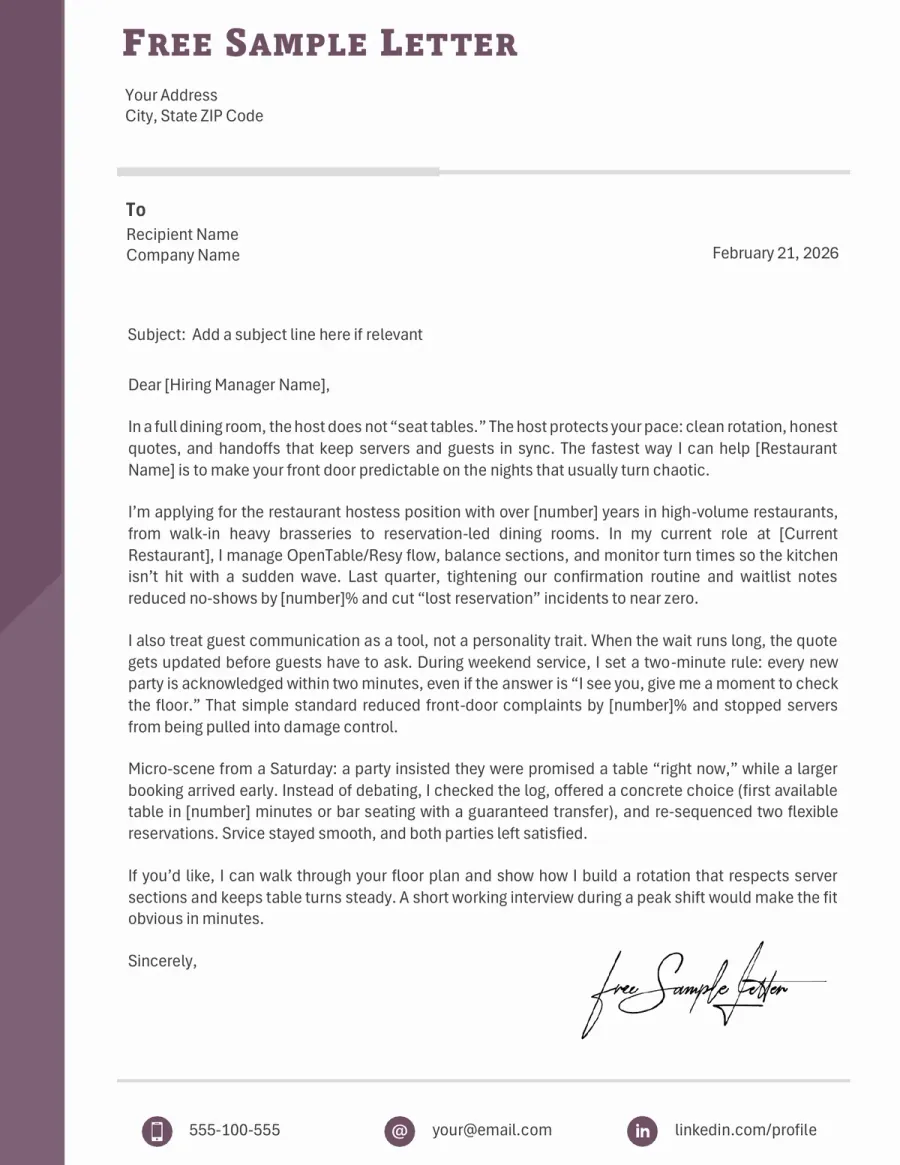
Below is a quick preview of the restaurant hostess cover letter template, available as an editable Word file and a print-ready PDF.
Make These Samples Yours in 5 Steps
Copy-paste letters are the fastest way to be overlooked. Replace the placeholders with your actual venue type, real peak-hour examples, and your host-stand routine (like quoting times, waitlist notes, or allergy tags), so your letter reads like a real shift - not just a template.
➡️ For more expert guidance, see our article on how to write a cover letter that gets interviews
Set the room in one line
Start by naming the dining room and service style (such as fine dining, casual, or brunch rush), along with the volume you typically handle. A single, focused line sets expectations for your pace, reservation handling, and how you manage guest flow at the door.
See an example
At [Restaurant Name], weekends mean [number] covers and a steady stream of walk-ins, so I keep quote times honest, tag reservations, and keep the waitlist clean from the first hello.
Swap traits for proof
Choose two specific examples from your shifts and make them concrete: covers handled, average quoted wait, fewer no-shows, or reduced seating disputes. Mention the tool or routine behind each (like Resy tags, call-backs, or table turns).
See an example
I added a confirmation text call-back routine in [Tool], cutting no-shows by [number]% and reducing double-seats because every party had the same note format at the stand.
Show your host-stand method
Write a concise line that demonstrates your process: how you quote times, update guests, balance sections, and hand off to servers. Hiring managers look for this kind of control, not just “people skills.”
See an example
I seat by rotation, not by pressure. I check table status, quote [number]-minute ranges, update at the halfway mark, then confirm the section with the server before I escort the party.
Match the voice to the brand
Match your letter’s tone to the restaurant’s brand. A hotel dining room expects polished and precise language; a casual spot values warmth and speed. Keep the structure, but adjust your voice and guest scenarios to fit.
See an example
For a fine-dining room, I write “I confirm allergy notes and coordinate discreet VIP seating.” For a brunch spot, I write “I keep families moving with clear quotes and stroller-friendly tables.”
Close with a practical next step
Close with a practical next step that fits the job - such as a short working interview, a pre-service walk-through, or a trial shift. Mention your availability window to make scheduling easy for the manager.
See an example
I can come in [day/time] to review your floor plan and run the stand for the first rush. You’ll see how I quote times, update guests, and hand off tables without slowing service.
Keyword Radar: What Recruiters Scan at the Host Stand
- OpenTable / Resy notes
- Waitlist
- Quote-time updates
- VIP seating coordination
- De-escalate walk-in disputes
- Table status checks
- Accurate reservation confirmation
- Pacing
- Balance sections to protect kitchen pacing
- Short, calm guest explanations
- Turn-time awareness
- Large-party timing and table resets
- Host stand handoff to servers
Do & Don’t: What a Restaurant Hostess Cover Letter Signals in 6 Seconds
Recruiters skim a restaurant hostess cover letter for signs of control under pressure: clear waitlist logic, honest quote times, accurate use of OpenTable or phone systems, and smooth handoffs to servers. If your letter reads like a generic friendly pitch, they’ll assume there’s chaos at the door.
Red Flags That Make Your Letter Look Generic
Red Flags- Open with a generic line that could fit any job.
- Claim you can multitask without showing your method at the stand.
- Ignore reservation tools and talk only about being friendly.
- Overpromise fine dining polish if your experience is casual-only.
- Leave out availability for evenings, weekends, or high-traffic shifts.
Trust Signals That Make You Seat-Ready
Trust Signals- Name the venue context and service pace in the first paragraph.
- Mention the system you can run (OpenTable, Resy, phone-first).
- Explain how you balance sections to protect servers and the kitchen.
- Reference clean notes: allergies, celebrations, VIP tags, special requests.
- Close with a practical test: trial shift, working interview, walk-through.
Standard: FAQ - Restaurant Hostess Cover Letter
Should I name OpenTable/Resy in my restaurant hostess cover letter? Toggle answer
Mention OpenTable or Resy only if you’ve actually used them. If not, don’t pretend - describe your own system: logging guest notes, confirming parties, quoting wait times, and keeping rotation fair. Add a line such as: “Ready to learn [System] quickly, since I already run the host stand by process.”
What does “control the door” mean in practice? Toggle answer
It means the entrance stays calm even when the dining room is packed. Prove it with a specific example: you updated a [number]-minute quote, offered bar seating, kept the waitlist accurate, and answered phones without losing track. That shows real host-stand control.
How do I write about long waits without blaming guests or the kitchen? Toggle answer
Use neutral language and reset expectations early: “When delays happen, I provide a realistic range, update guests at the halfway point, and confirm table status before seating.” Add a concrete outcome, like fewer walk-outs or fewer arguments, so it feels earned - not just like a slogan.
Should I mention section rotation and pacing? Toggle answer
Yes - one sentence is enough. For example: “I seat by rotation and table status, not by pressure at the door.” This shows you understand throughput, server workload, and kitchen pacing, which is what separates a greeter from a reliable host.
Fine dining only: how do I show polish if I’ve only done casual? Toggle answer
Don’t claim luxury experience you don’t have. Instead, translate your actual behaviors: discreet greetings, clear allergy notes, quiet coordination with servers, and calm problem-solving. Add a specific detail, like handling VIP notes, special occasions, or coat-check flow. Believable always beats exaggerated.
TL;DR - Make your restaurant hostess cover letter feel like a real shift
A restaurant hostess cover letter only works if it shows you can actually run the door: honest wait quotes, accurate waitlist notes, and seating decisions that respect section balance. Include one example of handling pressure and one clear process. The fatal mistake is writing a “friendly people-person” letter with zero host-stand proof.
Hiring managers look for restraint and control. Anyone can greet; few can de-escalate a tense situation without making it worse. Make your communication visible - delay updates, allergy or VIP notes, and handoffs to servers - so your letter reads like a safe hire before they even open your resume.