
Seasonal Food Service Job Cover Letter Examples Recruiters Trust in 2026
Seasonal hiring moves quickly, and managers often make decisions after a brief skim. Use these food service cover letter examples to highlight your availability, ability to keep pace, and guest-handling skills with one concise story from a real shift. Copy, customize, and send.
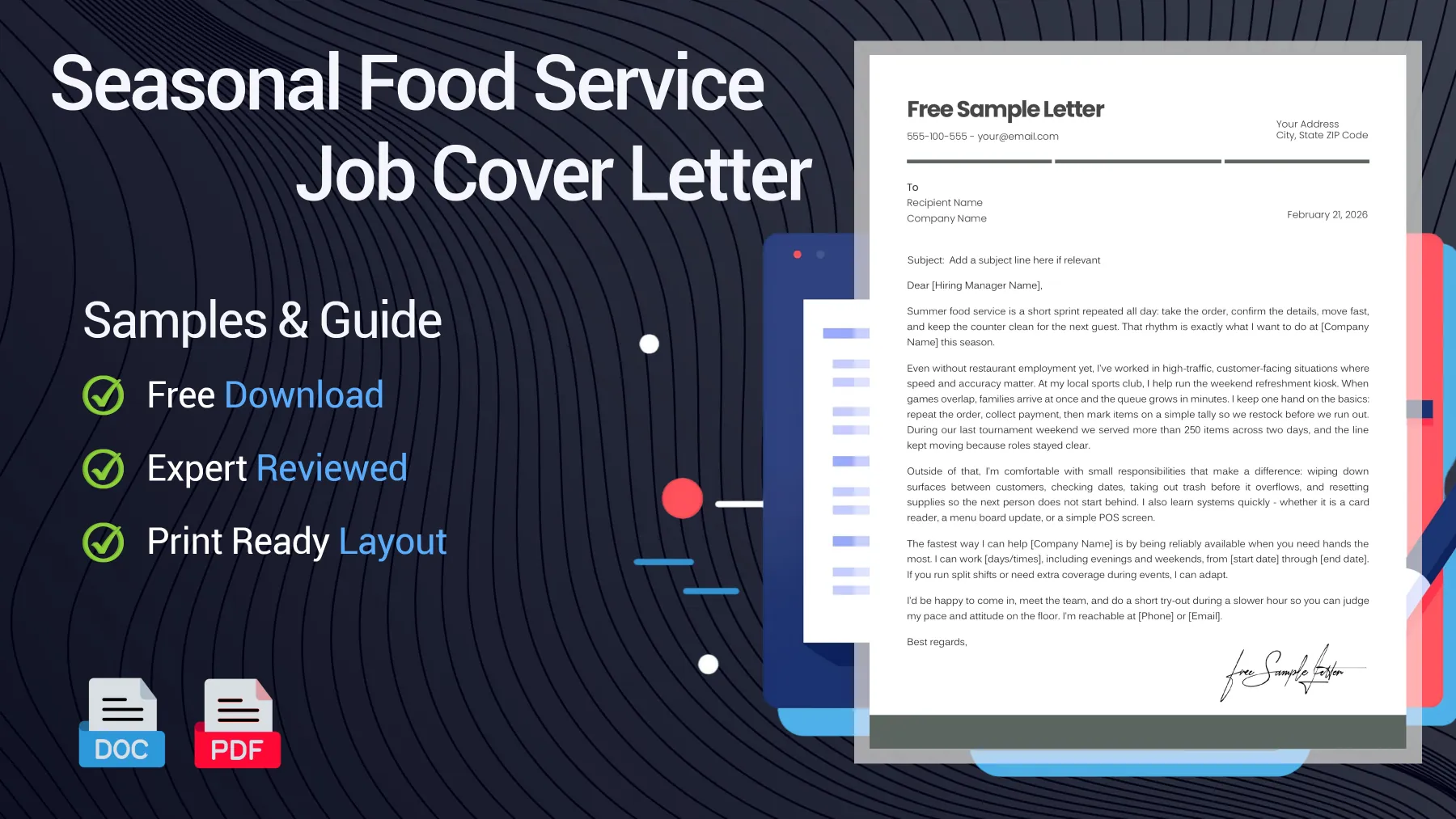
Free Samples of Seasonal Food Service Application Letters
The BLS Occupational Outlook Handbook projects food and beverage serving roles to grow 5% from 2024 to 2034, with about 1,159,600 openings per year. Much of this work is seasonal. What this means: managers skim applications quickly, so show your exact availability and provide proof you can keep pace, follow food safety basics, and stay calm when tickets pile up during peak weeks.
Entry-Level Student - Seasonal Food Service Cover Letter (Summer Hire)
Built for an entry-level student applying to a seasonal food service job: it proves availability, customer handling, and calm under pressure with a real shift scene.
Dear [Hiring Manager Name],
Summer food service is a fast-paced sprint: take the order, confirm the details, move quickly, and keep the counter ready for the next guest. That’s the rhythm I want to bring to [Company Name] this season.
Though I haven’t worked in a restaurant yet, I’ve handled busy, customer-facing situations where speed and accuracy count. At my local sports club, I help run the weekend refreshment kiosk. When games overlap, families arrive all at once and the line grows fast. I stick to the basics: repeat the order, collect payment, and track items on a tally so we restock before running out. During our last tournament weekend, we served over 250 items in two days, and the line kept moving because everyone knew their role.
I’m also comfortable with the small tasks that keep things running: wiping down surfaces between customers, checking dates, taking out trash before it overflows, and resetting supplies so the next shift starts ready. I pick up new systems quickly - whether it’s a card reader, menu board update, or simple POS screen.
The fastest way I can help [Company Name] is by being available exactly when you need extra hands. I can work [days/times], including evenings and weekends, from [start date] to [end date]. If you run split shifts or need extra coverage for events, I can fill in.
I’d be glad to come in, meet the team, and do a short trial during a slower hour so you can see my pace and attitude on the floor. You can reach me at [Phone] or [Email].
Best regards,
[Your Name]

Reviewed by James R., Hiring Manager
The closing suggests a short try-out, which is realistic for seasonal hiring. It reads confident without overselling prior experience.
Experienced Server - Seasonal Food Service Cover Letter for Peak Weeks
Use this sample if you have years of high-volume food service. It highlights rush-hour numbers, POS discipline, add-on sales, and quick onboarding support for summer teams.
Dear [Hiring Manager Name],
When a summer patio fills up in ten minutes, the difference between smooth service and chaos isn’t charisma - it’s precision. I’m applying for your Seasonal Food Service role because I’ve spent years maintaining that precision when tickets stack up.
Last August at [Previous Employer], a six-top flagged me down mid-rush: one guest had a nut allergy, and their dish arrived with the wrong garnish. Instead of debating at the table, I pulled the plate, walked the ticket straight to the expo, and re-fired it with a clear allergy note. While the kitchen worked, I reset drinks, offered a quick alternative, and kept the rest of the table moving. The meal landed right, the section stayed on pace, and the manager did not have to jump in.
I bring that same approach to the basics: orders go into [Toast / Square / Micros] right the first time, modifiers are confirmed out loud, checks are split accurately, and cash drops always match. My sections typically handle 50-70 covers during peak hours, and I keep turn times tight by pre-bussing early and staying in sync with runners and bartenders.
Seasonal teams also need someone who can help new hires get up to speed. I coach by example: how to carry a tray safely, where to stand to avoid blocking the line, what to prep before the rush, and how to close a station so the next shift starts ready. On my last contract, that approach helped two first-time servers handle full sections within two weeks.
I can start on [start date] and work [days/times], including weekends and late nights. If you have a busy service coming up, I’d rather show my pace on the floor than just describe it - a short trial shift would be ideal.
Sincerely,
[Your Name]
Reviewed by James R., Hiring Manager
Specific operations details matter here: covers, pre-bussing, POS cleanliness, cash drops. That reads like a real floor professional.
Concession Stand or Festival Counter Seasonal Food Service Cover Letter
Use this template if your job is counter service at a stadium, festival, or theme park. It turns your experience into proof of queue control, clean tickets, and quick restocking when the POS never stops.
Dear [Hiring Manager Name],
When a stadium line jumps from five people to fifty in one song, guests want two things: the right order and a quick handoff. I’m comfortable in that rhythm and want to bring it to [Event Venue / Company Name] this season at your concession stands.
Last season at [Previous Venue], I ran a high-volume kiosk selling [menu items]. One Saturday night, our card reader froze during the rush and the line wrapped into the walkway. I quickly opened a cash-only lane, called out totals clearly, had my teammate pre-stage bags and napkins, and we cleared about [number] transactions in [number] minutes while keeping the drawer balanced at close.
I keep accuracy tight because small mistakes add up fast at the counter. On the POS, I repeat orders back, flag allergy notes, and pause to double-check before hitting confirm. This reduces voids and keeps the kitchen from having to re-fire tickets. I also restock popular items before peak times and call out low inventory early, so we’re not improvising in front of guests.
You’ll get a teammate who handles the unglamorous jobs without needing to be asked. I wipe surfaces between waves, swap gloves when tasks change, and reset the station so the next person can step in ready. If a guest is frustrated, I keep it brief and helpful, then get the order back on track.
I’m available [days/times] from [start date] to [end date], including evenings and weekends. If you’re moving quickly on hiring, I’d be glad to do a short call and a paid trial shift during a slower period so you can see my pace and register accuracy on your setup.
Sincerely,
[Your Name]
Reviewed by James R., Hiring Manager
I like how it stays practical: speed, drawer balance, station resets, and allergy notes. The paid trial shift close feels confident and easy to schedule in-season.
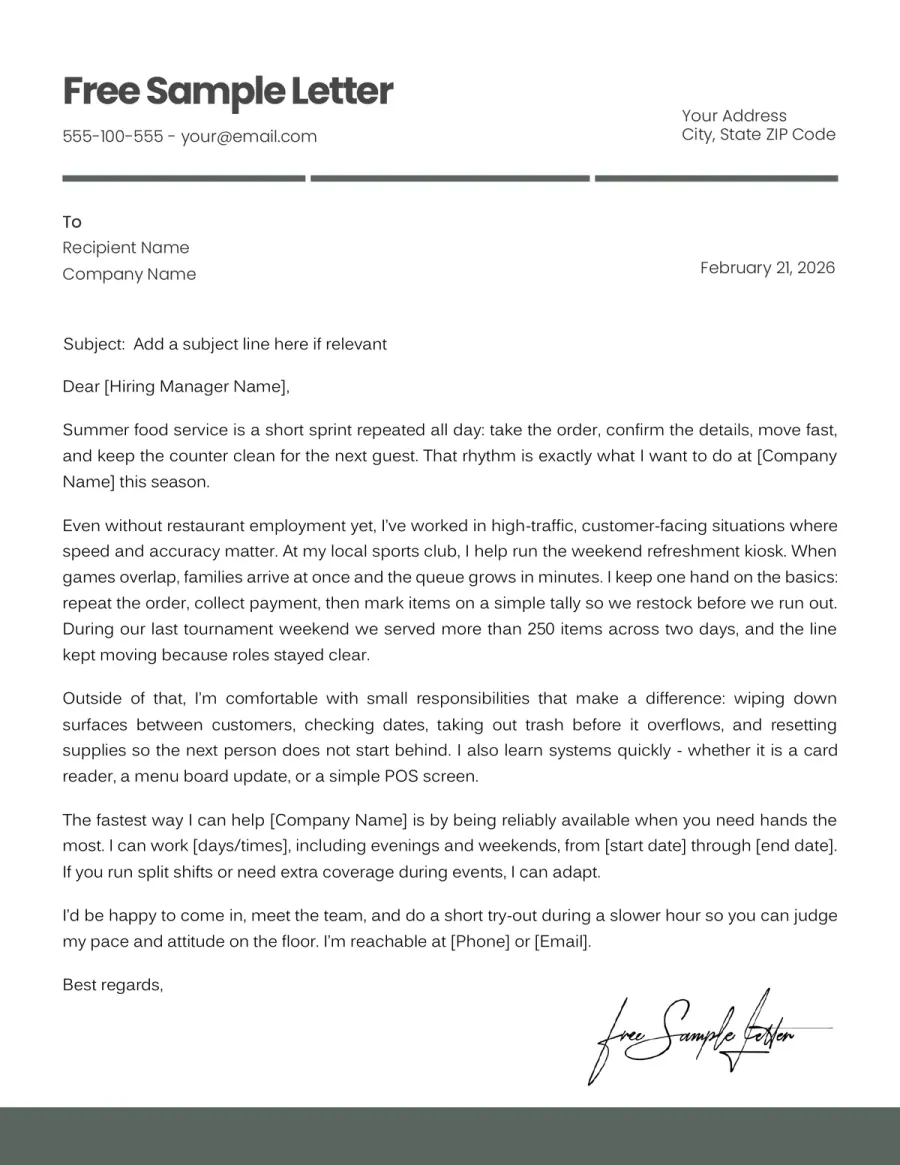
Template Preview Before Download (Word + PDF)
This preview lets you see your seasonal food service job cover letter template before downloading. Download it as a Word document for quick edits or as a PDF for a clean, ready-to-print version.
Tailor the Samples for Your Next Seasonal Shift
Copy-paste applications are easy to spot in seasonal food service. Instead, update your letter with your actual availability, one real shift story, and the specific tools you used (POS, prep, closing). Match the restaurant’s atmosphere - whether it’s counter service, patio, or resort - and managers will see you as ready to work.
➡️ More expert guidance in our article how to write a cover letter hiring managers skim and still remember
Match the posting and lock your dates
Start by matching the job posting: use the exact job title, then clearly state your start and end dates, weekly hours, and availability for weekend or evening shifts. Seasonal managers hire to fill specific coverage needs, not vague intentions.
See an example
I’m available from [start date] to [end date], can work [days], and I can cover doubles during event weekends. I’m happy on early prep shifts and late closes when the patio line spikes.
Swap in one real proof moment
Swap out generic claims for one specific moment from work, school, or volunteering, like handling a line, ensuring order accuracy, or resolving a guest issue. Two sentences are enough if you show what you did and the result.
See an example
When the queue doubled after a game, I split orders into cash and card lanes, repeated modifiers aloud, and we cleared 40 guests in 20 minutes with zero remakes, then reset the station before the next wave.
Name the tools and standards you actually use
Seasonal teams value hires who require little extra training. Mention the tools you’ve used (Toast, Square, Micros) and the standards you follow: hand washing, allergen call-outs, date labeling, and clean-as-you-go routines. Be concrete.
See what to include
I enter orders in [POS], repeat modifiers back, and I mark allergy tickets clearly. Between rushes, I wipe surfaces, restock lids and napkins, and check label dates using FIFO so prep stays safe.
Match the venue voice and teamwork reality
Adjust your tone to fit the venue: a resort wants calm professionalism, a concession stand values speed, and a diner appreciates friendly clarity. Include one line about how you communicate with the kitchen, runners, or bartenders during busy times.
See an example
On a full patio, I call back tickets to the expo, flag allergy items, and pre-bus early so table turns stay smooth. If the kitchen is backed up, I update guests before they have to ask.
Close with a practical next step
End your letter with a practical next step, like offering a quick phone call, interview, or paid trial shift during a slower period. Restate your best availability line to leave it top of mind.
See an example
If you’re hiring for [week], I can come in Tuesday afternoon for a quick chat and stay for a short trial on the floor. You’ll see my pace, POS accuracy, and station reset habits right away.
The Hiring Manager Scan: Seasonal Food Service Signals
- FIFO
- Weekend availability
- Cash handling and end-of-shift count
- Toast / Square / Micros familiarity
- Expo communication during peak service
- Guest recovery when an order is wrong
- Upsell
- Food handler card / ServSafe basics
- Modifiers and allergy notes entered correctly
- Counter line speed with polite clarity
- Restock lids, napkins, cups before rush
- Split checks, no confusion at payment
- Team-first help: run drinks, run food
- Quiet resets between rush windows
- Show up on time, every shift
Do & Don't: Seasonal Food Service Letters Managers Trust Fast
Seasonal hiring moves quickly. Managers look for proof that you keep tickets accurate, follow food safety, and remain polite under pressure. Mention your POS habits and how you reset during busy hours. If your letter hides your availability or sounds generic, they’ll assume you need extra training and move on.
Red Flags That Make You Look Like Extra Training
Red Flags- Hide your start and end dates
- Use vague lines instead of one real shift moment
- Overclaim experience that the letter can’t back up
- Skip food safety basics (allergens, clean station)
- Make it all about needing money or tips
- Ignore POS accuracy and order modifiers
Trust Signals That Say “Ready for the Rush”
Trust Signals- State your availability window in one clean line
- Use one short scene that proves pace under pressure
- Name the POS you’ve used or how you learn it fast
- Mention allergen call-outs and clean-as-you-go resets
- Describe how you help the team during rush (run, pre-bus, restock)
- Close by offering a quick call or a short trial shift
FAQ - Seasonal Food Service Job Cover Letter
Do restaurants actually read cover letters for seasonal food service roles? Toggle answer
If the posting requests a cover letter, you should include one. Even when optional, a short cover letter can set you apart from applications with nothing extra. Keep it brief: state your availability, provide one real proof you can work quickly, and include a line that demonstrates your clean work habits.
Where do I put my availability so it gets noticed? Toggle answer
Include your availability in the first third of your letter and repeat it near the end. Be specific: “Available [date] to [date], nights/weekends, and can cover event weekends.” Seasonal hiring is about scheduling - make their decision easy.
Should I mention a planned vacation or blackout dates? Toggle answer
If your planned time off falls during peak weeks, mention it briefly near the end of your letter with one clear line and the dates, no explanation or apology needed. If it’s flexible or later in the season, save it for the interview so it doesn’t become the focus of your application.
No restaurant experience - what proof works? Toggle answer
Use a specific scene from any fast-paced environment: a concession stand, retail rush, school event, or volunteer kiosk. Describe what you did (split lines, repeated orders, fixed a mistake, restocked) and the result (the line moved, fewer errors). That shows your skills transfer to food service.
What food-safety or allergen lines actually help? Toggle answer
One or two concrete examples work best: “I flag allergens clearly, repeat modifiers, and reset the station between rushes (wipe, restock, glove change).” This shows you prevent remakes, avoid kitchen friction, and keep service predictable.
TL;DR - Seasonal food service cover letter playbook
A seasonal food service cover letter wins when it answers three questions fast: when you can work (exact dates), whether you can handle rush rhythm, and whether you keep orders clean (modifiers, allergens, POS discipline). Fatal mistake: hiding availability or writing a generic “customer service” paragraph.
What actually reassures a manager is predictability. A simple work process (repeat the order, send clean tickets, reset the station) reads like someone who won’t slow the team down in week one. If you have a preplanned break, state it once with dates and move on - clarity beats surprises.