
Apprentice Commis Chef Cover Letter Examples That Get Interviews in 2026
Chefs hire apprentices who keep stations clean, follow specifications, and remain calm under pressure. Use our 2026 Apprentice Commis Chef cover letter samples to demonstrate those habits with concrete examples.
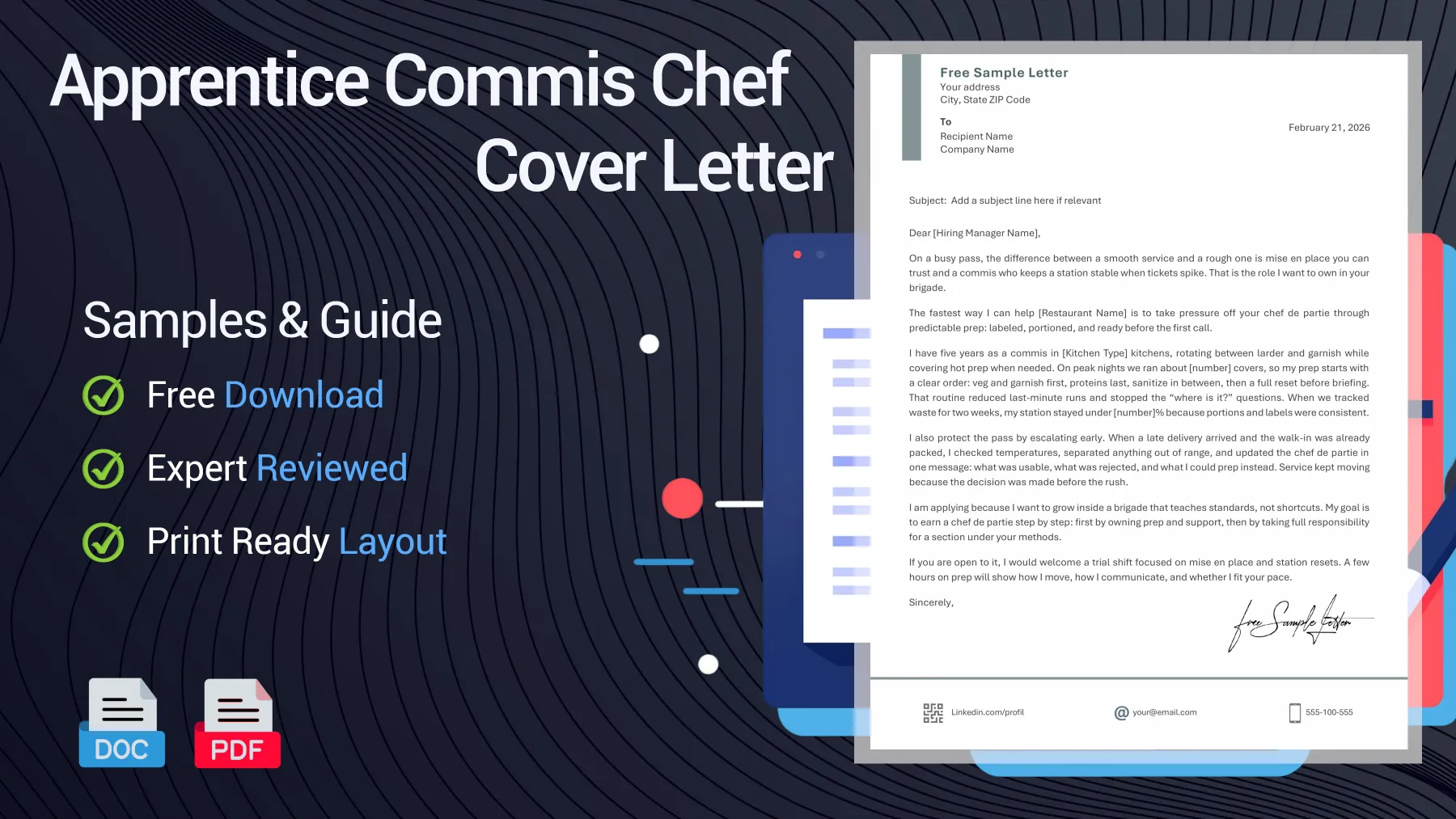
Free Samples of Application Letters for Apprentice Commis Chef
According to BLS (2024-34 outlook), cook positions are projected to grow 5% from 2024 to 2034, with approximately 432,200 openings each year. In a volume-driven hiring market, you need to prove day-one basics: mise en place, hygiene, and working at pace.
Entry-Level Apprentice Commis Chef Cover Letter Sample (No Experience)
Made for a junior entry-level candidate with no paid kitchen role. It shows training service work, hygiene routines, and mise en place habits chefs trust in an apprentice commis chef letter.
Dear [Hiring Manager Name],
When prep is clean, the whole line works better. I want to earn my place in your kitchen by keeping my station predictable: labeled, stocked, and ready before the rush.
My kitchen experience comes from [Culinary School / Training Program] rather than a paid commis role, so I rely on habits, not titles. I keep a written prep checklist, follow FIFO without shortcuts, and log temperatures for chilled items during training. On assessment days, I plan my tasks to avoid blocking others: veg first, proteins last, sanitize in between, then reset the board and knives. I practice knife cuts to spec and weigh ingredients for consistent portions.
If you are concerned a junior apprentice might slow the team, here’s how I avoid that: I ask a question once, write down the standard, and repeat it the same way the next day. When a sauce split during lab service, I didn’t hide it - I flagged it early, restarted with measured heat, and kept the batch small until it held. The chef saw the correction, not just the mistake.
I’m applying to [Restaurant Name] because your menu values discipline over flash. That’s the kind of kitchen where I learn fastest: clear specs, clear timing, and a chef who values consistency.
I’d welcome a short stage focused on prep and cleaning. If my station is where it should be after [number] hours, we’ll both know if this is a good fit.
Sincerely,
[Your Name]

Reviewed by James R., Hiring Manager
I trust this because it admits the lack of paid experience, then replaces it with specific habits that reduce errors on a real station.
Experienced Cook Apprentice Commis Chef Cover Letter Example
Designed for a commis chef applying to a structured brigade. It turns station ownership, mise en place discipline, and service support into proof of readiness for a chef de partie track.
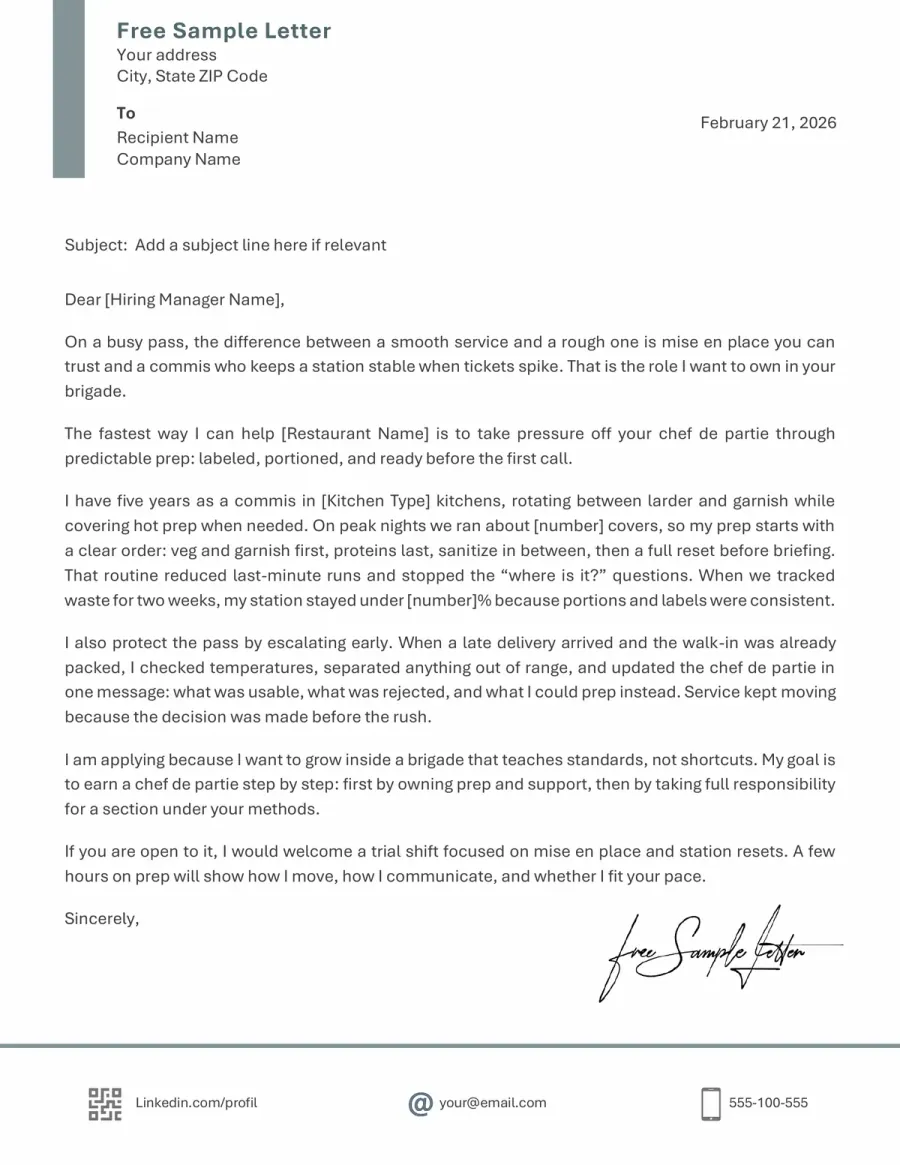
Dear [Hiring Manager Name],
On a busy pass, the difference between a smooth service and a rough one is mise en place you can trust and a commis who keeps the station steady when tickets spike. That’s the role I want to own in your brigade.
The quickest way I can help [Restaurant Name] is by taking pressure off your chef de partie with reliable prep: labeled, portioned, and ready before the first call.
I have five years’ experience as a commis in [Kitchen Type] kitchens, rotating between larder and garnish and covering hot prep when needed. On peak nights, we ran about [number] covers. My prep always follows a clear order: veg and garnish first, proteins last, sanitize in between, then a full reset before briefing. That routine cut down last-minute runs and stopped the “where is it?” questions. When we tracked waste for two weeks, my station stayed under [number]% because my portions and labels were consistent.
I also protect the pass by escalating issues early. When a late delivery arrived and the walk-in was already full, I checked temperatures, separated anything out of range, and updated the chef de partie in a single message: what was usable, what was rejected, and what I could prep instead. Service kept moving because the decision was made before the rush.
I’m applying because I want to grow in a brigade that teaches standards, not shortcuts. My goal is to earn a chef de partie role step by step: first by mastering prep and support, then by taking full responsibility for a section under your methods.
If you’re open to it, I’d welcome a trial shift focused on mise en place and station resets. A few hours on prep will show you how I work, how I communicate, and whether I fit your pace.
Sincerely,
[Your Name]
Reviewed by James R., Hiring Manager
The letter sells growth without entitlement; I see a commis who wants stronger standards and will take direction to reach chef de partie.
Culinary Student Internship Cover Letter for Apprentice Commis Chef
For a culinary student on a training internship, this sample shows quick learning and safe execution. It focuses on prep support, cleanliness, and listening under real service pressure.
Dear [Hiring Manager Name],
A good internship isn’t about watching. It’s about doing the unglamorous work right, every time, so the kitchen moves faster. That’s the kind of internship I’m looking for at [Restaurant Name] as part of my [Culinary School / Training Program] placement.
During training service, I’ve learned how to stay useful without getting in the way. I set up my station early, confirm the prep list, and keep my hands on the next task, not on my phone. I follow standards the first time: glove changes as needed, boards separated, labels clear, and a quick sanitize between raw and ready-to-eat prep.
One moment from my last stage showed me what “calm” really means. A delivery arrived while we were plating. The sous chef asked me to check and store it. I verified temperatures, labeled everything, and put items away in the correct zones without blocking the line. When I came back, the pass hadn’t slowed, and the chef knew the delivery was handled.
I’m ready to help with basic but critical work: peeling and chopping to size, weighing ingredients, portioning, and keeping garnish and sauces stocked. I reset my station before switching tasks, so the next person isn’t cleaning up after me. I take notes on specs so I don’t ask the same question twice.
If you’re open to it, I’d like a short trial shift during prep time. You’ll see how I move around the kitchen, keep my bench clean, and pick up your mise en place standards quickly.
Sincerely,
[Your Name]
Reviewed by James R., Hiring Manager
The letter signals respect for standards (boards, gloves, labels) without sounding like a textbook, which is rare at student level.
Preview the Cover Letter Template Before You Download (Word/PDF)
Preview these Apprentice Commis Chef cover letter templates before downloading. Each sample is available in Word and PDF, making it easy to edit quickly and maintain clean formatting.
Turn These Samples Into Your Own Letters
Copy-pasting a generic kitchen letter is easy for recruiters to spot. Keep the structure, but personalize it with your own station details, menu references, and proof points - such as prep routines, hygiene habits, and work pace - so it reads like your real shift notes.
➡️ More expert guidance in our article how to write a cover letter for a fast-paced job application
Target the kitchen you want
Look for three clues in the job post or menu: style, volume, and prep routines. Use their language once, then anchor your opening paragraph to what the kitchen needs during service.
See an example
At [Restaurant Name], speed matters as much as cleanliness. I’m applying to support prep and keep the line steady - labeled mise en place, quick resets, and calm handovers when tickets stack up.
Swap adjectives for proof
Choose two proof points: one success during prep and one during service. If possible, include a metric (covers, waste, timing). Place these examples in the middle paragraphs so the chef sees your value quickly.
See an example
I prepped [number] portions of veg to spec before briefing, labeled trays by allergen, and we started service on time. On a busy night, I kept my station stocked so no one left the line.
Add food-safety signals recruiters scan for
Include two or three food safety signals chefs look for: FIFO, labeling, allergen separation, temperature checks. Briefly mention them, then show how you apply these standards under pressure.
See an example
I label every container with date and allergens, keep raw and ready-to-eat tools separate, and log chilled temps in training. When service hits, I don’t skip steps - I shorten the batch.
Align tone with your profile
Match your tone to your experience level. Juniors should emphasize their willingness to learn and reliability; more experienced candidates should explain why they want the apprenticeship and how they take direction without ego.
See an example
Choosing an apprenticeship is deliberate. I want your standards and feedback loop, so I’m happy to run prep to spec, take notes, and repeat your method until it becomes automatic.
Close with a practical next step
Close with a practical next step that fits the kitchen environment: suggest a short trial prep shift, a stage, or a quick conversation after service. Reference a specific time or prep hours to make it feel genuine.
See an example
If you’re open to it, I’d love a two-hour prep trial this week. You’ll see how I move, reset, and label, and I’ll learn your standards before we talk start dates.
Keyword Radar: What Chefs and ATS Scan First
- Basic stocks and sauces prep
- FIFO
- Clean-as-you-go resets
- Prep list discipline
- Cold section support
- Portioning to spec
- Temperature checks for chilled prep
- Plating support during ticket rush
- Allergen labels
- Garnish rebuild to exact cut size
- Hotel banqueting pace and volume
- Sanitize between raw and ready-to-eat
- Weekend availability and early prep starts
Do & Don't - What Makes an Apprentice Commis Chef Letter Trusted
Kitchen recruiters treat your letter as a risk check. They look for signs you’ll protect standards under pressure - cleanliness, labeling, timing - and avoid candidates who show vague claims, disorganization, or unsafe habits.
What Makes an Apprenticeship Letter Feel Generic
Red Flags- Claim fine-dining mastery with no proof
- Describe “passion for food” instead of station habits
- Name tools and techniques you can’t explain in practice
- Sound defensive about being junior or being senior
- Promise creativity when the role needs consistency
What Makes Your Letter Feel Kitchen-Ready
Trust Signals- Name the station work you can support first
- Show one prep system you repeat every shift
- Describe a real service moment you handled calmly
- Mention 2-3 safety signals (FIFO, labels, separation)
- Prove you take direction: note it, repeat it, improve it
FAQ - Apprentice Commis Chef Cover Letter
Should I ask for a trial shift (stage) in my cover letter? Toggle answer
Yes, if you make it practical. Suggest a short prep-focused trial (1-3 hours) and what you’ll do: labeling, veg prep to spec, station reset. It reads like confidence, not begging.
I have no kitchen job yet - what proof can I use? Toggle answer
Use repeatable habits, not titles: clean-as-you-go, FIFO, labeling, allergen separation, and written prep lists. Add one real moment from training service where you kept standards under pressure.
Do chefs read cover letters, or is a CV enough? Toggle answer
Many recruiters skim quickly. Your letter needs to work as a risk check: “Will this person slow down the line or help protect standards?” Keep it short, concrete, and focused on how you operate. If the application requests a letter, always include one.
Should I mention food safety as an apprentice? Toggle answer
Yes, but make it practical. Mention two or three food safety signals (FIFO, allergen labels, chilled temperature checks) and show how you use them in action. One clear example is better than a long list of rules.
I’m coming from FOH/dishwashing - can that work? Toggle answer
Absolutely, if you translate it. Dishwashing shows pace and standards; FOH shows timing and communication. Link it to kitchen value: fast resets, clean stations, listening to calls, staying calm when tickets stack up.
TL;DR - Make Your Apprentice Commis Chef Cover Letter “Kitchen-Ready”
Your Apprentice Commis Chef cover letter only needs to prove three things: you protect hygiene, you keep mise en place predictable, and you don’t fall apart when service speeds up. The fatal mistake is writing a “passion for food” letter with zero station-level proof (labels, FIFO, allergens, resets).
Recruiters don’t hire hope - they hire low-risk behavior. One believable micro-scene (a prep problem solved calmly) plus a practical next step (a short prep trial) signals you understand how kitchens actually decide. That’s the difference between “nice applicant” and “useful on day one.”