
Team Manager Cover Letter Examples That Get Interviews in 2026
Hiring managers expect a Team Manager to balance effective coaching with performance management. These cover letter examples demonstrate how to address KPIs, scheduling, and conflict resolution with practical detail that reflects real team dynamics.
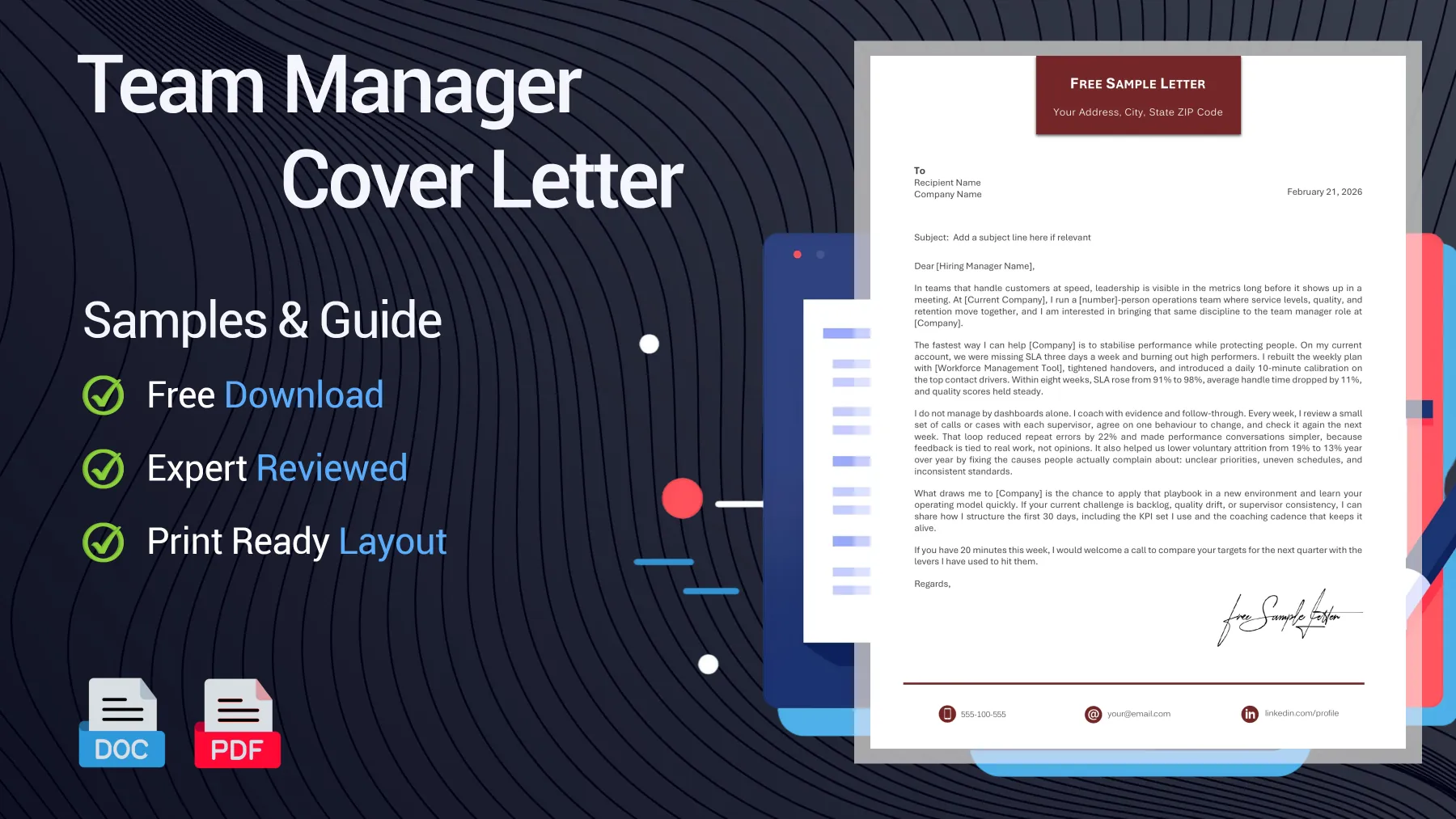
Free Samples of Team Manager Application Letters for People Management Roles
Gartner found that 74% of managers are not prepared to lead change (July 2024 survey of HR leaders). Gartner. What this means for your cover letter: show evidence of change leadership, effective coaching, and consistent KPI results.
First-Time Team Manager Cover Letter
Built for a first-time team manager stepping up after a strong team lead run. It proves you can coach, run shifts, and hit daily targets with calm, specific examples, even without years of management history.
Dear [Hiring Manager Name],
When a shift goes off track, people don’t need a speech - they need clear priorities, steady coaching, and decisions they can count on. That’s been my approach as a team lead at [Current Company], and it’s the same mindset I’d bring to the team manager role at [Company].
Last Friday illustrates this well: two callouts right at opening, the queue doubled within 20 minutes, and a new hire froze at the register. I quickly reassigned stations, ran a five-minute huddle, and paired the new hire with our fastest closer. We cleared the backlog before lunch and still hit our accuracy checks, because everyone knew the plan and escalation path.
Over the past [number] months, I’ve made performance easier to manage by making work visible. I built a simple daily scorecard in [Tool] to track staffing versus demand, top issues, and follow-ups from one-to-ones. Our on-time task completion increased from 82% to 94%, and we reduced end-of-day rework by 18% by addressing the same three root causes instead of firefighting new ones every shift.
I also coach in small, consistent steps. My weekly one-to-ones follow a simple structure: one win, one obstacle, one action for next week. This approach reduced late starts by 30% and improved customer feedback on service consistency, because expectations are discussed early and reinforced on the floor - not saved for a quarterly review.
If we speak, I’d be happy to walk you through how I plan the first 30 days: listening to the team, refining shift handover notes, and setting two KPIs the crew can actually influence. A 15-minute call next week is plenty to see if my approach fits what [Company] needs.
Regards,
[Your Name]

Reviewed by James R., Hiring Manager
I can picture the candidate on the floor making fast calls without drama. The coaching cadence feels real, and the KPIs are concrete, which tells me they can run a team, not just talk.
Experienced Team Manager Cover Letter (New Challenge)
Use this application letter when you are an experienced team manager moving to a new group or industry. It turns operational wins, retention work, and change delivery into proof recruiters trust.
Dear [Hiring Manager Name],
In fast-paced customer teams, leadership shows up in the numbers before it does in meetings. At [Current Company], I manage a [number]-person operations team where service levels, quality, and retention move together. I’m interested in bringing that same discipline to the team manager role at [Company].
The quickest way I can help [Company] is by stabilizing performance while supporting people. On my current account, we were missing SLA three days a week and risking burnout among top performers. I rebuilt the weekly plan with [Workforce Management Tool], improved handovers, and started a daily 10-minute calibration on the top contact drivers. Within eight weeks, SLA rose from 91% to 98%, average handle time dropped by 11%, and quality scores stayed steady.
I don’t manage by dashboards alone - I coach with evidence and follow-through. Each week, I review a small set of calls or cases with every supervisor, agree on one behavior to improve, and check in the following week. This loop reduced repeat errors by 22% and made performance conversations simpler, since feedback is tied to real work, not opinions. It also helped lower voluntary attrition from 19% to 13% year over year by fixing the issues people actually raise: unclear priorities, uneven schedules, and inconsistent standards.
I’m drawn to [Company] by the chance to apply that playbook in a new environment and learn your operating model quickly. If you’re facing challenges like backlog, quality drift, or supervisor consistency, I’d be glad to share how I approach the first 30 days - including the KPI set I use and the coaching cadence that keeps it on track.
If you have 20 minutes this week, I’d welcome a call to discuss your upcoming targets and the levers I’ve used to achieve them.
Regards,
[Your Name]
Reviewed by James R., Hiring Manager
Strong structure, no fluff, and the numbers are believable. I also appreciate the focus on protecting people while lifting performance, which is how mature managers think.
Internal Promotion Team Manager Cover Letter
Use this application letter if you are an internal candidate moving from team lead to team manager. It focuses on trust, cross-team coordination, and how you will support supervisors in the first weeks.
Dear [Hiring Manager Name],
When supervisors are stretched, the team looks for someone who can quickly remove friction and keep the day fair. For the past [number] years as a team lead in [Department] at [Company], I’ve been that person during the toughest shifts, and I’m ready to step up into the team manager role.
The best way I can support our department is by making leadership consistent across all shifts. Right now, I coordinate coverage when sick calls come in, handle escalations from customers or other departments, and reset priorities when the plan breaks. During our last peak period, I rebuilt the break and rotation plan to protect the busiest stations and keep output stable. Overtime hours dropped by 12% while throughput stayed on target, because we stopped relying on the same two people to carry the day. I also introduced an end-of-shift checklist that cut missed handover actions from [number] to [number] per week.
I also take coaching seriously, especially when performance varies. I run brief check-ins, document agreements in [Tool], and follow up on the floor, not just behind a desk. This approach helped one high-skill employee who was clashing with teammates: we agreed on clear behaviors, I observed two shifts, and the conflict resolved without any loss of productivity. The team noticed the improvement right away.
If promoted, I’ll focus on two things in the first month: clearer handovers and better supervisor alignment. I’d like to meet and hear where you want the biggest lift - quality, attendance, or training speed - and bring a draft staffing plan and coaching notes so we can stress-test them together.
Regards,
[Your Name]
Reviewed by James R., Hiring Manager
The letter proves readiness without politics. The pivot line, handover checklist, and supervisor alignment focus tell me this person can actually run the team.
Preview the Team Manager Cover Letter Template Before Downloading (Word/PDF)
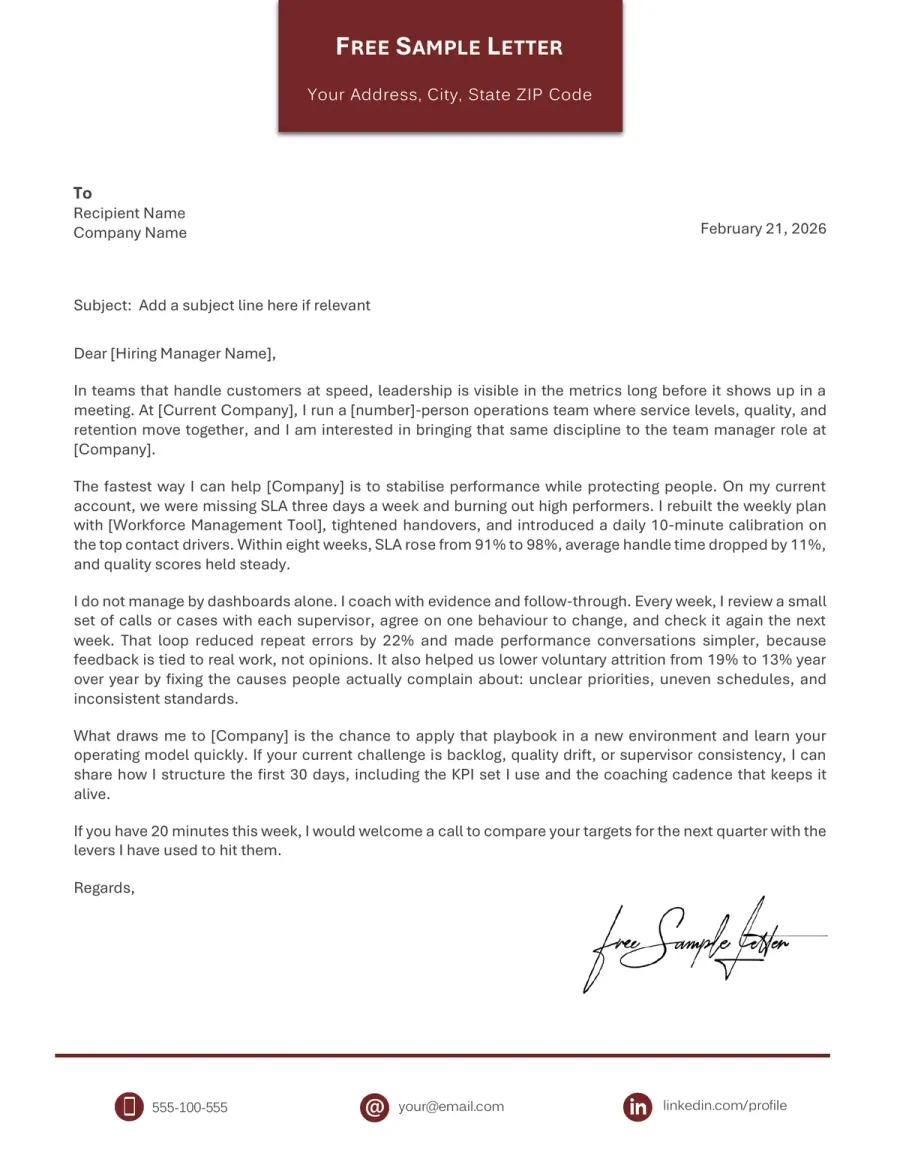
This preview shows what your Team Manager cover letter template will look like before you download it. After downloading the file in Word or PDF, customize the application letter with your team size, relevant KPIs, and examples of coaching success.
How to Personalize These Team Manager Cover Letter Samples
Avoid sending these templates without personalization. Hiring managers quickly recognize generic cover letters, so replace examples with your own KPIs, coaching moments, and real experiences - such as handling shifts, handovers, or escalations - before submitting your application. Make sure your letter is tailored to the specific job posting.
➡️ Find more expert guidance on writing a cover letter that sounds authentic and matches the job requirements
Anchor the opening to the job pressure
Start with the job posting: choose three main pressures they highlight (such as coverage, service levels, or quality). Open your letter by describing how you have successfully managed one of those challenges.
See what to include
In my previous role, weekend coverage was the biggest challenge. I rebuilt the rota in [Tool] and reduced last-minute callouts by 18% while maintaining consistent service levels.
Add one real shift moment recruiters can picture
Include a brief, concrete example that shows your judgment in action - such as responding to a callout, resolving a conflict, or managing a backlog. Two sentences are enough if the scenario is clear. Then connect it to the metric you protected.
See an example
Two people called in sick at 7:05 a.m. I quickly reassigned stations, set a 30-minute check-in schedule, and coached our newest hire during the busiest time. We cleared the queue and still met our quality target.
Prove impact with two outcomes
Select two outcomes that fit the role: one performance metric (such as SLA, output, or sales) and one people metric (like retention or ramp time). Include details about your team’s size, number of shifts, or volume handled for context.
See what to include
I led a team of [number] across [number] shifts and increased on-time completion from 82% to 94% by improving handovers and completing daily follow-ups in [Tool].
Run an ATS pass (keywords, tools, scope)
Run an ATS check: copy 8-12 role-specific keywords from the job posting (such as shift scheduling, performance reviews, or escalation). Work them naturally into your proof paragraphs instead of listing them separately.
See what to include
I use [Workforce Management Tool] for staffing forecasts, maintain SOP updates in [System], and run weekly performance check-ins to ensure coaching connects directly with KPI reporting and escalation trends.
Replace the generic closing with a clear next step
Rewrite your closing lines to invite a specific next step - such as a brief call to discuss your 30-day plan or how you would stabilize coverage and quality. Avoid ending with a generic thank you.
See a closing example
If you have 15 minutes, I would like to walk you through how I would align supervisors, improve handovers, and identify two KPIs the team can impact in the first month.
Recruiter Keyword Radar for Team Manager Letters
- SLA
- Performance improvement plans (PIP)
- Workforce management (WFM)
- Capacity planning
- Quality calibration huddles
- KPI dashboard ownership
- Supervisor alignment across shifts
- Coaching
- Attendance management
- Cross-functional handoffs
- Training ramp time reduction
- Store floor standards
- Conflict de-escalation
- Audit readiness
- Policy compliance
- Turnover reduction
- Shift handover notes that stop repeat mistakes
Do & Don’t for Team Manager Cover Letters Recruiters Trust
Recruiters hire team managers they can trust with other people’s days. They scan for proof of control: staffing decisions, coaching habits, and measured outcomes. If your letter reads like a generic leader bio, it gets ignored in seconds.
Red Flags That Kill a Team Manager Application Letter
Red Flags- Claim leadership without showing what you actually ran
- Name-drop KPIs with no “before/after” or method
- Sound “bossy” by ordering instead of coaching
- Ignore scheduling reality (coverage gaps, peak hours, callouts)
- Talk culture only and skip operational control
- Stuff keywords unnaturally for ATS
Team Manager Cover Letter Signals That Build Trust
Trust Signals- Open on one real pressure from the job post and your response to it
- Explain your coaching cadence (1:1s, floor feedback, follow-ups)
- Name the tools you use for staffing, tracking, and handovers
- Show how you align supervisors so standards match across shifts
- Describe how you prevent repeat issues (root cause, action log, review)
- Write like you manage trade-offs, not perfection
FAQ - Team Manager Cover Letter
I lead the team on shift, but my title isn’t “manager”. How do I prove I’m ready? Toggle answer
Use scope and decisions, not titles: team size, shift ownership, escalations, handovers, coaching. Name one moment you made the call and what changed by end of day. Recruiters trust “I ran the operation” more than “I helped lead.”
Which KPIs belong in a team manager cover letter - and which ones backfire? Toggle answer
Pick 1-2 KPIs tied to customer impact and execution (SLA, quality, output, shrink, complaints). Add the “how” (cadence, coaching loop, staffing tweak). Avoid vanity metrics or numbers you can’t defend in an interview.
I’m applying for an internal promotion. How do I write about my current team without oversharing? Toggle answer
Frame it as readiness: you already know the workload, gaps, and standards. Mention one improvement you drove (training, rota fairness, daily huddle) and what it fixed. Don’t name colleagues or internal drama - keep it about systems and results.
I’ll be managing former peers. How do I address that without sounding defensive? Toggle answer
One line is enough: you lead with clarity and consistency - same standards, same follow-up, fair scheduling, documented decisions. Then prove it with a real example (coaching, conflict reset, performance conversation). Don’t write a speech about authority.
The role is heavy on scheduling and coverage. How do I make that sound strategic? Toggle answer
Show it as control of performance: forecasting peak hours, reducing callouts, protecting service levels, and preventing burnout. Mention the tool or method (rota rules, coverage thresholds, check-in cadence). Hiring managers read scheduling as your ability to run the day.
TL;DR - What Actually Wins With a Team Manager Cover Letter
A team manager cover letter only works if it reads like operational control, not “leadership vibes”. Show scope (team size, shifts, volume), one real decision moment, and 1-2 KPIs you improved with a clear method. Fatal mistake: claiming you “motivate teams” without proving what you ran.
The underrated credibility signal is your management system. Recruiters trust candidates who can explain their cadence (handover, 1:1s, coaching loop, follow-ups) and how they keep standards consistent across people and pressure. If your letter doesn’t show how you lead on a bad day, it’s not doing its job.