
Shift Manager Cover Letter Examples for a Stronger 2026 Application
Shift Manager roles are evaluated in real time: during a rush, when handling a complaint, or covering a staffing gap. These cover letter examples show how you can lead the floor, maintain standards, and deliver results.
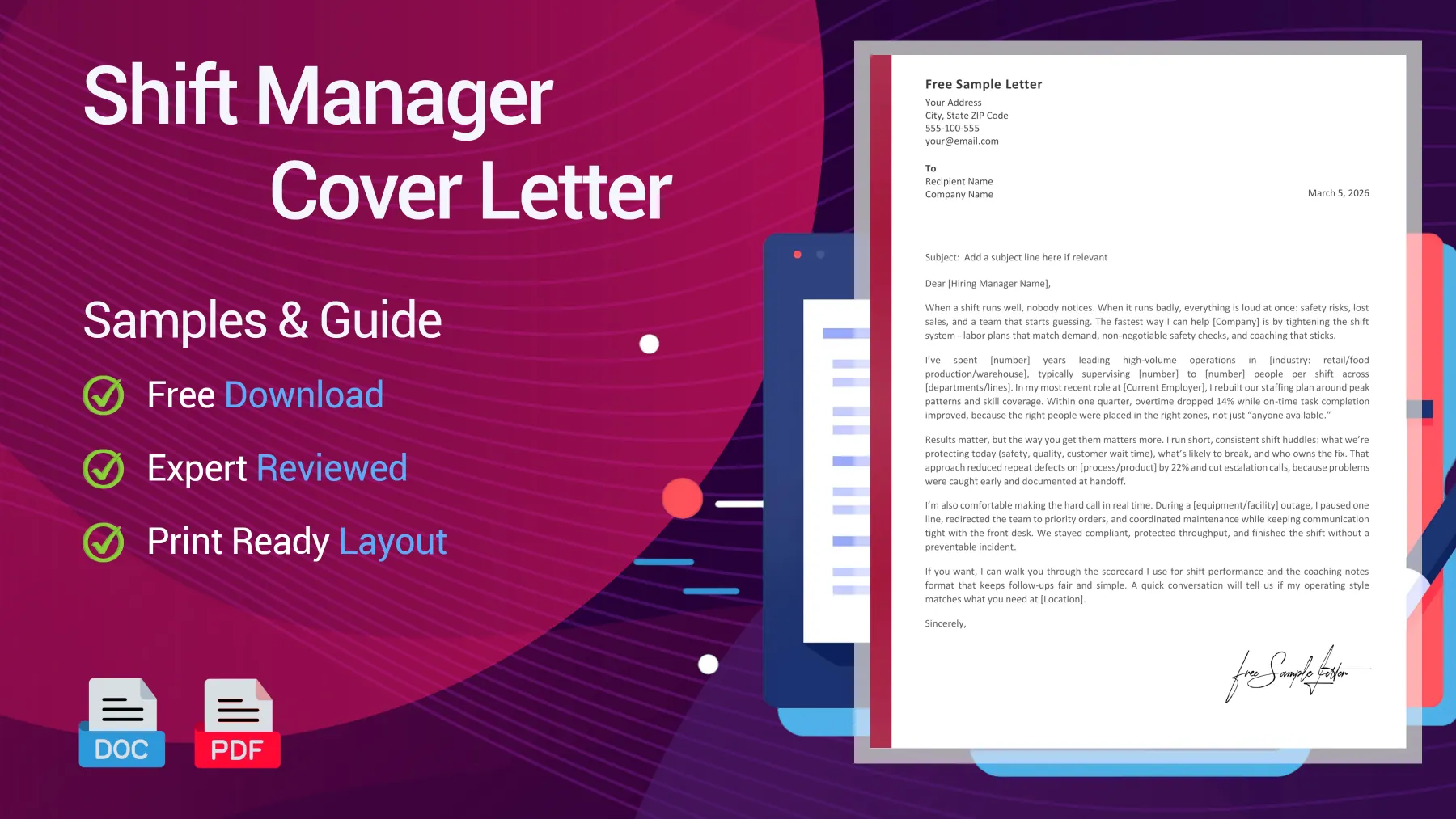
Free Samples for Shift Manager Application Letters
According to a July 2024 Gartner survey cited by HBR (n=3,529), only 38% of employees were satisfied with their manager’s quality. HBR Expert take: your Shift Manager cover letter should show how you lead people when the floor is strained.
Junior Shift Manager Application Letter Sample
If you’re a junior applicant without a Shift Manager title yet, this sample helps you prove readiness through real floor moments, tight checklists and team-first communication.
Dear [Hiring Manager Name],
A Shift Manager has to keep the floor steady when staffing, pace, and customer expectations collide. The best way I can support [Company] is by running a smooth shift: setting clear roles at the start, making quick corrections during busy periods, and ensuring a clean handoff at closing.
I’m applying as an entry-level candidate, but I’ve led from the front as a [Lead Cashier/Keyholder] at [Current Employer]. During our busiest months, I took on cash office duties, coached new teammates on register flow, and kept our closing checklist on track. By tightening our last-hour routine, we reduced voids and re-rings by 20% and cut average close time by 15 minutes, all without sacrificing standards.
I’ve learned to address friction early. When two teammates clashed over section coverage, I pulled them aside for a quick reset: clarifying responsibilities, defining what “done” looks like, and when to ask for backup. The shift stayed on track, and the next day I updated our coverage board to prevent future confusion.
I’m comfortable with the details that protect profit: cycle counts, waste logs, and quick spot-checks that catch issues before they spread. Each shift, I track labor hours versus traffic, top reasons for refunds, and which tasks slip during rushes, then adjust the next schedule or prep plan accordingly.
If helpful, I can bring a one-page shift plan to an interview and walk you through how I’d approach an opening or close at [Location]. You’ll see exactly how I think, and you’re welcome to test it against the scenarios you see most often.
Sincerely,
[Your Name]

Reviewed by Olivia B., HR Consultant
The tone is confident without overreaching. I never once felt they were pretending to have a manager title, which keeps trust intact.
Senior Shift Manager Application Letter Sample
Built for an experienced Shift Manager with 15+ years: it spotlights KPIs, labor control, safety routines, and coaching that actually lifts performance.
Dear [Hiring Manager Name],
When a shift runs well, no one notices. When it runs badly, everything is loud at once: safety risks, lost sales, and a team that starts guessing. The best way I can help [Company] is by tightening the shift system: labor plans that match demand, non-negotiable safety checks, and coaching that lasts.
I’ve spent [number] years leading high-volume operations in [industry: retail/food production/warehouse], usually supervising [number] to [number] people per shift across multiple departments or lines. In my most recent role at [Current Employer], I rebuilt our staffing plan around peak patterns and skill coverage. Within one quarter, overtime dropped 14% and on-time task completion improved because the right people were placed in the right zones, not just anyone available.
Results matter, but how you achieve them matters more. I run short, consistent shift huddles: what we’re protecting today (safety, quality, customer wait time), what’s likely to break, and who owns each fix. This approach reduced repeat defects on [process/product] by 22% and cut escalation calls by catching problems early and documenting them at handoff.
I’m also comfortable making tough calls in real time. During a [equipment/facility] outage, I paused one line, redirected the team to priority orders, and coordinated maintenance while keeping communication clear with the front desk. We stayed compliant, maintained throughput, and finished the shift without preventable incidents.
If you’d like, I can walk you through the scorecard I use for shift performance and the coaching notes format that keeps follow-ups fair and simple. A quick conversation should show if my operating style matches what you need at [Location].
Sincerely,
[Your Name]
Reviewed by Olivia B., HR Consultant
I trust this candidate because the labor and coverage decisions feel lived-in. That’s what separates a real shift leader from a talker.
Internal Promotion Shift Manager Cover Letter Sample
Made for an internal promotion to Shift Manager: it shows how to lead former peers, protect standards, and speak the same KPI language your company uses.
Dear [Hiring Manager Name],
[Company] already knows how I run a shift: clean handoffs, standards that hold, and steady decisions when the floor gets busy. Moving into the Shift Manager role is a natural next step, but my focus would shift from helping the team to owning the entire operation for [Location].
As a [Current Title] on the [morning/evening] team, I’m the person teammates come to when something is off: a drawer count that doesn’t match, a customer issue that escalates, or a delivery that arrives short. What keeps those moments from turning into chaos is process. I keep the shift running smoothly by doing a quick pre-rush scan (stations staffed, key tasks timed, top risks flagged), then logging two things during the shift: exceptions and fixes. That log makes our handoff to the next manager faster and more accurate.
Two recent wins show my approach. First, I noticed we were losing time to repeated stock runs, so I reorganized our backroom pick zones and added a simple par-level card for high-movers. Within three weeks, our mid-shift restock calls dropped and we cut wasted steps during peak. Second, I started coaching in the moment on [SOP topic: food safety/customer service/quality]. Instead of generic reminders, I point to the exact standard, demonstrate the right way, then check back later. Compliance improved because expectations were clear and specific.
If promoted, I’d keep our team culture intact by staying consistent: same standards for everyone, private corrections, public credit, and clear escalation when policy requires it. I’d welcome the chance to sit down for 20 minutes and walk you through my first 30-day plan for staffing, training, and shift scorecards at [Location].
Sincerely,
[Your Name]
Reviewed by Olivia B., HR Consultant
The two wins are operational, not fluffy. I can tell this person already thinks like a manager, especially with par levels and standards coaching.
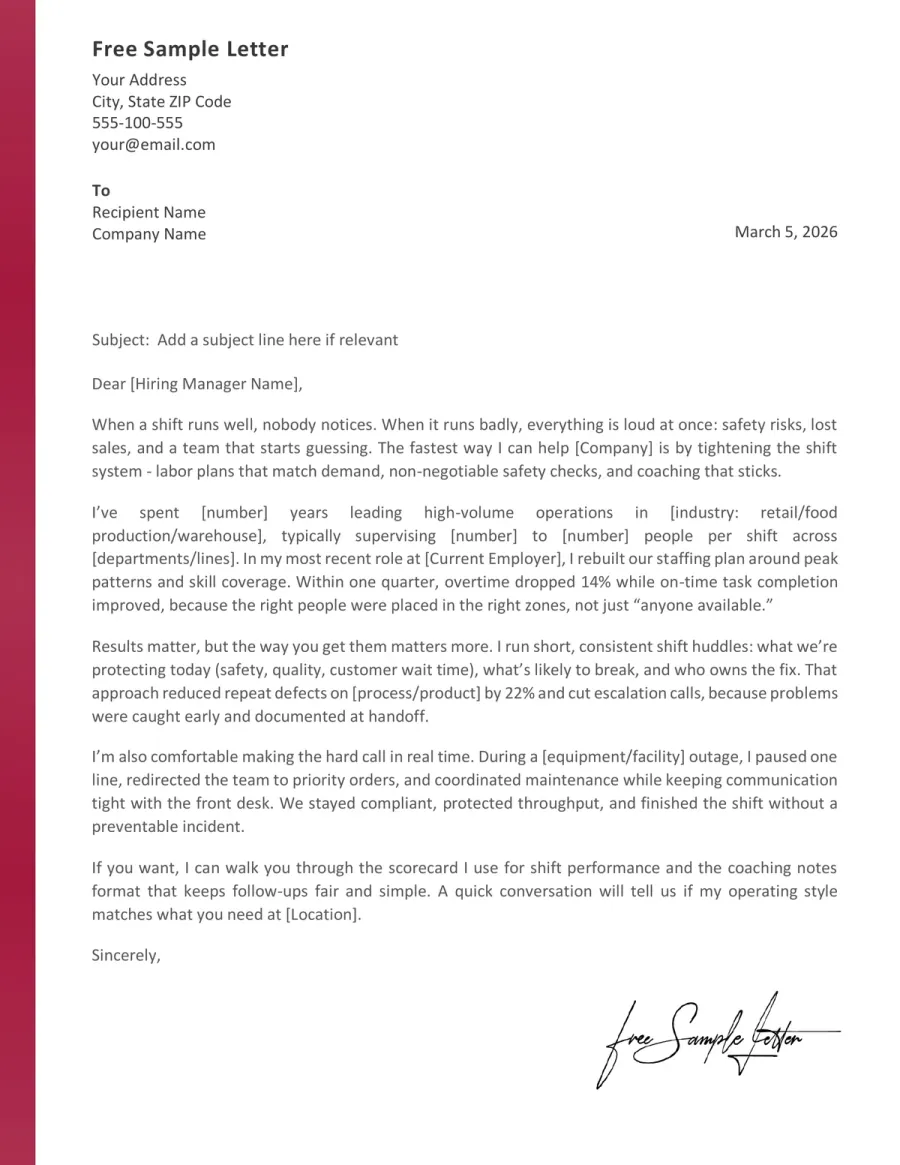
Shift Manager Cover Letter Template Preview Before Download (Word/PDF)
Preview the shift manager cover letter template before you download it. Choose the editable Word version or the print-ready PDF, then customize the details for your store or location.
Make These Shift Manager Templates Yours in 5 Steps
Copy-paste cover letters are easy to spot: shift leadership is concrete and specific. Replace generic details with your real shift metrics, the actual tools you used, and a real pressure moment you handled. Keep the structure, but make the story your own.
➡️ Want a stronger structure? See how to write a cover letter that gets read beyond the opening paragraph.
Match the role reality
Match your cover letter sample to the job ad. Pull three phrases from the posting, such as hours, volume, or compliance, and use them in your first paragraph to reflect the real demands of the role.
See an example
At [Company], your late-night shifts call for tight labor coverage and clean handoffs. I keep service moving by setting station roles at open and logging exceptions before the close.
Replace claims with scope and outcomes
Replace generic leadership claims with specifics. Mention the number of people per shift, peak volume, or close time, and highlight one metric you improved (refunds, waste, overtime, defects). Concrete numbers make your claims credible.
See a quick rewrite
I supervised [number] associates on a [morning/evening] shift and cut closing time by 15 minutes by tightening the checklist and confirming handoff notes before the last customer left.
Add one pressure moment recruiters can picture
Include a pressure moment relevant to the role: a call-out, equipment issue, or customer escalation. In two sentences, focus on the decision you made and the outcome. Hiring managers trust real examples over vague claims.
See Show a micro-scene
When the POS froze mid-rush, I switched one lane to cash-only, called for a quick reboot, and reassigned a teammate to greet and triage the line. We cleared the backlog without breaking standards.
Weave in tools, standards, and ATS language
Mention the tools and standards the ATS expects: POS, cash counts, labor scheduling, SOPs, incident logs, food safety, or OSHA. Use these terms naturally in your examples so your letter reads like a true account of your daily work.
See a snippet
I close each shift with a two-step cash count, log variances, and note any incident reports in the handover. On busy nights, I adjust labor coverage to keep service times stable.
Land the close with a real next step
Close your letter like a real shift leader. Offer a next step tied to the job, such as walking through your opening plan, discussing a staffing scenario, or explaining how you’d handle an escalation at [Location].
See an example close
If it helps, I can bring a one-page shift plan to our interview and talk through a short-staffed Friday close. You’ll see how I set roles, protect standards, and hand off cleanly.
Recruiter Keyword Radar for Shift Manager Applications
- SOP adherence
- Handoffs
- Incident reporting
- Close checklist
- Customer escalation notes
- Labor schedule vs hourly sales pacing
- POS
- Shrink and waste tracking
- Safety walk and PPE compliance
- Cross-training plan
- Cash handling
- Daily huddle priorities
- Stockouts prevention
- On-the-spot conflict reset
- Labor scheduling
- Coaching
Do & Don’t for a Shift Manager Cover Letter
Shift manager cover letters are judged on credibility, not personality. Recruiters want evidence that you can manage people, pace, and standards at the same time. Vague claims without clear outcomes lead to quick rejections.
What makes a shift leader application look generic
Red Flags- Start with vague leadership claims and ignore real shift context
- Name-drop responsibilities without showing one real decision you made
- Overpromise availability or authority you cannot back up in an interview
- Use one-size-fits-all lines that ignore the employer’s tools and routines
- Write around conflict instead of showing how you reset a situation fast
What makes your shift manager letter feel credible
Trust Signals- State your shift scope in one line: team size, peak window, and environment
- Quantify an improvement tied to operations: close time, errors, waste, or overtime
- Reference the real tools: POS, cash counts, labor scheduling, logs, SOPs
- Explain your handoff habit so continuity feels baked in, not accidental
- Demonstrate coaching with a concrete method
FAQ - Shift Manager Cover Letter
How do I prove I can run a shift if I’ve never had the Shift Manager title? Toggle answer
Don’t argue the title. Show the duties: opening/closing, break coverage, cash handling, training, escalation calls. Add one pressure moment and the decision you made. If you can describe the hour-by-hour rhythm, you’re believable.
Which numbers actually matter in a Shift Manager cover letter (and which look fake)? Toggle answer
Use numbers you can explain fast: team size, peak window, close time saved, error reduction (refunds/voids/waste), overtime reduction, audit pass rate. Avoid giant percentages with no method. One clean metric tied to a habit beats five “big wins.”
How do I write about staff scheduling if I didn’t build the schedule myself? Toggle answer
Focus on real-time coverage, not just “writing schedules.” Mention how you rebalance stations, adjust breaks, call for backup, and document handoffs when staffing changes. That’s real shift leadership. If you’ve tracked coverage gaps or suggested improvements, include those details.
I’m up for an internal promotion - how do I address leading former peers? Toggle answer
Describe your shift in mindset: from “helping” to owning standards. Show fairness through private corrections, consistent rules, and clear escalation when required by policy. Sharing an example of coaching a peer effectively is much more persuasive than a generic loyalty message.
What “operations proof” should I include: cash counts, inventory, safety, SOPs? Toggle answer
Pick 2-3 that match the job post and show how you verify them: two-person cash count with variance log, spot-checks on inventory, temperature/safety checks, incident notes, close checklist sign-off. Tools + actions + verification reads like real work.
TL;DR - Shift Manager Cover Letter Playbook
Your shift manager cover letter has to prove you can run the hour: break coverage, handoffs, standards, and the one call you made when something broke. Use one pressure scene and one metric you can defend. Fatal mistake: sounding like a “helper” instead of the person who owns the shift outcome.
Recruiters don’t need a speech about leadership. They look for control signals: tools, routines, and verification (cash counts, logs, checklists, SOPs). If your letter reads like you could be dropped into a short-staffed Friday and still keep pace and standards, you’re in the interview pile.