
Reference Letter Examples for Management Jobs in 2026
Strong manager references should read as evidence, not just praise. The following examples demonstrate how to document decisions, cross-team leadership, and measurable improvements without exaggeration.
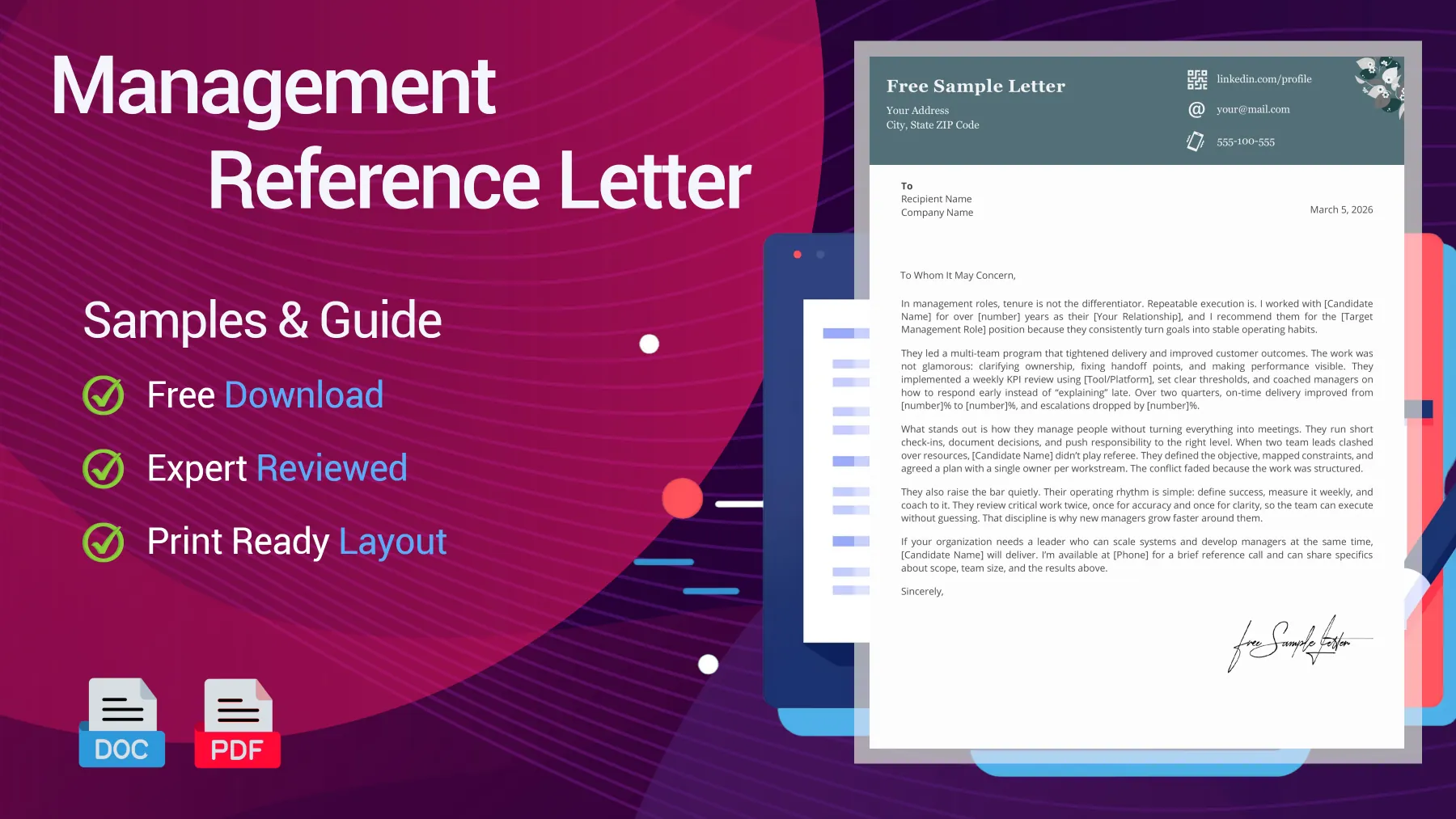
Free Recommendation Letter Samples for Management Applications
The Bureau of Labor Statistics projects approximately 1.1 million management job openings each year from 2024 to 2034. BLS OOH. Expert interpretation: Your recommendation should demonstrate leadership outcomes, trust, and how the manager improved both people and results.
Entry-Level Management Recommendation Letter Sample
For a junior, entry-level manager application, this reference letter proves readiness with internship-based results and a real on-the-floor moment that hiring teams can verify.
To Whom It May Concern,
If you have reservations about hiring a junior candidate into a management track, your caution is understandable. What I can share is that [Candidate Name] has already been tested in real work under real constraints and has demonstrated the habits you want before earning a formal title.
I led the project workstream where [Candidate Name] supported our operations team. Rather than trying to impress with big statements, they focused on practical questions: Who owns each step? What does “done” look like? Where does work get stuck? They built a weekly dashboard in [Tool/Platform] to make delays visible. After the dashboard launched, overdue tasks dropped from about [number] per week to [number], and our handoffs became much smoother.
They also showed sound judgment in moments that might otherwise become bigger problems. During a tense cross-team meeting, two stakeholders began blaming each other for a missed deadline. [Candidate Name] paused the debate, summarized the facts, and suggested a reset: agree on the next deliverable, assign a single owner, and set a deadline everyone could meet. The conversation calmed, and progress resumed.
What stands out most is their integrity. When they didn’t know something, they said so, then followed up with the answer and its source. That honesty is rare and is precisely what helps early-career managers avoid costly mistakes.
I recommend [Candidate Name] for [Target Management Role]. If you’d like to discuss or confirm any details from this letter, feel free to call me at [Phone]; I’m happy to walk you through what I observed firsthand.
Kind regards,

Reviewed by Olivia B., HR Consultant
I buy this recommendation because it addresses the risk of a junior hire head-on, then backs it with a clean dashboard outcome and a real meeting reset.
Senior Management Recommendation Letter Sample
For a senior management application, this reference letter shows measurable wins, cross-team leadership, and the processes they use to keep standards steady under pressure.
Dear [Hiring Manager Name],
In management roles, tenure is not what sets someone apart: repeatable execution does. I worked with [Candidate Name] for over [number] years as their [Your Relationship] and recommend them for the [Target Management Role] position because they consistently turn goals into stable operating habits.
They led a multi-team program that improved delivery and customer outcomes. The work wasn’t glamorous: clarifying ownership, fixing handoff points, and making performance visible. They introduced a weekly KPI review using [Tool/Platform], set clear thresholds, and coached managers on responding early instead of explaining issues after the fact. Over two quarters, on-time delivery improved from [number]% to [number]%, and escalations dropped by [number]%.
What stands out is how they manage people without relying on unnecessary meetings. They run brief check-ins, document decisions, and delegate responsibility effectively. When two team leads clashed over resources, [Candidate Name] didn’t intervene as a referee. Instead, they defined the objective, mapped out constraints, and developed a plan with a single owner per workstream. The conflict subsided because the work was structured.
They also raise expectations quietly. Their operating rhythm is straightforward: define success, measure it weekly, and coach toward it. They review critical work twice: once for accuracy and once for clarity, so the team can execute confidently. That discipline helps new managers develop more quickly around them.
If your organization needs a leader who can scale systems while developing managers, [Candidate Name] can deliver. I’m available at [Phone] for a brief reference call and can provide specifics about scope, team size, and the results above.
Sincerely,
Reviewed by Olivia B., HR Consultant
I like the weekly thresholds and coaching angle. It proves results and people development together, and it’s easy to probe in an interview.
Career-Change Management Recommendation Letter Sample
For a career-change management application, this reference letter explains the pivot and proves transferable leadership: coaching, planning, and calm decision-making.
Dear [Hiring Manager Name],
Good managers aren’t made overnight. They’re shaped by repeated moments where people, priorities, and pressure intersect. I recommend [Candidate Name] for the [Target Management Role] because I’ve seen them lead through those challenges, and because their career change is a deliberate step toward work they already excel at.
I served as [Your Title] at [School/Organization], where [Candidate Name] led high-stakes operations in a classroom setting: planning, coaching, stakeholder communication, and making quick decisions when plans changed. They didn’t just “handle” chaos; they built systems. For example, they redesigned our student support workflow with clear ownership and weekly follow-ups. Attendance for a key group improved from [number]% to [number]%, and staff stopped duplicating work because next steps were always clear.
The fastest way [Candidate Name] can contribute to [Company] is by making execution predictable: setting clear expectations, tracking follow-through, and coaching performance without unnecessary drama. I’ve seen them handle difficult conversations with calm, factual communication and follow up until habits changed.
One moment sums it up: during an unexpected incident on campus, emotions ran high and information was scattered. [Candidate Name] coordinated communications, kept people moving to safety, and documented the incident so we could improve the process afterward. That mix of composure and learning is exactly what you want in a manager.
[Candidate Name] isn’t asking you to overlook their background, but to recognize the management experience already within it. If you’d like, I’m available at [Phone] for a brief call to discuss scope, leadership style, and the results above.
Sincerely,
Reviewed by Olivia B., HR Consultant
I like that it explains the career shift without apologizing. The pivot line connects transferable leadership to execution, which hiring teams need.
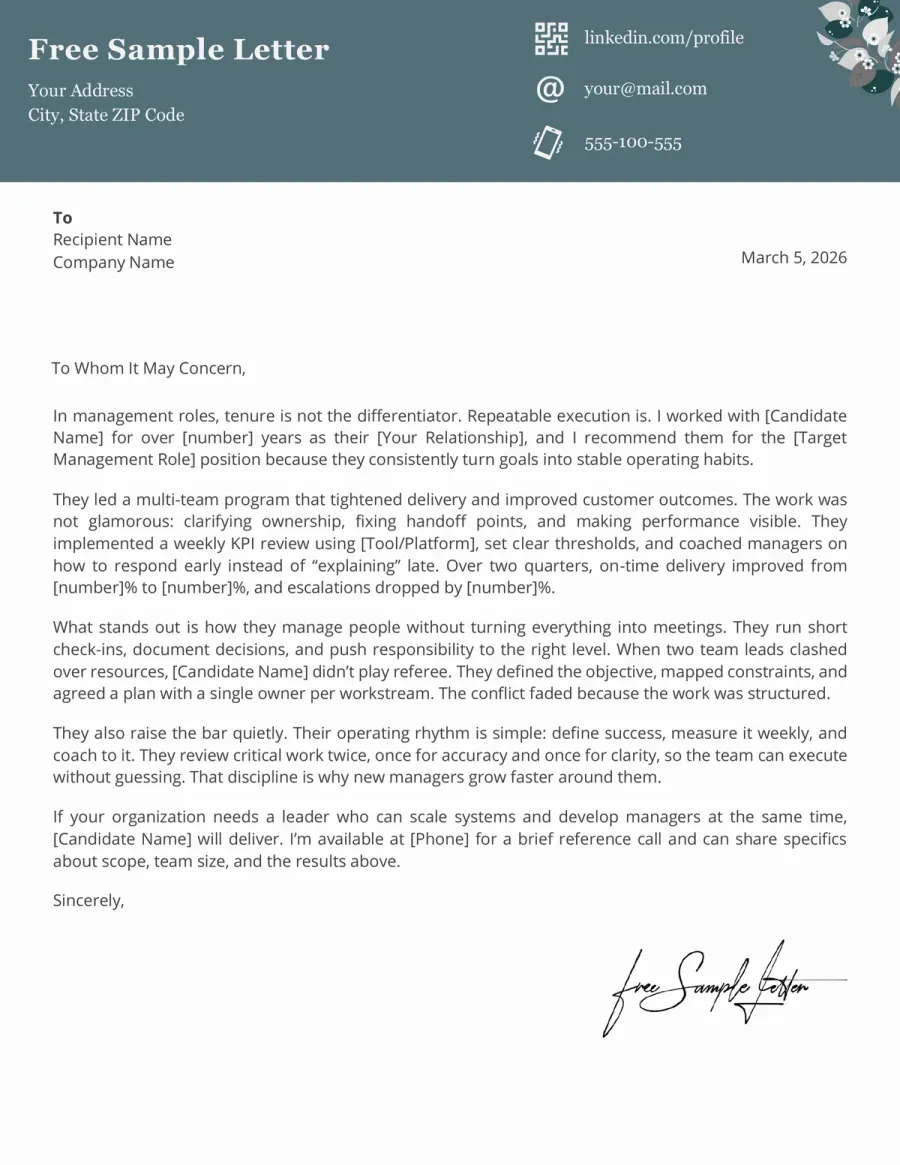
Management Recommendation Letter Template Preview Before Download (Word / PDF)
Preview an example management recommendation letter before downloading. Available formats: Word (.docx) and PDF.
Customize the Templates: 5 Steps to a Strong Manager Reference
Copy-pasting a manager recommendation letter can weaken its impact quickly: dates, scope, and outcomes must reflect your actual experience. Personalize the examples with real leadership evidence that a hiring team can verify.
➡️ More expert guidance in our article How to Write a Recommendation Letter (Step-by-Step Guide)
Define the relationship and scope
Begin with your name, title, and how you worked with [Candidate Name]. Include the timeframe, team size, and what you directly observed to make the reference feel specific and easy to validate.
See Define the relationship and scope
I served as [Your Title] at [Company] and managed [Candidate Name] from [Month/Year] to [Month/Year], observing their planning, coaching, and delivery across a team of [X].
Choose two leadership proofs, not ten traits
Choose two specific moments that highlight leadership in action: a tough decision, a conflict resolution, or a process improvement. Describe each as an action and its outcome, so your letter reads as evidence, not just praise.
See an example
When two leads clashed over resources, [Candidate Name] clarified the objective, set one owner per workstream, and restored delivery within a week without adding unnecessary meetings.
Add measurable impact and operating rhythm
Management letters are more effective when they show rhythm: how the candidate runs check-ins, documents decisions, and tracks follow-through. Whenever possible, include at least one metric, even if it’s a simple before-and-after comparison.
See what to include
They ran 15-minute check-ins, kept decisions in a shared log, and used a weekly dashboard. On-time delivery improved from [X]% to [Y]% over two quarters.
Match the target role and speak the application language
Match the exact job title and scope of the target role. For operations roles, mention throughput and execution; for people leadership, highlight coaching and retention. Only include claims you directly observed.
See an example line
For a [Target Management Role] application, I can confirm [Candidate Name] led a team of [X], coached [X] direct reports, and improved delivery quality by tightening ownership and reviews.
Close with a clear endorsement and next step
End with your level of recommendation and offer a practical next step: suggest a brief call, provide your best contact information, and specify what you can confirm. A clear closing signals accountability and makes the letter feel trustworthy.
See an example closing
I recommend [Candidate Name] without hesitation for [Target Role]. If helpful, I’m available this week at [Phone] to confirm scope, leadership style, and the outcomes noted above.
Decision Signals Inside a Management Recommendation Letter
- KPIs
- Hiring and onboarding
- Weekly operating rhythm
- Decision log discipline
- Cross-functional alignment
- Ownership
- Conflict reset in tense meetings
- On-time delivery improvement
- Coaching
- Retention and team stability
- Budget or resource allocation
- Clear priorities with named owners
- Performance feedback tied to evidence
Do & Don’t: Management Recommendation Letters That Get Taken Seriously
Hiring teams treat manager references as evidence. They look for details about scope, outcomes, and decision-making that sound verifiable. The strongest letters show how the leader raised standards and how the team improved as a result.
What makes the reference feel generic
Red Flags- Hide the reporting line or timeframe
- Use broad praise with no proof moment
- Describe leadership without decisions
- Overdo superlatives and perfect language
- End with a generic polite closer only
What makes the endorsement feel credible
Trust Signals- State role, relationship, and observed scope
- Show two leadership moments with outcomes
- Name how they coached and followed up
- Make the endorsement level explicit
- Offer a short reference call as next step
FAQ - Management Recommendation Letter
Who should write it: manager, skip-level, or peer? Toggle answer
Pick whoever observed your leadership closest to the work. A peer is fine if they saw you lead cross-team delivery. A higher title with no exposure reads thin. Your recommender must state relationship, timeframe, and what they directly witnessed.
How do I prove leadership without a manager title? Toggle answer
Use “acting” evidence: ownership of a workstream, running weekly priorities, coaching a teammate, handling escalations, or resetting conflict. Titles are less important than decisions made, follow-through, and the team outcome after your intervention.
Should the letter include KPIs, team size, or budget? Toggle answer
Yes, if it’s accurate and appropriate to share. Even a single clear metric, such as cycle time, churn, or delivery rate, adds credibility. If numbers are confidential, use ranges or operational signals (team size, multi-site scope, monthly cadence, audited process) instead of vague praise.
How do you write a promotion recommendation without sounding biased? Toggle answer
Anchor your letter in observable behavior: specify what the candidate owned, what changed, and what remained steady under pressure. Include one example of a tough decision and one of people development. Then offer a reference call so the committee can ask for more details.
Should a management recommendation letter mention weaknesses? Toggle answer
Only include weaknesses if they are framed as past challenges that have been clearly resolved, with supporting evidence. An honest “before and after” example can boost credibility. Avoid vague negatives, such as “not great under pressure,” if you cannot show how they were addressed.
TL;DR - Management Recommendation Letter That Gets Taken Seriously
Treat the management recommendation letter as evidence: include clear scope (role, timeframe, team size), two specific leadership moments with outcomes, and at least one measurable improvement. The biggest mistake is using generic praise that could apply to anyone, or making exaggerated claims that won’t hold up in a reference call.
Hiring teams also look for operating rhythm. When a letter describes how the manager set priorities, coached performance, and handled conflict efficiently, it signals mature leadership. If the recommender offers a quick call and can repeat the same specifics verbally, the application feels much more credible.