
How to Write a Reference Letter That Sounds Specific
A recommendation letter should do more than offer praise. This guide explains how to write a specific, credible reference letter by choosing the right proof and tailoring your tone for work, study, internship, scholarship, or career moves.
What a Recommendation Letter Really Needs to Do
A weak recommendation letter simply says the person is good. A strong recommendation letter shows why the reader should trust your judgment. That is the difference between generic praise and a letter that genuinely helps.
The reader needs to understand three things right away: how you know the candidate, what you have seen them do, and why those qualities matter for the job, program, internship, scholarship, or opportunity they are pursuing.
MIT admissions guidance says useful recommendation letters should be specific and storied, with facts, anecdotes, and context the rest of the application cannot provide (MIT Admissions). This advice applies well beyond college admissions. Whether you are a manager, professor, supervisor, or colleague, the letter needs evidence, not just approval.
A recommendation letter is not a résumé in disguise. Do not list every duty, course, or skill. Instead, choose proof that matters, explain your relationship honestly, and make your endorsement feel earned.
Recommendation Letter vs Reference Letter
People often use the terms recommendation letter, reference letter, and letter of recommendation interchangeably. In practice, the right choice of words depends on who is asking for the letter and what they need it for.
A recommendation letter is usually written to actively support someone for a specific opportunity, such as a job, internship, graduate program, scholarship, promotion, or other career move. It explains why the person deserves consideration.
A reference letter is often broader. It might confirm character, work history, reliability, academic performance, or overall suitability. Some employers use it for background or reference checks, while schools may expect a more detailed endorsement.
The simplest safe rule is to use the wording requested by the employer, school, organization, or application portal. If nothing is specified, choose the term that fits the situation and focus on the main goal: a specific, honest, and useful endorsement.
Before You Agree to Write One
Not every request deserves an automatic yes. A recommendation letter reflects your judgment, and often your name, title, organization, or academic role. If you cannot write it honestly, it is better to pause.
Before agreeing, ask yourself whether you know the person well enough to give real examples. Did you supervise their work? Teach them? Manage their project? Review their performance? See how they behave when things become difficult?
Sometimes the most helpful answer is a polite no. A weak or lukewarm recommendation can hurt the candidate more than an honest refusal, especially when the reader expects clear support.
A credible recommendation letter starts before the writing. It starts with an honest decision: can I recommend this person with enough detail to make the reader believe me?
What to Gather Before You Start Writing
Good recommendation letters are rarely written from memory alone. Even if you know the person well, you still need to understand the target, the deadline, the submission process, and the kind of evidence that will be most persuasive.
Ask for the job description, program details, scholarship brief, internship requirements, or application instructions. A letter for a management role does not need the same proof as one for an internship, a medical job, or an MBA program.
You can also request a current CV or résumé, especially if the candidate is switching fields or applying outside your shared context. A focused CV or resume and a tailored cover letter can help you understand what the candidate is trying to demonstrate.
Useful information to request:
- Current CV, résumé, or student profile
- Job advert, program page, or application instructions
- Deadline and submission method
- Dates and context of your working or academic relationship
- Two or three achievements the candidate would like you to highlight or support
- Any required formats, portal questions, or letterhead rules
If the candidate is not sure how to ask or what to provide, direct them to our reference letter request samples. A clearer request gives you better material and usually results in a stronger letter.
Recommendation Letter Format at a Glance
A recommendation letter does not need a fancy layout. What matters is a clear structure that helps the reader understand your endorsement without searching for context.
- Sender details - name, role, organization, email, phone, and letterhead when appropriate.
- Date - especially useful for job, school, scholarship, or formal application records.
- Recipient or greeting - use a specific name if you know it, or a neutral greeting otherwise.
- Relationship context - explain how you know the candidate and for how long.
- Main endorsement - state your recommendation clearly and early, not buried halfway through the letter.
- Proof points - one or two examples that show performance, behavior, judgment, or potential.
- Fit with the opportunity - connect the proof to the role, program, or next step.
- Closing and contact details - offer to provide more information if appropriate.
For most job or academic uses, one page is enough. A longer letter works for selective academic programs or senior roles only if the added detail provides real evidence.
How to Write a Recommendation Letter Step by Step
A good recommendation letter is not just a list of compliments. It works when the reader sees your relationship, concrete evidence, fit, and honest judgment presented in a clear order.
Confirm the purpose of the letter
Start with the opportunity. A job reference, internship recommendation, graduate program letter, and internal promotion letter do not need the same proof.
See what to ask
Could you send me the role description, deadline, and any points you would like the letter to support, especially around [skill], [project], or [achievement]?
State your relationship clearly
The reader needs to know why your opinion matters. Explain your role, the context, and how long you have known or supervised the candidate.
See an example
I managed [Candidate Name] for three years at [Company Name], where they worked as [Job Title] on [team, project, or responsibility].
Choose one or two proof points
Do not list every good quality. Choose examples that best support the opportunity and make the candidate easier to trust.
See what to include
During [Project Name], [Candidate Name] took ownership of [task], coordinated with [team], and helped deliver [result] ahead of [deadline].
Connect the proof to the opportunity
Evidence is more convincing when the reader understands why it matters. Connect each example to the job, program, internship, scholarship, or next step the candidate wants.
See how it sounds
That experience is directly relevant to your program because it shows the same mix of independent work, structured thinking, and follow-through.
Keep the praise honest and specific
Strong letters are positive, but they should not sound exaggerated. Specific praise is always more persuasive than big adjectives with no story behind them.
See the difference
Instead of calling the candidate outstanding in general, describe a moment when they solved [problem], improved [process], or helped [person or team].
Close with a clear endorsement
End with confidence. Restate your recommendation, connect it to the opportunity, and offer to provide further details if appropriate.
See an example
I recommend [Candidate Name] without hesitation for [Position or Program] and would be glad to answer any questions about their work with [Company or Department].
How to Start and End a Recommendation Letter
The opening has one job: make your endorsement easy to trust. Skip long warm-ups. Say who you are, how you know the candidate, and why your opinion matters.
Do not let the closing fade into a generic sentence. Restate your recommendation, connect it to the opportunity, and make it easy for the reader to follow up.
Try closing lines like these:
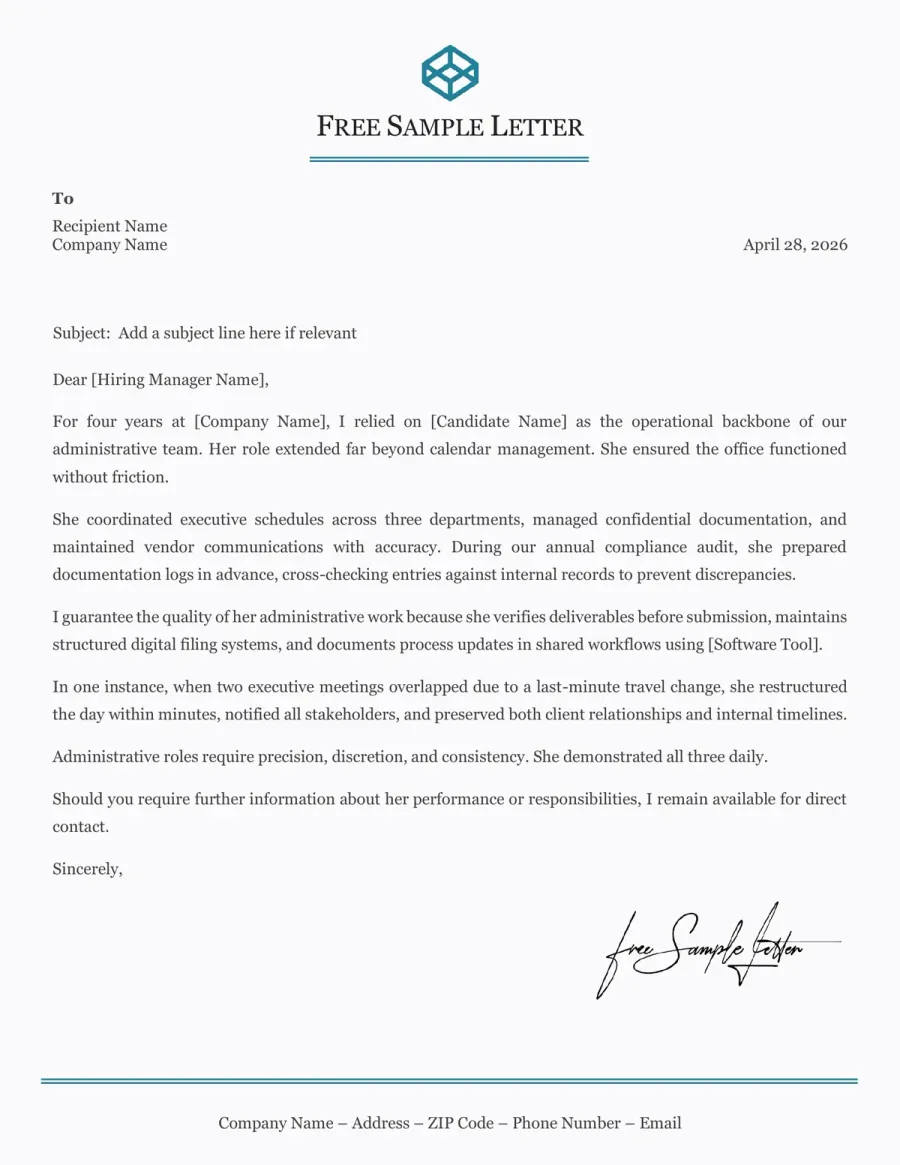
What a Clean Recommendation Letter Looks Like on the Page
A strong recommendation letter should look easy to read at a glance. Clear spacing, short paragraphs, and a visible endorsement make the reference letter easier to trust.
Special Cases That Need a Different Angle
The structure stays similar, but the proof changes. A recommendation letter for a mechanic should not sound like one for an MBA candidate. A summer job reference does not need the same weight as a graduate program endorsement.
- Employee or coworker recommendation. Focus on work habits, reliability, ownership, team contribution, and times when the person made someone else’s work easier. A manager can usually give stronger proof than a peer, but a peer can still describe collaboration effectively.
- Student recommendation. Show academic behavior in context: coursework, research, class participation, writing, persistence, curiosity, or growth. Avoid overblown claims. One clear example from a project or assignment often says more than three broad compliments.
- Internship or trainee recommendation. Do not pretend the candidate has senior experience. Show learning speed, initiative, coachability, punctuality, and how they handled real tasks during their placement or training.
- MBA or graduate program recommendation. The reader wants to see judgment, leadership potential, maturity, and evidence that the candidate can handle demanding work. The letter should sound selective, not inflated.
- Trade, manual, technical, or service recommendation. Help the reader picture the work. Mention safety, reliability, customer contact, tools, deadlines, quality, teamwork, or consistency, depending on the field.
Recommendation Letter Examples by Situation
Once you know the structure, choose the real-world example that fits best. A recommendation letter for an employee, student, intern, MBA applicant, mechanic, or summer worker should not rely on the same kind of proof.
Use the guide above for the writing method, then open the sample that matches the person you are recommending. Each example below gives you a more targeted model without turning this guide into a duplicate sample page.
Office and Administrative Reference Letter
Healthcare Recommendation Letter
Hospitality Reference Letter
Management Recommendation Letter
Sales and Marketing Reference Letter
Mechanic Reference Letter
Computer Science Recommendation Letter
Manual Worker Recommendation Letter
Summer Job Reference Letter
Internship Reference Letter
MBA or Master’s Recommendation Letter
What Readers Notice First in a Recommendation Letter
- Relationship to the candidate
- Context
- Real proof
- Clear endorsement
- Specific example
- No vague praise
- Candidate’s role and responsibilities
- Fit with the target opportunity
- Evidence from work or academic performance
- Honest tone without inflated claims
- Contact details for follow-up questions
- One story the reader can remember
Do & Don't - What Makes a Recommendation Letter Trustworthy
The reader is not checking whether the candidate is liked. They are looking for praise that is specific, earned, and useful for their decision.
What Weakens the Letter Quickly
Red Flags- Open with praise before explaining the relationship
- Use broad adjectives without a concrete example
- Repeat the candidate’s CV in softer language
- Exaggerate strengths you cannot support honestly
- Ignore the role, program, or opportunity being targeted
- End with a lukewarm or automatic recommendation
What Makes the Letter Easier to Trust
Trust Signals- State your relationship to the candidate early
- Use one example the reader can picture
- Connect the proof to the target opportunity
- Keep the tone positive without overclaiming
- Show work habits, judgment, or potential in context
- Close with a clear and confident endorsement
Recommendation Letter FAQ
What is the difference between a recommendation letter and a reference letter? Toggle answer
The terms often overlap. A recommendation letter usually supports a person for a specific job, program, or opportunity. A reference letter may be broader, confirming character, reliability, work history, or general suitability.
How long should a recommendation letter be? Toggle answer
One page is enough in most cases. Academic or highly selective program letters can be longer, but only if the extra detail adds useful evidence. A short, specific letter is stronger than a long generic one.
Can I write a recommendation letter if I only know the person a little? Toggle answer
Only if you can provide honest, useful context. If you barely know their work, it is better to say so or decline. A vague letter can quietly weaken the candidate.
What should I ask for before writing the letter? Toggle answer
Ask for the opportunity details, deadline, submission instructions, current CV, and two or three points the candidate hopes you can support. Good input helps you write a more specific letter.
Should I mention weaknesses in a recommendation letter? Toggle answer
Usually not unless the format specifically asks for it. A recommendation should stay honest and positive. If you cannot recommend the person confidently, it is often better to decline than to write a faint letter.
Can I reuse the same recommendation letter? Toggle answer
You can reuse the structure, but not the finished letter. The target role, program, examples, and endorsement should be adapted so each letter feels written for the current opportunity.
Download the Guide and Browse Free Letter Templates
Want to keep the structure close while writing your own version? Download this recommendation letter guide as a PDF, then use a clean Word template for the final document.
Summary: What Makes a Recommendation Letter Worth Trusting
A strong recommendation letter is not just a collection of kind words. It explains your relationship, gives real proof, and connects that proof to the job, program, internship, or opportunity in front of the reader. The common mistake is writing praise that could apply to anyone.
The best reference letters feel calm and specific. They do not oversell. They choose one or two moments that make the candidate easier to trust. If the reader understands why your opinion matters, what you saw, and why the candidate fits the next step, the letter has done its job.