
Internship Recommendation Letter Examples for Students in 2026
Students and graduates often have short resumes, which means the reference letter carries more weight. These examples will help you highlight initiative, reliability, and learning ability effectively.
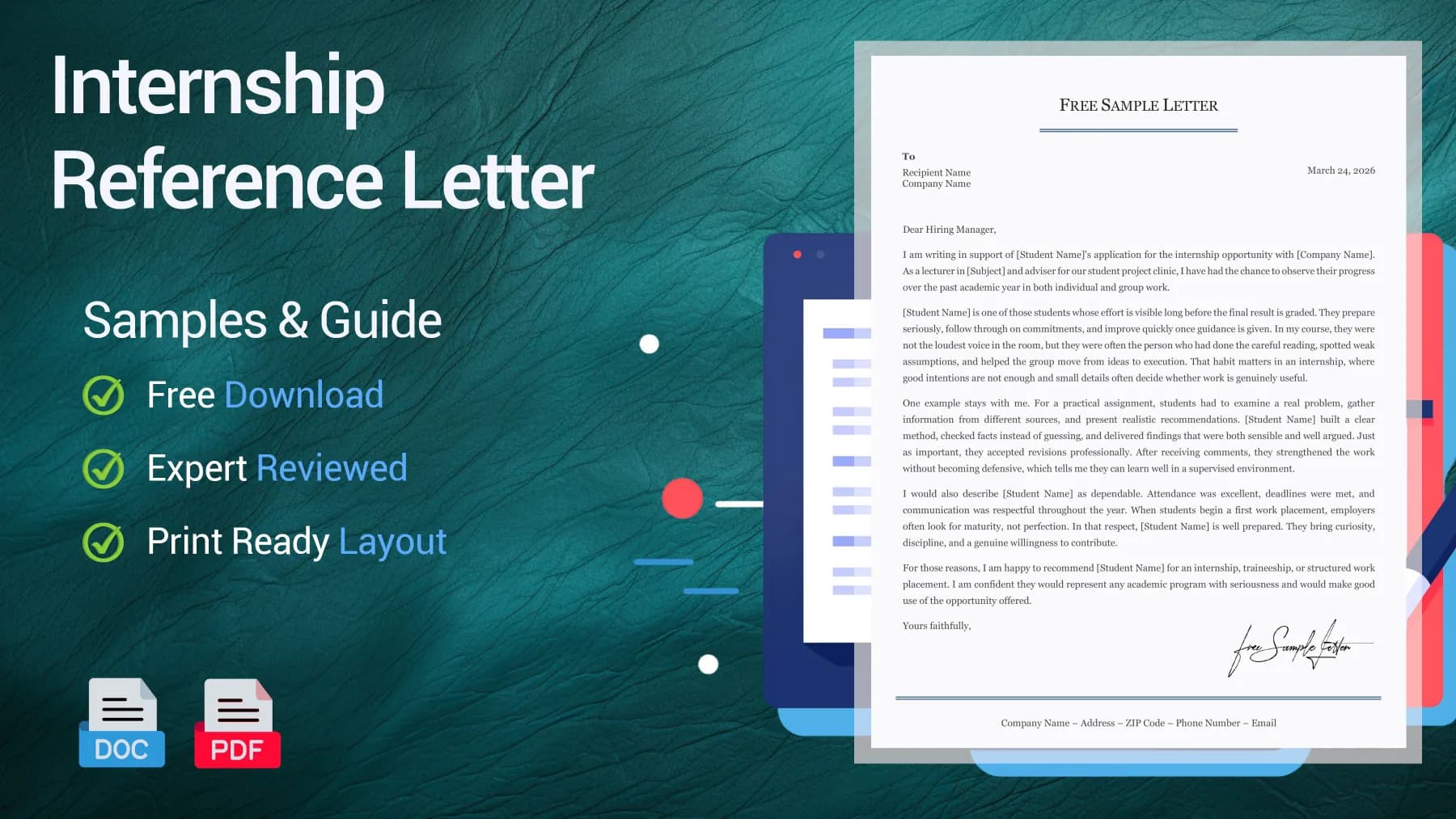
Free Samples for Internship, Traineeship and Work Placement Applications
Deloitte notes that 57% of U.S. hiring organizations reported that recent graduates lacked workplace professionalism, and 38% avoided hiring Gen Z graduates for that reason, based on a December 2023 survey cited in its 2025 report. In practical terms, an internship reference letter must demonstrate reliability, sound judgment, and follow-through, not just potential.
Internship Reference Letter for an Undergraduate Student
Built for an undergraduate seeking a first internship, this reference letter turns classroom promise into employer-ready proof. It highlights reliability, curiosity, and learning speed.
Dear Hiring Manager,
I am writing to support [Student Name]'s application for the internship at [Company Name]. As a lecturer in [Subject] and adviser for our student project clinic, I have observed their progress throughout the past academic year, both in individual assignments and group projects.
[Student Name] stands out for showing consistent effort well before the final result is graded. They prepare thoroughly, follow through on commitments, and respond quickly to feedback. In my course, they were not the most vocal, but they were always well-prepared, identified overlooked issues, and helped the group move from ideas to execution. This habit is especially valuable in an internship, where attention to detail and follow-through can make the difference between useful and unused work.
One example stands out. For a practical assignment, students examined a real problem, gathered information from multiple sources, and presented realistic recommendations. [Student Name] developed a clear approach, verified facts rather than guessing, and delivered findings that were both logical and well supported. Equally important, they accepted feedback professionally, strengthening their work without becoming defensive. This shows they can learn effectively in a supervised environment.
[Student Name] is also highly dependable. Their attendance was excellent, deadlines were consistently met, and communication remained respectful all year. When students start a first work placement, employers value maturity over perfection. In this regard, [Student Name] is well prepared. They bring curiosity, discipline, and a genuine willingness to contribute.
For these reasons, I am pleased to recommend [Student Name] for an internship, traineeship, or structured work placement. I am confident they will represent any academic program seriously and make full use of the opportunity offered.
Yours faithfully,

Reviewed by Emma C., Education Advisor
I like the balance here. It reads like a real teacher recommendation, with enough substance and restraint to support an internship decision.
Work Placement Recommendation for a Recent Graduate
Made for a recent graduate aiming at a trainee role, this sample connects academic results with professional readiness. It helps the recommender sound specific, not overly formal.
To Whom It May Concern,
I am pleased to recommend [Graduate Name] for your graduate traineeship program. I taught them during the final stage of our [Degree Name] and later supervised their capstone project, giving me direct insight into both their academic ability and professional attitude.
While many recent graduates need time to turn academic success into workplace value, [Graduate Name] is already making that transition. They approach work methodically, communicate clearly, and recognize that strong performance depends on preparation, follow-through, and meeting deadlines. During their final project, they managed a demanding workload that included research, analysis, and presentation, all while keeping their work organized and on track.
What impressed me most was their judgment. When projects became complex, some graduates tended to overcomplicate matters or seek constant reassurance. [Graduate Name] did neither. They sought guidance when appropriate, made sound decisions independently, and stayed focused on objectives instead of getting lost in details. This balance is rare at this stage and makes them particularly well suited for a trainee role where learning and contribution must go hand in hand.
They also work well with others. In seminars and project meetings, [Graduate Name] contributed ideas without seeking attention, listened carefully, responded thoughtfully, and showed genuine respect for different viewpoints. This level of maturity is valuable in any structured internship or work placement, especially when joining an established team.
I recommend [Graduate Name] to any employer seeking a recent graduate with strong learning agility, reliable work habits, and the potential to become productive quickly. They are committed to their field, receptive to feedback, and ready to grow in a demanding environment.
Please feel free to contact me if further information would be helpful.
Sincerely,
Reviewed by Emma C., Education Advisor
I find this version strong because it translates academic success into workplace value, which is exactly what a graduate reference should do.
Apprenticeship Reference Letter for a Vocational Student
Created for a vocational student or apprentice, this sample values practical habits over polished language. It gives real weight to punctuality, safety, and hands-on progress.
To Whom It May Concern,
I am writing to recommend [Apprentice Name] for a work placement or apprenticeship opportunity. I supervised them during practical training in our [Workshop, Lab, or Training Center] and observed their progress in daily tasks that demanded care, punctuality, and steady effort.
From the start, [Apprentice Name] stood out for their dependability. They arrived on time, stayed focused, and never treated routine work as unimportant. In hands-on learning environments, this attitude is crucial. Employers need someone who consistently shows up, listens carefully, and follows instructions without creating unnecessary problems. [Apprentice Name] has demonstrated all of these habits.
Their technical skills are still developing, as expected at this stage, but their progress has been strong because they learn the right way. They pay attention during demonstrations, ask good questions, and apply corrections quickly. I have seen them improve their accuracy through repetition, rather than rushing to appear confident. This shows they understand the importance of doing the job safely and correctly.
Another strength is their attitude. [Apprentice Name] accepts guidance readily and works respectfully with both instructors and other trainees. Even when tasks are repetitive or physically demanding, they remain engaged. When mistakes occur, they correct them and move on. This kind of coachability is one of the clearest signs of long-term potential in a hands-on role.
I confidently recommend [Apprentice Name] for any practical placement, vocational internship, or apprenticeship where reliability and a willingness to learn are valued. They are building the right professional habits and, in my opinion, would be a positive addition to any supervised team environment.
Please feel free to contact me if more information is needed.
Sincerely,
Reviewed by Emma C., Education Advisor
I trust this letter because it respects the reality of hands-on roles. It shows discipline, consistency, and attitude with no fluff.
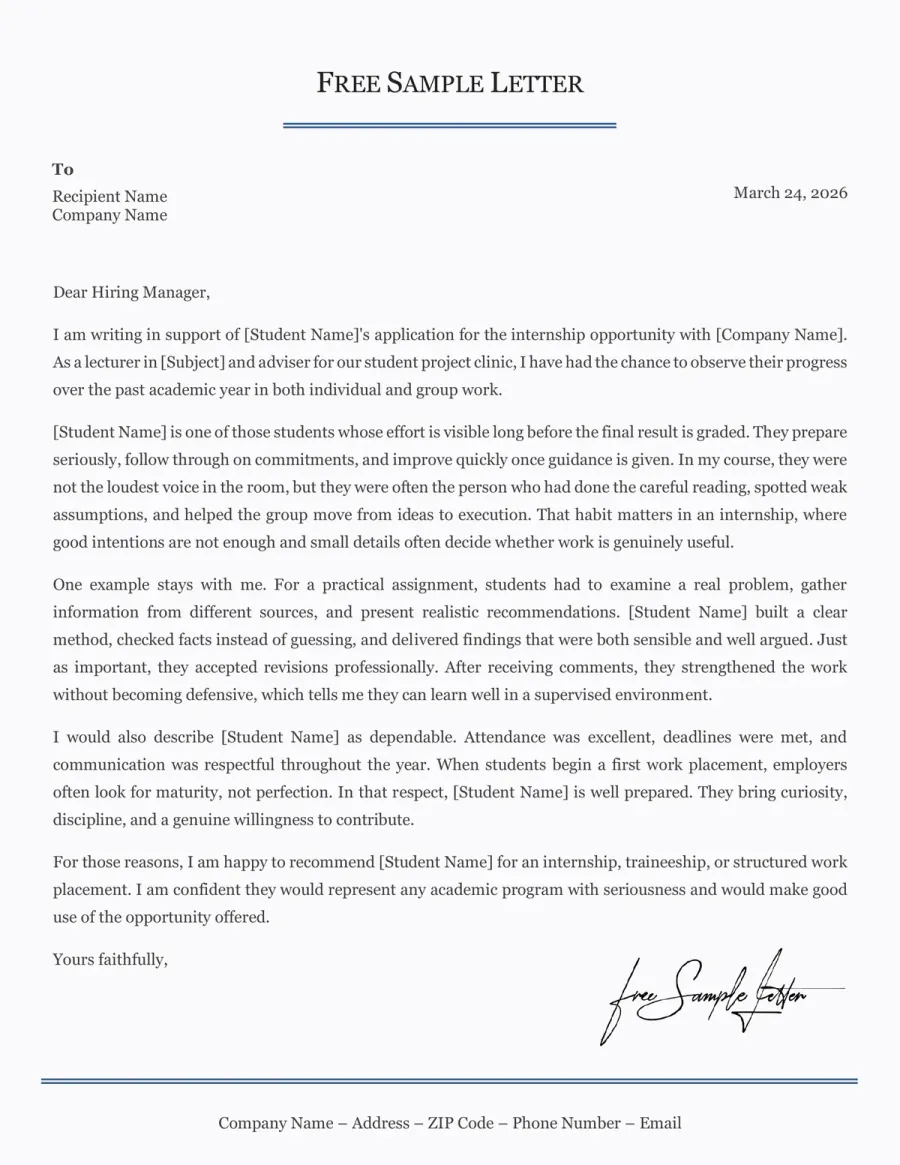
Preview This Internship Reference Letter Template Before Word or PDF Download
Review the internship reference letter template before downloading the editable Word or PDF version. This sample is suitable for traineeship, work placement, or apprenticeship applications as well.
Adapt These Internship Reference Letter Templates
Generic copy-paste letters often lose credibility. A strong reference should feel tailored to a specific student, referee, and internship goal. Adjust the examples, the relationship context, and the closing so the letter feels authentic, not reused.
➡️ Read our expert guide how to adapt a recommendation letter to a real application
Clarify the Referee’s Link to the Student
Begin by explaining why the referee is qualified to recommend the student. The reader should quickly understand who supervised the student, in what setting, and for how long.
See Open sample wording
I taught [Student Name] in two upper-level finance courses and supervised their final group project over one academic year, which gave me a clear view of their work habits and progress.
Match the Letter to the Exact Internship Goal
Be specific about the internship or placement. Engineering roles, summer traineeships, and apprenticeships each require different types of evidence, tone, and examples.
See View targeted phrasing
I am pleased to recommend [Student Name] for a data analysis internship, where careful research, deadline discipline, and clear reporting will matter from day one.
Replace Praise With Verifiable Proof
Words like bright, serious, or motivated mean little without evidence. Add a specific academic, project-based, or practical example to make each claim convincing.
See Read proof-based lines
During a research assignment, [Student Name] organized source material, checked conflicting data, and delivered a clear final report two days before the deadline.
Highlight Workplace Behaviors, Not Just Grades
Strong grades help, but they are rarely enough. Internship and traineeship letters are much stronger when they demonstrate punctuality, coachability, communication, and follow-through through real examples.
See employer-ready wording
What impressed me most was not only the quality of the work, but the way [Student Name] accepted feedback, adjusted quickly, and stayed dependable in group work.
Close With a Precise Recommendation
The closing should do more than sound polite. Specify the type of opportunity you recommend the student for, then reinforce two or three strengths that make your recommendation credible.
See Open closing example
I recommend [Student Name] with confidence for an internship, traineeship, or work placement in business administration, especially where reliability and quick learning are valued.
Keyword Radar for a Strong Internship Reference Letter
- Reliable
- Coachability
- Clear written communication
- Work placement readiness
- Group project accountability
- Attendance
- Apprenticeship potential
- Evidence of initiative
- Professional attitude
- Turns coursework into workplace value
- Traineeship fit
- Practical learning ability
- Respectful team behavior in real tasks
- Mentor endorsement
- Problem-solving
Do & Don't - What Makes This Reference Letter Believable
Recruiters review these letters quickly. What stands out is not polished praise but proof that the student was observed closely, managed real responsibilities well, and is being recommended for a specific reason.
Red Flags in an Internship Reference Letter
Red Flags- Generic praise with no example behind it
- No clear link between the referee and the student
- Overstated claims that do not match an internship level
- A letter that could fit any field or any candidate
- Too much focus on grades and none on behavior
- A weak closing that never clearly recommends the student
Trust Signals in an Internship Reference Letter
Trust Signals- State the teaching, mentoring, or supervisory context early
- Use one or two concrete examples from class or projects
- Show reliability, coachability, and communication in action
- Match the wording to the internship, traineeship, or work placement type
- Keep the tone measured and credible from start to finish
- Close with a direct recommendation tied to the student’s strengths
FAQ - Internship Reference Letter
Can a professor write an internship reference letter if they never supervised me at work? Toggle answer
Yes, if they know how you learn, meet deadlines, handle feedback, and contribute in projects. For an internship reference letter, close observation matters more than formal job history.
Is a detailed letter from a regular lecturer better than a generic one from a famous professor? Toggle answer
Almost always, yes. Recruiters trust specifics. A precise letter with real examples beats a prestigious signature attached to vague praise.
What should the letter focus on when the student has no real job experience yet? Toggle answer
It should demonstrate workplace potential through academic and practical evidence, such as reliability, learning speed, teamwork, punctuality, initiative, and how the student managed real assignments or supervised tasks.
What should I send the recommender so the letter does not sound vague? Toggle answer
Share the internship description, your CV, the target field, key projects, and a few reminders of what they directly observed. That gives the referee enough material to write something concrete.
What should I do if a professor warns me the letter may be generic? Toggle answer
Take this as a genuine warning, not just a formality. A generic or lukewarm internship recommendation letter can undermine your application. If possible, choose someone who knows your work directly.
TL;DR - What Makes an Internship Reference Letter Worth Reading
A strong internship reference letter does three things fast: it explains how the referee knows the student, ties the endorsement to a real internship or traineeship goal, and proves potential with concrete examples. The fatal mistake is easy to spot: broad praise with no evidence behind it.
What really lands is not elegance. It is credibility. A precise internship recommendation letter from a professor, mentor, lab supervisor, or instructor who actually observed the student will usually carry more weight than a polished but generic endorsement. That is the difference between support and filler.