
MBA, Master and Bachelor Reference Letter Examples for 2026
Admissions teams can quickly spot a vague recommendation. These examples show how to highlight academic achievement, leadership, and genuine potential in a reference letter that truly supports an application.
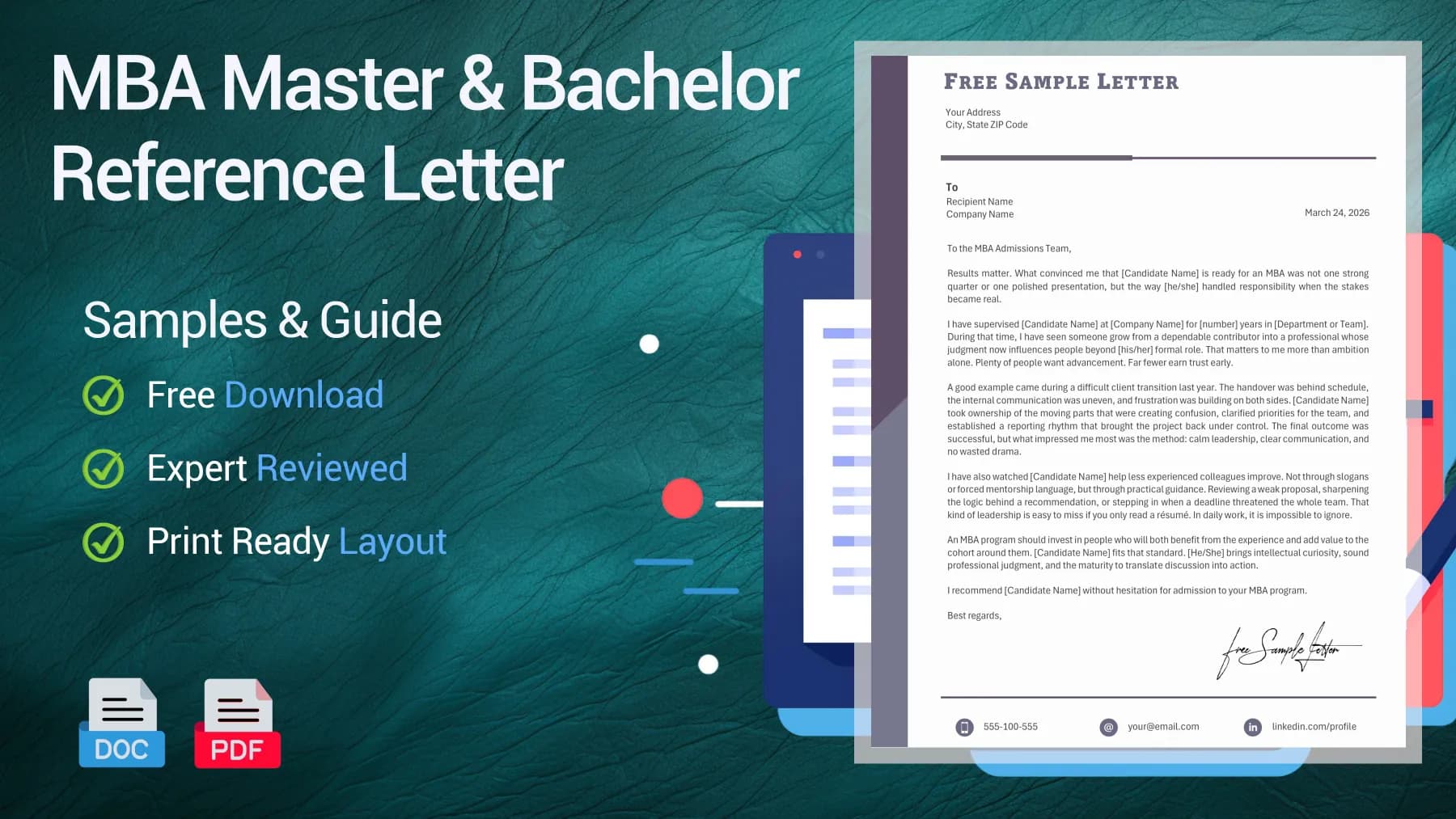
Free Recommendation Letters for MBA, Master and Graduate Program Applications
GMAC says in its 2026 MBA guide that applicants usually need two recommendation letters and should choose recommenders who know them well. For this page, specific evidence and direct observation matter far more than prestige.
MBA Reference Letter from a Manager or Supervisor
A professional MBA recommendation needs more than generic praise from a boss. This version shows leadership, execution, and management potential with examples that fit a business school application.
Dear MBA Admissions Team,
Results matter. What convinced me that [Candidate Name] is ready for an MBA was not simply a strong quarter or a polished presentation, but how [he/she] handled real responsibility when the stakes were high.
I have supervised [Candidate Name] at [Company Name] for [number] years in [Department or Team]. During that time, I have watched [him/her] grow from a dependable contributor into a professional whose judgment now influences people beyond [his/her] formal role. That matters more to me than ambition alone. Many people want advancement. Far fewer earn trust early.
One example stands out from a difficult client transition last year. The handover was behind schedule, internal communication was uneven, and frustration was growing on both sides. [Candidate Name] took ownership of the factors causing confusion, clarified priorities for the team, and set up a reporting rhythm that brought the project back on track. The outcome was successful, but what impressed me most was the approach: calm leadership, clear communication, and no wasted drama.
I have also seen [Candidate Name] help less experienced colleagues improve, not through slogans or forced mentorship, but through practical guidance: reviewing a weak proposal, sharpening the logic behind a recommendation, or stepping in when a deadline threatened the team. That kind of leadership may be easy to miss on a résumé, but in daily work, it is impossible to ignore.
An MBA program should invest in people who will benefit from the experience and add value to their peers. [Candidate Name] fits that standard. [He/She] brings intellectual curiosity, sound judgment, and the maturity to turn discussion into action.
I recommend [Candidate Name] without hesitation for admission to your MBA program.
Best regards,

Reviewed by Emma C., Education Advisor
I would keep this application in the serious pile. The tone is measured, and the examples make the MBA potential feel earned.
Reference Letter for Bachelor or Master Admission
Designed for a student applying to a bachelor’s or master’s program, this sample focuses on academic discipline, curiosity, and readiness for higher studies without sounding inflated.
Dear Admissions Committee,
I am pleased to recommend [Candidate Name] for admission to your bachelor’s or master’s program. I have taught [him/her] in [Course Name] and followed [his/her] academic progress closely through coursework, written assignments, and class discussions. Over that period, I saw not just a capable student, but someone who approaches learning with seriousness and consistent effort.
What sets [Candidate Name] apart is not just the ability to earn strong results. Many students perform well when expectations are clear and the path is straightforward. What impressed me more was how [he/she] responded when the work required patience, reflection, and revision. In one major assignment, for example, [Candidate Name] chose a challenging topic, worked through complex materials carefully, and improved the final paper significantly after feedback. That willingness to refine an argument instead of defending weak first ideas is, in my experience, one of the clearest signs of true study potential.
I also want to highlight [his/her] attitude in the academic setting. [Candidate Name] is thoughtful in discussion, respectful of other viewpoints, and dependable when it comes to deadlines. There is no need to stand out through performance or empty confidence. Instead, [he/she] contributes through preparation, discipline, and a clear interest in truly understanding the subject. These qualities matter in higher education, where independent effort is just as important as natural ability.
For these reasons, I recommend [Candidate Name] with confidence for further study. Whether in a bachelor’s or master’s setting, I believe [he/she] would bring intellectual seriousness, steady work habits, and the maturity to make the most of advanced education.
Sincerely,
Reviewed by Emma C., Education Advisor
I trust this sample because it shows how the student learns, revises, and handles demanding study expectations without sounding inflated.
Master’s Recommendation Letter for a Career Changer
This version is built for a mid-career applicant changing direction. It makes the transition feel deliberate by tying past strengths, recent study efforts, and graduate readiness into one story.
Dear Admissions Committee,
A career change can look uncertain on paper. In person, however, it is often much easier to judge whether it comes from restlessness or true conviction. In [Candidate Name]'s case, I have no doubt which applies.
I worked with [Candidate Name] at [Organization Name] for [number] years in [Previous Field]. During that time, [he/she] built a strong reputation for reliability, sound judgment, and consistent performance. What changed was not the quality of [his/her] work, but the direction of [his/her] long-term interests. Over time, it became clear that [Candidate Name] was not pursuing graduate study as a way to escape challenges. The decision was thoughtful, researched, and backed by sustained effort.
I saw that effort firsthand. While still managing professional responsibilities, [Candidate Name] completed additional coursework in [New Subject or Field], asked insightful questions about the academic demands of the transition, and demonstrated the discipline to learn beyond familiar territory. That stands out because many people talk about reinvention in broad terms. [Candidate Name] did the harder work and built real evidence for it.
One moment stands out: we were discussing a project issue related to user behavior and data interpretation. Although this was outside [his/her] original role, [Candidate Name] had clearly spent time developing new knowledge and was able to bring a fresh, structured perspective to the conversation. It was not superficial curiosity, but the start of a genuine new professional direction.
I recommend [Candidate Name] for admission to your master’s program because [he/she] combines maturity with humility. There is enough confidence to start over and enough realism to do the work well. In graduate study, especially for someone changing fields, that balance is essential.
Sincerely,
Reviewed by Emma C., Education Advisor
I find this career-change reference strong because it makes the pivot feel disciplined and earned, not like a vague reset story.
Preview These Recommendation Letter Templates Before Word/PDF Download
Preview our reference letter templates before downloading an editable Word version or PDF file. These samples are suitable for bachelor’s admission, graduate studies, and career-change applications.
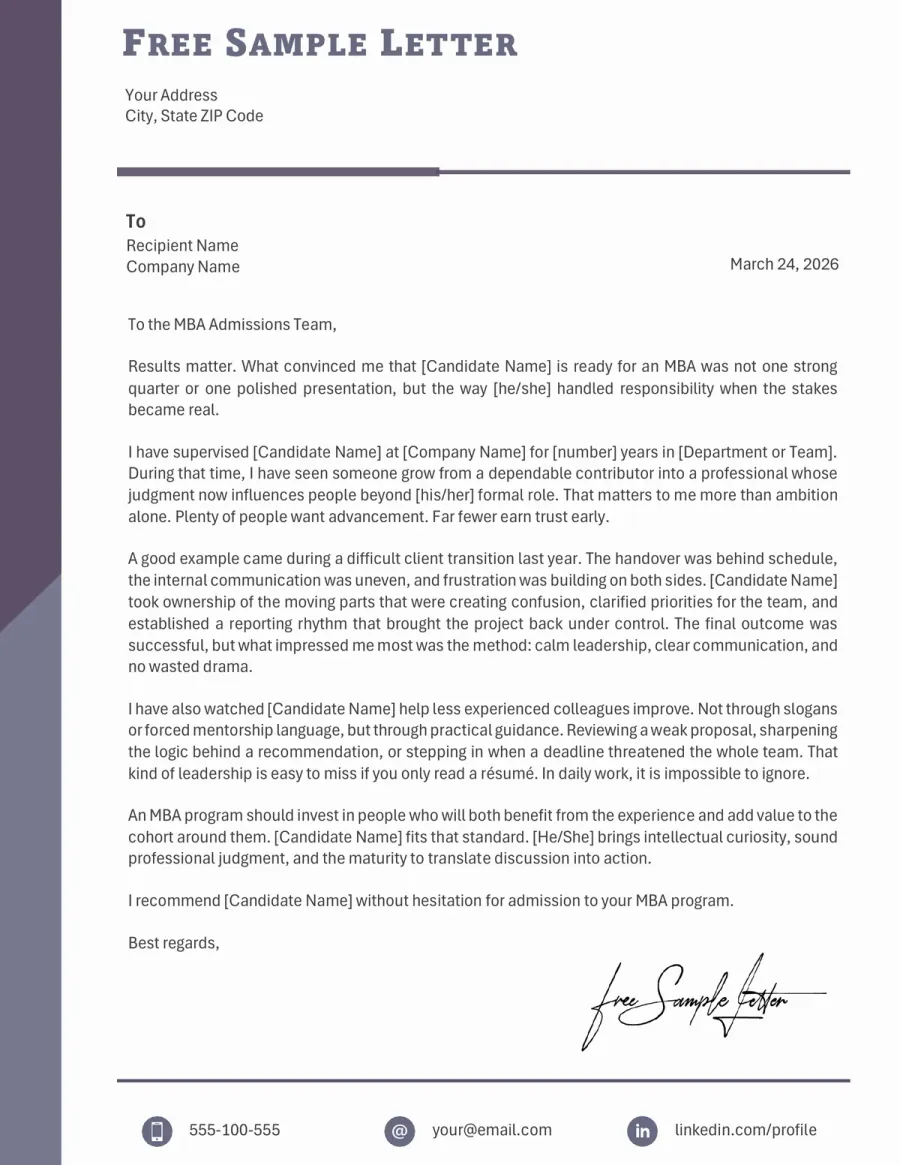
Adapt These MBA and Study Recommendation Templates
Copy-pasting damages credibility quickly in graduate admissions. A strong recommendation letter should feel specific to one student, one referee, and one program. Adapt the relationship, examples, and closing so the letter feels genuine and directly observed, not recycled.
➡️ Get sharper tips in our article how to make a reference letter feel personal instead of generic
Choose the Right Referee First
The strongest letters come from the right person. Choose someone who has seen the applicant think, work, improve, or lead over time, not just the most senior name available.
See Open sample wording
I taught [Candidate Name] in two graduate-level courses and supervised the final strategy project, which allowed me to observe both academic discipline and leadership in practice.
Match the Letter to the Exact Program
An MBA reference letter should not sound like a bachelor’s reference, and a master’s recommendation should not read like a job endorsement. Tailor the tone and examples to match the target program.
See View targeted phrasing
I recommend [Candidate Name] for your MBA program because [he/she] combines analytical discipline, leadership under pressure, and the maturity to contribute to peer learning.
Replace Praise With Specific Proof
Words like outstanding, brilliant, or highly motivated mean little on their own. The letter becomes convincing when each strength is supported by a specific example, project, or observed result.
See Read proof-based lines
During a case-study assignment, [Candidate Name] challenged a weak assumption, reorganized the team’s reasoning, and helped produce a far stronger final recommendation.
Show Readiness Beyond Grades or Titles
Admissions readers already have transcripts, test scores, and résumés. The letter should provide what those documents cannot: maturity, openness to feedback, judgment, teamwork, and learning habits.
See an example
What impressed me most was not only [Candidate Name]'s performance, but the calm way [he/she] handled criticism, adjusted quickly, and supported others during group work.
End With a Clear, Program-Specific Recommendation
The closing should not fade into politeness. Clearly state what the applicant is being recommended for, and reinforce the two or three qualities that make your support credible.
See Open closing example
I recommend [Candidate Name] with confidence for your master’s program and believe [he/she] will bring discipline, intellectual curiosity, and a serious approach to graduate study.
Keyword Radar for a Strong School or University Reference Letter
- Leadership
- Program fit
- Classroom credibility
- Intellectual curiosity
- Manager endorsement
- Admissions-ready tone
- Direct observation
- Specific anecdote
- Graduate-level maturity
- Academic rigor
- Referee authority
- Consistent follow-through
- Thoughtful response to feedback
- Study readiness
Do & Don't - What Makes This Recommendation Letter Convincing
Admissions readers move quickly. They already have grades, scores, and résumés. What matters here is judgment, direct observation, and evidence that the recommendation is written specifically for this applicant, not just anyone with a polished profile.
What Makes a Study Reference Letter Sound Generic
Red Flags- Choose a prestigious referee who barely knows the applicant
- Repeat the résumé instead of offering real personal observation
- Pile on adjectives without one concrete example
- Keep the same tone for an MBA and a bachelor application
- Close politely but fail to make a clear recommendation
What Strengthens an Academic Recommendation Letter
Trust Signals- Name the relationship and context in the opening lines
- Show one specific moment that reveals character or ability
- Match the endorsement to the specific degree or program type
- Add evidence of maturity, revision and follow-through
- Finish with a direct, confident recommendation
FAQ - MBA, Master or Bachelor Letter of Recommendation
Is a current manager better than a former professor for an MBA recommendation letter? Toggle answer
Usually, yes, if that manager has closely observed your judgment, leadership, and daily work. For an MBA, direct professional observation is often more valuable than distant academic prestige.
Will a generic recommendation letter weaken a master’s application? Toggle answer
Yes. A vague letter rarely adds value. Admissions readers want evidence, not just polite adjectives. If the recommender cannot be specific, the letter may feel like filler rather than real support.
What should I send a recommender so the letter sounds specific? Toggle answer
Send your CV, target programs, deadlines, a brief reminder of projects or classes you shared, and the strengths you hope they can honestly support. This makes the letter more focused and easier to trust.
Can I use a professional recommender for a master’s application if I have been out of school for years? Toggle answer
Absolutely, especially if they can speak to your discipline, growth, responsibility, and why graduate study now makes sense. For non-traditional applicants, this can be more useful than an outdated academic letter.
How should a reference letter explain a career change toward graduate study? Toggle answer
It should show the move is deliberate, not impulsive. The best letters connect past strengths, recent learning, and a clear reason the applicant is ready for advanced study in a new field.
TL;DR - What Makes an MBA or Master Reference Letter Worth Reading
A strong MBA or master reference letter does not repeat a transcript or a résumé. It explains why this recommender matters, shows one or two real examples, and connects the applicant to the exact program with credibility.
The weak version is easy to spot. It praises everything, proves nothing, and could belong to almost anyone. The strong one feels observed. That is what makes an admissions reader slow down and take the endorsement seriously.