
How to Request a Recommendation Letter for Work or Study in 2026
A strong request goes beyond being polite. It provides your recommender with clear context, timing, and enough detail to write a letter that genuinely supports your application or study plans.
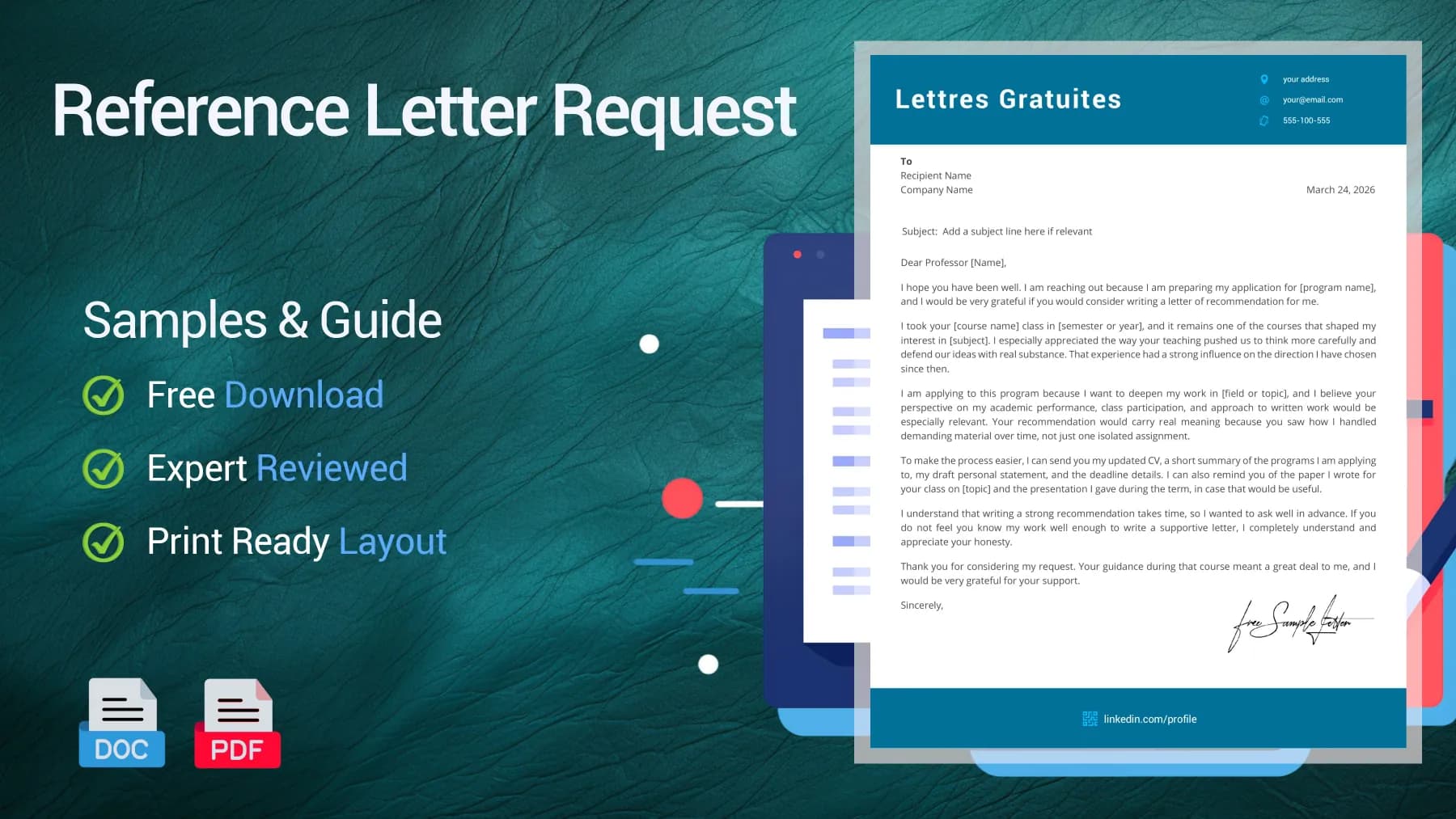
Free Samples for Reference Letter Request
GMAC advises applicants to choose recommenders who have worked closely with them. In practice, this means you should ask someone who can provide direct examples of your work, rather than simply choosing the person with the most impressive title.
Request a Letter of Recommendation From a College Teacher
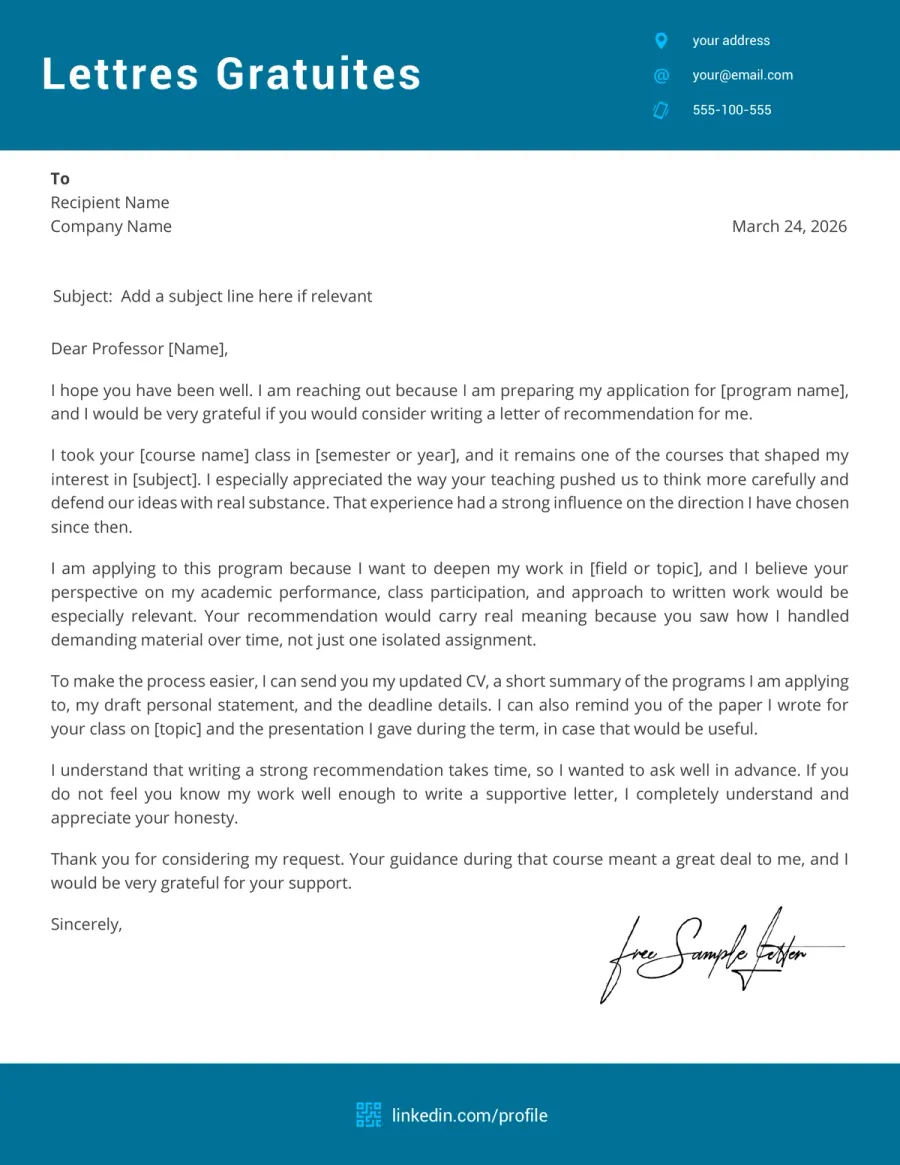
This sample is designed for a student requesting support from a college teacher. It provides enough context without sounding burdensome, making the request feel respectful, specific, and easy to respond to.
Dear Professor [Name],
I hope you have been well. I am reaching out because I am preparing my application for [program name], and I would be very grateful if you would consider writing a letter of recommendation for me.
I took your [course name] class in [semester or year], and it remains one of the courses that shaped my interest in [subject]. I especially appreciated how your teaching encouraged us to think critically and defend our ideas with substance. That experience strongly influenced the direction I have chosen since then.
I am applying to this program because I want to deepen my work in [field or topic], and I believe your perspective on my academic performance, class participation, and approach to written work is especially relevant. Your recommendation would be meaningful because you observed how I managed challenging material throughout the course, not just on a single assignment.
To make the process easier, I can send you my updated CV, a brief summary of the programs I am applying to, my draft personal statement, and deadline details. I can also remind you of the paper I wrote for your class on [topic] and the presentation I gave during the term, if that would be helpful.
I understand that writing a strong recommendation takes time, so I wanted to reach out well in advance. If you do not feel you know my work well enough to write a supportive letter, I completely understand and appreciate your honesty.
Thank you for considering my request. Your guidance during that course meant a great deal to me, and I would be very grateful for your support.
Sincerely,
[Your Name]

Reviewed by Olivia B., HR Consultant
This sample stands out because it remains respectful without sounding stiff and gives the professor enough context to write a meaningful letter.
Request a Letter of Reference From an Employer
This sample is intended for a professional request to a manager or employer. It maintains a direct and mature tone, allowing the writer to make a clear request without sounding overly formal or uncomfortable.
Dear [Manager Name],
I hope you are doing well. I am writing to ask whether you would be comfortable providing a letter of reference for me as I apply for [job, program, or training opportunity].
Working with you at [company name] has been a key part of my professional development. During my time on the [team or department], I learned a great deal about managing responsibility, meeting expectations, and contributing effectively in a professional setting. Because you have seen my work directly, I believe your perspective would be both relevant and meaningful.
I am applying for this opportunity to take the next step in [career goal or field], and I believe a reference from you could highlight the practical side of my experience better than my CV alone. In particular, you could speak to my work on [project, responsibility, or task], my reliability under deadlines, and how I have collaborated within the team.
To make the process easier, I can send you the job posting, my updated CV, and a brief summary of the key points that may be most helpful to highlight. I am also happy to provide the deadline and submission instructions together, so the request is straightforward on your end.
I completely understand if your schedule does not allow it or if you prefer not to provide a reference at this time. I wanted to ask directly and respectfully, as I value your judgment and the experience I gained while working with you.
Thank you for considering my request. I sincerely appreciate your support and everything I have learned under your supervision.
Kind regards,
[Your Name]
Reviewed by Olivia B., HR Consultant
This version remains professional without sounding cold and makes the employer’s role in the request very clear.
Request a Recommendation Letter From an Internship Supervisor
Designed for a shorter professional relationship, this sample helps the candidate quickly reestablish context. It works well for internships, placements, and supervised project-based experience.
Dear [Supervisor Name],
I hope you have been well since my internship at [organization name]. I am writing to ask whether you would be willing to provide a letter of recommendation for me as I apply for [job, program, or internship].
Although our time working together was limited to [internship period], I learned a great deal during that experience and truly valued your supervision. Because you saw my work directly on [project, task, or department], I believe your recommendation would be especially helpful. You observed not only the final results of my work, but also how I handled feedback, deadlines, and day-to-day responsibilities in a professional setting.
I am currently applying for [target opportunity], and I think your perspective could highlight the practical side of my experience more clearly than my résumé can. In particular, you could speak to my work on [specific task], how I adapted to the team, and the way I responded to guidance during the internship.
If you are willing, I can send you my updated CV, a brief description of the opportunity, the deadline, and a few reminders about the projects I supported while with your team. My goal is to make this request as straightforward and useful as possible.
I completely understand if your schedule does not allow it or if you feel you do not know my work well enough to write a detailed letter. Either way, thank you again for the opportunity and for everything I learned under your supervision.
Sincerely,
[Your Name]
Reviewed by Olivia B., HR Consultant
This sample rebuilds context quickly and makes a shorter mentoring relationship feel credible for a strong letter.
Preview a Request a Letter of Recommendation Template Before Word/PDF Download
Preview a reference letter request template before downloading the editable Word file or PDF version. These samples are also suitable for recommendation request emails sent to a professor, employer, or mentor.
Adapt These Reference Letter Request Templates
Copy-pasting often comes across as lazy in a recommendation request. The strongest messages feel personal, timely, and easy to answer. Adjust the relationship, the purpose, and the reminder details so your request feels genuine and well-earned.
➡️ More expert advice in our article how to write a recommendation letter that sounds specific and credible
Pick the Right Person Before You Write
Start with someone who has genuinely seen your work, attitude, or progress. A shorter but real relationship is more valuable than a big title with only a vague memory of your efforts.
See Open sample wording
I am reaching out because your class gave you a direct view of my work over the full semester, and I believe your perspective would be especially relevant for this application.
Rebuild Context Fast
Do not assume the recommender remembers every detail. Remind them who you are, where you worked together, and which course, project, internship, or team connects you both.
See View context reminder
I took your [course name] class in [term], and I also completed the final paper on [topic], which had a strong influence on my decision to apply.
Explain Exactly What the Letter Is For
A request is stronger when the purpose is clear. State whether the letter supports a master’s program, internship, first job, scholarship, or internal promotion.
See targeted phrasing
I am applying to [program name], and I believe your recommendation could help explain my academic discipline and how I approached demanding coursework.
Give Useful Material, Not a Burden
Make it easier for your recommender by providing useful support: your CV, deadlines, target programs, and a few concise reminder points. Avoid overwhelming them with too much information at once.
See Open support details
If helpful, I can send my updated CV, the deadline, a short summary of the program, and a few reminders about the work we did together.
Leave Space for an Honest No
End your request respectfully, without pressure. If a recommender feels trapped, they may agree but write a less enthusiastic letter. Give them space to decline gracefully.
See Open closing example
If you do not feel you know my work well enough to write a supportive letter, I completely understand and appreciate your honesty.
Keyword Radar for a Strong Reference Letter Request
- Course reminder
- Supportive letter
- Updated CV
- Deadline details
- Brief context
- Workplace reference request
- Application goal stated in one line
- Direct observation
- Polite tone
- Career goal
- Relevant strengths
- Easy to answer
- Professional wording
Do & Don't - What Makes a Reference Request Worth Answering
The person reading your message decides quickly: an easy yes, an awkward maybe, or polite silence. What matters is not perfect phrasing, but clear context, a real reason for asking, and a request that feels manageable from the start.
What Makes the Request Feel Vague or Awkward
Red Flags- Ask someone who barely remembers your work
- Open with a vague favor and no context
- Hide the real purpose of the letter
- Dump too many details in one block
- Push for a yes without offering an easy out
What Makes the Message Easy to Support
Trust Signals- Name the course, team, project or internship early
- State the target program or role in one clear line
- Remind them of work they truly observed
- Offer your CV, deadlines and submission details
- Leave space for an honest refusal
FAQ - Request a Letter of Recommendation
How should I ask for a reference letter? Toggle answer
Keep your request polite, brief, and clear. A short email or letter is usually sufficient if it explains the purpose and provides useful context. If the person declines or seems unable to write a strong letter, thank them and seek another recommender.
When should I ask, and who should I choose? Toggle answer
Ask as early as possible. Two weeks’ notice is a sensible minimum. Choose someone who knows your work well enough to describe your strengths in a real academic or professional setting. If you are not confident they can write a supportive letter, consider asking someone else.
How much notice should I give before asking for a recommendation letter? Toggle answer
At least two weeks’ notice is a sensible minimum; more is better. A rushed request often leads to a weaker letter, even when the person wants to help.
What should I provide with my request? Toggle answer
Provide your updated résumé, the job posting or application requirements, the dates you worked together, a brief reminder of your relationship, and your contact details. This gives the recommender enough context to write a more targeted and useful letter.
Is it okay to ask a professor for a recommendation letter years later? Toggle answer
Yes, you can ask a professor years later if they genuinely remember your work or if you can clearly remind them of your connection. Mention the class, the term, and specific work you completed together.
Should I ask the most senior person I know, or the one who knows my work best? Toggle answer
Ask the person who can be specific about your work. Direct observation is more valuable than prestige. A detailed letter from someone who knows your work well is usually much stronger than a vague letter from a more senior contact.
TL;DR - What Makes a Recommendation Request Worth Answering
A strong recommendation request is clear and direct. It reminds the recipient who you are, explains the purpose of the letter, and provides enough material to make agreeing easy and straightforward.
A weak request feels vague from the beginning. A strong one feels easy to answer. That difference often determines whether you receive a polite promise or a letter that genuinely helps.