
Employment Reference Check Response Letter Examples
An employment reference check response should provide useful, verified information without oversharing. These examples help employers confirm facts, limit unnecessary detail and respond consistently.
Before You Send an Employment Reference Response
An employment reference response is a formal HR record, not a personal opinion. Before replying, verify the employee’s or former employee’s authorization, review your company reference policy, confirm employment dates, job title and role history, and check whether the reason for leaving has been disclosed. Only provide information your organization is permitted to share.
Keep the response accurate, fair and consistent. Acas explains that if an employer provides a reference, it must be accurate and fair, and the employer can decide how much information to include: Acas reference guidance. GOV.UK also notes that employers do not usually have to give a work reference, except in some situations, but if they do, it must be fair and accurate: GOV.UK work reference guidance.
Do not include private details, unsupported opinions, medical information, references to protected characteristics, internal disputes, confidential investigations or informal comments that cannot be verified. If your policy is to provide only employment dates and job title, state that clearly and apply it consistently.
Factual Employment Reference Check Response
A careful, factual employment reference response for employers who confirm only verified employment dates, role and basic job details.
Dear [Recipient Name],
We are responding to your request for an employment reference regarding [Employee Name].
According to our records, [Employee Name] was employed by [Company Name] from [Start Date] to [End Date]. Their most recent position was [Job Title] in the [Department / Team Name].
The role involved [brief description of main duties], including [responsibility 1], [responsibility 2] and [responsibility 3], as recorded in our employment records.
Consistent with our company reference policy, we are providing factual employment information only. We do not provide detailed performance assessments, personal opinions or information outside the verified employment record.
If you need confirmation that this response was issued by [Company Name], please contact [HR Contact Name] at [Email Address].
Sincerely,
[Your Name]
[Your Position] [Company Name]

Reviewed by Michael T., Business Communications Consultant
This response is effective because it provides useful verified facts while clearly stating the company’s reference policy.
Positive Reference Check Response From an Employer
A measured positive employer reference response when company policy allows comments on duties, strengths and work contributions.
Dear [Recipient Name],
Thank you for contacting us regarding [Employee Name], who has authorized [Company Name] to provide this employment reference.
[Employee Name] was employed as [Job Title] from [Start Date] to [End Date]. In this role, they were responsible for [main duties / area of work], including [specific duty 1] and [specific duty 2].
During their time with [Company Name], [Employee Name] demonstrated [verified strength: reliability, attention to detail, customer service, technical skill, teamwork or leadership] in [specific work context]. They contributed to [project / team / business function] by [brief factual example if appropriate].
Based on our records and our experience working with [Employee Name], we can confirm that they performed the duties described above in a professional manner.
This reference is provided in good faith and in accordance with our company policy. Please contact [HR Contact Name] if you need to verify the employment details included in this letter.
Sincerely,
[Your Name]
[Your Position] [Company Name]
Reviewed by Michael T., Business Communications Consultant
This version provides a positive reference without relying on vague praise. It links positive comments to specific duties and a factual work context.
Reference Response Limited by Company Policy
Use this policy-limited reference response when the employer confirms only employment dates and job title for all reference checks.
Dear [Recipient Name],
Thank you for your request for a reference for [Employee Name].
Consistent with [Company Name] policy, we provide only factual employment confirmation in response to external reference requests.
Our records show that [Employee Name] was employed by [Company Name] from [Start Date] to [End Date]. Their most recent job title was [Job Title].
We are unable to provide further comments on performance, conduct, attendance, eligibility for rehire or other employment matters as part of our standard reference process.
This response is provided for verification purposes only. Please contact [HR Contact Name] at [Email Address] if you need to confirm the authenticity of this letter.
Sincerely,
[Your Name]
[Your Position] [Company Name]
Reviewed by Michael T., Business Communications Consultant
This policy-limited response is clear and consistent. By declining to provide additional detail, it avoids implying anything negative about the former employee.
Letter Declining to Provide an Employment Reference
A neutral letter declining an employment reference request when the company cannot verify authorization or does not provide references.
Dear [Recipient Name],
Thank you for contacting [Company Name] regarding your request for an employment reference for [Employee Name].
At this time, we are unable to provide the requested reference because [brief reason: we have not received the required authorization / our policy does not allow references beyond employment verification / we cannot confirm the records needed to respond].
If your request is for basic employment verification, please send [required authorization / verification form / employee consent / additional identifying information] to [HR Contact Email]. We will then review whether we can respond under our standard process.
We appreciate your understanding that we must handle reference requests consistently and in accordance with our internal policy and applicable privacy obligations.
Sincerely,
[Your Name]
[Your Position] [Company Name]
Reviewed by Michael T., Business Communications Consultant
This decline is careful because it gives a process reason rather than sounding evasive or implying negative information about the former employee.
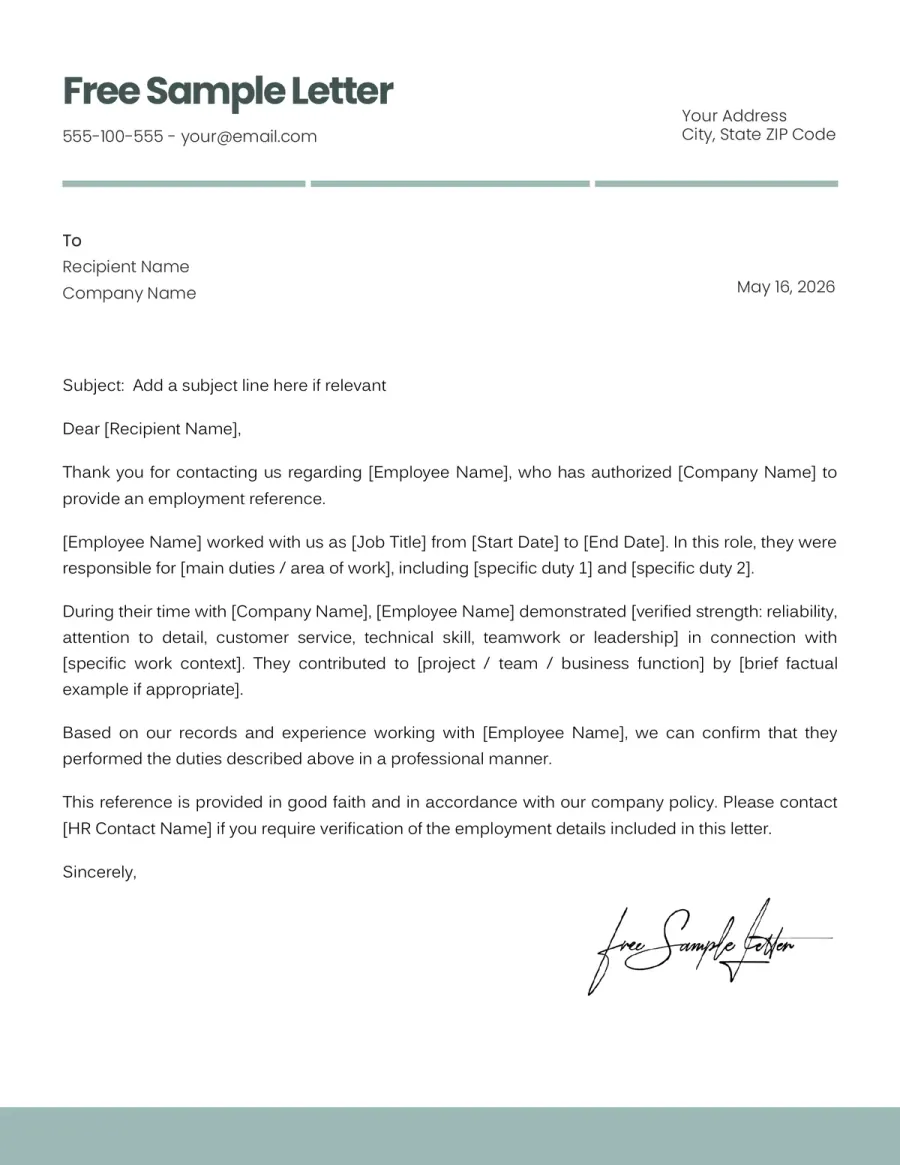
Preview of the Free Reference Check Response Letter Template
Use this preview to check the template’s structure before downloading the editable version. It keeps employment dates, role details, policy limits and HR contact information easy to verify.
How to Write an Employment Reference Check Response
A strong employment reference response should be accurate, limited and consistent with company policy. Confirm only information you can verify, avoid unnecessary detail and clarify whether the response is strictly factual or includes performance-related comments.
➡️ More practical help in our guide how to write a professional HR letter with a clear and careful scope
Confirm authorization and company policy first
Before replying, confirm whether the employee or former employee has authorized the reference and check what your company policy allows. If you need to write a full recommendation instead, use a guide to writing an employee recommendation.
See Why this matters
A reference check response may confirm only employment facts. A recommendation letter usually provides a broader endorsement and specific examples.
Verify the employment facts
Confirm employment dates, job title, department, role changes and any duties you plan to mention. Do not rely on memory when HR records are available.
See a factual line
Our records show that [Employee Name] was employed from [Start Date] to [End Date] as [Job Title].
Limit comments to what you can support
If you include performance or conduct comments, keep them factual, job-related and supported by records or direct work knowledge. Avoid informal opinions or speculation.
See safer wording
[Employee Name] was responsible for [Duty] and contributed to [Project / Function] by [factual example].
Avoid confidential or protected information
Do not include medical details, disability information, family status, age, religion, internal complaints, investigations or other private information unless you have a clear lawful basis and HR or legal approval.
See What to exclude
A reference should not explain absences, health issues or internal disputes unless the process and applicable rules clearly allow it.
Use the right HR document for the situation
If the person is leaving and you need to acknowledge their departure, use a company reply to an employee resignation. If the issue is a new hire joining your team, use a new employee welcome email instead.
See Why this helps
A reference response verifies past employment. A resignation acceptance or welcome message belongs to a different HR situation.
What to Include in a Reference Check Response
- Employee Authorization If Required
- Employee Name
- Employment Dates
- Job Title
- Department
- Main Duties If Allowed
- Policy Limit Statement
- Verified Performance Comments If Allowed
- No Unsupported Opinions
- No Private or Protected Details
- HR Contact
- Verification Note
Do & Don’t - Employment Reference Response
A reference check response should help the requester verify employment while protecting both the former employee and the company from unnecessary risk.
What Weakens the Response
Red Flags- Give informal opinions that are not supported by records
- Mention health, age, family status or protected characteristics
- Disclose internal investigations or private HR matters casually
- Say more than company policy allows
- Imply a negative reason when declining to provide details
- Use a different standard for similar reference requests
What Makes the Response Safer
Trust Signals- Confirm authorization or required consent first
- Use verified employment records
- State dates, role and duties accurately
- Keep performance comments factual if included
- Explain policy limits clearly
- Refer complex requests to HR or legal review
FAQ - Employment Reference Check Response
What should an employment reference response include? Toggle answer
It usually includes the employee’s name, employment dates, job title and, if company policy allows, main duties or performance comments. Keep the response accurate, fair and limited to information you can verify.
Does an employer have to provide a reference? Toggle answer
Not always. Requirements vary by country, contract and industry. Some employers provide only basic employment verification. If a reference is provided, it should be accurate, fair and consistent with the employer’s policy.
Can an employer give a negative reference? Toggle answer
This depends on the rules that apply and the facts available. Any negative information should be accurate, fair, job-related and supportable. Many employers avoid detailed negative comments unless HR or legal policy clearly allows them.
Should I include performance details in a reference check? Toggle answer
Only if your company policy allows it and the information is factual, relevant and supportable. If policy limits references to dates and job title, do not add informal opinions even if the requester asks.
Can I refuse to answer a reference request? Toggle answer
Yes, in many situations. If you cannot verify authorization, records or policy approval, you may decline or provide only basic employment confirmation. Use neutral wording so the refusal is not interpreted as a negative reference.
What information should I avoid in an employment reference? Toggle answer
Avoid unnecessary personal information, medical details, references to protected characteristics, family status, internal complaints, confidential investigations, speculation or unsupported opinions. Keep the response focused on verified employment information.
TL;DR - Keep the Reference Response Accurate and Limited
A strong employment reference check response confirms only what the employer can verify: dates, role, duties and approved comments. It should be fair, consistent and aligned with company policy.
Before sending it, check authorization, records and the rules that apply in your jurisdiction. Avoid private details, unsupported opinions and casual remarks. When in doubt, provide factual employment verification or refer the request to HR or legal review.