
Reference Letter Examples for Manual Worker Jobs in 2026
Strong manual job references provide clear evidence, not just compliments. These examples show how to document experience in factory, warehouse, site, or labor roles without sounding vague or exaggerated.
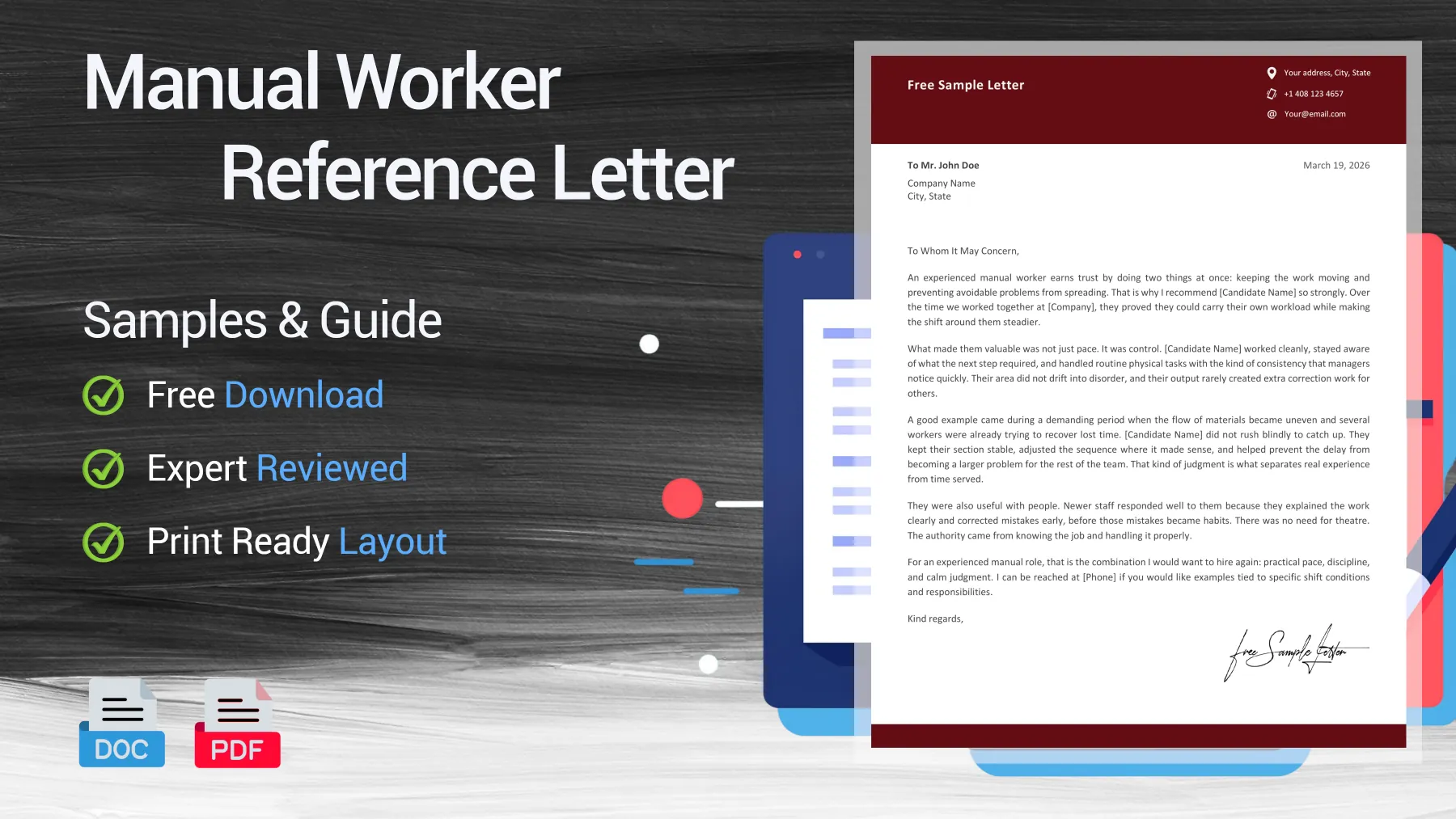
Free Recommendation Letter Samples for Manual Job Applications
The Bureau of Labor Statistics projects approximately 1,008,300 annual openings for hand laborers and material movers from 2024 to 2034. Expert interpretation: references for manual workers should provide proof of reliability, pace, and safe execution.
Entry-Level Manual Worker Recommendation Letter
Built for a beginner manual worker, this recommendation letter shows real shift habits instead of empty praise. It highlights attendance, safe execution, and fast learning in a first hands-on role.
Dear [Hiring Manager Name],
When I evaluate a beginner manual worker, I am less concerned about speed and more about how trustworthy they are when the day gets difficult. I supervised [Candidate Name] during a temporary assignment at [Company], and I recommend them for an entry-level manual worker role because they consistently showed habits that made managing the team easier.
One morning, a pallet broke during unloading while two other tasks waited. [Candidate Name] did not hesitate or rush into the wrong job. They secured the area, helped move the loose items safely, and followed instructions, preventing a small issue from becoming a bigger problem. It was not dramatic, but it proved they stay useful when the pace suddenly shifts.
Their day-to-day work was equally reliable. [Candidate Name] always arrived on time, wore the right gear, and followed basic handling rules without needing reminders. They learned the layout quickly and completed tasks in the right order instead of trying to look faster than they were.
I also appreciated their response to feedback. Early on, they moved too quickly through one step of the loading routine. After being corrected once, they slowed down, repeated the task properly, and never made the same mistake again. That kind of adjustment matters more than many realize in manual work.
For a first manual job, I recommend someone steady over someone flashy. [Candidate Name] is dependable, willing to learn, and already comfortable in a real work setting. I would be glad to discuss their shift behavior and work habits by phone at [Phone].
Sincerely,

Reviewed by Robert H., Technical Recruiter
I trust this because the supervisor shows real task-level proof: pace, attendance, and safe habits. It feels grounded, not padded with nice words.
Senior Labourer / Factory Worker Reference Letter
A solid reference for an experienced labourer should show what held up over time. This one highlights output, reliability, and the ability to keep standards steady during demanding periods.
To Whom It May Concern,
Experienced manual workers earn trust by keeping the work moving and stopping problems from spreading. That is exactly why I recommend [Candidate Name]. In our time together at [Company], they managed their workload and helped keep the shift steady for everyone.
Their value was not just in their pace, but in their control. [Candidate Name] worked cleanly, stayed ahead of what needed doing next, and handled routine tasks with a consistency managers notice. Their area stayed organized, and their output rarely needed correction from others.
For example, during a tough period when the flow of materials was uneven and several workers were trying to catch up, [Candidate Name] did not rush. They kept their section stable, adjusted the sequence where needed, and helped prevent the delay from becoming a bigger issue for the team. That kind of judgment is what sets real experience apart from just time served.
They were also good with people. Newer staff responded well because [Candidate Name] explained tasks clearly and corrected mistakes early, before they became habits. There was no need for theatrics. Their authority came from knowing the job and handling it properly.
For an experienced manual role, that is the combination I would want to hire again: practical pace, discipline, and calm judgment. I can be reached at [Phone] if you would like examples tied to specific shift conditions and responsibilities.
Kind regards,
Reviewed by Robert H., Technical Recruiter
I would move this candidate forward because the letter connects performance to team stability, which is exactly what experienced hires should bring.
Team Leader / Shift Supervisor Reference Letter (Promotion)
Built for promotion into a lead or responsible position, this letter highlights people judgment, operational clarity, and the kind of practical leadership that keeps work moving without noise.
To Whom It May Concern,
A promotion into a responsible manual role should not happen just because someone has been around longer than everyone else. It should reflect visible leadership, steadier workflow, and the confidence of the people already working beside them. From what I have seen at [Company], [Candidate Name] has already earned that step.
My view comes from direct observation over [number] years. [Candidate Name] has repeatedly taken on work that goes beyond personal output. They help newer workers settle into the pace, spot issues before they interrupt the rest of the shift, and keep people moving without creating unnecessary tension. That kind of presence matters more than a loud personality.
One example stayed with me because it showed real authority without formal power. We had a backlog building across two sections, and frustration was starting to spread between workers who felt they were carrying different levels of pressure.
[Candidate Name] did not give speeches. They brought the team’s focus back to the work, helped reset the order of tasks, and kept communication clear so everyone could settle into a workable rhythm. The result was not perfect, but it was under control, and that is what real leadership looks like in operations.
I also saw them handle people well. When someone was slipping, [Candidate Name] corrected the issue early and directly, without showing them up in front of others. That balance of firmness and calm matters more to me than talk about leadership qualities.
For a promotion into a team lead or supervisor position, that is what I would want to see. [Candidate Name] already shows practical authority, operational steadiness, and the trust of the people around them. I am available at [Phone] if you would like more detail about the scope I observed.
Kind regards,
Reviewed by Robert H., Technical Recruiter
This reads like a real step-up recommendation. The examples show authority, accountability, and calm decisions rather than ambition on its own.
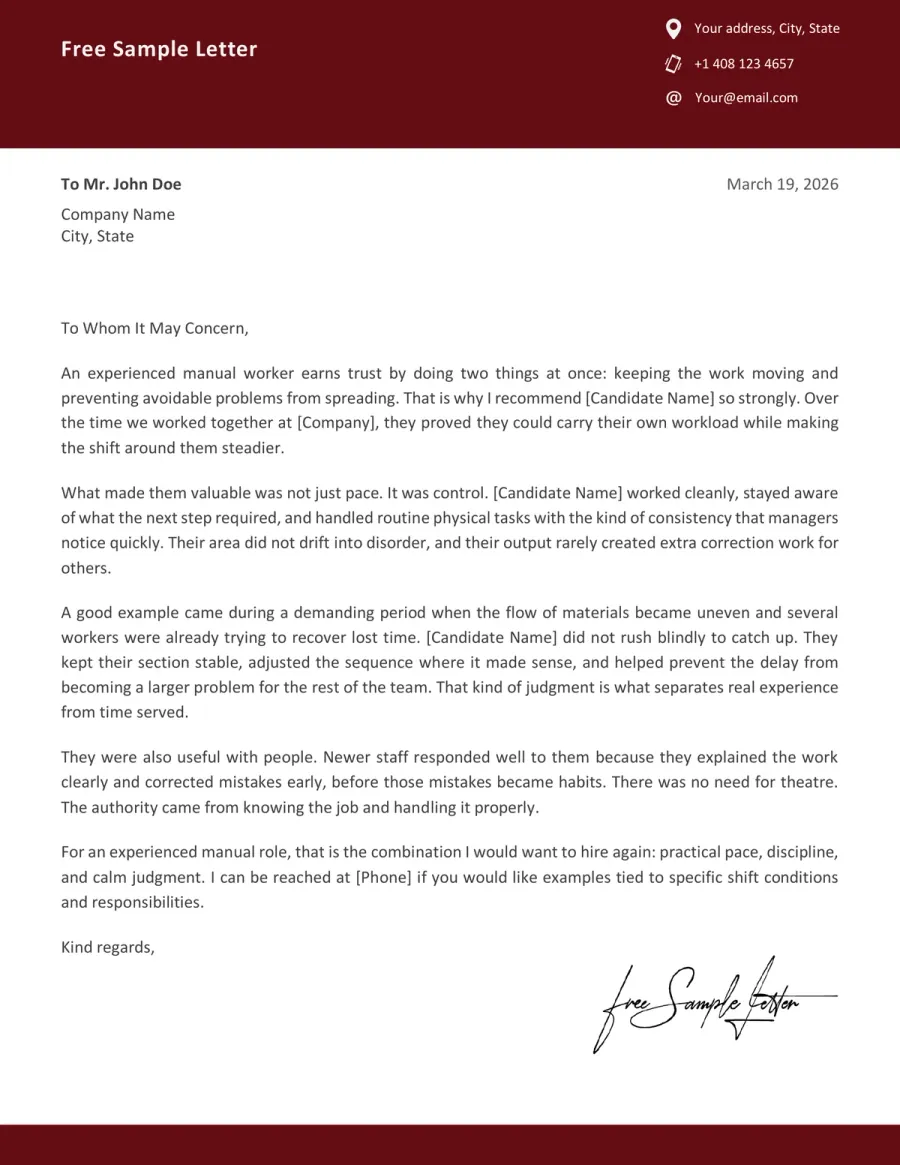
Manual Worker Recommendation Letter Template Preview Before Download (Word/PDF)
Review a manual job recommendation letter example before downloading. Available formats: Word (.docx) and PDF.
Adapt These Manual Worker Recommendation Templates in 5 Steps
Copy-pasting a manual worker reference letter often results in an empty-sounding document. Warehouse, factory, site, and labor roles each require specific proof, so the wording should reflect the actual tasks, pace, safety habits, and level of responsibility involved.
➡️ More expert guidance in our article How to Write a Recommendation Letter That Sounds Credible
Name the real work setting
Begin by describing the actual work environment: warehouse, factory floor, site work, loading area, or general labor. References are more credible when employers can visualize where the work took place.
See an example
I supervised [Candidate Name] during [shift type] at [Company], where I directly observed their work on unloading, handling materials, and keeping pace in a physically demanding area.
Choose two visible proof moments
Select two moments that demonstrate effective behavior under pressure, such as handling a loading issue safely, keeping a section moving, or containing a workflow problem before it escalated.
See what to include
When a pallet broke during unloading, [Candidate Name] secured the area first, followed instructions clearly, and helped recover the load without creating wider confusion on the shift.
Add the right trust signals
Highlight the habits that matter in manual work: consistent attendance, safe handling, proper use of PPE, maintaining clean work areas, following correct sequences, and asking questions early when something could affect workflow.
See In practice
They arrived prepared for each shift, wore the correct safety gear, kept the work area organized, and completed routine tasks in the correct order without needing frequent reminders.
Match the wording to the target application
Tailor the letter to the specific role, whether it is a laborer, warehouse worker, production operator, site worker, or team lead. Each reference should reflect the unique requirements of the target position.
See Example excerpt
For a production role, I would stress [Candidate Name]’s pace, consistency, and ability to keep work flowing cleanly across a demanding shift.
Close with accountable support
Finish with a direct recommendation and a practical next step. A strong closing shows the recommender is prepared to stand behind their examples, not just sign off politely.
See an example closing
I recommend [Candidate Name] for a manual worker role without hesitation and would be glad to discuss their work habits, pace, and reliability by phone at [Phone].
Manual Job Hiring Signals Inside a Recommendation Letter
- PPE
- Attendance
- Pace
- Loading
- Reliable in repetitive physical work
- Safe handling
- Shift discipline
- Material movement
- Clean work area
- Follows task sequence
- Keeps output steady
- Asks early when safety matters
Do & Don't: Manual Worker Recommendation Letters That Feel Credible Fast
Manual employers read these letters for proof they can trust on the floor, on site, or on shift. They want visible habits, clear role context, and examples that sound real enough to confirm later without hesitation.
What makes the letter sound generic
Red Flags- Use broad praise with no work setting
- Describe effort but ignore safe habits
- Inflate the role beyond what was observed
- Sound vague about pace or reliability
- Close politely without a clear endorsement
What makes the letter sound credible
Trust Signals- Name the exact work environment and role
- Show two visible moments from the job
- Use habits employers trust quickly
- Match the wording to the target position
- Offer a short phone follow-up with confidence
FAQ - Manual Worker Reference Letter
Can a short manual job still be a useful reference later? Toggle answer
Yes. A short role can still carry weight if the letter proves attendance, safe habits, pace, and how the person behaved on real shifts. In manual hiring, believable work behavior often matters more than contract length.
What counts as proof for a beginner manual worker? Toggle answer
Use visible basics: arriving ready, following instructions, handling materials safely, keeping the work area under control, and asking early when unsure. A beginner does not need senior scope. They need trusted habits.
Should the letter focus on strength or safe work habits? Toggle answer
Safe habits win. Physical ability matters, but employers trust workers who follow sequence, protect flow, and avoid preventable mistakes. A strong manual reference should sound grounded, not macho.
Do manual-job employers really check references? Toggle answer
Sometimes lightly, sometimes properly. Even when checks are basic, the letter still has to survive simple verification: relationship, dates, reliability, and whether the recommender would hire the person again.
Can a manual worker reference support a promotion later? Toggle answer
Yes, if it shows more than personal output. Once the letter proves coordination, judgment, and team steadiness, it starts supporting a step-up case, not just a floor-level application.
TL;DR - Manual Worker Reference Letter That Feels Real on First Read
A strong reference letter for manual worker jobs needs three things: the real work setting, one or two visible task moments, and proof of habits employers trust, such as attendance, safe execution, pace, and follow-through. The fatal mistake is generic praise that could fit any worker, any shift, and any site.
What gives a manual-job recommendation real weight is not fancy wording. It is the recommender’s ability to describe the work plainly enough to repeat it later on a phone call. That is what makes the letter feel credible instead of assembled.