
Reference Letter Examples for IT & Computer Science Jobs in 2026
Strong IT references provide evidence, not just compliments. These examples show how to document coding, support, infrastructure, or project delivery in a way that feels credible and specific, never inflated or generic.
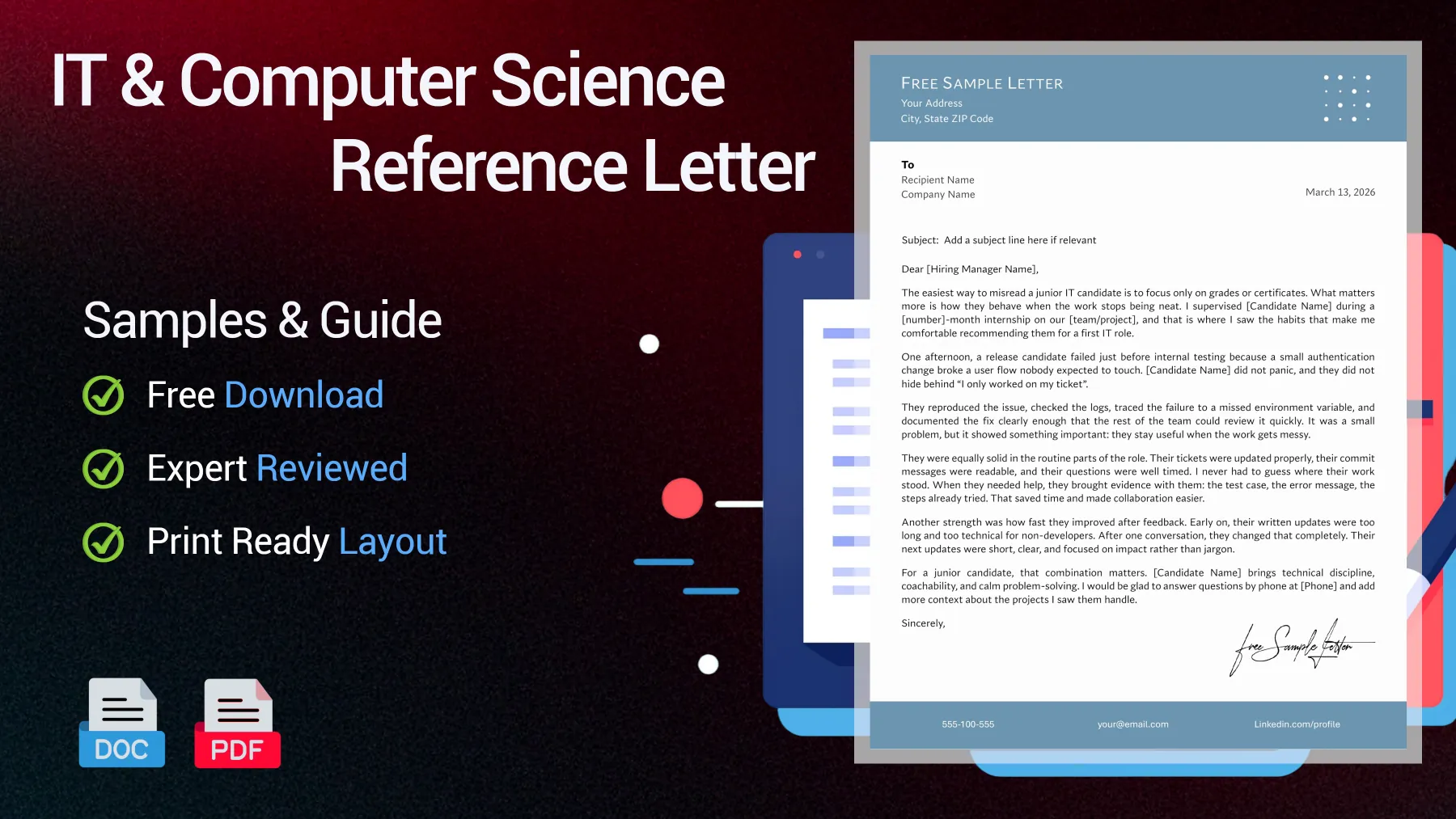
Free Recommendation Letter Samples for IT & CS Applications
The Bureau of Labor Statistics (BLS) projects 317,700 annual openings in computer and information technology occupations between 2024 and 2034 (BLS OOH). Expert takeaway: a strong reference letter should demonstrate technical value, reliable delivery, and team trust.
Junior Computer Science Reference Letter Sample for a First Tech Role
Built for a junior IT or computer science candidate, this sample focuses on project delivery, debugging habits, and team communication. The value comes from visible actions, not inflated claims about “high potential.”
Dear [Hiring Manager Name],
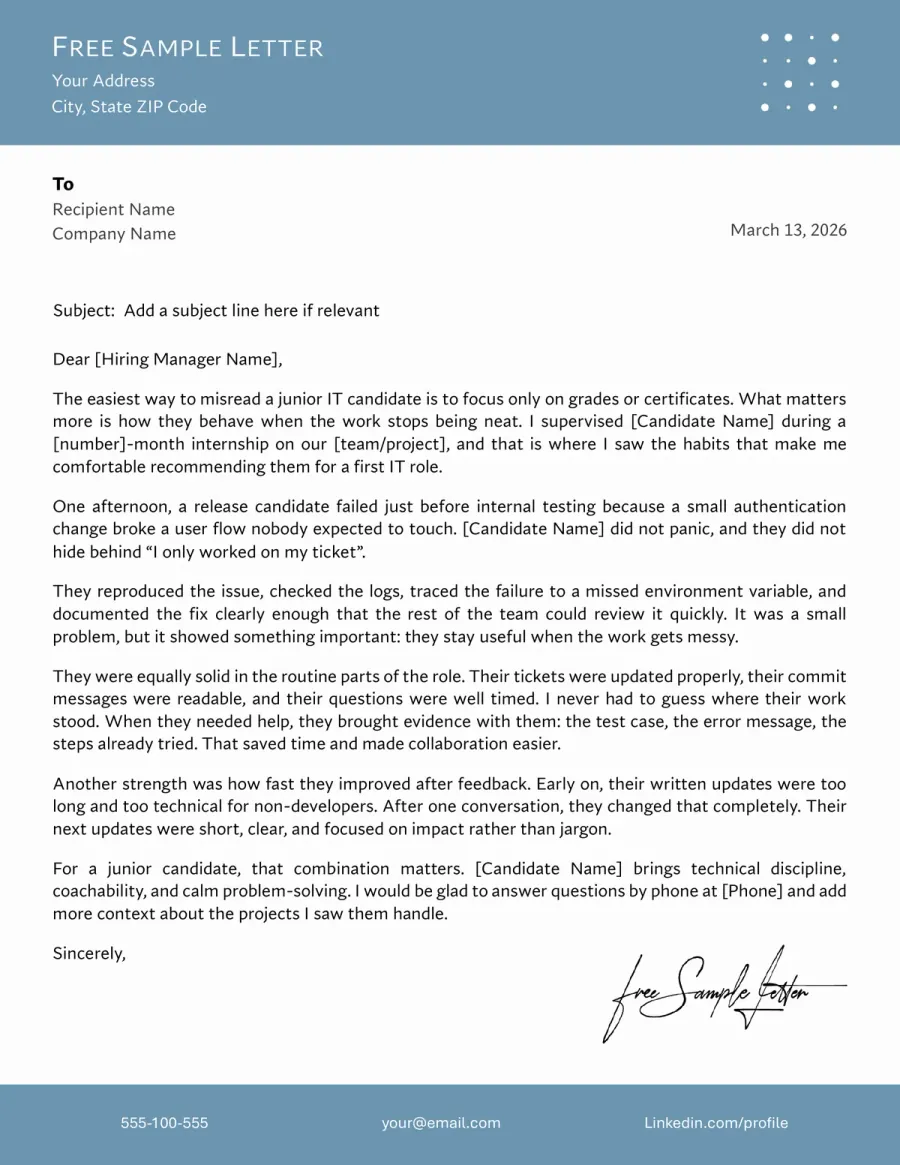
It is easy to overlook a junior IT candidate by focusing only on grades or certificates. What matters most is how they respond when the work gets messy. I supervised [Candidate Name] during a [number]-month internship on our [team/project], and that is where I saw the habits that make me confident recommending them for a first IT role.
One afternoon, a release candidate failed just before internal testing because a minor authentication change unexpectedly broke a user flow. [Candidate Name] did not panic or deflect responsibility with “I only worked on my ticket.”
They reproduced the issue, checked the logs, traced the failure to a missed environment variable, and documented the fix clearly so the rest of the team could review it quickly. It was a small problem, but it revealed something important: [Candidate Name] remains effective even when things get complicated.
[Candidate Name] was just as reliable in the routine parts of the job. They kept tickets updated, wrote clear commit messages, and asked questions at the right time. I always knew the status of their work. When they needed help, they provided the test case, error messages, and steps they had already tried. This approach saved time and made collaboration smoother.
Another strength was how quickly they improved after feedback. Early on, their written updates were too long and too technical for non-developers. After a single conversation, they adjusted their approach. Their next updates were short, clear, and focused on impact instead of jargon.
For a junior candidate, that combination is essential. [Candidate Name] brings technical discipline, coachability, and calm problem-solving. I would be happy to answer questions by phone at [Phone] and provide more context about the projects I observed.
Sincerely,

Reviewed by James R., Hiring Manager
I like that the recommender never oversells. The candidate sounds coachable, technically grounded, and easy to integrate into a team.
Senior IT Recommendation Letter for an Experienced Technical Hire
Senior tech references should prove judgment, not just years. This sample shows ownership, technical clarity, and how the candidate helped systems, people, and deadlines hold together.
To Whom It May Concern,
Many senior IT professionals can talk knowledgeably about systems. Far fewer can improve them without slowing down everyone around them. That is why I recommend [Candidate Name] with confidence. During our time working together at [Company], they showed that technical authority matters most when it benefits the product, the platform, and the people who rely on both.
One example stands out. We faced a recurring reliability issue that had survived several partial fixes, as everyone focused on the symptoms in their own area. [Candidate Name] stepped back, mapped the full chain, and identified that the real problem was not in the app layer, despite repeated blame, but in how state was managed across services under specific load. They proposed a fix, set a realistic rollout plan, and stayed involved until the issue was resolved. This broke a cycle of repeated frustration for both engineering and support.
Their impact extended beyond technical problems. [Candidate Name] also improved team processes: they cleaned up decision records, made handovers more reliable, and advocated for post-incident notes that people would actually use. These are not glamorous wins, but they are the kinds of changes that make senior people truly valuable.
I also valued their restraint. When the answer was uncertain, [Candidate Name] said so. When a decision involved tradeoffs, they explained them clearly. That approach builds credibility quickly, especially in environments where overconfidence often wastes time.
For a senior IT or computer science role, that matters more than polished language or buzzwords. [Candidate Name] brings technical judgment, operational maturity, and the kind of clarity teams rely on when the work gets tough. I am happy to discuss specific examples by phone at [Phone].
Kind regards,
Reviewed by James R., Hiring Manager
I would move this candidate forward because the letter shows platform value, team influence, and operational maturity without any empty buzzwords.
IT Manager Promotion Recommendation Letter Sample
A promotion case in tech needs more than strong delivery. This recommendation letter proves leadership through team coordination, incident handling, and decisions that made the work more stable.
Dear [Hiring Manager Name],
The strongest candidates for an IT manager promotion stand out before their title changes. They stabilize delivery, reduce friction, and help others think more clearly under pressure. That is why I am recommending [Candidate Name] for promotion to [IT Manager / Engineering Manager / Technical Lead] at [Company].
I worked with [Candidate Name] for [number] years at [Company], first as a technical contributor and later as someone the team relied on for direction. During a difficult release cycle, two teams were handing off work with inconsistent notes and unclear ownership. [Candidate Name] simplified the process, set a lighter review cadence, and clarified responsibilities. Within weeks, rework dropped and last-minute surprises became less frequent.
Another situation showed the same maturity under pressure. When a production issue escalated after hours, [Candidate Name] did more than help fix it. They organized the response, kept updates clear for non-technical stakeholders, and ensured follow-up actions were assigned before the pressure eased. The incident was resolved that night, but the real impact came afterward: their post-incident review led to better response habits instead of another round of blame.
The fastest way [Candidate Name] can help [Company] as a manager is by making delivery more predictable without slowing the team down. They translate technical constraints into clear decisions, protect focus when priorities shift, and offer feedback people can use right away. That is why junior engineers already seek them out for guidance.
This promotion would formalize responsibilities [Candidate Name] is already handling. I am happy to speak by phone at [Phone] if you would like examples related to coordination, incident handling, and leadership readiness.
Sincerely,
Reviewed by James R., Hiring Manager
This reads like a real promotion letter. I can see operational maturity, team influence, and manager-level accountability clearly.
IT Recommendation Letter Template Preview Before Download (Word / PDF)
Preview an IT recommendation letter example before downloading. Available formats include Word (.docx) and PDF.
Customize the Templates: 5 Steps to a Credible Tech Reference
Simply copy-pasting an IT recommendation letter quickly sounds inauthentic. A strong letter should reflect the actual role, tech stack, and type of work the candidate handled, whether coding, support, systems, data, or delivery.
➡️ More expert guidance in our article How to Write a Recommendation Letter That Hiring Teams Trust
Name the real tech lane
Begin by defining the candidate's actual role: developer, IT support, sysadmin, QA, analyst, data, or web position. A reference letter becomes credible more quickly when the reader understands the specific work being endorsed.
See an example
I supervised [Candidate Name] on our [team] as they worked on [frontend features / support tickets / data tasks / infrastructure checks], which gave me direct visibility into both their output and their working habits.
Pick two proof moments
Select two moments that demonstrate technical value in real situations: a bug fixed cleanly, a support issue handled effectively, a script improved, or a handoff that helped the team work more efficiently.
See an example
When a release candidate failed before internal testing, [Candidate Name] reproduced the issue, traced it to a missing environment variable, fixed it, and documented the steps clearly for the rest of the team.
Add role-specific trust signals
Align your proof with the candidate’s role. In IT, trust often comes from clear ticket updates, well-documented commits, strong testing habits, reliable notes, safe system changes, and thoughtful questions instead of assumptions.
See In practice
Their ticket updates were clear, their commit messages explained their intent, and before asking for help, they brought logs, screenshots, and a list of steps they had already tried.
Match the application target
Tailor your wording to the target application. A junior developer reference should not sound like help-desk praise, and a support letter should not pretend to be for a backend engineering role.
See an example
For a [Target Role] application, I would highlight [Candidate Name]’s debugging discipline, team communication, and ability to deliver clear, maintainable work under normal project constraints.
Close with a clear endorsement
Close with a direct recommendation and a practical next step. The strongest closings sound accountable, not ceremonial.
See an example closing
I recommend [Candidate Name] for a [Target Role] without hesitation and would be glad to discuss their work, project scope, and team behavior by phone at [Phone].
IT Hiring Signals Inside a Recommendation Letter
- Debugging
- Testing
- Documentation
- Incident handling
- Release support
- System reliability
- Readable commit messages
- Code reviews
- Writes updates non-engineers
- Tickets
- Finds the issue before guessing
- Handles feedback
- Keeps technical work visible and trackable
Do & Don't: IT Recommendation Letters That Sound Credible Fast
Tech recruiters read these letters for evidence of usefulness, not just polished praise. They look for what the candidate actually handled, how they collaborated with others, and whether the recommender provides enough specific detail to be trusted on a follow-up call.
Red flags tech recruiters notice first
Red Flags- Use broad praise with no real project context
- Name tools without showing actual value
- Inflate scope beyond what was observed
- Describe talent but ignore delivery habits
- Sound vague about teamwork and communication
Trust signals hiring teams recognize fast
Trust Signals- Name the exact tech role and environment
- Show two real work moments with outcomes
- Mention habits that make teams easier to trust
- Use one concrete example tied to delivery
- Keep the technical language specific but readable
FAQ - IT Reference Letter
Do recommendation letters still help in tech hiring? Toggle answer
Yes, but mostly as reinforcement. Reference letters are most helpful when they are specific and align with what the hiring team can later confirm. A vague “great engineer” letter adds little, but a concrete letter can strengthen the application.
New graduate: what counts as proof without full-time experience? Toggle answer
Internship results, real project contributions, debugging habits, clear ticket updates, and how the candidate handled feedback all count as proof. Teams know juniors are still learning, but they want evidence the person can already contribute in a real-world workflow.
What do reference checks really verify in IT roles? Toggle answer
At a minimum, reference checks verify the candidate’s role, employment dates, and basic fit. Sometimes, questions go deeper: rehire status, collaboration, reliability, and how the person handled pressure. The stronger the letter, the easier it is for the recommender to confirm those facts later.
Should the letter mention tools and certifications? Toggle answer
Yes, but only when relevant to actual work. Simply stating “knows Python, AWS, or Jira” is weak. Describing how the candidate used Python to clean a broken dataset or handled support tickets in Jira with clear notes is much stronger.
Career change into IT: what makes the letter believable? Toggle answer
A clear explanation of the career change, plus at least one real project example, makes the letter believable. Hiring teams want proof the candidate’s switch to IT is intentional and has already been tested in real projects, not just a course list or a vague interest.
TL;DR - IT Reference Letter That Feels Specific, Not Generic
A strong reference letter for IT / computer science jobs needs three things: the real tech lane, two concrete proof moments, and trust signals that match the role - code, systems, support, data, or delivery. The fatal mistake is broad “smart, talented, technical” praise with no project context and no visible team value.
The detail most candidates underestimate is reference-check survival. A credible IT recommendation letter is one the recommender can repeat on the phone without hesitation: what the candidate handled, how they worked, and why another team should trust them. That is what makes the application feel real instead of assembled.