
Graduation Speech Examples and Commencement Remarks
A graduation speech should celebrate achievement, thank the right people, and look ahead without sounding generic. These samples help you speak clearly to graduates, families, teachers, and guests.
Graduation Speech Samples You Can Adapt
Before writing a graduation speech, decide who is speaking and who should feel included. A student representative speaks as part of the class. A teacher, principal, or dean addresses the graduates, their families, and the institution. A diploma presenter needs a more formal and practical structure.
The strongest graduation speeches don’t try to cover every detail of the past or predict the entire future. They usually focus on one shared memory, one clear theme, and one forward-looking message. If your main role is to open the event, welcome guests, and introduce the program, this welcome speech for an event or ceremony may be a better starting point.
Student Representative Graduation Speech
A complete student representative graduation speech for a class speaker who wants to thank the room, honor classmates, and look ahead without sounding too formal.
Good afternoon, everyone.
To our teachers, families, friends, guests, and most importantly, to the graduating class of [Year]: thank you for being here today.
Standing here as a student representative is both exciting and a little strange. I’m supposed to speak for the class, but each person here has lived a different version of these years. Some of us arrived confident. Some arrived quiet. Some arrived with a plan. Some of us changed that plan several times before breakfast.
But whatever our path looked like, we arrived at this day together.
Graduation is often described as an ending, and in some ways it is. It marks the end of routines we’ve known: classrooms, deadlines, familiar faces, and jokes that only made sense because we were all tired at the same time. It closes a chapter that has shaped us in ways we may not fully understand yet.
But today is also proof—proof that we kept going, that we learned more than what appeared on exams, and that we found our way through difficult assignments, uncertain moments, changing friendships, late nights, early mornings, and the quiet pressure of becoming someone new while still trying to pass everything on time.
When I think about our class, I don’t only think about grades or ceremonies. I think about [shared school memory]. I think about the small moments that made this place feel real: the conversations before class, the group projects that somehow survived, the teachers who pushed us further than we thought we could go, and the friends who made hard weeks easier to carry.
To our teachers and staff, thank you. Thank you for the lessons, the patience, the corrections, the encouragement, and the belief you sometimes had in us before we had it in ourselves. You didn’t just teach subjects. You taught us how to think, ask better questions, try again, and understand that learning isn’t always comfortable while it’s happening.
To our families and friends, thank you for standing behind us. Thank you for the rides, the meals, the reminders, the support, the messages, the quiet sacrifices, and the times you listened when we were stressed about something that may or may not have been our own fault. This day belongs to you too.
And to my fellow graduates, congratulations.
We should be proud—not because we have everything figured out, but because we’ve reached a point that once seemed far away. We leave with knowledge, yes, but also with resilience, friendships, memories, and a clearer sense of what we can do when we keep showing up.
The next chapter won’t look the same for all of us. Some will continue studying. Some will start work. Some will travel, move, change direction, take a break, build something, try something, fail at something, and try again. That’s not a sign that we’re lost. It’s part of becoming.
My hope is that we leave here with enough confidence to begin and enough humility to keep learning. I hope we remember that success isn’t just about moving fast, but about moving with purpose. I hope we stay curious, stay kind, and stay willing to help each other when the next challenge feels unfamiliar.
Today, we celebrate what we’ve finished. Tomorrow, we begin discovering what this education will become in our hands.
Congratulations to the class of [Year]. We made it here together, and now we carry what we’ve learned into everything that comes next.

Reviewed by Martin D., Speechwriter
This student speech speaks for the class without pretending every graduate had the same experience. The tone is proud, inclusive, and easy to deliver.
Graduation Speech from a Teacher or Faculty Member
A warm graduation speech from a teacher, written for a faculty member who wants to celebrate students, families and the work behind the ceremony.
Good afternoon, everyone.
To the graduates, families, colleagues, friends, and guests gathered here today—welcome. It’s a pleasure to stand before you on a day filled with pride, relief, gratitude, and, for some of you, probably a little disbelief that this moment has finally arrived.
Graduation ceremonies are full of symbols: the gowns, the diplomas, the applause, and the photographs that will be taken again and again until everyone is smiling at the same time. But beneath the ceremony is something much more human: work, effort, growth, and the ordinary discipline of continuing when the excitement has worn off.
That is what we are honoring today.
Graduates, we’ve seen you grow through this program in ways grades can’t capture. We’ve seen you ask better questions. We’ve seen you take feedback—sometimes reluctantly—and turn it into progress. We’ve seen you work through confusion, collaborate with classmates, meet deadlines, miss a few, recover, and discover strengths that weren’t always obvious at the beginning.
There’s a moment I often think about from this year: [shared class memory]. It stands out because it shows something important about this class. You didn’t just complete requirements. You learned how to stay with difficulty long enough for it to become understanding.
That’s one of the great lessons of education. At first, many things feel beyond us: a subject, a skill, a project, a language, a presentation, or a problem we can’t solve quickly. Then we return to it. We ask for help. We practice. We make mistakes. We adjust. Slowly, what once felt impossible becomes part of us.
To the families and friends here today—thank you. You may not have sat every exam or submitted every assignment, but you were part of this achievement. You encouraged, supported, waited, listened, helped, and believed. Education rarely belongs only to the person whose name is printed on the diploma.
To my colleagues and the staff who made this day possible—thank you for the care that often happens behind the scenes. Institutions are remembered through ceremonies, but they’re held together by people who do patient, practical work long before the applause begins.
Graduates, as you leave this place, I hope you take more than knowledge with you. Take the habit of learning. Take the courage to ask questions when others pretend to know everything. Take the discipline to begin before you feel fully ready, because most meaningful things begin that way.
You’re entering a world that will ask you to adapt. It will reward skill, but it will also test character. You’ll work with people who think differently, solve problems without perfect instructions, and make choices when the path isn’t obvious.
Don’t be discouraged by that. You’ve already practiced it here.
Today isn’t the end of learning. It’s the moment when your learning becomes more visibly yours. You’ll take it into workplaces, further studies, communities, families, projects, and decisions none of us can fully predict.
So my advice is simple: keep learning. Keep your standards high, but your mind open. Be serious about your work without becoming too impressed by yourself. Stay grateful to the people who helped you, and become someone who helps others in turn.
Congratulations to the graduating class of [Year]. We’re proud of you, we believe in you, and we look forward to seeing what you build from here.
Reviewed by Martin D., Speechwriter
The faculty voice celebrates achievement without relying on empty inspiration. It gives students credit for real effort, uncertainty, and growth.
Principal or Dean Graduation Ceremony Speech
A formal but human graduation ceremony speech for a principal, dean, school leader or administrator addressing graduates and families.
Good afternoon, everyone.
Graduates, families, faculty, staff, honored guests, and friends of [School / University Name]: welcome to this graduation ceremony for the class of [Year].
Today is a day of celebration, but it’s also a day of recognition. We’re here to recognize not only the completion of a program, but the effort, persistence, and growth that made this moment possible.
To the graduates: today, your name will be called, and you’ll cross the stage. That moment will be brief. It may last only a few seconds. But behind it are months and years of work: classes attended, assignments completed, questions asked, difficulties handled, feedback accepted, exams prepared, projects finished, and choices made when it would have been easier to stop.
A diploma is a document, but it’s also evidence—evidence that you stayed with the work long enough to be changed by it.
This graduating class has shown [quality or achievement: resilience, curiosity, creativity, service, leadership, adaptability]. We saw it in [specific school or class example]. We saw it in the way you responded to challenges, supported one another, and contributed to the life of this institution.
Graduation is often seen as a personal achievement, and it is. Each graduate here has earned the right to be proud. But no one reaches a day like this entirely alone.
To the families and friends, thank you. Your encouragement, patience, and support have mattered. You’ve made sacrifices, offered advice, shared worry, celebrated small victories, and stood behind these graduates in ways that may not appear on stage but are deeply present today.
To the faculty and staff, thank you for your dedication. The work of teaching, guiding, organizing, advising, and supporting students isn’t always visible in a ceremony, but it’s woven into every name we’ll hear today.
Graduates, you leave us at a time when knowledge alone isn’t enough. The world needs people who can think clearly, listen carefully, work responsibly, and remain human under pressure. It needs people who can adapt without losing their values, compete without losing kindness, and succeed without forgetting the communities that helped them begin.
Your education has given you tools. What matters now is how you use them.
Use them to build. Use them to serve. Use them to ask better questions. Use them to enter rooms with confidence, but also with humility. Use them not only to advance your own path, but to make the path wider for someone else.
There will be moments ahead when you don’t feel ready. That’s normal. Readiness often comes after the first step, not before it. Remember what you’ve already done. Remember the work behind this day. Remember that growth rarely feels comfortable while it’s happening.
As you move forward, stay curious. Stay disciplined. Stay generous. Keep learning from people, places, and problems that don’t look like classrooms but will teach you anyway.
On behalf of [School / University Name], I congratulate each member of the class of [Year]. We’re proud to have been part of your story, and we’re excited to see what you’ll contribute beyond this ceremony.
Congratulations, graduates. This day is yours. Step into what comes next with courage, gratitude, and purpose.
Reviewed by Martin D., Speechwriter
This ceremony speech stays formal without sounding cold. It includes graduates, families, faculty, staff, and the institution in a clear order.
Diploma Presentation Speech
A practical diploma presentation speech for a graduation ceremony, certificate award, school event or program completion ceremony.
Ladies and gentlemen,
We’re gathered today to recognize the achievements of the students completing [Program / Course / Degree Name] at [School / University / Organization Name].
This ceremony marks an important moment. It’s the public recognition of work that has often happened quietly: study, practice, questions, revisions, projects, exams, presentations, cooperation, and persistence.
Before we begin presenting diplomas, I’d like to thank the families, friends, teachers, staff, and partners who have supported these students throughout their training. A certificate or diploma carries one name, but the effort behind it is often supported by many people.
This year, our graduating students have completed [duration or requirement], including [coursework / practical training / projects / internships / examinations / research / community work]. They’ve developed knowledge in [field or subject], but also skills that will matter beyond this ceremony: discipline, communication, problem-solving, teamwork, and the ability to keep learning.
We are proud of what they have accomplished.
As each graduate comes forward, we ask the audience to hold applause until [instruction, if needed], so every name can be heard clearly and every student can receive the recognition they deserve.
We will begin with [Category / Department / Program Group].
The first diploma is awarded to [Graduate Name], from [City / Program / Group], who has completed [Program Name] with [achievement or distinction, if applicable]. During [his/her/their] time with us, [Graduate Name] demonstrated [quality: dedication, curiosity, professionalism, leadership, perseverance, creativity].
[Graduate Name], please come forward.
[Pause for presentation.]
Congratulations.
We will now continue with the next graduate.
As we proceed through the ceremony, let’s remember that each name represents a story: effort invested, support received, challenges overcome, and a future opening in a new way.
To all graduates receiving their diplomas today, congratulations. May this recognition remind you not only of what you’ve completed, but of what you’re now prepared to begin.
Reviewed by Martin D., Speechwriter
This diploma presentation speech is practical enough for a real ceremony. It provides structure, audience instructions, and individual recognition without becoming too long.
Preview of the Graduation Speech Template You Can Download
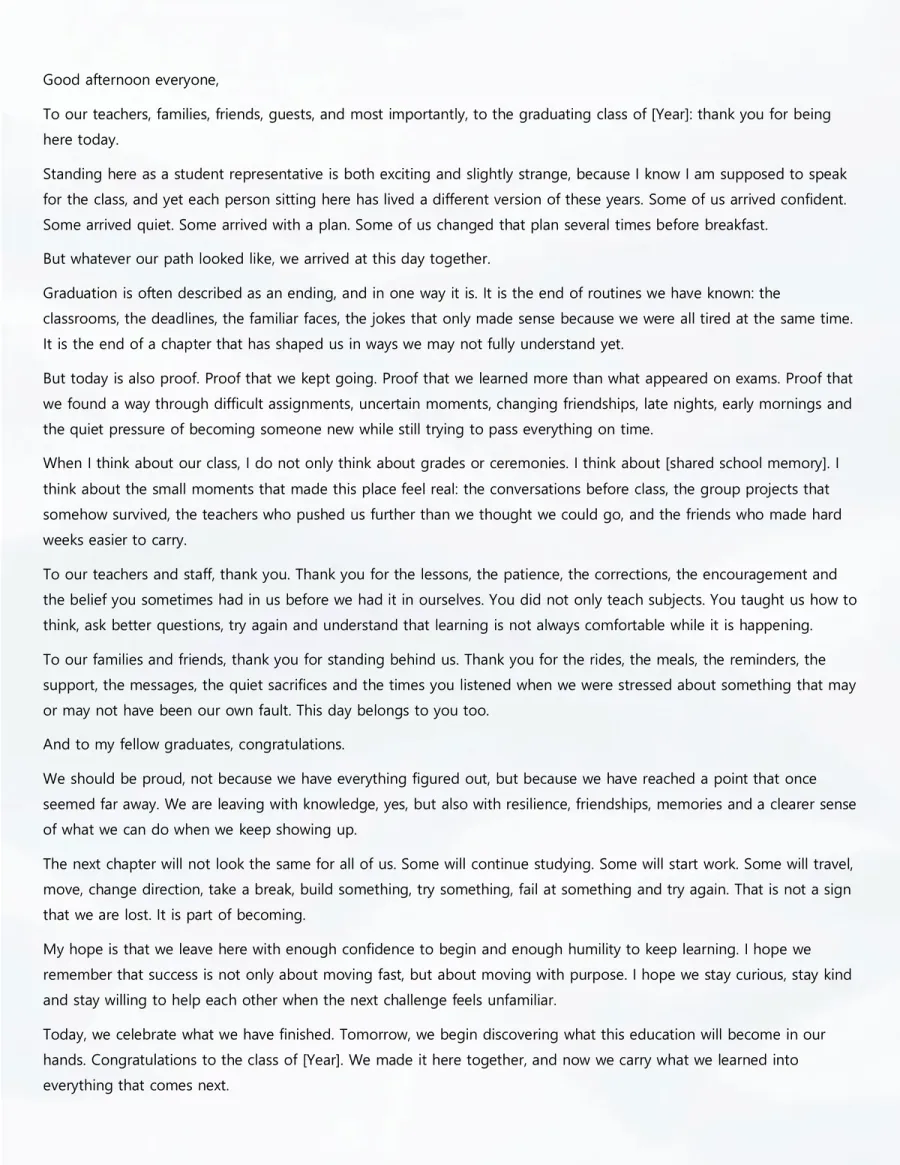
Below is a preview of the graduation speech template you can download and personalize. The document is available in Word and PDF formats for printing, rehearsing, or adapting before a graduation ceremony.
How to Personalize a Graduation Speech Before the Ceremony
A graduation speech sample works best when it fits the speaker’s role. A student, teacher, principal, and diploma presenter don’t need the same tone, length, or level of formality.
➡️ Need help speaking to graduates, families and teachers? Read how to write a ceremony speech that feels inclusive
Decide who you are speaking as
A student representative speaks from inside the class. A teacher speaks as someone who watched the class grow. A principal or dean speaks for the institution. A diploma presenter needs clarity and a smooth ceremony flow.
See an example
Student: “We learned this together.” Teacher: “We watched you grow.” Dean: “This institution recognizes your achievement.”
Include every audience in the room
Graduation ceremonies include graduates, families, teachers, administrators, and guests. Your speech shouldn’t speak only to one group unless the format is very short.
See Useful order
Welcome the room, celebrate graduates, thank families and staff, then look forward to the next chapter.
Choose one shared memory or theme
A graduation speech is easier to remember when it’s built around one idea. Use a shared class memory, a lesson, a challenge, or a theme that fits the year.
See Avoid
Don’t list every achievement, teacher, event, or subject. One clear story will hold the room better than a long timeline.
Keep inspiration grounded
Graduates hear many broad phrases about the future. Make your message concrete: What did they learn? What did they overcome? What should they carry forward?
See Better angle
Instead of saying “follow your dreams,” say, “keep asking better questions when the first answer isn’t enough.”
Respect the ceremony length
A graduation ceremony already has many moving parts. Keep the speech long enough to mean something, but short enough to respect the audience and the program.
See Useful range
A student speech may be 500 to 800 words. A formal commencement address may be 800 to 1,100 words. A diploma presentation script is usually shorter and more practical.
Close with forward momentum
The ending should make graduates feel recognized and ready to begin. Avoid a vague quote if a direct, clear final line feels stronger.
See an example
Congratulations to the class of [Year]. Take what you’ve learned here and use it with courage, generosity, and purpose.
What Makes a Graduation Speech Easy to Listen To
- Graduation Speech
- Commencement Speech
- Student Representative Speech
- Teacher Graduation Speech
- Principal Speech
- Dean Speech
- Diploma Presentation
- Graduates
- Families
- Faculty
- Shared Memory
- One Theme
- Forward-Looking Message
- Spoken Rhythm
- Word and PDF
Do & Don’t - Giving a Graduation Speech
A graduation speech should celebrate achievement without becoming generic motivation. The best version includes the room, names the effort behind the day, and gives graduates a useful message to carry forward.
What Can Make the Speech Feel Generic
Red Flags- Rely only on broad advice about following dreams
- Ignore families, teachers or staff who helped the graduates
- List every achievement instead of choosing one theme
- Make the speech too long for the ceremony
- Use jokes that only one class group understands
- End with a quote that sounds disconnected from the day
What Makes the Speech Ceremony-Ready
Trust Signals- Match the speech to the speaker’s role
- Welcome the different audiences in the room
- Choose one shared memory or clear theme
- Thank families, teachers and staff when appropriate
- Write short paragraphs that are easy to speak aloud
- Close with a clear message for what comes next
FAQ - Graduation Speeches and Commencement Remarks
How long should a graduation speech be? Toggle answer
A student graduation speech is often strongest at around 500 to 800 words. A formal commencement or principal speech can be 800 to 1,100 words if the ceremony allows. A diploma presentation script should usually stay shorter and more practical.
What should a graduation speech include? Toggle answer
Include a welcome, recognition of the graduates, thanks to families and staff, one shared memory or theme, and a forward-looking closing. The exact structure depends on whether the speaker is a student, teacher or school leader.
How do I start a graduation speech? Toggle answer
Start by greeting the room and naming the occasion. Then move quickly to the graduates or the class. Avoid a long joke, dictionary definition or quote before the audience knows why your message matters.
Can a graduation speech be funny? Toggle answer
Yes, but the humor should be inclusive. Use a shared school moment, a light observation or a gentle line about the ceremony. Avoid jokes that exclude families, embarrass students or depend on private class references.
What should a student representative say at graduation? Toggle answer
A student representative should speak from inside the graduating class: shared effort, memories, thanks and what the class is carrying forward. The speech shouldn’t sound like an administrator’s address.
How do I end a graduation speech? Toggle answer
End by congratulating the graduates and giving them one clear message for the next chapter. A direct closing is often stronger than a famous quote if it connects to the speech’s theme.
TL;DR - Make the Graduation Speech About the Room
A strong graduation speech shouldn’t sound like a motivational poster read aloud. It works better when it recognizes the graduates, includes families and teachers, uses one shared memory or theme, and gives the class a clear message for what comes next.
Before delivering it, read the speech aloud and cut anything too vague, too long, or too disconnected from the ceremony. The best version should feel prepared, generous, and easy for the room to follow.