
Import Export Manager Cover Letter Examples Hiring Teams Trust in 2026
Customs delays, missing documents, or incorrect Incoterms can derail an application. Use these Import Export Manager cover letter examples to demonstrate your command of compliance, cost management, and on-time delivery.
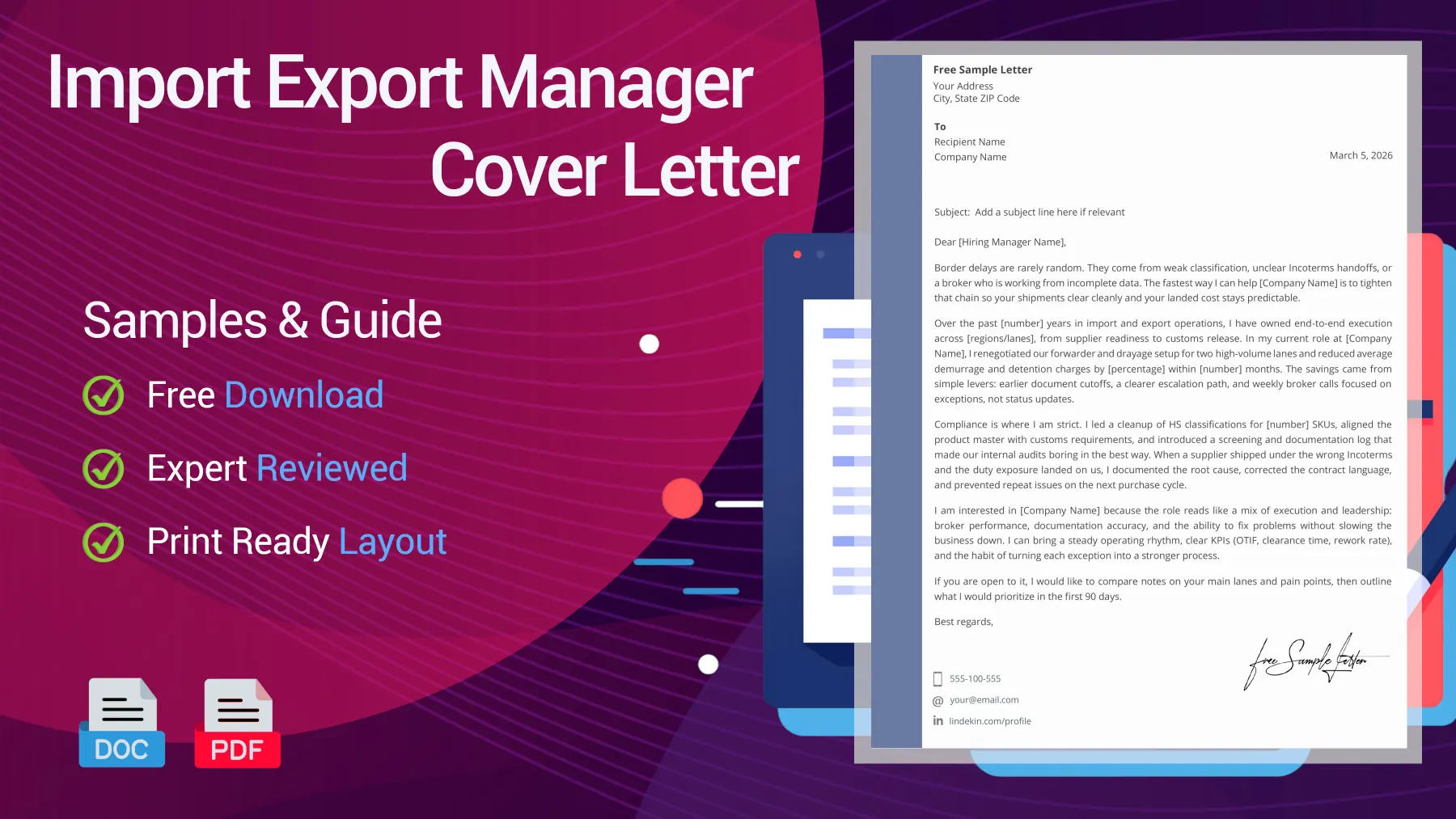
Free Samples for an Import Export Manager Application Letter
According to the BLS, logisticians earned a median wage of $80,880 in May 2024, with jobs projected to grow 17% from 2024 to 2034. Expert tip: Show how you reduce delays and maintain strict customs compliance.
Entry-Level Import Export Manager Cover Letter Sample (No Experience)
Built for a junior candidate: it proves trade compliance thinking and document accuracy without pretending you have already run shipments alone.
Dear [Hiring Manager Name],
Import Export Managers aren’t hired for busy work. They’re trusted to keep documents accurate, costs predictable, and shipments moving, even when last-minute changes occur. I’m applying to [Company Name] with that reality in mind, even as a junior candidate.
My background is in [Degree / Program], with hands-on experience gained during a logistics operations internship. I focused on the areas where errors are most expensive: commercial invoices, packing lists, Incoterms alignment, and following up with suppliers and forwarders. On one project, I cleaned up a product master file used for export documentation and reduced recurring invoice corrections by [percentage] in just one month. I accomplished this by identifying the root cause, standardizing the values, and adding a two-step verification before release.
I also supported import tracking for [lane/region]. Each morning, I reconciled ETAs on the forwarder portal, flagged exceptions such as missing documents, rollovers, or customs questions, and shared updates with sales and customer service. This foundational work prevents costly surprises, supports daily recordkeeping, and helps keep customer commitments reliable.
If you’re looking for someone who has already negotiated freight tenders, I’m not there yet. But if you need a junior Import Export Manager who learns SOPs quickly, protects compliance, and keeps documentation running smoothly, my approach can support your team.
I’d welcome a short conversation to review the role’s main lanes and the tools you use, so I can explain how I’d support your workflow in the first 60 days.
Sincerely,
[Your Name]

Reviewed by Nina P., Senior Editor
I like the calm, process-first tone; it shows maturity for entry-level and avoids inflated claims while still proving real trade exposure.
Senior Import Export Manager Cover Letter Sample
This experienced-level cover letter shows leadership across global lanes, contract negotiation, export controls, and KPI ownership, with numbers that hiring teams can verify.
Dear [Hiring Manager Name],
Border delays are almost never random. They’re usually caused by weak classification, unclear Incoterms handoffs, or brokers working with incomplete information. The fastest way I can help [Company Name] is by tightening that chain, so your shipments clear efficiently and your landed costs remain predictable.
Over the past [number] years in import and export operations, I have managed end-to-end processes across [regions/lanes], from supplier readiness to customs release. In my current role at [Company Name], I renegotiated our forwarder and drayage contracts for two high-volume lanes, reducing average demurrage and detention charges by [percentage] within [number] months. These savings came from practical changes: earlier document cutoffs, a clearer escalation path, and weekly broker meetings focused on exceptions, not just status updates.
I take compliance seriously. I led a cleanup of HS classifications for [number] SKUs, aligned our product master with customs requirements, and set up a documentation log that made internal audits routine and uneventful. When a supplier shipped under the wrong Incoterms and we faced unexpected duty exposure, I documented the root cause, updated the contract language, and prevented the issue from recurring in the next cycle.
I’m interested in [Company Name] because this role combines execution with leadership: broker performance, documentation accuracy, and the ability to solve problems without slowing down the business. I bring a steady operating rhythm, clear KPIs (OTIF, clearance time, rework rate), and a habit of turning each exception into a stronger process.
If you’re open to it, I’d like to discuss your main lanes and challenges, and share what I’d prioritize in my first 90 days.
Best regards,
[Your Name]
Reviewed by Nina P., Senior Editor
I like that it leads with levers and numbers; demurrage savings plus a broker cadence tells me this person runs lanes, not slogans.
Cover Letter Example for an Import Export Internship
This intern sample proves you can be useful immediately: clean commercial invoices, track HS codes, coordinate with the forwarder, and keep a simple audit trail.
Dear [Hiring Manager Name],
An import/export intern adds value when they remove friction: fewer missing fields, less chasing documents, better tracking, and smoother handoffs to the forwarder. That’s the role I’m prepared to play for [Company Name].
I’m currently a [Year] student in [Program] and have worked on trade and logistics assignments that mirror daily operations. In a recent group project, we simulated an export cycle from order to customs release. I managed the documentation pack and built a checklist to ensure consistency across invoice lines, HS codes, weights, and Incoterms. The result: no rework during final review, while other teams lost time fixing mismatches. I also used Excel to track milestones (ETD, ETA, document cutoff) and flag exceptions early.
Outside of class, I work in [part-time role / student job], where accuracy is critical. I handle data entry and reconciliation, and I’ve learned to ask for missing details up front instead of sending repeated follow-up emails.
I ensure quality by maintaining an audit trail: saving source files, logging approvals, and recording every change to a commercial invoice or packing list. Before sending anything, I run three checks: totals and units match the PO, commodity descriptions are consistent, and the forwarder receives the complete set in a single thread. It’s not glamorous, but it protects the shipment.
If you’d like, I can walk you through the checklist and tracker I use and adapt them to your lanes in my first week. A short interview about your workflow would clarify the next step.
Best regards,
[Your Name]
Reviewed by Nina P., Senior Editor
The letter is technical without overreaching; I can see this intern supporting documentation packs and trackers confidently from week one.
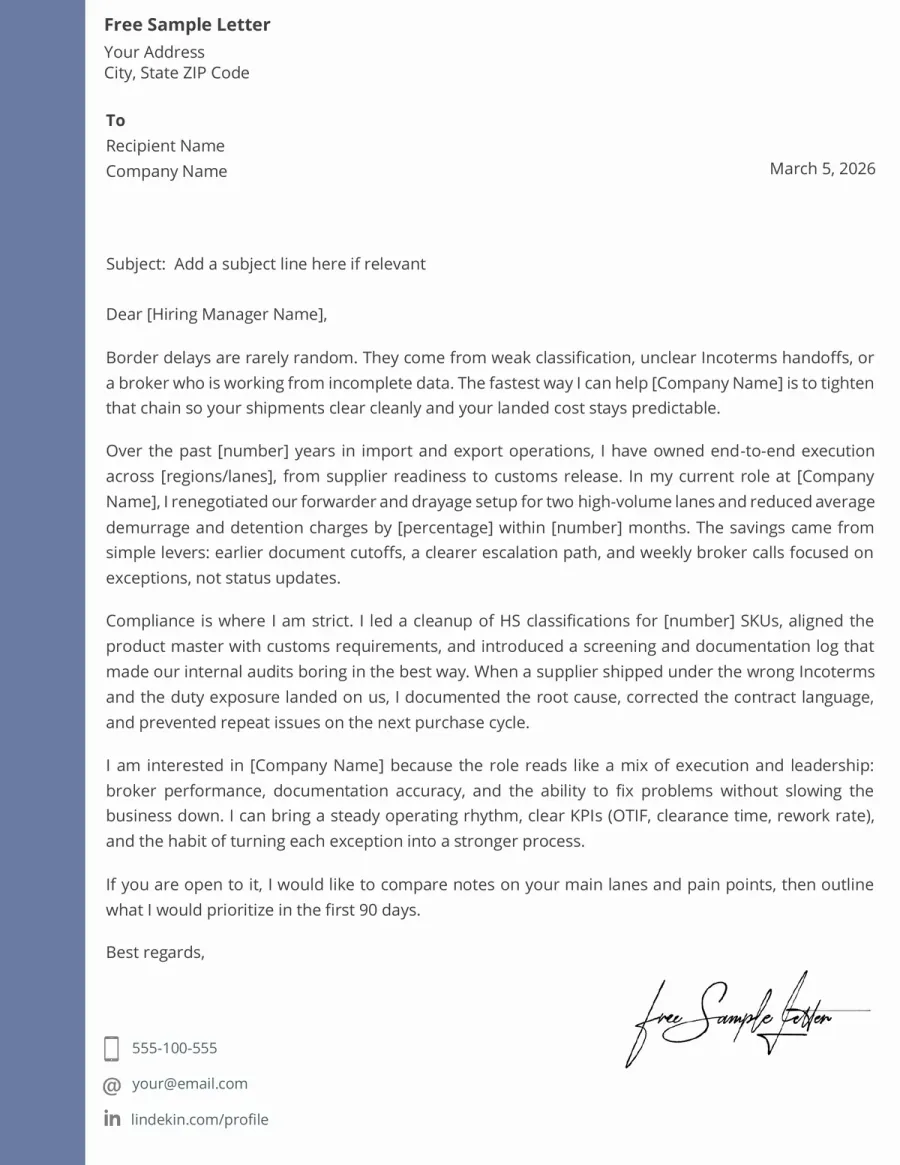
Preview the Import Export Cover Letter Template Before Download (Word/PDF)
Review this preview to see the import export manager application letter template before downloading. The template is available in both Word and PDF formats for easy editing and printing.
Turn These Samples Into Real Import/Export Application Letters
Copy-paste applications are obvious to hiring teams. Keep the structure, but personalize your lanes, Incoterms, documents, and figures. Adjust the verbs so the letter reflects your own responsibilities and results.
➡️ More expert guidance in our article how to write a cover letter that hiring managers actually finish
Title: Mirror the lane and scope
Start by mirroring the posting: lanes, modes, and scope. Mention your main regions, Incoterms, and the handoffs you own, so the reader can place you in their workflow.
See an example
At [Company Name], I ran [Region A] to [Region B] moves by [air/ocean], confirming Incoterms at PO stage and keeping broker handoffs clean before the document cutoff.
Prove document control and compliance habits
Trade roles live and die on documentation. Add two lines on what you control: HS codes, COO, export declarations, screening, and retention. Finish with one sentence on your check routine.
See Here’s a line you can use
Before release, I validate HS code vs master data, confirm COO requirements, and send the broker one clean pack (invoice, packing list, AWB/BOL) to avoid customs holds.
Add two measurable wins, not opinions
Pick two KPIs the business feels: clearance time, OTIF, demurrage/detention, rework rate, and landed cost variance. Put the number next to the action, not in a braggy sentence.
See an example
I reduced document rework from [number] cases/week to [number] by standardizing invoice templates and setting a 48-hour doc cutoff, cutting average clearance time by [number] hours.
Name tools and handoffs the ATS expects
ATS wants tools, humans want clarity. Name the systems you use (ERP, TMS, broker portal) and the handoffs you run (forwarder, warehouse, finance). Show you keep updates short and timely.
See an example line
Using [ERP] and [TMS], I reconcile ETD/ETA daily, flag exceptions to [Team], and send the broker one thread with updated docs, so nothing gets lost.
Close with a trade-specific next step
Replace generic closings with a trade-specific next step: offer to walk through one lane, your document checklist, or a first-30-day plan. Keep it calm and practical.
See an example closing
If helpful, I can map your top [Region] lanes and share the checks I run before release. A 15-minute call this week is enough to test fit.
Keyword Radar: What Import/Export Recruiters and ATS Catch First
- Incoterms
- Demurrage
- Landed cost
- Customs broker coordination
- Commercial invoice accuracy
- Packing list and weights match
- Export declarations
- Cutoff times
- COO requests before booking
- Forwarder portal tracking
- Exception handling under vessel cutoff
- HS codes
- SLA follow-ups with brokers
- ETD / ETA updates to Sales
- Duty and tax validation
Do & Don't: Import Export Manager Cover Letters That Hiring Teams Trust
Recruiters look for operational proof in import/export cover letters: accurate documents, broker coordination, and calm handling of exceptions. Vague claims or missing trade details lose their interest quickly. Ensure every line builds credibility.
What makes an import/export cover letter look careless
Red Flags- Overclaim lane ownership when you only supported tasks
- Skip trade specifics like Incoterms, HS codes, or document flow
- Hide compliance responsibilities behind vague phrases like handled paperwork
- Drop tools with no context instead of naming real handoffs and outputs
- Copy generic openings that could fit any operations role
What makes your letter feel operational and credible
Trust Signals- Name one lane, one mode, and one constraint to ground the story
- Show your check routine for HS codes, COO, and document packs
- Quantify impact with a KPI tied to an action (clearance time, rework, demurrage)
- Describe how you coordinate broker, forwarder, warehouse, and finance
- Write one short exception moment that shows calm troubleshooting
FAQ - Import Export Manager Cover Letter
Should I name specific Incoterms, or is that too detailed? Toggle answer
Name 1-2 that match the role’s reality (EXW, FOB, CIF, DDP, FCA). Then tie it to what you actually controlled: handoffs, docs, and cost exposure. Vague “trade terms” reads like fluff.
How do I prove I understand HS codes without sounding like I’m guessing? Toggle answer
Don’t “teach” HS codes. Describe your habit: verify classification vs product master, escalate uncertainties to compliance/broker, and document decisions. One concrete example beats a paragraph of theory.
How do I explain a customs hold or late-document issue without blaming others? Toggle answer
Focus on how you resolved the issue, not the drama. State the root cause, such as missing COO or mismatched invoice and packing list, your action, like reissuing documents or aligning with the broker, and what you did to prevent it from happening again, such as introducing a new cutoff, checklist, or master data cleanup. This approach shows operational thinking.
Which KPIs matter most for import/export roles? Toggle answer
Use trade-native metrics: clearance time, document rework rate, customs hold rate, demurrage/detention, OTIF on critical lanes, landed cost variance. Pick two and attach them to actions you took, not “results I achieved.”
Junior profile: How do I sound credible without overstating my experience managing shipments? Toggle answer
Claim tasks you can prove: document packs, tracking, exception flagging, data hygiene, broker follow-ups. Then show judgment with one micro-situation you helped resolve. Recruiters reject juniors who inflate ownership faster than those who admit scope.
TL;DR - Your Import Export Manager cover letter game plan
Stop trying to “sound qualified.” Prove you can run the trade workflow: name a lane, anchor 1-2 Incoterms, and show how you prevent document errors (HS code, invoice/packing list, broker handoff). Fatal error: writing a logistics-generic letter that never touches customs reality.
Recruiters hire the person who stays calm when the file breaks at 4:45 PM. The credibility signal most candidates miss is your quality routine: what you check, how you document decisions, and how you prevent repeat holds. That’s the difference between “handled shipments” and “kept them moving.”