
Buyer Cover Letter Examples You Can Adapt Fast in 2026
A strong buyer cover letter quickly demonstrates commercial judgment. These examples show how to present supplier selection, product decisions, and margin impact in language hiring teams trust.
Free Buyer Cover Letter Samples for Commercial Applications
According to the BLS, buyers are evaluated on price, quality, delivery, and inventory decisions. Expert interpretation: your cover letter should demonstrate commercial judgment through specific examples, not general enthusiasm.
Entry-Level Buyer Cover Letter for a Recent Graduate
This buyer cover letter suits an entry-level candidate because it transforms internships, retail analysis, and product awareness into a credible commercial application.
Dear [Hiring Manager Name],
A strong buyer shows attention to detail long before holding the title. That’s why your Buyer opening caught my eye. You need someone who can interpret product performance, identify what deserves more space, and support decisions with clear, reasoned analysis, not guesswork.
During my final year at [University Name], I completed a merchandising internship with [Company Name], where I supported weekly product reviews for the women’s accessories category. One assignment became a valuable lesson. After comparing store feedback, stock cover, and sell-through on a group of underperforming lines, I noticed that two slow sellers were taking space from lower-priced items that moved faster in urban locations.
My report helped the team rebalance the display plan in [number] stores, and those replacement items sold through [number]% faster over the next four weeks. While I wasn’t making the final buying decisions, I saw firsthand how small commercial choices can quickly impact results.
I also worked part-time in retail while studying, which taught me things reports don’t always capture. Customers hesitate for specific reasons: price, fit, timing, and product relevance among them. At [Store Name], I tracked recurring customer comments and shared them with the store manager ahead of weekly replenishment meetings. This feedback reduced repeat stock requests for a slow-moving line and improved availability for a faster-selling seasonal group.
The most practical way I can help [Company Name] is by supporting your buying team with clear analysis, disciplined follow-up, and product insights grounded in real customer response.
I’m drawn to [Company Name] by the opportunity to grow in a team where commercial judgment matters every day. I’d welcome the chance to discuss how I could contribute to category reviews, supplier coordination, and buying preparation from the start.
Sincerely,
[Your Name]

Reviewed by Nina P., Senior Editor
I like the discipline here. The candidate sounds early-career, yet the examples show product thinking, store awareness, and hiring maturity.
Experienced Buyer Cover Letter
This sample fits a senior buyer by highlighting assortment planning, supplier management, sell-through, and margin decisions that recruiters expect from candidates with commercial ownership experience.
Dear [Hiring Manager Name],
Buying delivers value when judgment holds up under pressure. That’s the standard I’ve maintained for the past [number] years across [category] and [category] at [Company Name]. Your Buyer role caught my attention because it combines category ownership with the pace and accountability that make the work meaningful.
In my current position, I manage a seasonal buying cycle worth approximately [amount] across [number] suppliers. Over the past two years, I’ve improved initial margin by [number] points and reduced end-of-season markdown exposure through tighter option planning and earlier line reviews. One result I’m especially proud of started with a weak pre-launch response to a mid-price capsule. Instead of pushing the original plan, I adjusted depth by store cluster, reduced exposure to three weaker options, and shifted spend to a supplier who could offer a better opening price and shorter lead time. This revised buy increased full-price sell-through by [number]% in the first six weeks.
I ensure the quality of my buying by pressure-testing every range against four criteria before committing: customer relevance, depth logic, supplier reliability, and exit risk. This process has also helped me negotiate more effectively. Last year, I led a renegotiation with two core vendors, securing improved payment terms and protecting delivery windows during a tight supply period, without forcing reactive substitutions later in the season.
[Company Name] seems to be at a stage where clear category thinking is more important than noise. That matches my approach. I’d welcome a conversation about how I could help your team with sharper assortment decisions, stronger supplier planning, and improved stock outcomes across the [category] area.
Yours sincerely,
[Your Name]
Reviewed by Nina P., Senior Editor
I notice the candidate thinks in structure, not slogans. That is exactly what separates a true buyer from someone repeating job-description terms.
Career Change Buyer Cover Letter for Mid-Career Applicants
This buyer cover letter works for a career changer by framing the transition clearly and replacing doubt with evidence of preparation and commercial fit.
Dear [Hiring Manager Name],
My move toward buying wasn’t accidental. After [number] years in hospitality operations, I began paying closer attention to a part of the business I once treated as background: who we ordered from, why certain products generated repeat demand, and how poor purchasing choices could create waste long before it appeared in the numbers.
One morning at [Former Company Name], a late supplier delivery forced us to rewrite service plans for a high-volume weekend. We had enough stock on paper, but not the right mix, and the shortfall revealed how weak ordering discipline can ripple through an operation. I handled the immediate fix with substitutions and tighter allocation between sites, but the experience stayed with me. It led me to study procurement fundamentals, complete [Course or Certification Name], and spend the last [number] months developing a stronger understanding of supplier evaluation, cost analysis, and inventory planning.
That shift hasn’t replaced what I already know. In operations, I managed budgets, negotiated with vendors, monitored usage, and made daily decisions where availability, timing, and cost all mattered at once. At [Company Name], I reduced supply overspend by [number]% after reviewing order patterns across three locations and replacing ad hoc purchasing with a tighter weekly process. I also introduced a supplier comparison sheet that highlighted price differences without overlooking service reliability. If you need someone whose entire career has been in buying, I’m not that person. If you need someone making a deliberate move with mature judgment, commercial discipline, and a clear reason for choosing this function, that’s what I offer.
I’d welcome the opportunity to discuss how I could contribute to [Company Name] in a junior buyer or buyer support role while continuing to develop my category expertise.
Sincerely,
[Your Name]
Reviewed by Nina P., Senior Editor
I like that the candidate does not hide the transition. The letter answers the obvious doubt early, then earns credibility through process and numbers.
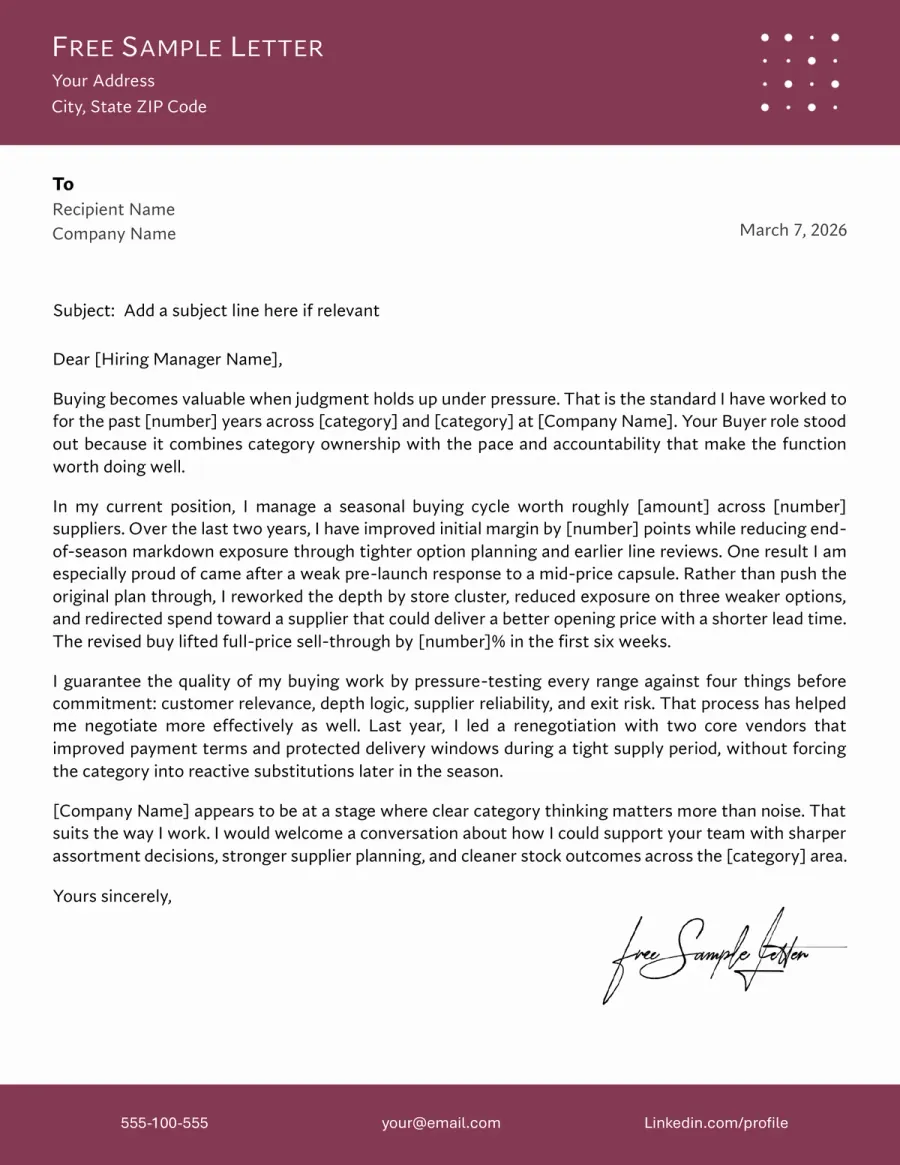
Buyer Cover Letter Template Preview Before Word and PDF Download
Preview the buyer cover letter template before downloading it in Word or PDF format. Use this view to assess the structure, tone, and commercial focus of your application letter before saving.
Turn These Buyer Samples Into Your Own Letters
Copy-paste approaches fall short in buyer hiring because the role relies on judgment, not generic enthusiasm. Recruiters look for how you approach suppliers, stock, margins, customer demand, and category choices in a real business context.
➡️ More expert guidance in our article how to write a cover letter that sounds specific and credible
Start with the category reality
Your opening lines should reflect the real demands of the role: category performance, supplier choices, margin, stock balance, or customer demand. This is what makes a buyer cover letter feel grounded and relevant.
See opening idea
Instead of starting with generic interest, write something like: Retail buying works when product choices, timing, and margin discipline stay aligned, and that is where I have done my best work.
Replace claims with trading proof
Don’t just claim to be strategic or commercially minded. Prove it. Highlight one result related to sell-through, cost control, vendor terms, markdown reduction, forecasting, or stock improvement, even if your scope was limited.
See what to include
You can write: I reviewed slow-moving lines across [category], flagged overlap at entry price points, and helped redirect spend toward stronger options that improved early sell-through by [number]%.
Show how you work with suppliers
Buyer roles aren’t secured by trend talk alone. Include a sentence showing how you compare vendors, negotiate terms, track delivery windows, or respond to quality and availability issues under pressure.
See supplier angle
A useful line sounds like this: I supported supplier reviews by comparing price, lead time, and repeat reliability, which helped the team make faster choices before final commitment.
Match the tone to the business
A fashion buyer letter can sound sharper and more commercial, while a manufacturing or procurement-focused letter should be more measured, process-driven, and precise. Match your tone to the business environment.
See tone shift
For a retail brand, write: I keep a close eye on product momentum and customer response. For a more operational employer, write: I work from demand signals, supplier performance, and inventory discipline.
Close with a practical next step
Your closing should feel practical, not just formal. Invite a conversation about category support, supplier planning, or buying decisions. This approach is more natural than a generic thank-you line.
See closing example
Try: I would welcome the chance to discuss how I could support [Company Name] with sharper assortment decisions, cleaner supplier follow-up, and stronger stock outcomes across [category].
Buyer Keyword Radar for Recruiters and ATS
- Supplier negotiation
- Open-to-Buy planning
- Margin
- Forecasting
- Vendor scorecards
- SKU optimization
- Customer demand signals
- Negotiating cost and delivery time
- Category performance
- Range reviews
- Purchase orders
- Cross-functional trading meetings
- Markdown exposure
- Trend analysis
- Sell-through
- Rebalancing slow sellers
- Supplier reliability
- Pricing strategy
- Managing stock depth
Do & Don't for a Buyer Cover Letter That Feels Commercial
A buyer cover letter is judged quickly. Recruiters scan for commercial judgment, not just enthusiasm. They want evidence that you understand stock, suppliers, margin, and product decisions well enough to be effective in a live trading environment.
Buyer cover letter red flags
Red Flags- Open with vague excitement and no business angle
- Describe yourself with empty traits instead of trading evidence
- Overstate buying authority
- Repeat the job ad
- Use a closing that feels copied from any office role
Buyer cover letter trust signals
Trust Signals- Start with a real buying pressure point
- Anchor one paragraph in category performance
- Clarify your scope honestly
- Use buyer vocabulary
- Close by proposing a useful next conversation
FAQ - Buyer Cover Letter
How do I write a buyer cover letter if I do not have a buyer job title yet? Toggle answer
Show related experience. Use examples from merchandising, inventory, store analysis, vendor follow-up, or purchasing support. A buyer cover letter falls flat when it claims authority you didn’t have. It’s more effective when it demonstrates judgment that’s already relevant.
Should I mention negotiation if I only supported suppliers, not led the deal? Toggle answer
Yes, but be specific. For example, say you compared quotes, tracked delivery issues, prepared vendor reviews, or supported PO follow-up. Recruiters can tell the difference between assisting a negotiation and leading one. Being honest about your scope is stronger than overstating your role.
Do buyer recruiters expect tools like Excel, ERP, or MRP in the cover letter? Toggle answer
Often, yes. You don’t need to list every software, but mentioning tools tied to forecasting, PO tracking, supplier data, or inventory control can help, especially for operational or manufacturing-focused roles.
How do I make a retail buyer letter sound commercial instead of generic? Toggle answer
Discuss sell-through, margin, pricing, assortment, stock depth, or product response. Simply saying “I love trends” isn’t enough. A buyer cover letter is credible when it connects product choices to business results.
Can I move into a buyer role from inventory, operations, or store management? Toggle answer
Yes, but only if you clearly explain the overlap. Skills like forecasting, supplier coordination, stock analysis, and cost control are relevant. Don’t assume recruiters will connect the dots. Make those connections in your letter.
TL;DR - What Makes a Buyer Cover Letter Worth Reading
A buyer cover letter works when it demonstrates sound judgment. Show a specific decision related to suppliers, stock, margin, pricing, or sell-through. Use commercial language, not vague enthusiasm. The main mistake is writing like a general retail candidate when the role is really about business decisions.
The deeper signal is restraint. Strong buyer applications don’t exaggerate authority or rely on trend talk. They sound specific, composed, and commercially aware. If your cover letter shows how you make decisions under product, timing, and supplier pressure, you’ll stand out as a credible applicant.