
Event Planner Cover Letter Examples That Get Interviews in 2026
Show how you protect the run-of-show, not just your passion for events. Use these Event Planner cover letter examples to highlight timelines, vendor coordination, budget decisions, and your approach to handling surprises. Download each sample in Word or PDF format.
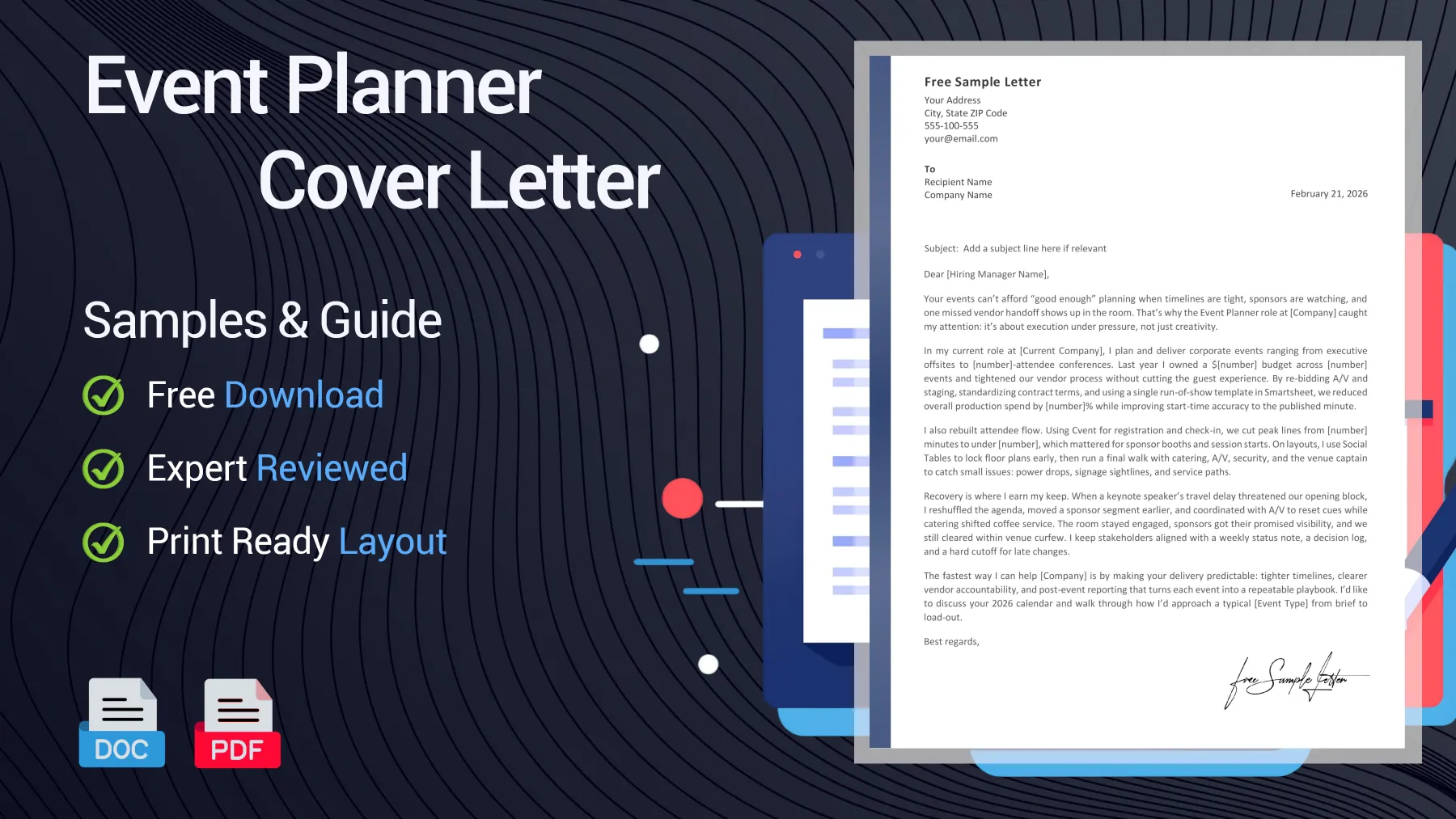
Free Samples of Event Planner Application Letters
The Bureau of Labor Statistics projects 5% growth in meeting, convention, and event planner roles from 2024 to 2034, with about 15,500 openings each year. What this means: show how you protect the run-of-show when vendors slip or budgets tighten.
Entry-Level Event Planner Cover Letter (No Direct Experience)
Built for entry-level or junior applicants: it shows readiness through checklists, vendor follow-ups, run-of-show basics, and a clean closing, without pretending you have years in the role.
Dear [Hiring Manager Name],
Great events happen because of thoughtful decisions made long before guests walk in. That attention to detail is exactly what I would bring to the Event Planner role at [Company], even as an entry-level candidate.
My background blends hospitality coursework with hands-on support roles where details really matter. For my capstone project in [Program/School], I created a full event plan for a [type of event] at [Venue Type], including budget lines, vendor quotes, staffing, floor plan, and a timed run-of-show. I stress-tested every step with “what if” scenarios - late deliveries, weather changes, or VIP arrival shifts - and wrote contingency steps as clear, actionable checklists.
On the floor, I’ve worked banquets for [Hotel/Venue] as a [Role], learning guest flow and timing firsthand, lessons a classroom can’t teach. At one reception, a last-minute seating change meant reworking the table layout while the kitchen was already plating. I quickly relayed new counts, updated place cards, and redirected guests without interrupting service. The transition was seamless for guests, which is exactly the goal.
If you’re unsure about hiring someone without a formal planner title, here’s how I reduce risk: I document every decision, confirm each handoff, and keep a single checklist that the team can follow, even if I’m not there. I’m comfortable working in Google Sheets, shared calendars, and simple task boards, and I always close events with a brief recap of what worked and what could be improved next time.
I’d welcome a conversation about the events you have planned for 2026 and where you need support most. I can bring a one-page event brief and run-of-show sample to walk you through how I’d adapt my approach to your venues and standards.
Sincerely,
[Your Name]

Reviewed by James R., Hiring Manager
I like how the letter turns banquet work into planning value; the seating-change scene proves calm coordination without overstating experience in a real room.
Experienced Event Planner Cover Letter
Made for experienced planners: it leads with measurable outcomes, then proves you can protect budget, timeline, and stakeholder trust across complex events, not just talk about being organized.
Dear [Hiring Manager Name],
Your events can’t afford “good enough” planning when timelines are tight, sponsors are watching, and a single missed vendor handoff can impact the whole room. That’s why the Event Planner role at [Company] stood out to me: it’s about delivering under pressure, not just generating ideas.
In my current role at [Current Company], I plan and deliver corporate events ranging from executive offsites to [number]-attendee conferences. Last year, I managed a $[number] budget across [number] events and streamlined our vendor process without sacrificing guest experience. By re-bidding A/V and staging, standardizing contract terms, and implementing a single run-of-show template in Smartsheet, we reduced production spend by [number]% and improved start-time accuracy to the published minute.
I also improved attendee flow. Using Cvent for registration and check-in, we cut peak lines from [number] minutes to under [number], which made a difference for sponsor booths and session timing. For layouts, I use Social Tables to finalize floor plans early, then conduct a final walk with catering, A/V, security, and the venue captain to resolve issues like power drops, signage, and service paths before doors open.
Problem-solving on event day is where I add the most value. When a keynote speaker’s travel delay threatened our opening block, I reshuffled the agenda, advanced a sponsor segment, and coordinated with A/V to reset cues while catering adjusted coffee service. The room stayed engaged, sponsors received full visibility, and we finished within venue curfew. I keep stakeholders aligned with weekly status notes, a decision log, and a firm deadline for late changes.
The fastest way I can support [Company] is by making your event delivery predictable: tighter timelines, clearer vendor accountability, and post-event reporting that turns each event into a repeatable playbook. I’d welcome the chance to discuss your 2026 calendar and walk through how I’d approach a typical [Event Type] from brief to load-out.
Best regards,
[Your Name]
Reviewed by James R., Hiring Manager
I trust this candidate because the numbers are tied to real levers: re-bids, contract terms, and start-time accuracy, not vague “managed events” claims.
Career Change to Event Planner Cover Letter (Mid-Career Pivot)
Built for a mid-career switch: it addresses the pivot head-on and translates operations skills into event deliverables like run-of-show, vendor terms, and contingency plans.
Dear [Hiring Manager Name],
Events may seem creative from the outside, but on event day, it’s really about operations: deadlines, vendors, budgets, and rapid decisions with incomplete information. That’s the work I’ve done for [number] years in [Previous Industry], which is why I made a deliberate mid-career move into event planning and am applying for the Event Planner position at [Company].
As an operations manager at [Previous Company], I managed multi-site schedules, negotiated vendor terms, and resolved urgent problems calmly and efficiently. I chose to leave that track on purpose. Over the past year, I completed [Event Planning Certificate/Program] and built a portfolio through work with [Community Organization/Nonprofit] and paid projects: a [type of event], a [type of event], and a [type of event], each with budgets from $[number] to $[number]. What I enjoy most is turning a vague brief into a run-of-show that teams can actually deliver.
I don’t depend on inspiration to stay organized. I keep my work reliable by following a structured process: a single master timeline, a vendor call sheet with owners and deadlines, a risk log with triggers and responses, and a final 72-hour confirmation check (counts, load-in, power, access, and weather). At a recent [Event Type], a rental delivery arrived missing [key item]. Because our checklist had a clear cutoff, I sourced a replacement within an hour and revised the floor plan before the venue walk-through.
Now, I’m seeking a team that values operational discipline as much as creative flair. If [Company] needs someone who can keep vendors accountable, protect the guest experience, and stay calm when things change, I’d appreciate the chance to talk. I can bring a sample event brief, run-of-show, and vendor tracker to our first conversation so you can see exactly how I work.
Best regards,
[Your Name]
Reviewed by James R., Hiring Manager
I respect how the pivot is stated plainly; the process details, training, and portfolio scope make the career change credible, not a hopeful story or hobby.
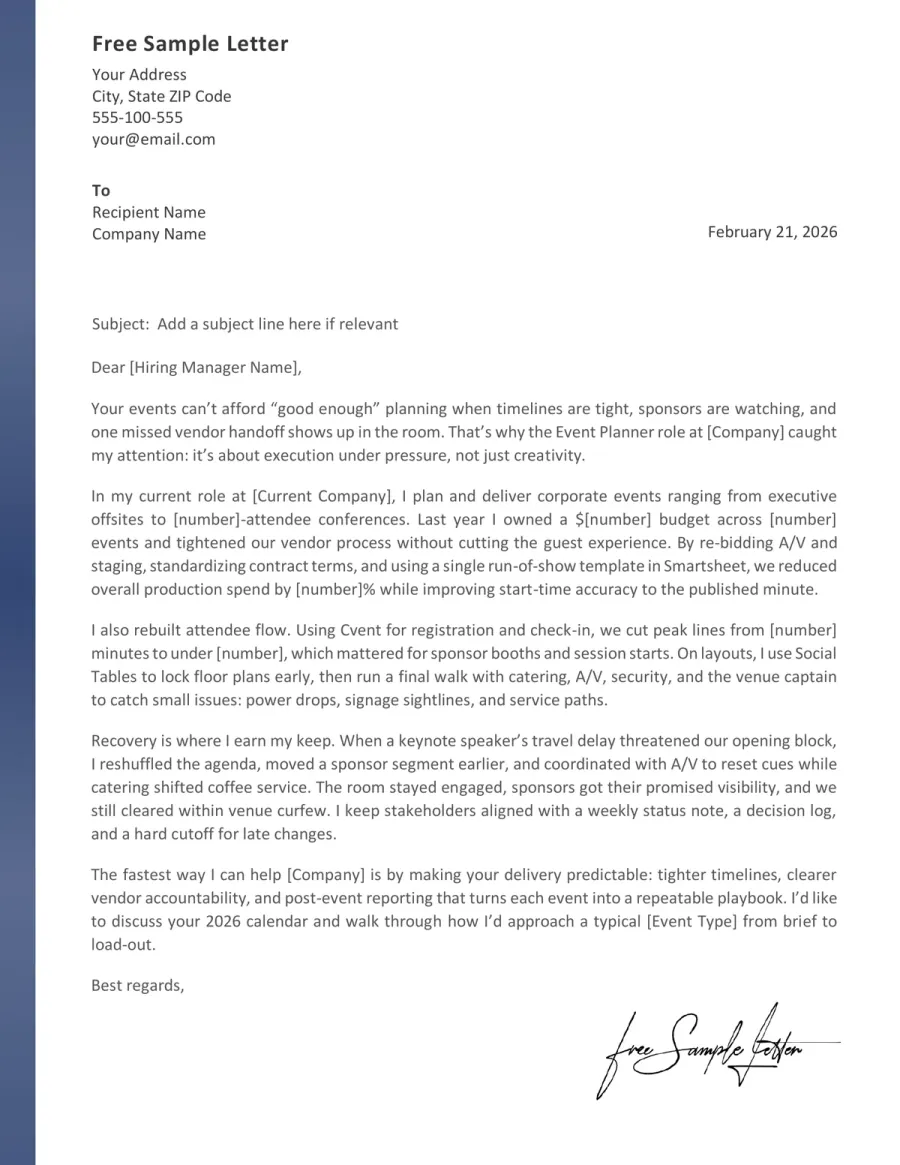
Event Planner Cover Letter Template Preview - Download Word or PDF
Preview this event planner cover letter template to see its structure before downloading. Editable files are available in Word and PDF formats.
Adapt the Samples in 5 Practical Steps
Copy-paste applications rarely work for event roles - recruiters can spot them instantly. Replace every placeholder with your actual venue type, headcount, budget, and tools. Then, include one real recovery moment (like a late vendor or agenda change) and describe the run-of-show you used.
➡️ More expert tips in our guide How to write a cover letter recruiters actually read
Map the brief and constraints
Start by identifying the employer’s event mix: corporate, weddings, conferences, or other types. Reference their constraints (budget cap, curfew, brand rules) and specify the deliverables you manage.
See what to include
For your [Conference/Client Dinner] at [Venue Type], I created the event brief, vendor call sheet, floor plan, and run-of-show. I tracked sign-off decisions in [Tool] so last-minute changes didn’t derail doors-open.
Turn experience into two measurable wins
Choose two accomplishments that address their key challenges: budget control, on-time start, or smoother check-in. Write them as action + result + constraint, and name the tools you used (like Cvent, Social Tables, or Google Sheets).
See what to write
I re-bid A/V for [Event], negotiated a flat labor rate, and saved [number]% while maintaining the same run-of-show. At check-in, I moved scanners to two lanes, reducing peak wait times to under [number] minutes.
Add one day-of recovery moment
Include a brief example where something didn’t go as planned: a late vendor, speaker delay, or weather change. Describe your decision, how you communicated, and the outcome in two lines. That’s what hiring managers look for in a planner.
See an example
When the keynote arrived 40 minutes late, I moved the sponsor segment forward, had A/V reset cues, and shifted coffee service to keep the event moving. We stayed within the venue curfew, and sponsors received their promised time.
Match your tools to their workflow
Mention the planning tools only if you have actually used them. Choose 2-3 tools relevant to the role (such as Cvent, Asana, or Google Sheets) and explain how you used them, whether for registration, task tracking, budgeting, or vendor communication.
See an example
I tracked budgets and change orders in Google Sheets, managed tasks in Asana by owner and due date, and sent a single vendor recap email after each call. This led to fewer surprises during load-in and faster approvals.
Close with a next step that fits this job
Close by offering something concrete, such as a run-of-show, budget tracker, or post-event report format. This shows you work from templates and checklists, not just intuition, and invites a real conversation.
See an example
If helpful, I can bring a one-page run-of-show for a [Client Dinner] and a budget tracker to demonstrate how I handle change orders. Together, we can map that process to your 2026 calendar and venues.
Keyword Radar: What Event Planner Recruiters Scan For
- Run-of-show
- Load-in / load-out coordination
- RSVPs
- Cvent registration + badge exports
- Vendor contracts
- Floor plan in Social Tables
- On-site triage
- BEO review with catering and venue
- Stakeholder sign-off log
- Speaker travel and green room timing
- AV cue sheet
- Risk log and contingency plan
- Guest flow at check-in
- Multi-room session transitions
- RFP and vendor re-bids
- Sponsorship deliverables and booth traffic flow
- Post-event report with KPIs
Do & Don't: What Makes an Event Planner Cover Letter Credible
Recruiters look for proof that you can protect the run-of-show under pressure. They skip letters that only express enthusiasm for events. Instead, they shortlist candidates who demonstrate control over timelines, budget decisions, vendor follow-ups, and real day-of recovery moments, with stakeholders aligned.
What gets an Event Planner cover letter skipped
Red Flags- Lead with vague enthusiasm instead of specifying event scope
- Use a generic template without naming the event type or audience
- Hide the hard parts: budgets, vendors, curfews, approvals
- List tools you’ve never actually used in event delivery
- Omit run-of-show details and true day-of ownership
- Ignore stakeholder communication and decision deadlines
What convinces a hiring manager to call you
Trust Signals- Specify the event types you support and the settings you’ve worked in
- Show two proof points tied to outcomes or constraints
- Refer to real deliverables: run-of-show, cue sheet, BEO, and floor plan
- Demonstrate vendor control: confirmations, recap emails, contract terms
- Reference only the tools you’ve actually used and explain where they fit in your process
- Make budget choices visible, such as re-bids, change orders, or variance
FAQ - Event Planner Cover Letter
Should I mention a run-of-show in my cover letter? Toggle answer
Yes, but don’t paste the full document. Mention that you can share a one-page run-of-show and a day-of command sheet. This signals that you plan with real deliverables, not just intuition. Keep this as an offer in your closing paragraph.
How do I show day-of problem solving without sounding disorganized? Toggle answer
Choose a single, clear example: what changed, what you protected (doors-open, guest flow, curfew), and the decision you made. Keep it to two sentences, no drama. Recruiters want evidence of control and calm, not hero stories.
Which planning tools should I name if the employer uses a different system? Toggle answer
Only mention tools you’ve actually used, and briefly describe the workflow they supported: registration, budget tracking, vendor follow-ups, or task management. Hiring teams can translate between systems, but they can’t translate vague claims.
How do I discuss vendor negotiation without revealing sensitive numbers? Toggle answer
Focus on levers and outcomes: re-bid process, standardized SOW, fewer change orders, clearer load-in assumptions, or reduced surprise fees. You can share ranges or percentages, or keep it qualitative if your process is strong.
Can I reuse the same cover letter for different applications? Toggle answer
Reuse the structure, not the content. Customize the event type, audience size, venue constraints, and include a real recovery moment for each application. If a recruiter could copy your letter onto another job posting without changes, your letter is too generic.
TL;DR - An Event Planner Cover Letter Must Read Like Delivery
Your Event Planner cover letter should prove you can protect the run-of-show: timelines, vendor follow-ups, budget decisions, and at least one real recovery moment. The fatal mistake is writing a letter focused only on your passion for events without naming scope, constraints, or deliverables.
Recruiters pay attention to decision-making. Show how you keep stakeholders aligned with a decision log, confirmations, or short status notes. Then, offer a concrete next step: for example, a walk-through of your one-page run-of-show or tracker. That feels testable, and it’s exactly how planners build trust.