
Business Follow-Up Letter and Email Examples After a Proposal
A strong business follow-up does more than ask for a response. It reminds the client of the context, makes the next step clear and keeps the working relationship open.
Before You Send a Business Follow-Up Letter
A business follow-up letter should make the next reply easy. Before writing, confirm the key details: the meeting date, proposal version, quoted price, decision deadline, questions raised, documents sent and any next step agreed during your last conversation.
The follow-up should not sound like pressure by default. A first message can confirm receipt or invite questions. A second follow-up can restate the value or ask whether the timing has changed. A final message can close the loop politely without blaming the prospect.
If the issue is not a proposal but an unpaid invoice, use a more payment-focused overdue invoice follow-up letter. For general structure, the UNC Writing Center reminds business writers to include contact information for follow-up and close by thanking the reader for their time: UNC Writing Center.
Follow-Up Email After Sending a Business Proposal
A concise proposal follow-up email for a prospect or client who has received your offer but has not yet replied with questions or a decision.
Subject: Follow-up on the [Project Name] proposal
Hello [Client Name],
I’m following up on the proposal I sent on [Date] for [Project Name / Service / Solution]. I hope you received it and had a chance to review the main points.
As a quick reminder, the proposal covers [brief scope], including [key benefit or deliverable]. Based on our earlier conversation, I believe this approach could help with [Client Goal / Business Need], especially regarding [specific point discussed].
If you have any questions about the scope, timeline, pricing or next steps, please let me know. I would also be happy to arrange a short call if it would help to review the proposal together.
Would [Day] or [Day] work for a quick discussion?
Best regards,
[Your Name]
[Your Position] [Company Name]

Reviewed by Michael T., Business Communications Consultant
This example works because it does more than ask for an update. It reminds the client about the proposal, highlights the value and suggests a specific next step.
Business Follow-Up Letter After a Client Meeting
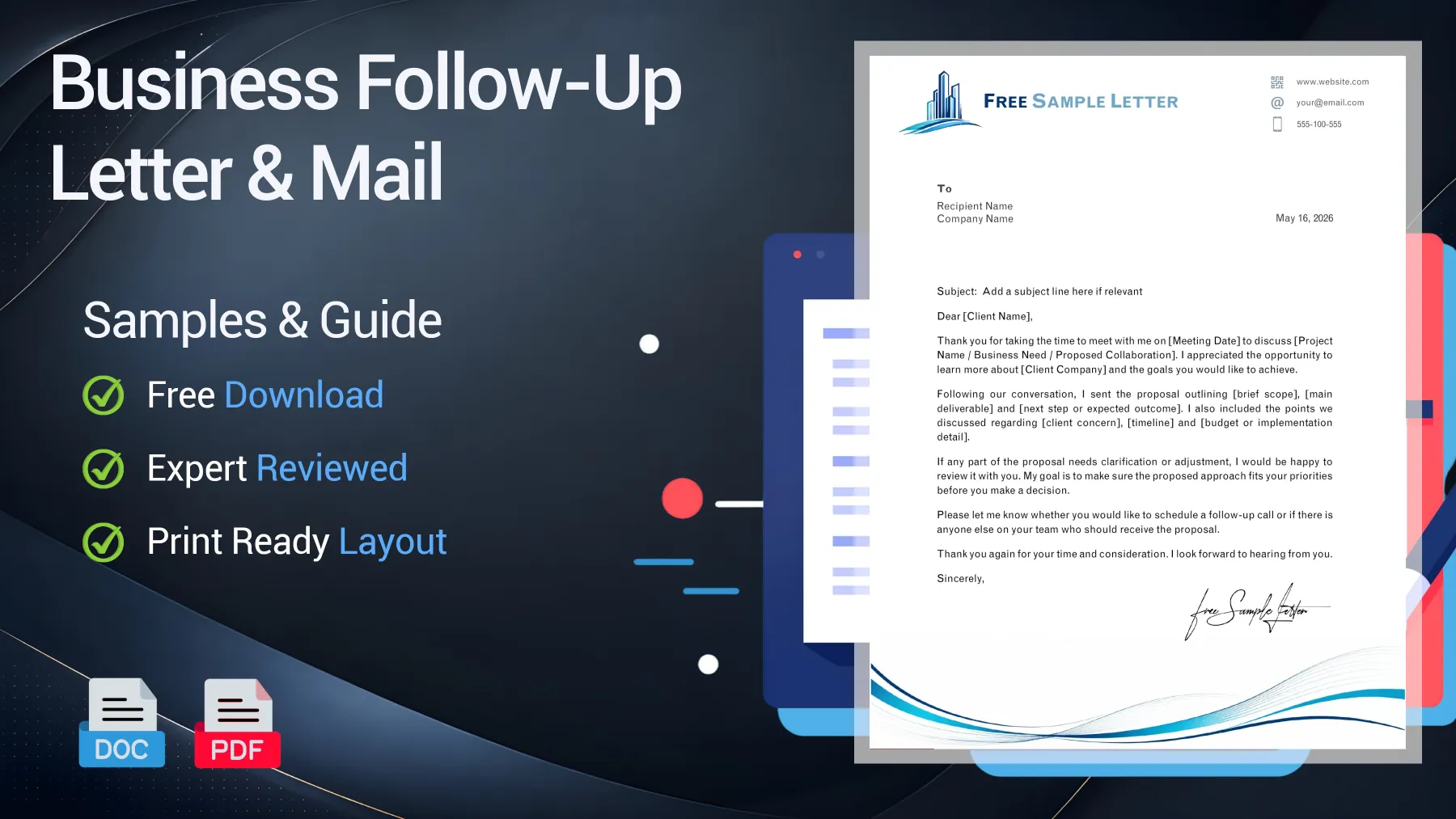
Use this business follow-up letter after a meeting when you want a warmer, more formal message that summarizes the discussion and maintains momentum.
Dear [Client Name],
Thank you for meeting with me on [Meeting Date] to discuss [Project Name / Business Need / Proposed Collaboration]. I appreciated the opportunity to learn more about [Client Company] and the goals you would like to achieve.
Following our conversation, I sent a proposal outlining [brief scope], [main deliverable] and [next step or expected outcome]. I also included the points we discussed regarding [client concern], [timeline] and [budget or implementation detail].
If any part of the proposal needs clarification or adjustment, I would be happy to review it with you. My goal is to ensure the proposed approach fits your priorities before you make a decision.
Please let me know if you would like to schedule a follow-up call or if there is anyone else on your team who should receive the proposal.
Thank you again for your time and consideration. I look forward to your reply.
Sincerely,
[Your Name]
[Your Position] [Company Name] [Phone Number] [Email Address]
Reviewed by Michael T., Business Communications Consultant
This letter is useful when the meeting was important. It summarizes the discussion, shows that the proposal was tailored to the client and avoids sounding like a generic sales follow-up.
Second Follow-Up Email After No Response
A polite second follow-up email after no response to a proposal, quote or business discussion, keeping the tone professional and open.
Subject: Checking in on [Project Name]
Hello [Client Name],
I’m following up on my earlier message about the proposal for [Project Name]. I understand you may have other priorities, so I wanted to make the next step simple.
Is this project still something you would like to move forward with, or would it be better for me to check back at another time?
If you have concerns about the scope, timing or budget, I would be glad to discuss them and see whether the proposal can be adjusted.
A quick reply would help me understand where things stand.
Best regards,
[Your Name]
Reviewed by Michael T., Business Communications Consultant
This follow-up is direct but not pushy. It lets the client pause, request changes or confirm whether the opportunity is still active.
Closing-the-Loop Email After a Business Proposal
A respectful closing-the-loop business email for prospects who have not replied after several follow-ups and may no longer be interested.
Subject: Closing the loop on [Project Name]
Hello [Client Name],
I’ve followed up a few times about the proposal for [Project Name], and since I haven’t heard back, I’ll assume the timing is not right at the moment.
I’ll close the file on my side for now, but please feel free to contact me if the project becomes a priority again or if you would like to revisit the proposal later.
Thank you again for the time you gave to our initial discussion. I appreciated learning more about [Client Company / Project Goal], and I would be glad to help if the need arises again.
Best regards,
[Your Name]
[Company Name]
Reviewed by Michael T., Business Communications Consultant
This final message protects the relationship. It ends the follow-up sequence politely without guilt, pressure or false urgency.
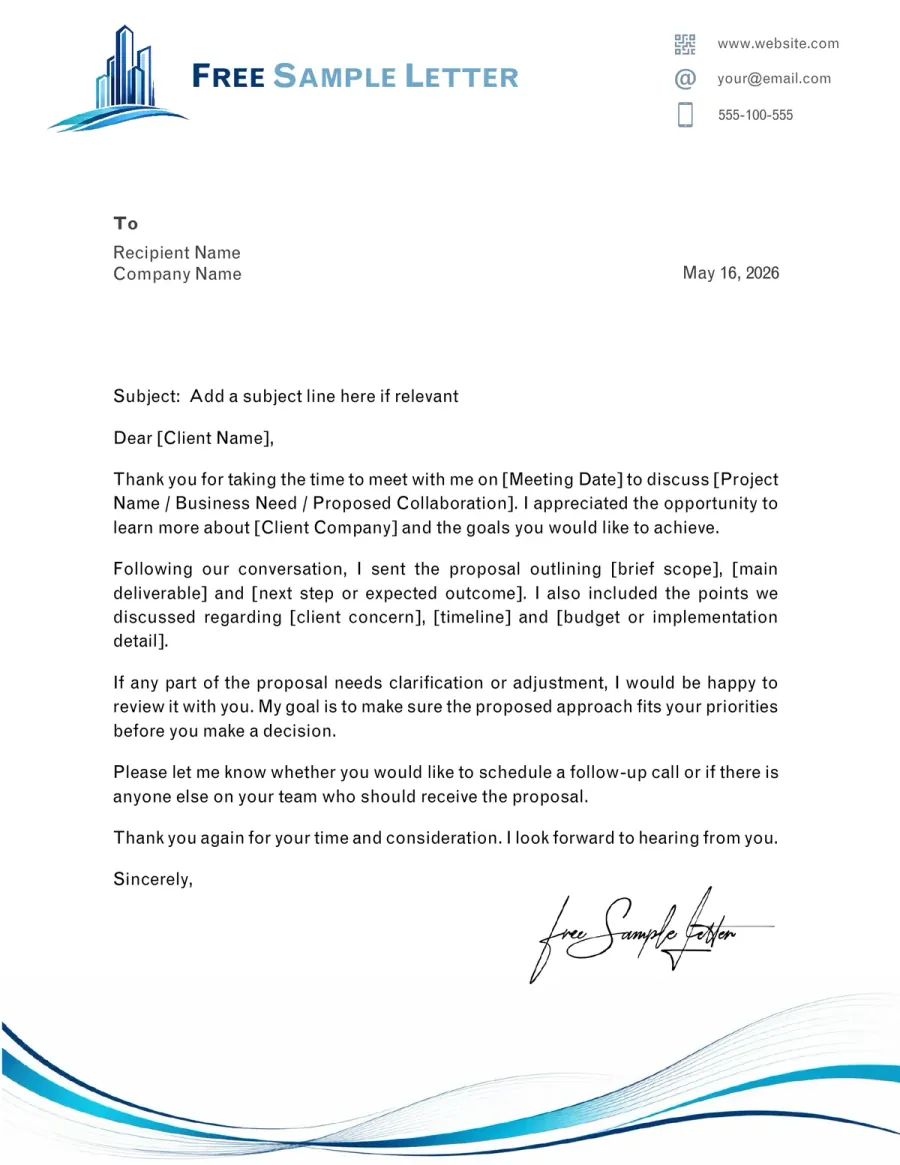
Preview of the Free Business Follow-Up Letter Template
Use this preview to check the structure before downloading the editable version. The template keeps the context, proposal reminder, client question and next step easy to scan.
How to Write a Business Follow-Up Letter That Gets a Reply
A strong business follow-up letter should clearly remind the client why you are writing while staying brief enough for a quick reply. The goal is not to repeat the entire proposal. It is to reopen the conversation with context, value and one clear next step.
➡️ More practical help in our guide how to write a professional letter that leads to action
Open with the exact context
Mention the meeting, call, proposal, quote or document you are following up on. If the follow-up is about an accepted order rather than a proposal, a business order confirmation letter may be the better format.
See a clear opening
I’m following up on the proposal I sent on [Date] for [Project Name], following our meeting on [Meeting Date].
Remind the client of the value, not every detail
Give one useful reminder of the proposal’s purpose. Avoid copying the entire offer into the follow-up, especially if the client already has the document.
See a focused reminder
The proposal focuses on reducing [Problem], improving [Result] and keeping the implementation within [Timeline].
Ask for one clear next step
A vague “just checking in” message is easy to overlook. Ask for a reply, a meeting, feedback, approval, another contact or a better time to follow up.
See a useful question
Would you like to schedule a short call this week, or should I send a revised version of the proposal first?
Match the tone to the stage
The first follow-up can be light. A second message can ask whether priorities have changed. A final note can close the loop. If the issue is a missed commitment from a supplier, use a late delivery notice to a supplier instead of a sales follow-up.
See the tone shift
First follow-up: I wanted to check that you received the proposal. Final follow-up: I’ll close this file for now unless the project becomes active again.
Keep the follow-up useful and brief
A business follow-up should make things easier for the recipient. Add a document, answer a likely question or offer a call only if it helps the recipient make a decision.
See what to avoid
Avoid long paragraphs that simply repeat the full sales pitch. The recipient should understand the point within a few seconds.
What the Recipient Checks First
- Project Name
- Meeting or Proposal Date
- Reason for the Follow-Up
- Main Client Goal
- One Useful Proposal Reminder
- Question or Concern to Answer
- Clear Call to Action
- Suggested Meeting Time
- Attachment If Relevant
- Contact Details
Do & Don’t - Business Follow-Up Letter
A business follow-up should keep the conversation moving without sounding desperate. The best version is specific, brief and useful, making it easy for the recipient to respond quickly.
What Weakens the Follow-Up
Red Flags- Send a generic “just checking in” message without context
- Repeat the entire proposal in the follow-up email
- Follow up every day when the client has not replied
- Add artificial urgency when there is no real deadline
- Sound annoyed because the client is busy
- Ask several questions instead of offering one clear next step
What Makes the Follow-Up Easier to Answer
Trust Signals- Mention the proposal, meeting or project in the first lines
- Give one useful reminder of the value or agreed discussion
- Ask for a call, feedback, confirmation or clear next step
- Keep the message brief and easy to scan
- Adjust the tone for a first, second or final follow-up
- Close the loop politely when the opportunity has gone quiet
FAQ - Business Follow-Up Letter
What is a business follow-up letter? Toggle answer
A business follow-up letter or email is sent after a meeting, proposal, quote, call or previous contact. It reminds the recipient of the context, answers possible questions and requests a clear next step.
Should I send a letter or an email after a proposal? Toggle answer
Email is usually better for speed, replies and normal client workflow. A formal letter may be appropriate for a high-value proposal, a company document sent on letterhead or part of a more official business record.
How soon should I follow up after sending a proposal? Toggle answer
There is no universal rule. In many business situations, sending a first follow-up after a few business days is reasonable. If the client gave a review date, use that date instead of following up too soon.
What should I write in a proposal follow-up email? Toggle answer
Mention the proposal, date or meeting, then remind the client of one useful point. Ask for one clear next step: feedback, a short call, approval, a revised proposal or a better time to reconnect.
How many times should I follow up with a prospect? Toggle answer
A short sequence works better than endless reminders. A first check-in, a second value-based follow-up and one polite closing-the-loop message are usually enough. After that, repeated messages may hurt the relationship.
How do I follow up without sounding pushy? Toggle answer
Use specific context, not pressure. Ask whether the project is still active, whether anything needs adjustment or whether another time would be better. Avoid blame, guilt or artificial deadlines unless there is a real business reason.
TL;DR - Make the Business Follow-Up Easy to Answer
A strong business follow-up letter reminds the recipient of the proposal, meeting or project without repeating every detail. It gives one useful reason to reply and suggests one clear next step.
Before sending it, consider the stage of the relationship. A first follow-up can confirm receipt. A second can ask about questions or timing. A final note can close the loop politely. The goal is not to chase the client; it is to make the next decision easier.