
Production Operator Cover Letter Examples for Factory Jobs in 2026
When a factory role receives dozens of applications, vague claims do not get you noticed. These samples show how to present machine skills, work pace, quality control, and safety habits in a way that hiring managers find credible.
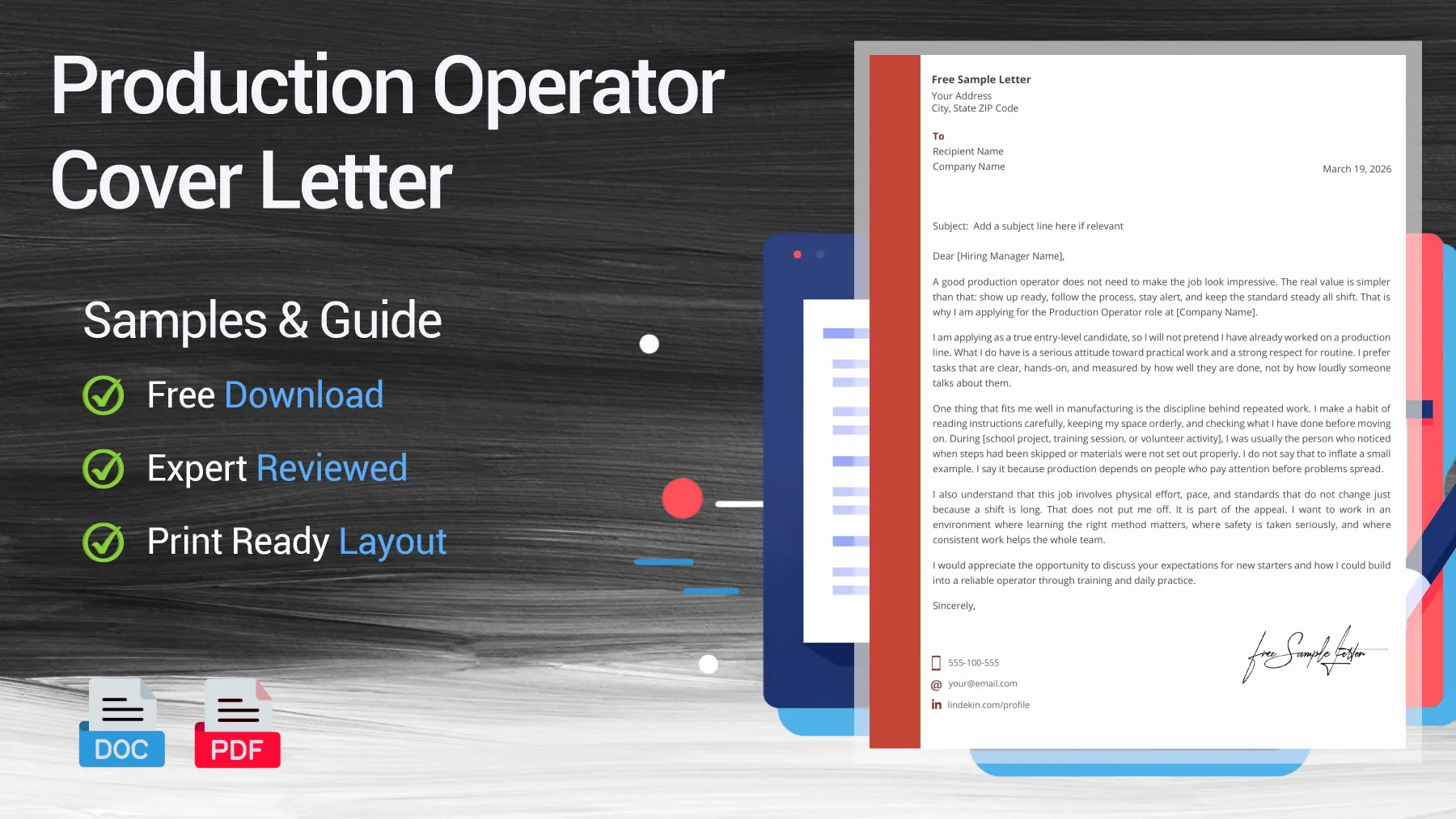
Free Production Operator Cover Letter Samples for Factory Applications
BLS notes about 963,400 openings a year across production occupations for 2024-2034, even as automation rises. For applicants, that means hiring managers now respond faster to cover letters that demonstrate safety awareness, machine familiarity, and reliable output.
Entry-Level Production Operator Cover Letter with No Factory Experience
Built for an entry-level candidate, this production operator sample turns discipline, fast learning, and attention to detail into a credible factory application letter.
Dear [Hiring Manager Name],
A good production operator does not need to make the job sound impressive. The real value is simpler: show up ready, follow the process, stay alert, and keep standards steady through every shift. That is why I am applying for the Production Operator role at [Company Name].
I am applying as a true entry-level candidate, so I will not claim experience I do not have. Instead, I bring a serious attitude toward practical work and a strong respect for routine. I prefer tasks that are clear, hands-on, and measured by the work itself, not by how loudly someone talks about it.
What draws me to manufacturing is the discipline of repeated work. I make a habit of reading instructions carefully, keeping my space orderly, and checking my work before moving on. During [school project, training session, or volunteer activity], I was often the one who noticed when steps were skipped or materials were missing. I am not inflating a small example. It matters because production depends on people who pay attention before problems spread.
I also understand that this job involves physical effort, a steady pace, and standards that do not change just because a shift is long. That does not put me off. In fact, it is part of the appeal. I want to work where learning the right method matters, safety is taken seriously, and consistent work helps the whole team.
I would welcome the chance to discuss your expectations for new starters and how I could grow into a reliable operator through training and daily practice.
Sincerely,
[Your Name]

Reviewed by Robert H., Technical Recruiter
I like the way this letter stays grounded. The candidate sounds teachable, steady, and aware of what production work actually asks day after day.
Experienced Factory Operator Cover Letter
This senior production operator sample highlights line ownership, downtime awareness, and quality control with concrete proof that speaks to hiring managers fast.
Dear [Hiring Manager Name],
Production lines stay productive when the operator spots problems early, keeps quality steady, and does not need to be chased for the basics. After [number] years in manufacturing, that is the value I would bring to the Production Operator position at [Company Name].
In my current role at [Current Employer], I operate and monitor [machine or line type], complete in-process checks, record production data, and act quickly when output starts drifting from the standard. Over the past year, our team reduced avoidable downtime on my line by [number]% after I pushed for a cleaner pre-start routine and more consistent changeover checks. It was not a dramatic fix, just a matter of catching small issues early, from worn parts to incorrect material setup, before they became repeated stops.
I take handovers seriously. On one shift last quarter, I noticed a pattern of minor sealing defects that had turned up twice in the same week. Instead of leaving a vague note, I isolated the affected batch, documented the issue clearly, and walked the incoming operator through what I had already checked. Maintenance found a setup problem before the next full run. We avoided a longer interruption and kept rework under control. That is how I prefer to work: calm, specific, and genuinely helpful to the next person.
I do best in environments where standards matter and excuses do not. I am used to shift work, production targets, SOPs, and the daily discipline that keeps a floor running safely. Housekeeping, documentation, and PPE are not side tasks. They are part of output.
I would appreciate a conversation about the equipment, targets, and quality priorities on your line to see where my experience could quickly support the team.
Sincerely,
[Your Name]
Reviewed by Robert H., Technical Recruiter
I trust this sample because it sounds like someone who has actually owned a line, not someone listing factory buzzwords from memory.
Career Change Production Operator Cover Letter
This career-change factory operator letter works because it does not fake line experience. It shows transfer, intent, and respect for plant-floor standards.
Dear [Hiring Manager Name],
I have chosen to move into manufacturing because I want my work tied to a visible process, clear standards, and daily results that depend on discipline. That is what draws me to the Production Operator role at [Company Name].
My previous career was in [Previous Industry], which may seem unrelated at first. What I gained, though, was a strong habit of precision, routine, and accountability under pressure. In that role, I worked to schedules, followed set procedures, handled checks that could not be skipped, and learned that small lapses become bigger problems later. That is one reason I feel suited to production work. The environment is different, but the mindset transfers well.
I hope you will see my application not as a random change, but as a move made with intention. I am comfortable with repetitive tasks when they matter, with standing work, with shift structure, and with being measured by consistency, not talk. In my previous job, I regularly caught errors before they reached the next stage by following a simple habit: confirm the instruction, complete the task, then check the outcome against the requirement before moving on. That process saved time and prevented avoidable corrections for the team.
I know I am not coming in with years on a production line. What I offer is seriousness, fast learning, and respect for the standards that keep a plant running safely. I do not need to pretend this is the same as my former field. It is not. That is exactly why I am making the move with intention and am ready to be trained the right way.
I would welcome the chance to discuss your onboarding process and how someone with a strong procedural background can become effective quickly in your production environment.
Sincerely,
[Your Name]
Reviewed by Robert H., Technical Recruiter
I would keep this application because the career change is explained directly. The candidate sounds intentional, not lost or vaguely interested.
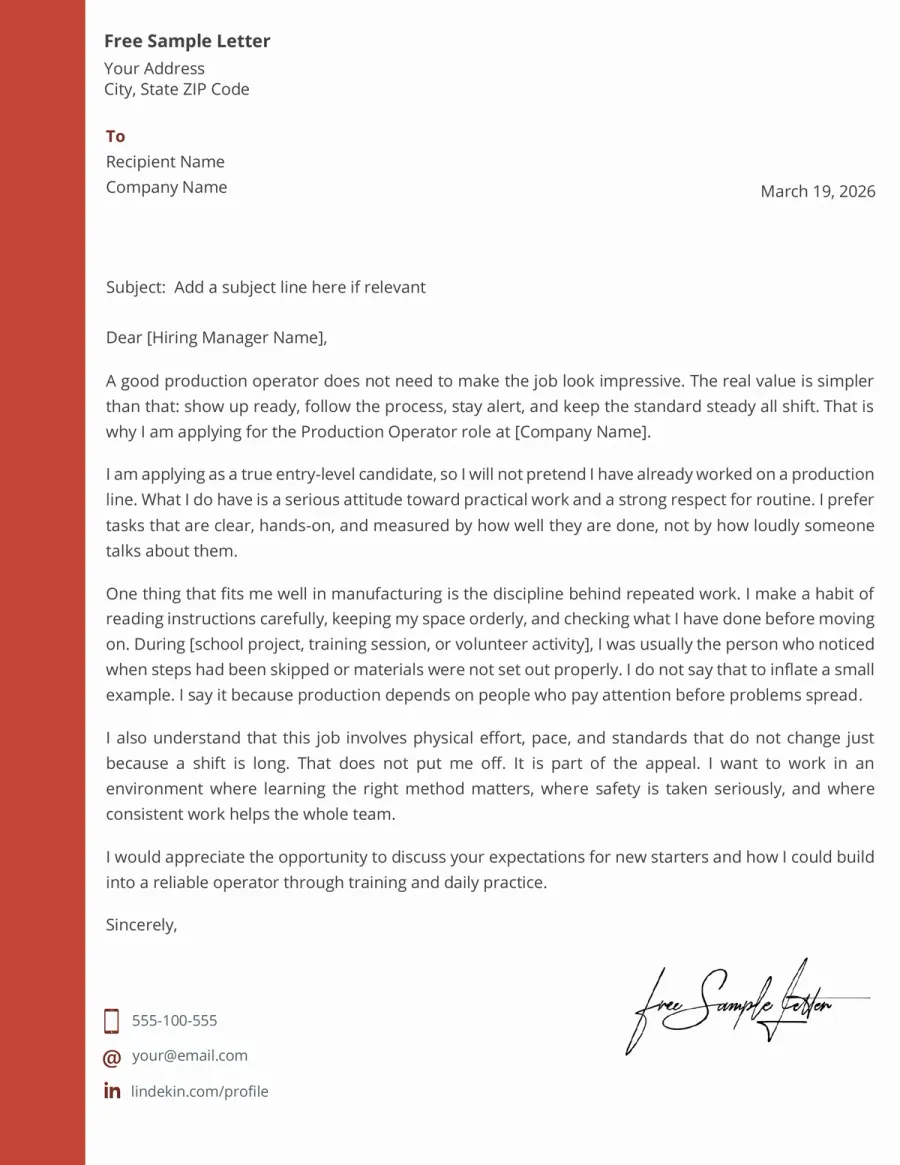
Preview This Factory Operator Template Before Word and PDF Download
Preview the production operator cover letter template before downloading the Word or PDF file. Use this sample to review the layout, tone, and structure before you apply.
Turn These Samples Into Your Own Letter in 5 Steps
Copy-paste letters fall apart quickly in manufacturing hiring. A production operator application needs to reflect your actual line experience, safety practices, shift reality, and machine knowledge, or it will sound generic and unconvincing.
➡️ More expert advice in our article how to build a cover letter around the actual job requirements
Match the Plant and the Line
Start by identifying the real work environment. When your opening refers to the plant, product, or shift pattern, your letter feels grounded and specific, not copied from a generic factory template.
See what to include
I am interested in the evening Production Operator role in [Company]'s blending area, where accuracy, housekeeping, and batch control support consistent output.
Swap Claims for Floor Proof
Cut empty statements about being hard-working or reliable. Instead, include a brief example, a measurable result, or a specific task you handled under pace, pressure, or quality constraints.
See an example
During peak demand at [Company], I kept my station supplied, flagged a recurring sealing issue early, and helped the team finish the shift without a last-minute backlog.
Add the Process Language
Use the vocabulary real operators use: SOPs, quality checks, downtime, batch records, GMP, handovers, housekeeping, and machine settings. This language signals to the reader that you genuinely understand factory work.
See an example
I make a point of following SOPs closely, recording quality checks clearly, and reporting any deviation before it slows output or creates rework for the next stage.
Tune the Tone to the Site
A plant-floor letter should sound practical, steady, and aware of daily routines. Keep your tone direct and straightforward. Long, emotional sentences often weaken a production application rather than strengthen it.
See an example
I am comfortable with repetitive work when the standard is clear, the pace is real, and the team depends on each station to stay accurate from start to finish.
Close With a Shop-Floor Next Step
End your letter by inviting a practical conversation, not by repeating standard polite phrases. Suggest a brief interview, a site visit, or a discussion about the production line, shift patterns, or priorities.
See an example
I would value the chance to discuss how I could support [Company]'s output, quality checks, and shift routine, and how quickly I could become useful on the line.
Keyword Radar: What Recruiters and ATS Pick Up Fast
- SOP compliance
- Machine setup and changeovers
- PPE
- Batch records and handover notes
- Meet output targets without cutting corners
- In-process quality checks
- Shift flexibility
- Downtime reporting
- Raw material weighing and labeling
- GMP standards
- Follow work instructions
- Cross-shift communication
- Clean-as-you-go discipline
- Reject and report non-conforming product
Do & Don't for a Production Operator Cover Letter
Factory hiring managers look for evidence, not slogans. In a production operator letter, a vague paragraph can weaken your whole application, while a single concrete example about output, safety, or quality can make your profile feel real.
What Makes the Letter Feel Weak
Red Flags- Use broad traits with no line context
- Leave out safety, quality or machine details
- Recycle a letter that could fit any warehouse job
- Stack soft claims without one clear example
- Ignore shifts, pace or physical realities
What Makes the Letter Feel Reliable
Trust Signals- Name the machine, line or process stage
- Bring in SOPs, checks, logs, or handovers naturally
- Write like someone who understands shift work
- Keep the tone steady, practical, and specific
- Close with a real next step linked to the floor
FAQ - Production Operator Cover Letter
Can I write a production operator cover letter with no direct factory experience? Toggle answer
Yes, but do not exaggerate factory experience. Instead, highlight your ability to learn quickly, follow routines, work safely, and perform well in roles where pace, accuracy, or repetitive tasks were important.
Should I mention machine names if I only used similar equipment? Toggle answer
Yes, as long as you are honest. Name similar equipment or processes you have used, and explain what skills transfer, such as monitoring, making adjustments, performing checks, reporting issues, or following SOPs.
Do I need to mention GMP, SOPs, or safety rules? Toggle answer
If the job ad mentions them, absolutely include them. Even a single line about SOP compliance, PPE, or quality checks can make your application feel more grounded and relevant.
Is it worth mentioning shift work in the letter? Toggle answer
Yes. Production hiring managers want to know if you understand early starts, rotating shifts, handovers, and the fast pace of a live production line. These details quickly add credibility to your application.
How do I stay credible if my background is warehouse, retail, or another field? Toggle answer
Focus on transferable skills, not just job titles. Accuracy, stock handling, fast-paced workflows, physical stamina, incident reporting, and team coordination all translate well into production roles.
TL;DR - What Makes a Production Operator Cover Letter Credible
A production operator cover letter only becomes effective when it quickly proves three things: you understand the pace of the work, you respect safety, and you can maintain quality under routine pressure. The biggest mistake is sending a vague factory letter that never names the real work behind the role.
Often, the strongest approach is subtle. Hiring managers notice small details: a line about handovers, an honest mention of SOPs, a concrete example of catching an issue early, or a realistic reference to shift work. These are what make a factory worker or production operator application feel trustworthy, not generic.