
Assembly Line Worker Cover Letter Examples for Faster Hiring in 2026
On a production line, vague motivation does little to help. Employers need proof that you can maintain pace, follow procedures, and protect quality. The examples below demonstrate how to make that case clearly.
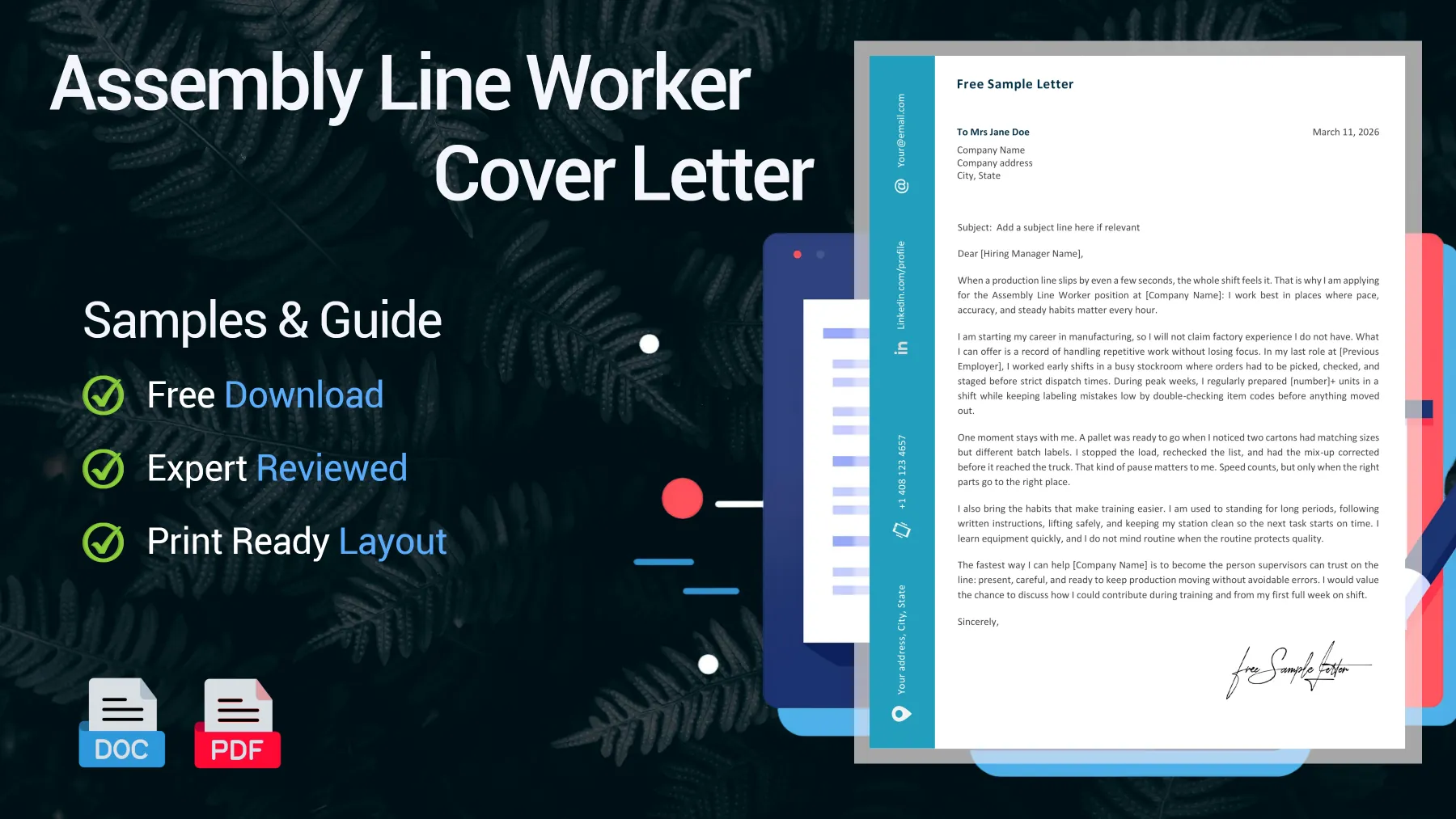
Assembly Line Worker Free Samples for Production Applications
According to the BLS, assemblers and fabricators still average 198,800 job openings per year, with median pay reaching $48,750 in transportation equipment manufacturing. In our view, a strong cover letter should quickly demonstrate your ability to work safely, maintain consistency, and follow line discipline.
No-Experience Production Line Worker Cover Letter
This junior assembly line worker cover letter works because it does not fake factory experience. It shows how a beginner can bring pace, focus, and safe habits to the line.
Dear [Hiring Manager Name],
When a production line falls behind by even a few seconds, the entire shift feels the impact. That is why I am applying for the Assembly Line Worker position at [Company Name]. I do my best work in roles where pace, accuracy, and steady habits matter every hour.
I am just beginning my career in manufacturing, so I will not claim experience I do not have. Instead, I can offer a proven record of handling repetitive work without losing focus. In my last role at [Previous Employer], I worked early shifts in a busy stockroom, where orders had to be picked, checked, and staged before tight dispatch deadlines. During peak weeks, I regularly prepared over [number] units per shift and kept labeling errors low by double-checking item codes before anything left the floor.
One moment stands out to me: a pallet was ready to ship when I noticed two cartons with matching sizes but different batch labels. I stopped the load, double-checked the list, and corrected the mix-up before it reached the truck. That kind of pause matters to me. Speed is important, but only when the right parts go to the right place.
I also bring habits that make training easier. I am used to standing for long periods, following written instructions, lifting safely, and keeping my station clean so the next task can start on time. I learn equipment quickly and do not mind routine, especially when routine protects quality.
The fastest way I can help [Company Name] is by becoming someone supervisors can trust on the line: present, careful, and ready to keep production moving without avoidable errors. I would value the chance to discuss how I could contribute during training and from my first full week on shift.
Sincerely,
[Your Name]

Reviewed by Robert H., Technical Recruiter
I would keep reading because the tone is honest and useful. The candidate sounds trainable, steady, and aware that speed only matters when quality holds.
Experienced Automotive Plant Production Worker
This automotive plant sample keeps extensive experience relevant and credible. It highlights precision, cross-training, and process discipline without becoming repetitive.
Dear [Hiring Manager Name],
In automotive production, the difference between a smooth shift and a difficult one often comes down to small, repeatable actions. That is why the Assembly Line Worker position at [Company Name] caught my attention. My background is rooted in plants where takt time, safety, and clean handoffs are not just slogans. They determine whether a shift runs well or not.
I have spent over [number] years on production lines assembling and checking vehicle components in environments where missing even one detail can immediately affect the next station. At [Current or Former Employer], I worked on [door panels / wiring assemblies / interior trim / chassis parts], followed work instructions closely, and rotated between stations as staffing or demand changed.
During a model update, I was cross-trained on [number] stations in less than [number] weeks. This gave supervisors more flexibility during absences and helped the team maintain stable output.
My strongest contribution is consistency under routine pressure. I do not rush past the basics. I verify materials, keep the work area clear, and flag any variations early. If you need someone who can step into a plant and respect the process from day one, that is my approach. I have also helped onboard new hires by showing them how to pace the task, where errors usually happen, and how to recover without causing delays for the next operator.
What keeps me in manufacturing is simple: I value measurable work. A line either runs cleanly or it does not. A part either meets the standard or it does not. That clarity suits me.
I would welcome the opportunity to discuss how my assembly background, quality mindset, and automotive plant experience could support [Company Name]'s production goals from the start.
Respectfully,
[Your Name]
Reviewed by Robert H., Technical Recruiter
I would remember this application because it sounds measured and current. The candidate proves value through repeatable actions, not seniority alone.
Internal Promotion to Production Line Team Lead Cover Letter
This sample builds trust in a believable next step. It shows how an assembly line worker can take on lead duties without sounding inflated.
Dear [Hiring Manager Name],
An internal promotion on the line should go to someone who already makes the shift run smoother for others. That is why I am applying for the Lead Assembly Line Worker role at [Company Name]. I am not trying to leave production behind. I want to stay close to the work and take more responsibility for keeping the line running well.
At [Current Employer], I have spent [number] years on [line or product area], building parts to spec, handling visual checks, and working within fixed takt time. Over the past year, I have become the person team members come to when the sequence changes, when a station falls behind, or when a new hire is unsure about the order of checks.
I ensure the quality of my work by reviewing the first unit after setup, confirming labels and materials before each run, and making sure my station is ready for the next operator rather than leaving problems behind.
That habit has made a difference more than once. During a busy shift, a new operator started skipping a small verification step to save time. I showed him a faster way to organize the parts at the bench, which kept the check in place and prevented the issue from recurring later in the run. On another occasion, I covered two adjacent tasks during an absence and kept output stable until support arrived.
What interests me about this promotion is the chance to bring more structure to the shift without losing the floor awareness that only comes from hands-on experience. I know the pressure points, where confusion starts, and how quickly small misses can turn into rework.
I would welcome a conversation about this promotion and how I could support [Company Name] as a lead operator who protects pace, quality, and team coordination on shift.
Best regards,
[Your Name]
Reviewed by Robert H., Technical Recruiter
I find this sample strong because it stays close to production reality. The candidate sounds like a stabilizer, not a title chaser at all.
Assembly Line Worker Template Preview Before Word/PDF Download
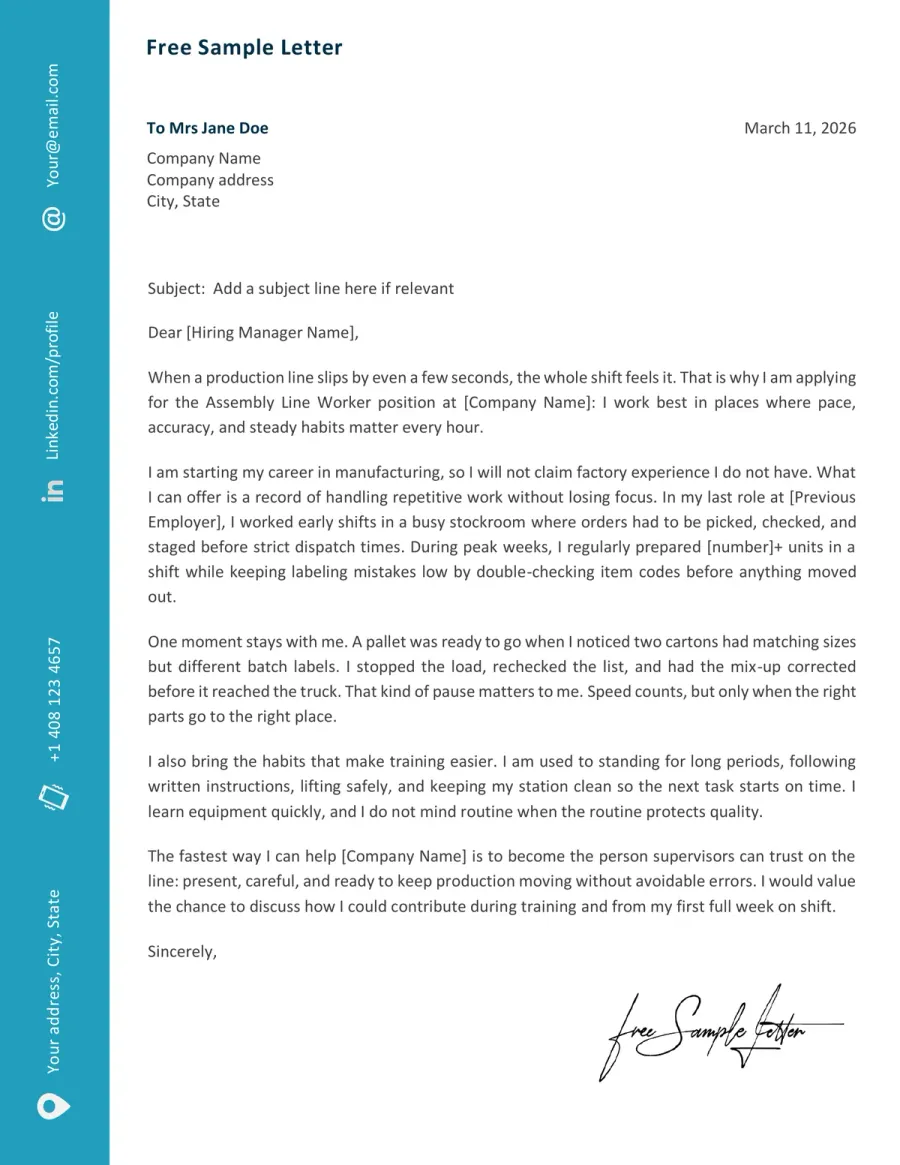
Preview the assembly line worker template before downloading it in Word or PDF format. This production line cover letter sample illustrates the layout, tone, and level of detail employers expect.
Turn These Templates Into Your Own Letters
Copy-pasting generic content is where many factory applications lose credibility. These templates are effective when you replace generic lines with details about your actual shift patterns, quality habits, tools, and production environment.
➡️ More expert advice in our guide how to adapt a cover letter sample without sounding copied
Match the Right Production Setting
Start by choosing the sample that matches your actual work environment. A warehouse helper, car plant operator, and career changer should each sound distinct from the very first paragraph.
See Open step example
“In my last role, I worked on timed routines, checked labels before release, and kept my area clear so the next task could start without delay.”
Replace Vague Claims With Line Proof
Avoid words like "reliable" or "hard-working" unless you can back them up. Instead, include a brief example, a measurable result, or a process you followed when output was critical.
See proof ideas
See a concrete line: “During peak production, I checked part numbers before setup and caught a mismatch before it moved to the next station on the shift.”
Name the Tools, Checks and Tasks
Use language that reflects real production work, not classroom terminology. Mention work instructions, hand tools, visual checks, batch labels, shift targets, or station cleanliness where relevant.
See Open wording example
See what to include: “I am comfortable following work instructions, using hand tools safely, and keeping a workstation organized during repetitive tasks.”
Adjust the Tone to Your Profile
A beginner should sound honest and willing to learn. An experienced operator should sound steady and up to date. A career changer should explain the switch directly, without apology or exaggeration.
See tone example
“I am changing fields on purpose because I want work built on process, timing, and visible standards rather than customer-facing chaos.”
End With a Practical Next Step
Close as someone ready for the job, not as someone asking for a favor. Offer to discuss training, shift readiness, production goals, or plant expectations directly.
See Open closing example
“I would welcome a short conversation about your process, the pace of the line, and how I could become useful quickly during training.”
Assembly Line Keyword Cloud for ATS and Recruiters
- Quality checks
- Batch labels and part numbers
- Shift pace
- Following work instructions
- Hand tools
- Reporting defects
- Station cleanliness
- Team handoff discipline
- Visual inspection for defects
- Safe lifting
- Meeting output targets
- Basic blueprint reading
- Fast manual assembly work
Do & Don’t: What Makes an Assembly Line Letter Credible
Recruiters scan these letters quickly. They look for signs that you understand pace, repetition, quality checks, and teamwork on a live line. One vague paragraph weakens trust; a single concrete process detail builds it.
What Makes Your Letter Sound Generic on a Real Production Floor
Red Flags- Keep the letter generic to any factory role
- Repeat the résumé instead of explaining value on the line
- Use soft traits without one concrete task
- Ignore safety, quality checks, or work instructions
- End with a passive closing that says nothing
What Makes Your Letter Feel Credible in a Live Plant
Trust Signals- Name one real process you follow
- Show how you protect quality under pace
- Mention the tools, checks, or instructions you handle
- Explain the production setting or transferable routine clearly
- Close with a practical next step about training or output
FAQ - Assembly Line Worker Cover Letter
Can I apply for an assembly line job with no direct factory experience? Toggle answer
Yes. If your background shows you can work at a steady pace, handle tools, follow instructions, or maintain shift discipline, state that clearly. Hiring teams care less about your previous industry and more about your ability to learn and keep a method consistent.
Should my letter talk more about speed or more about safety? Toggle answer
Emphasize safe output first. Speed alone does not reassure a plant. A stronger letter shows you can maintain pace while checking part numbers, following work instructions, and flagging defects before they move down the line.
Do I need to mention tools or machines if I only used basic equipment? Toggle answer
Yes, if you have actually used them. Even basic hand tools, scanners, pallet jacks, measuring tools, or packing equipment make your letter feel more credible. Do not mention machinery you have never used.
Is it smart to say I can handle repetitive work and long standing shifts? Toggle answer
Yes. Repetition is part of the job. If you can stay focused through repeated tasks, fixed sequences, and long periods on your feet, that is a strength - not just filler.
If I am changing careers, should I explain why I want assembly work? Toggle answer
Yes. Keep your explanation practical. Clear standards, hands-on work, routine, and measurable output are strong reasons. The switch sounds more convincing when it feels deliberate, not just an escape from your previous field.
TL;DR - What Actually Makes an Assembly Line Worker Cover Letter Work
A strong assembly line worker cover letter proves three things fast: you can follow work instructions, keep quality steady under pace, and work safely without creating problems for the next station. The fatal mistake is sending a generic letter full of work ethic claims but no real process detail, no line reality, and no proof you understand how production actually runs.
The recruiter is often reading for friction. Not flair. They want the person least likely to miss a defect, break the handoff, ignore a safety step, or drift when the work gets repetitive. One of the most underrated credibility signals is calm respect for routine: not treating repetitive work as “simple,” but showing you can stay accurate when the sequence barely changes all shift.