
Computer Operator Cover Letter Examples Recruiters Respect in 2026
Employers don't hire computer operators based on buzzwords alone. The following examples demonstrate how to showcase technical judgment, incident response, and everyday reliability in a way that feels credible to hiring managers.
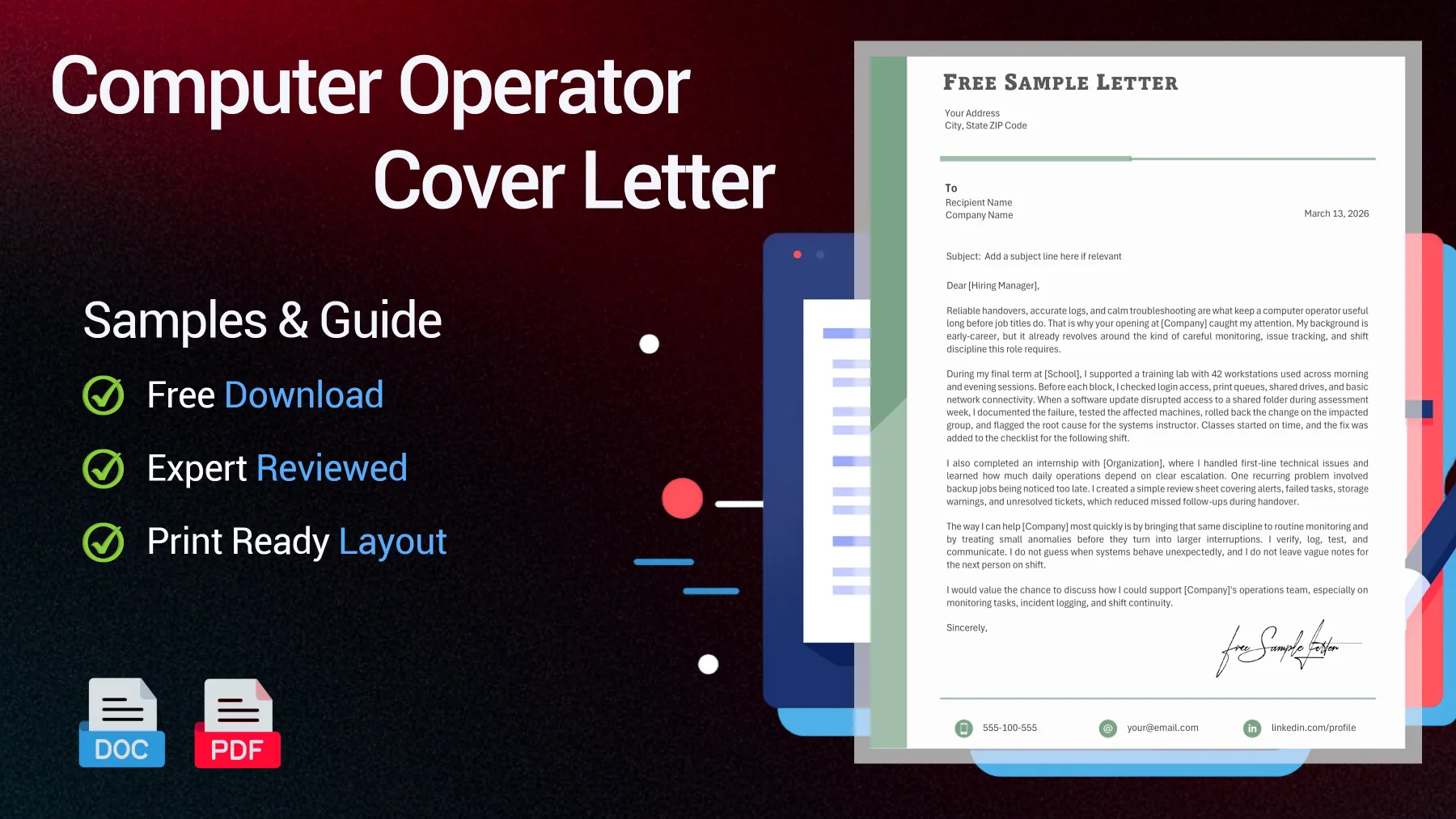
Free Computer Operator Application Samples for IT Operations
Uptime Institute’s 2024 outage analysis found that 39% of operators experienced a serious outage involving human error, and 48% cited staff failing to follow procedure. Expert advice: a strong computer operator letter should highlight precise handovers, alert logging, and calm escalation habits - not just broad IT buzzwords.
Junior Data Center Operator Cover Letter (First Shift Application)
Built for an entry-level applicant, this computer operator cover letter focuses on monitoring habits, clean escalation, and shift-ready discipline without pretending to have years of direct experience.
Dear [Hiring Manager],
Reliable handovers, accurate logs, and calm troubleshooting are what make a computer operator valuable long before job titles matter. That's why your opening at [Company] stood out to me. While I am early in my career, my experience already centers on careful monitoring, issue tracking, and the shift discipline this role demands.
During my final term at [School], I supported a training lab with 42 workstations used throughout both morning and evening sessions. Before each block, I checked login access, print queues, shared drives, and basic network connectivity. When a software update disrupted access to a shared folder during assessment week, I documented the failure, tested the affected machines, rolled back the change for the impacted group, and flagged the root cause for the systems instructor. Classes started on time, and the fix was added to the checklist for the next shift.
I also completed an internship with [Organization], where I handled first-line technical issues and saw firsthand how much daily operations rely on clear escalation. One recurring problem was backup jobs being noticed too late. To address this, I created a simple review sheet covering alerts, failed tasks, storage warnings, and unresolved tickets, which reduced missed follow-ups during handover.
The fastest way I can contribute to [Company] is by bringing that same discipline to routine monitoring and addressing small anomalies before they become larger issues. I verify, log, test, and communicate. I don't guess when systems behave unexpectedly, and I never leave vague notes for the next person on shift.
I would value the opportunity to discuss how I could support [Company]'s operations team, especially with monitoring tasks, incident logging, and shift continuity.
Sincerely,
[Your Name]

Reviewed by James R., Hiring Manager
The tone reassures me. Nothing is inflated; the value comes from visible work habits, job-specific details, and a clear sense of shift reality.
Experienced Computer Operator Cover Letter
Created for an experienced applicant, this sample avoids generic senior language and focuses instead on measurable improvements, alert triage, handover clarity, and day-to-day operational control.
Dear [Hiring Manager],
When a print queue stalls or a nightly job hangs just before a business deadline, the best computer operators don't add noise. They narrow down the cause, protect continuity, and leave a record the next shift can trust. That's the standard I've worked to for [X] years, and it's why I'm applying to [Company].
At [Current Company], I support daily system operations across a mixed environment of user endpoints, scheduled processing, shared resources, and core monitoring tools. One measurable improvement I made was redesigning the shift handover process.
The old notes were long, inconsistent, and difficult to act on. I replaced them with a concise template covering active alerts, completed checks, failed jobs, pending tickets, and escalation status. Missed follow-ups dropped significantly, and repeat questions between shifts fell enough that our team lead adopted the format across the wider rota.
Another example is less visible but equally important. During a month with repeated storage warnings, I noticed teams were reacting to the same alert in different ways. I grouped the alerts by threshold, flagged false positives, and built a quick reference linking each alert type to the correct response. This led to faster triage and fewer unnecessary escalations.
The fastest way I can help [Company] is to bring a disciplined operating model that keeps systems running smoothly and handovers clear. I still enjoy the practical side of the role: reading logs, checking task completion, testing the obvious before escalating, and noticing patterns others might dismiss as routine.
If that matches what [Company] needs, I'd be glad to discuss your environment and the kind of production support you're looking for in this position.
Sincerely,
[Your Name]
Reviewed by James R., Hiring Manager
The layout breathes, and the substance holds up. I see a candidate who can handle routine work without losing focus when an incident breaks flow.
Mid-Career Data Center Operator Cover Letter
Written for a mid-career changer, this data center operator sample avoids empty reinvention language and proves readiness through process, retraining, and practical troubleshooting.
Dear [Hiring Manager],
The first time I stayed late to rebuild a small test environment after work, I realized this was no longer just a side interest; I was in the middle of a real career change. After years in [Former Industry], I chose to move into computer operations because I'm at my best in roles where order, observation, and quick response matter every hour of the shift.
My background began in [Former Role], not IT. I managed evening operations in a busy production setting where delays could spread quickly if even one issue was missed at the wrong time. A typical handover included equipment checks, incident notes, and priority updates for the next team.
During one challenging week, repeated machine stoppages were reported differently by each supervisor. I rewrote the log format, added a simple status code system, and ensured each entry included the action taken and the next step. That change reduced confusion between shifts and cut down time lost at start-up meetings.
Once I committed to changing careers, I gave the process structure. I enrolled in [Course/Certification], practiced in a home lab, and took on volunteer tasks at [Community Organization] involving system setup, user support, and basic troubleshooting. One morning, two refurbished PCs failed during deployment. I checked cables, reviewed BIOS settings, tested the drives, and isolated a faulty memory module in one unit while reinstalling the image on the other. Small job, useful lesson: calm process beats guesswork.
I know a career change invites questions, and that's fair. What I can offer [Company] is proof that I take the work seriously, learn in a structured way, and bring mature operational habits with me. I'd appreciate the opportunity to discuss how that combination could benefit your team.
Kind regards,
[Your Name]
Reviewed by James R., Hiring Manager
I find this career change believable because it owns the break and translates field discipline into computer operations without forcing the match.
Computer Operator Cover Letter Template Preview Before Download (Word/PDF)
Preview the computer operator cover letter template before downloading it as a Word or PDF file. This page lets you review the sample's layout, tone, and structure to ensure it fits your needs.
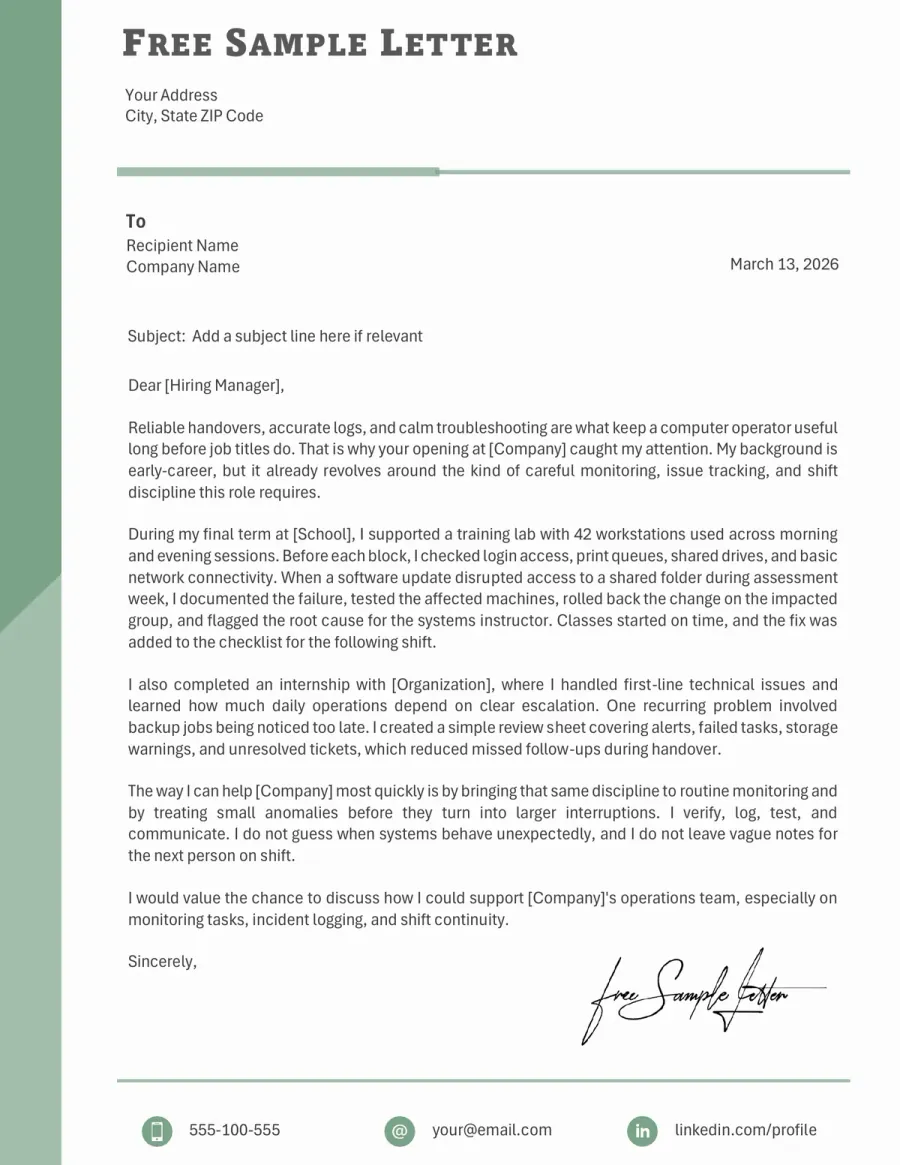
Adapt These Computer Operator Cover Letter Samples to Your Story
Copied letters often fail because they sound disconnected from the realities of the actual shift, tools, and pressures of the job. Adapt these samples to reflect your own systems, incidents, routines, and level of responsibility before sending your application.
➡️ More expert guidance in our article how to write a cover letter that sounds job-ready
Match the exact operator reality
Begin by replacing generic IT language with details from your actual routine. Mention shift coverage, monitoring, alerts, logs, scheduled tasks, handovers, or batch jobs, as appropriate for your experience.
See an example
Instead of writing, "I supported daily IT operations," try: "I monitored overnight alerts, checked failed tasks, and logged unresolved issues for the morning handover."
Insert two proof points
Choose two moments that demonstrate how you respond when systems need attention. One example can be a small incident; the other might be a routine responsibility you handle with consistency, speed, or accuracy.
See a stronger line
When a scheduled report failed before opening, I checked the task history, restarted the correct process, and updated the handover notes with exact timestamps.
Adjust the tone to your level
A junior letter should sound steady and willing to learn. A senior letter should convey control and practical value. If you're changing careers, acknowledge the transition and show how you've prepared for the move.
See the difference
"My training taught me to document each issue clearly" fits a junior profile, while "I built cleaner handover notes across shifts" fits an experienced operator.
Name the tools and environment
Keep your wording readable, but be specific. Name the systems, ticketing tools, operating environments, or monitoring checks you've used, even if your experience is limited.
See what works
Using [Ticketing Tool], I tracked login issues, failed print jobs, and unresolved alerts, then handed off open items to the next shift with clear notes.
Finish with a realistic next step
Your closing should sound like an operator addressing another team, not like a generic online letter. Ask for a discussion about shift coverage, the environment, or monitoring priorities.
See a better closing
I would appreciate the opportunity to discuss how I can support your shift coverage, incident logging, and daily system monitoring from day one.
Computer Operator Keyword Radar
- Alert review
- Clear notes
- Windows
- Incident triage in low-staff hours
- Batch job monitoring
- Linux
- Backup verification
- Shift handover
- Event logs
- User access checks
- Uptime
- Print queue checks
- Escalation judgment
- Ticket updates
- Monitoring dashboards
Do & Don't - What Makes a Computer Operator Letter Credible
Recruiters scan these letters quickly. They look for signs that you understand routine operations, not just general IT interest. The strongest letters are grounded in monitoring, logging, handovers, and sound judgment under pressure.
Red Flags Recruiters Notice Fast
Red Flags- Keep the letter vague about the real operating routine
- List soft skills without one concrete example
- Sound technical while naming no tools, checks, or systems
- Overstate seniority that the rest of the letter cannot support
- Ignore shift work, handovers or production discipline
Trust Signals That Strengthen Your Letter
Trust Signals- Name the real tasks you handled on a shift
- Mention logs, alerts, tickets, or scheduled checks naturally
- Write with calm control, not inflated language
- Connect your background to uptime and continuity
- Close by mentioning a specific discussion about the role or the environment
FAQ - Computer Operator Cover Letter
Should I mention night shift or weekend availability in the letter? Toggle answer
Yes, if it's true. For this role, stating your availability can quickly reassure the recruiter, since shift coverage, handovers, and off-hours discipline are often essential parts of the job.
What if my background is help desk or lab support, not computer operations? Toggle answer
That can still work. Translate your experience into operator language: monitoring systems, updating tickets, checking failed tasks, escalating issues, handling user access, and ensuring clear handovers between shifts.
Should I say computer operator or data center operator? Toggle answer
Use the employer's job title first. If your duties clearly match data center monitoring or console work, mention that variant once in your letter to reflect the role without sounding off-target.
Do certifications matter more than real examples? Toggle answer
Not in the letter itself. Certifications help, but a clear example of alert handling, incident logging, or following up on scheduled tasks is usually more convincing than a certificate name alone.
Should I mention routine checks, or only bigger technical problems? Toggle answer
Mention both. Routine work proves reliability, and sharing a small but real incident demonstrates judgment. This balance is much stronger than a letter that's all dramatic claims with no day-to-day detail.
TL;DR - What Actually Makes a Computer Operator Cover Letter Work
A strong computer operator cover letter quickly proves three things: you understand monitoring and handover discipline, you can describe a real incident or routine, and you know how your work protects uptime. The biggest mistake is sending a generic IT letter that never mentions logs, alerts, scheduled checks, escalation, or the realities of shift work.
The underlying signal is calmness. Recruiters judge this role by reliability, not personality. A candidate who writes with controlled, specific operating language feels ready to step into a live environment, especially when their closing shows genuine interest in the actual job, not just any computer role.