
Radiology Technician Cover Letter Examples with Recruiter Signals in 2026
Radiology managers look for techs who prioritize safety and remain calm with anxious patients. Use these Radiology Technician cover letter samples to highlight your technical strengths and increase your chances of landing interviews.
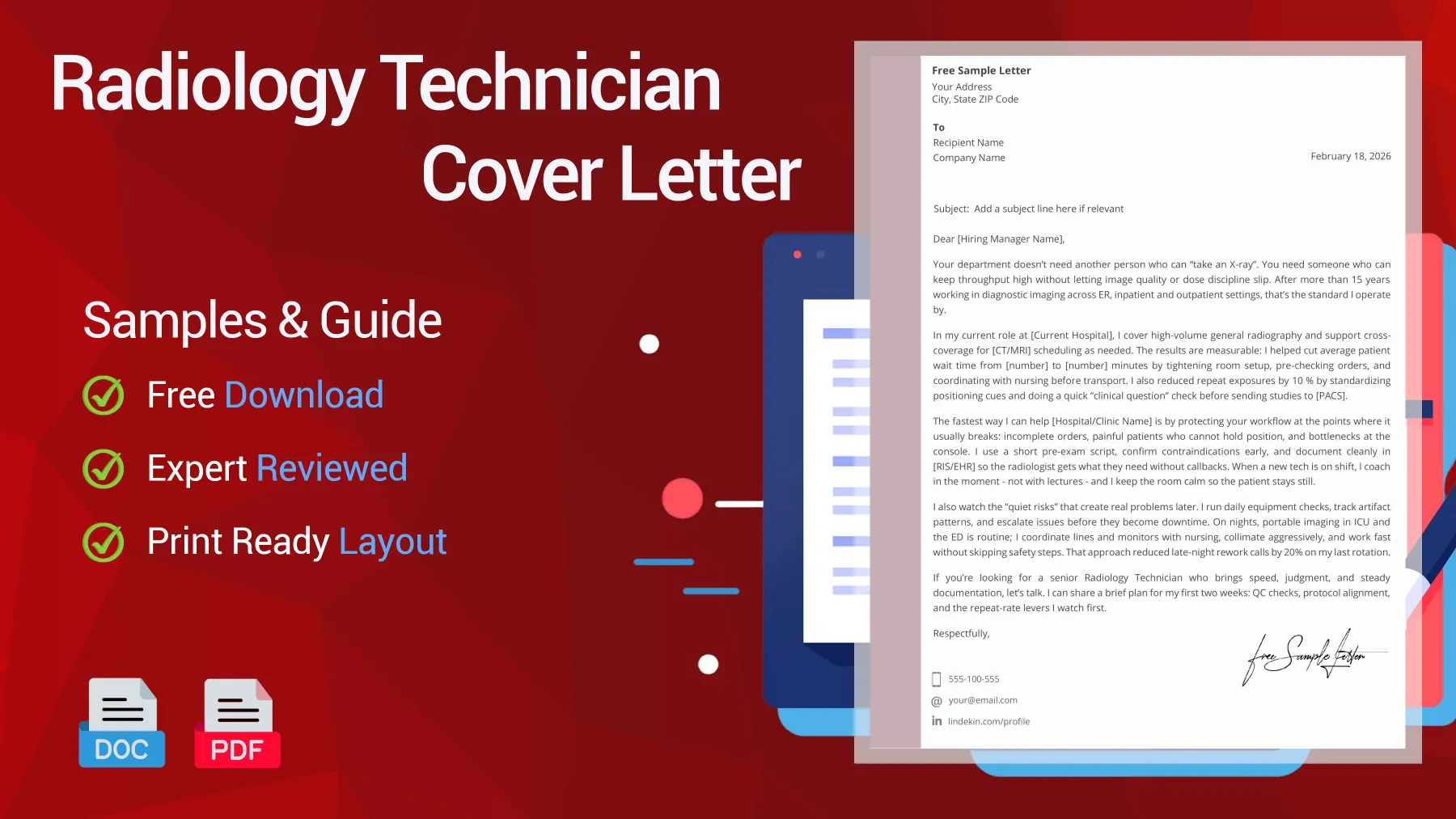
Free Samples of Radiology Technician Cover Letters
The BLS projects radiologic and MRI technologist jobs to grow 5% from 2024-2034, with approximately 15,400 openings each year. BLS OOH. Expert interpretation: show safety-focused workflow and calm patient care in your cover letter.
Entry-Level Radiology Technician Cover Letter Sample (New Grad)
Built for junior, entry-level applicants: this sample shows how to prove patient-safety habits, positioning basics, and clean PACS workflow without paid experience.
Dear [Hiring Manager Name],
The first time I assisted with a trauma series, the room went quiet in that familiar way - everyone focused, everyone moving fast. My job was simple: position correctly, keep the patient safe, and get an image the provider could act on. That’s the kind of work I’m ready to do as a Radiology Technician at [Hospital/Clinic Name].
I’m a junior, entry-level candidate coming out of a [Radiologic Technology] program, so I don’t lean on years of experience. I rely on habits. I confirm patient identifiers, check the order against the protocol, and communicate clearly before I move the tube or the patient. During clinical rotations, these habits helped me keep repeat rates low and maintain patient cooperation, even when patients were in pain or anxious about the scan.
Two examples stand out for me. During a portable chest round, a patient kept turning away from the detector due to shoulder discomfort. I paused, adjusted the pillow support, and explained what would happen next so we could get it right the first time. The study went through cleanly, and the nurse thanked me for not rushing. On a separate ortho rotation, I was asked to prep the room for a steady flow of extremities; I set up markers and shielding in advance and kept a running list of pending orders, which helped keep our turnaround tight during the morning rush.
If you’re looking for a new tech who will protect image quality and patient trust at the same time, that’s my lane. I’d welcome a short conversation about your typical case mix (ED, inpatient, outpatient) and the workflow you expect on day one.
Best regards,
[Your Name]
Reviewed by Olivia B., HR Consultant
Strong workflow language (PACS/RIS, repeats, protocols) without fluff. It reads like real clinical training to me, not generic claims.
Senior Radiology Technician Cover Letter Sample
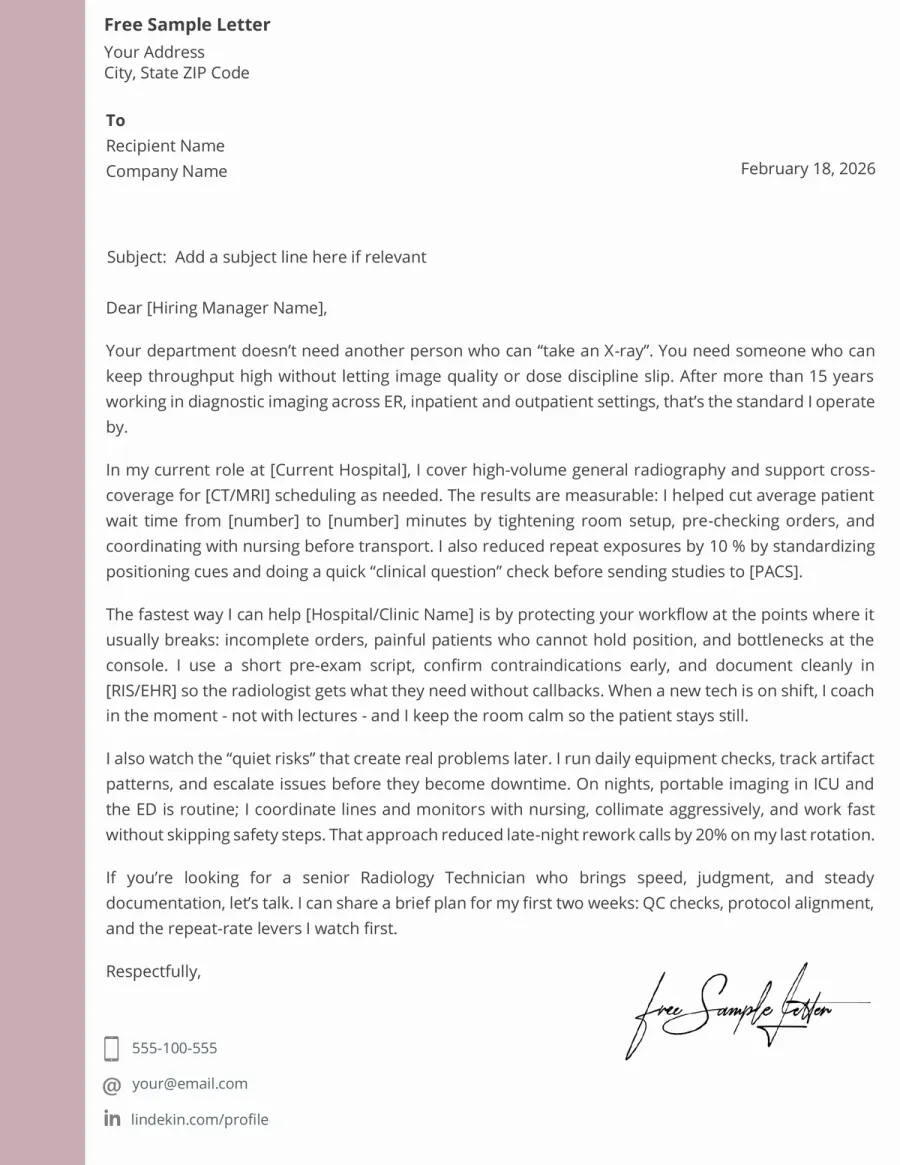
This senior Radiology Technician cover letter sample turns experience into proof: throughput gains, ALARA discipline, PACS/RIS fluency, and mentoring that keeps the room steady.
Dear [Hiring Manager Name],
Your department doesn’t need just another person who can “take an X-ray.” You need someone who can keep throughput high without letting image quality or dose discipline slip. With over 15 years of experience in diagnostic imaging across ER, inpatient, and outpatient settings, that’s the standard I work by.
In my current role at [Current Hospital/Clinic], I handle high-volume general radiography and provide cross-coverage for [CT/MRI] scheduling as needed. The results are measurable: I helped cut average patient wait time from [number] to [number] minutes by tightening room setup, pre-checking orders, and coordinating with nursing before transport. I also reduced repeat exposures by [number]% by standardizing positioning cues and performing a quick “clinical question” check before sending studies to [PACS].
The fastest way I can help [Hospital/Clinic Name] is by protecting your workflow at the points where it usually breaks: incomplete orders, patients who cannot hold position due to pain, and bottlenecks at the console. I use a short pre-exam script, confirm contraindications early, and document clearly in [RIS/EHR] so the radiologist gets what they need without callbacks. When a new tech is on shift, I coach in the moment, not with lectures, and keep the room calm so the patient stays still.
I also track the “quiet risks” that create real problems later. I run daily equipment checks, monitor artifact patterns, and escalate issues before they cause downtime. On nights, portable imaging in ICU and the ED is routine; I coordinate lines and monitors with nursing, collimate carefully, and work quickly without skipping safety steps. That approach reduced late-night rework calls by [number]% on my last rotation.
If you’re seeking a senior Radiology Technician who brings speed, sound judgment, and reliable documentation, let’s talk. I can outline my plan for the first two weeks: QC checks, protocol alignment, and the repeat-rate levers I prioritize first.
Respectfully,
[Your Name]
Reviewed by Olivia B., HR Consultant
The throughput and repeat-rate proof is exactly what I want from a senior tech. It’s operational, not self-promotional, and it feels real.
Radiology Technician Internship Cover Letter Sample (Student Placement)
This Radiology Technician internship cover letter sample proves you’re useful on day one: ALARA habits, clean room turnover, and small wins from clinical rotations.
Dear [Hiring Manager Name],
Good imaging starts before the exposure: with the right question, the right protocol, and a patient who understands what’s about to happen. That’s the habit I’m building now, and it’s why I’m applying for a Radiology Technician internship with [Hospital/Clinic Name].
I’m a [Radiologic Technology] student completing my clinical requirements, and I’m looking for a department where interns are treated like future technologists: expected to be careful, encouraged to become faster. In rotations, I’ve supported routine X-ray exams and portable work under supervision, and I’ve learned to screen for basics (pregnancy when relevant, mobility limits, lines/tubes) before positioning a patient. I also follow infection-control steps and reset rooms without being prompted.
Two things matter most to me. First, I track my repeats and ask for one correction at a time (tube angle, rotation, centering) so I can improve between cases, not just after the shift. Second, I’m reliable on workflow: I enter accurate notes in [RIS/EHR], route studies correctly in [PACS], and flag discrepancies early rather than hoping they’ll resolve on their own. On my last rotation, my preceptor trusted me to prep the next room while they finished with the prior patient, which saved about [number] minutes per exam during peak hours.
I check my quality by using a consistent routine before sending: identifiers, side marker, field size, exposure settings, and a quick review against the clinical question. If something isn’t diagnostic, I say so and fix it while the patient is still in the room.
If this matches what you’re looking for in an intern, I’d like to meet to discuss which exams you want interns to master first and how you measure readiness for greater independence.
Sincerely,
[Your Name]
Reviewed by Olivia B., HR Consultant
This reads honest about being a student, yet it still offers proof and a clear next step for an interview. That balance is rare and convincing.
Preview the Radiology Technician Cover Letter Templates Before Download
Preview the templates below to review the layout and wording before downloading. Files are available in Word and PDF formats.
Turn These Samples Into Your Own Letters - 5 Steps
Copy-paste applications are easy to spot in imaging roles. Personalize your letter by including your specific modality experience, workflow habits, and safety practices. Add two concrete examples, such as reducing repeats, improving throughput, or handling patients, to make your letter reflect your real shift, not a script.
➡️ For more expert guidance, see our article on how to write a cover letter hiring managers will actually read.
Anchor the letter in the real exam setting
Start with the real exam setting, whether it’s ED portables, outpatient orthopedics, or CT support. Reflect the job post’s main priorities (speed, safety, documentation) in your opening lines.
See an example
“On a busy [ED/Clinic] shift, I focus on getting diagnostic images on the first pass - tight positioning, clear instructions, and ALARA checks before I release the study to PACS.”
Add proof that reduces repeats and delays
Choose two specific examples: one technical, such as positioning, use of markers, or artifact prevention, and one patient-focused, like managing pain limits or easing anxiety. Include a metric if possible, even if it’s small.
See what to include
“I tracked my repeats during rotation and improved from [number]% to [number]% by adjusting centering cues and doing a quick rotation check before exposure.”
Speak PACS/RIS and safety language (ATS + humans)
Mention the systems and safety checks you use: PACS routing, RIS notes, patient ID verification, side markers, and quick QC steps. This reassures managers that you won’t create extra work or callbacks.
See an example snippet
“I document the exam in [RIS/EHR], route the study correctly in PACS, and pause for a 5-second QC check (marker, field, motion) before I send it.”
Show patient handling without “team player” fluff
Hiring teams pay attention to bedside communication. Demonstrate how you give clear instructions, respect patients’ pain limits, and coordinate with nursing staff during transfers. Focus on specific actions rather than general statements.
See an example
“Before repositioning, I ask what movement hurts, explain the next step in one sentence, and request a second set of hands when lines or monitors make the transfer risky.”
Close with a next step that sounds like real work
End with a practical next step: offer a brief conversation about your first 30 days, your shift availability, and how you work to keep repeat rates low. Mention your [ARRT/license] status only once.
See a closing example
“If it helps, I can walk you through my QC routine and what I’d tackle in week one - protocols, room setup, and repeat tracking. I’m available for an interview on [days/times].”
Keyword Radar for Radiology Technician Cover Letters (ATS + Humans)
- ALARA
- Calming anxious patients during painful exams
- PACS
- Patient ID
- Portable imaging
- Coordination with nursing for transfers
- Side markers
- Trauma series
- Positioning under pain limits
- Clean documentation in RIS and PACS
- Infection-control wipe-downs between patients
- DICOM study routing
- QC check before sending the study
- Artifact awareness and escalation
- Protocol adherence during busy shifts
Do & Don’t for Radiology Technician Cover Letters
In imaging, hiring managers treat your letter as a risk assessment. They want to know: “Will this person protect patients, control radiation dose, and keep workflow steady during busy exams?” Remove doubt by providing specific processes and real examples instead of relying on vague adjectives.
Hiring-Manager Dealbreakers in Imaging Applications
Red Flags- Overclaim modalities or independent responsibility you did not have
- Hide behind generic lines instead of naming the exam mix you can handle
- Skip ALARA, shielding, or dose discipline language entirely
- Sound careless about patient ID, laterality, or side markers
- Write about “loving teamwork” but never show handoffs or documentation habits
Credibility Markers for Radiology Technician Applicants
Trust Signals- Name the setting and pace you can handle (ED, inpatient portables, outpatient flow)
- Show one technical proof and one patient-handling proof, both in plain language
- Use workflow terms naturally: PACS, RIS notes, QC check, protocol confirmation
- Explain how you avoid repeats: positioning cues, quick rotation check, clean markers
- Demonstrate safe coordination: nursing handoff, lines/tubes awareness, early escalation
FAQ - Radiology Technician Cover Letter
Should I write “ARRT-eligible” if I’m waiting on my registry results? Toggle answer
Yes, if it’s accurate. Include your test date or expected results window, and mention your state license status if relevant. Don’t imply you’re already registered. Accuracy is essential in imaging hiring.
How do I mention clinical rotations without sounding like I’m inflating experience? Toggle answer
Keep it factual: include the site type (ED, outpatient), exam types, and what you did under supervision, such as positioning, QC checks, or documentation. One concise example is more convincing than a long list.
Should I name PACS/RIS (and which tasks) in a cover letter? Toggle answer
Yes, briefly. Mention practical actions: routing studies, entering clear exam notes, performing basic QC before sending, and escalating discrepancies early. This shows you won’t create rework for radiologists or charge technologists.
If the posting mentions fluoro/contrast, what do I say when I’m still supervised? Toggle answer
Be clear: state that you are “trained and comfortable assisting under supervision,” and specify what you’ve done, such as room preparation, patient screening basics, or post-procedure workflow. Don’t claim independent contrast administration unless you’ve actually performed it.
How do I prove image quality or low repeats if I don’t have official metrics? Toggle answer
Use process-based proof: mention repeat log habits, positioning checkpoints, marker discipline, and a brief example where you avoided a second exposure by adjusting the setup or your instructions. These details are believable and job-specific.
TL;DR - The Radiology Technician Cover Letter That Gets a “Yes”
A Radiology Technician cover letter wins when it reads like your real shift: tight safety habits (ALARA), clean PACS/RIS workflow, and one or two proof moments that show you reduce repeats and keep patients cooperative. The fatal mistake: overstating certifications or modalities - imaging managers treat that as a safety risk.
Hiring teams don’t “feel inspired” by adjectives in this field. They look for judgment during busy exams. A short micro-scene plus one clear process, such as your QC or repeat-control routine, does more than a full paragraph of claims because it tells them you’ll protect patients and protect throughput on day one.