
Dialysis Technician Cover Letter Examples Reviewed by Recruiters in 2026
Dialysis units don’t hire on empathy alone. They look for precision, mastery of protocols, and a strong focus on patient safety. The samples below show how to demonstrate these qualities in your cover letter.
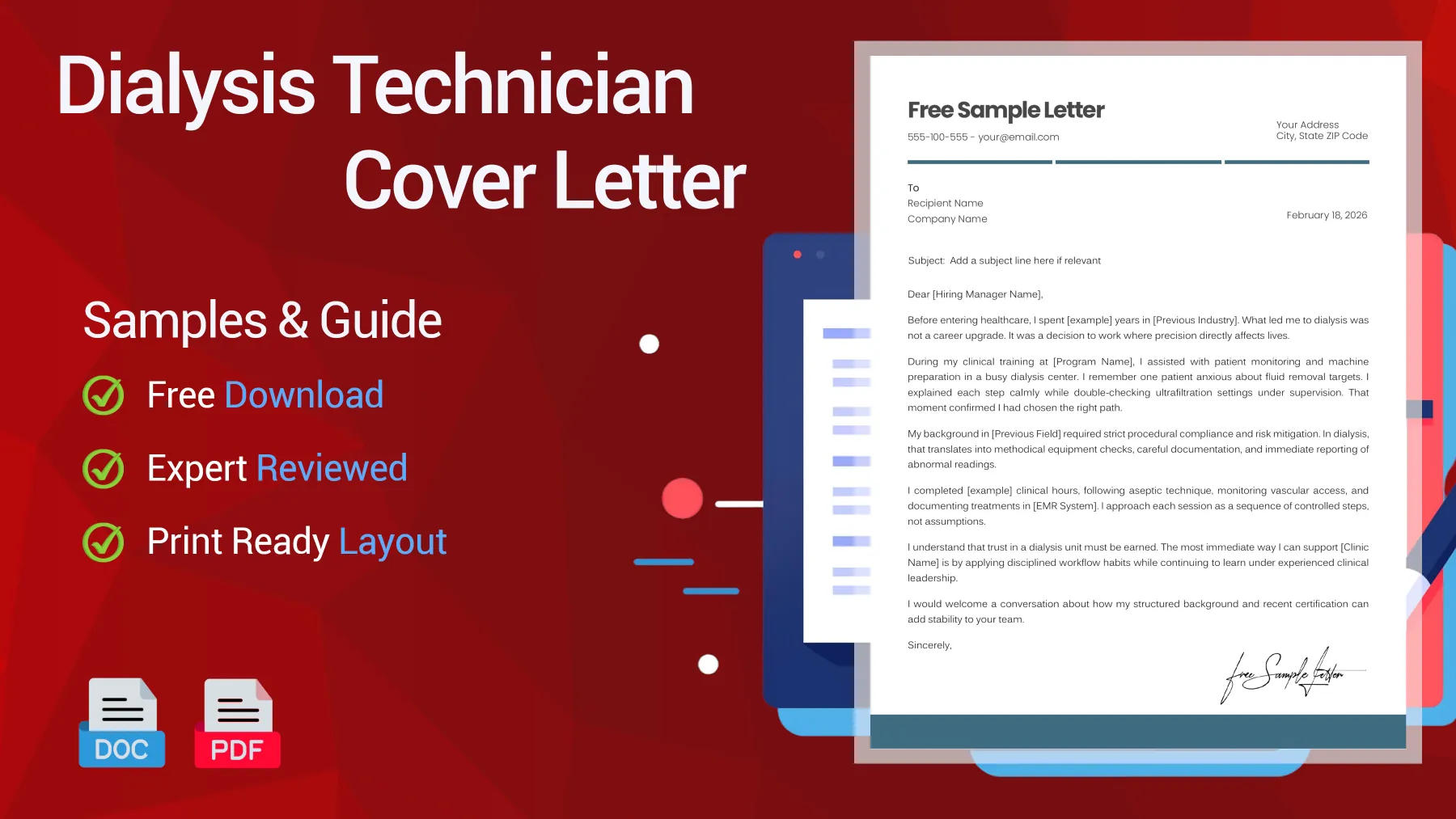
Free Dialysis Technician Cover Letter Samples
According to the U.S. Bureau of Labor Statistics (2024), demand for clinical laboratory and related technicians remains steady due to rising cases of chronic kidney disease. In dialysis units, this means employers focus on safety compliance and precise patient care. Your cover letter should highlight protocol accuracy and your ability to make a measurable clinical impact.
Entry-Level Dialysis Technician Cover Letter (Newly Certified)
Designed for a junior dialysis technician who completed clinical training, this cover letter highlights protocol accuracy, patient monitoring, and supervised hemodialysis exposure.
Dear [Hiring Manager Name],
While you may prefer candidates with years of dialysis experience, I offer recent, rigorous training aligned with today’s clinical standards.
At [Program Name], I completed [example] hours of supervised hemodialysis practice. My responsibilities included preparing machines, verifying dialysate composition, and documenting treatment parameters in [EMR System]. My preceptor expected strict adherence to protocol, so every session began with equipment calibration checks and a patient assessment review.
During my rotation, I helped monitor patients with vascular access complications and learned to escalate concerns quickly. I understand how even small oversights can quickly become critical events.
Although I’m newly certified, I’m not unfamiliar with the dialysis environment. I know the pace, the responsibility, and that patient safety depends on getting the details right every time.
I can support [Clinic Name] from day one by maintaining strict compliance with setup procedures, assisting with patient monitoring, and ensuring documentation accuracy.
I would welcome the opportunity to discuss how I can integrate smoothly into your team’s workflow.
Respectfully,
[Your Name]

Reviewed by Olivia B., HR Consultant
I like how the candidate addresses the experience gap head-on and replaces it with discipline and protocol mastery. That feels safe to me.
Experienced Dialysis Technician Cover Letter
Designed for seasoned hemodialysis technicians, this letter emphasizes metrics, protocol compliance, and clinical workflow leadership in real dialysis settings.
Dear [Hiring Manager Name],
In a dialysis unit, consistency saves lives. Over the past 12 years at [Clinic Name], I’ve focused on making that consistency measurable.
I managed an average of [number] patients per shift while maintaining 100% adherence to infection control audits. By standardizing my pre-treatment checklist, I helped reduce access-related complications in my assigned group by [example]% over twelve months.
I can support [Clinic Name] by stabilizing workflow during demanding shifts. I routinely prepare and calibrate dialysis machines before each shift, verify dialysate composition, and monitor patients for early signs of hypotension or cramping. I complete documentation in [EMR System] in real time to prevent treatment gaps.
In addition to my technical skills, I train junior technicians on vascular access monitoring and proper equipment disinfection. Dialysis care is repetitive by design, but the difference lies in how rigorously each step is performed.
At [Current Employer], I’ve also worked closely with RNs during acute complications, ensuring rapid intervention without disrupting workflow. That coordination is central to patient safety.
I would welcome the chance to discuss how my experience can support quality control and patient flow management at [Clinic Name].
Respectfully,
[Your Name]
Reviewed by Olivia B., HR Consultant
Training junior staff and citing metrics makes this profile feel mature and leadership-ready.
Career Change Dialysis Technician Cover Letter (Mid-Career Transition)
Built for career changers entering dialysis, this cover letter connects prior procedural discipline with new clinical certification and patient safety standards.
Dear [Hiring Manager Name],
Before entering healthcare, I spent [example] years in [Previous Industry]. My move to dialysis wasn’t simply a career change. It was a decision to work in a field where precision directly affects lives.
During my clinical training at [Program Name], I assisted with patient monitoring and machine preparation in a busy dialysis center. I remember working with a patient who was anxious about fluid removal targets. I explained each step calmly while double-checking ultrafiltration settings under supervision. That experience confirmed I was on the right path.
My background in [Previous Field] required strict procedural compliance and risk management. In dialysis, this translates into methodical equipment checks, careful documentation, and immediate reporting of abnormal readings.
I completed [example] clinical hours, practicing aseptic technique, monitoring vascular access, and documenting treatments in [EMR System]. I approach each session as a sequence of controlled steps, not assumptions.
I understand that trust in a dialysis unit must be earned. The best way I can support [Clinic Name] is by applying disciplined workflow habits while continuing to learn from experienced clinical leaders.
I would welcome the opportunity to discuss how my structured background and recent certification can add stability to your team.
Sincerely,
[Your Name]
Reviewed by Olivia B., HR Consultant
The career shift feels intentional, not impulsive. I see reflection and clinical seriousness.
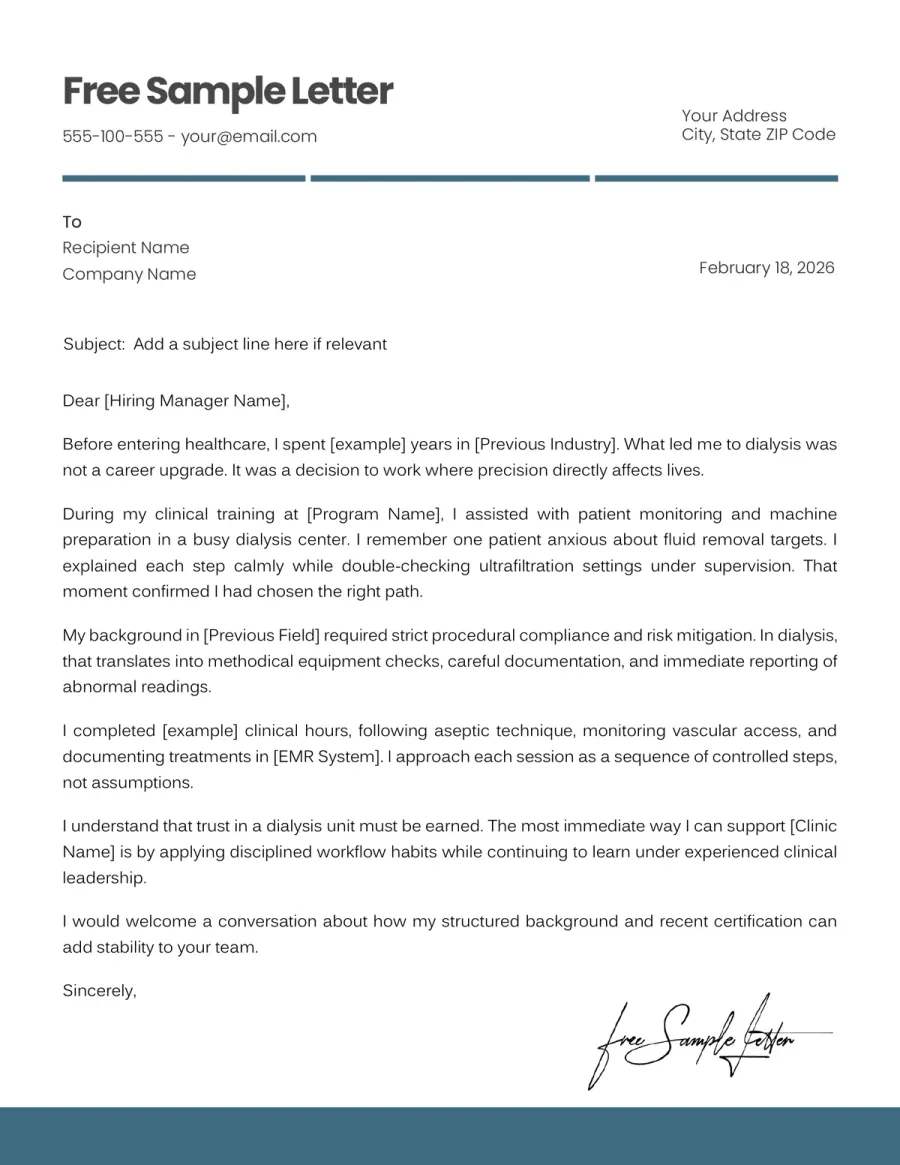
Dialysis Technician Cover Letter Template Preview Before Download
Below is a visual preview of the dialysis technician cover letter template. Editable versions are available in Word and PDF formats.
Make These Dialysis Cover Letter Samples Yours
Copy-pasting a sample is the quickest way to appear generic to a dialysis recruiter. They spot repetition right away. Use the structure for guidance, but make sure to replace all examples, numbers, and details with your own clinical experience.
➡️ Learn the full structure in our complete guide to writing a professional cover letter
Define Your Clinical Positioning
Decide how to present yourself: are you newly certified, experienced, or transitioning from another field? Your positioning shapes the tone, examples, and level of credibility your cover letter will have.
See an example
“I recently completed [number] supervised clinical hours in a high-volume dialysis unit, focusing on strict infection control and patient monitoring.”
Replace Generic Skills with Clinical Proof
Skip generic phrases like “detail-oriented” or “team player.” Instead, use dialysis-specific actions such as machine calibration, ultrafiltration monitoring, or vascular access checks to illustrate your skills.
See what to include
“Before every session, I verify conductivity, temperature, and dialysate composition to prevent treatment deviation.”
Translate Experience into Measurable Impact
Numbers show accountability. Even if you’re just starting out, you can quantify clinical hours or supervised rotations to demonstrate your hands-on experience.
See an example
“I completed over [example] hours of supervised hemodialysis training in a fast-paced outpatient unit.”
Reflect the Reality of Dialysis Work
Dialysis work is repetitive, technical, and emotionally demanding. A strong cover letter recognizes this reality without romanticizing the job.
See an example
“I approach each dialysis session as a sequence of controlled steps, not assumptions.”
Add a Forward-Looking Closing
Avoid ending with generic expressions of thanks. Instead, suggest a realistic next step connected to patient safety, workflow, or compliance.
See an example
“I would welcome the opportunity to discuss how I can support peak patient flow while maintaining protocol integrity.”
What Dialysis Hiring Managers Scan First
- Hemodialysis setup
- Infection control protocols
- EMR documentation accuracy
- Vascular access monitoring
- Hypotension response
- Aseptic technique
- Patient flow management during peak shifts
- Dialysate conductivity verification
- Machine calibration
- Fluid removal targets
- Chronic and acute dialysis care
- Team coordination with RNs
- Ultrafiltration settings monitoring
- Safety
Do & Don’t: How Dialysis Letters Earn or Lose Trust
Dialysis managers review applications with a focus on safety. They aren’t looking for enthusiasm alone, but for risk awareness, procedural discipline, and steady accountability during demanding shifts.
Common Signals of Clinical Unreliability
Red Flags- Describe dialysis as “helping people” without mentioning safety protocols
- Ignore infection control procedures
- Overuse emotional language instead of clinical evidence
- Fail to mention machine setup or monitoring responsibilities
- Claim experience without specific dialysis context
Signals That Reassure a Dialysis Manager
Trust Signals- Reference infection control audits or compliance
- Mention machine calibration and conductivity checks
- Show awareness of hypotension or vascular access complications
- Describe documentation habits in EMR systems
- Acknowledge the structured and repetitive nature of dialysis work
FAQ - Dialysis Technician Cover Letter
Should I mention CCHT / CCHT-A in the cover letter? Toggle answer
Yes, if it’s required or preferred for the job. Mention it early in your letter, linking it to patient safety and compliance rather than just listing a credential. For example: “CCHT-certified and trained to follow facility protocols and document variances accurately.”
How do I talk about infection control without sounding copy-pasted? Toggle answer
Be specific about your actions: list disinfection steps, aseptic technique, access-site observation, and your audit mindset. For example, “I follow the same setup checklist every session” is more credible than “I’m detail-oriented.” Dialysis managers see this as risk control.
I only have supervised clinical hours. How do I make that credible? Toggle answer
Describe your clinical hours as supervised experience in a dialysis unit. Quantify your hours and explain what you did under supervision, such as setup, vitals, monitoring, or charting. The goal is to show you are safe and coachable, not already completely independent.
Should I list machines or dialyzer setup details? Toggle answer
Include machine or dialyzer details only if you can do so clearly in one line and if it’s relevant to the job. Mentioning “Fresenius-style workflow” or “machine setup and conductivity checks” can be useful. Avoid listing brand names unless you can explain your hands-on experience with them.
How do I mention handling hypotension or complications without hurting my application? Toggle answer
Describe handling complications as calm escalation and following protocol. A short example works well: explain what you noticed, what you checked, who you informed, and how you stabilized workflow. This shows maturity, not drama.
TL;DR: Dialysis Technician Cover Letter Game Plan
A strong Dialysis Technician Cover Letter is a safety test in disguise. Lead with protocol-focused thinking, provide specific examples of machine setup and monitoring, and quantify your experience where you can: clinical hours, patients per shift, or audit readiness. The biggest mistake is writing a “caring” letter that fails to show compliance, documentation discipline, or risk awareness.
One thing most candidates miss: explain how you prevent errors, not just how you “work hard.” Dialysis managers trust technicians who describe checkpoints, escalation habits, and calm execution in high-stakes care. That’s what turns a Dialysis Technician Cover Letter from acceptable into hire-worthy.