
Laboratory Technician Cover Letter Examples That Get Hired in 2026
Struggling to write a Laboratory Technician cover letter that leads to interviews? Here you'll find proven examples and straightforward tips to help you secure your next job offer.
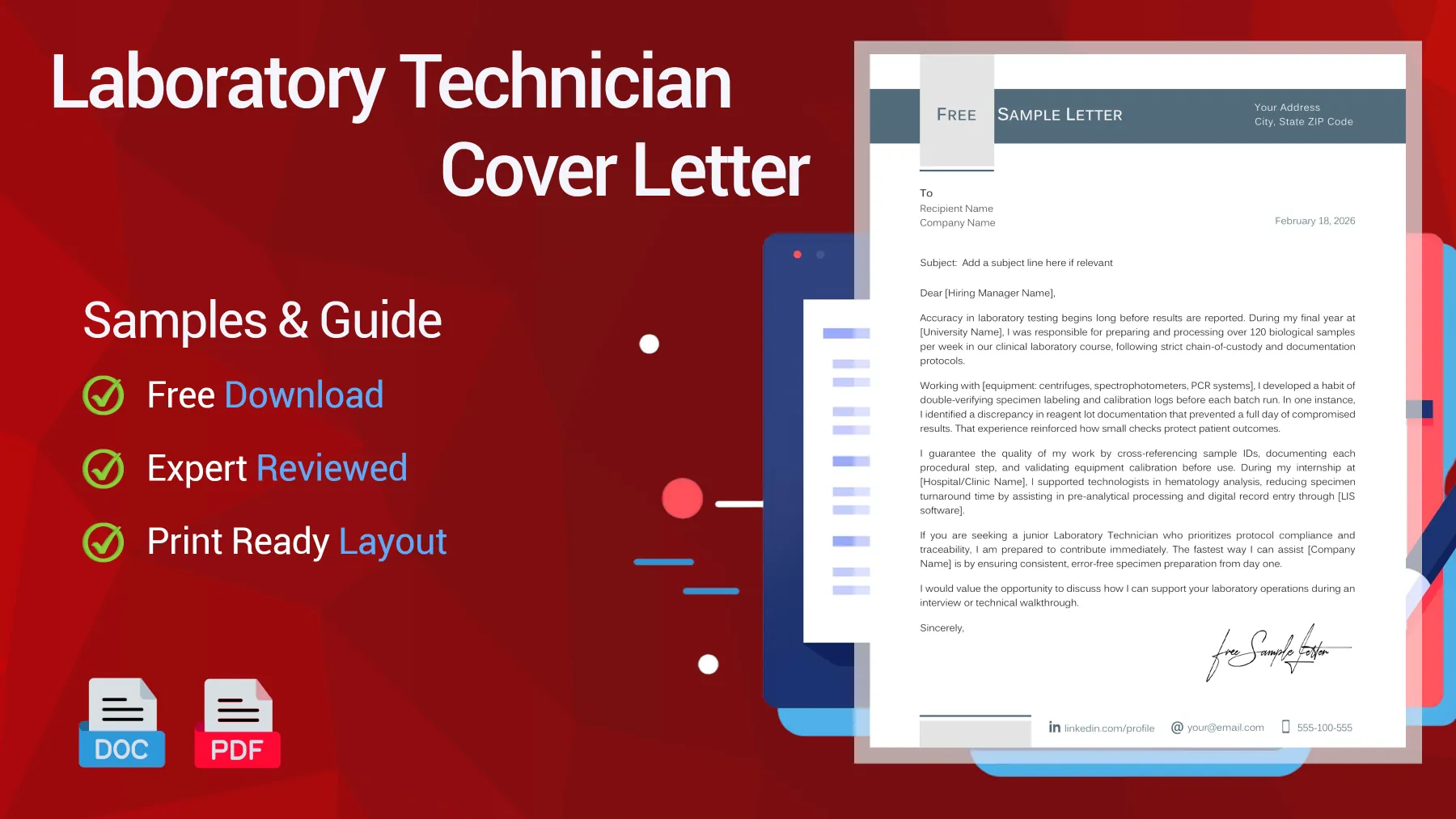
Free Sample Laboratory Technician Cover Letters
According to the U.S. Bureau of Labor Statistics, employment for clinical laboratory technologists and technicians is projected to grow through 2034, with about 22,600 openings each year driven by retirements and turnover. However, competition remains steady, so a clear, skills-focused cover letter is essential for standing out.
Entry-Level Laboratory Technician Cover Letter
This entry-level Laboratory Technician cover letter helps recent graduates demonstrate job-readiness through lab skills, adherence to safety protocols, and measurable academic results.
Dear [Hiring Manager Name],
Accuracy in laboratory testing starts long before results are reported. In my final year at [University Name], I prepared and processed over 120 biological samples each week in our clinical laboratory course, always following strict chain-of-custody and documentation protocols.
Working with [equipment such as centrifuges, spectrophotometers, or PCR systems], I made it a habit to double-check specimen labeling and calibration logs before every run. On one occasion, I caught a discrepancy in reagent lot documentation, which prevented a full day of compromised results. That experience reinforced how essential small checks are to protecting patient outcomes.
I support quality by cross-referencing sample IDs, documenting each procedural step, and validating equipment calibration before use. During my internship at [Hospital/Clinic Name], I assisted technologists in hematology analysis and helped reduce specimen turnaround time by supporting pre-analytical processing and digital record entry using [LIS software].
If you are seeking a junior Laboratory Technician who values protocol compliance and traceability, I am ready to contribute immediately. I can help [Company Name] from day one by ensuring consistent, error-free specimen preparation.
I welcome the opportunity to discuss how I can support your laboratory operations in an interview or technical walkthrough.
Sincerely,
[Your Name]

Reviewed by Olivia B., HR Consultant
I like the balanced tone: confident yet grounded in real lab responsibilities without overstating early-career experience.
Senior Laboratory Technician Cover Letter
Built for experienced laboratory professionals, this cover letter demonstrates leadership, quality control expertise, and operational optimization in clinical environments.
Dear [Hiring Manager Name],
Clinical laboratories evolve, but the fundamentals remain: traceability, calibration, and disciplined documentation. Throughout my career at [Institution Name], I have focused on strengthening these pillars.
I have overseen quality assurance protocols for chemistry, microbiology, and hematology departments, ensuring compliance with CAP and CLIA standards. When error variance increased during a testing phase, I led a root-cause analysis that revealed equipment recalibration gaps. Addressing these issues reduced repeat testing by 22%.
Beyond daily operations, I mentor new technicians and lead quarterly internal audits. I also maintain detailed maintenance schedules, cross-check reagent lot traceability, and verify LIS integration accuracy.
If your laboratory needs a senior technician who balances operational oversight with hands-on expertise, I am ready to contribute.
I would appreciate the chance to discuss your current technical priorities in more detail.
Sincerely,
[Your Name]
Reviewed by Olivia B., HR Consultant
The structured quality control approach and accreditation readiness demonstrate technical maturity and operational control expected at senior level.
Laboratory Technician Internship Cover Letter
Created for students seeking a laboratory technician internship, this model emphasizes training, technical foundations, and learning agility.
Dear [Hiring Manager Name],
When a mislabeled sample brought our simulation lab session to a halt, I saw firsthand how small errors can disrupt clinical decisions. That experience shaped how I approach laboratory work.
As a [Year] student in [Medical Laboratory Science], I have completed coursework in hematology, microbiology, and clinical chemistry. In supervised sessions, I routinely prepare slides, calibrate equipment, and document sample data using [LIS software].
In a recent project, I coordinated specimen logging for a class-wide analysis batch, ensuring accurate tracking of 60 samples. Our group achieved complete traceability with no documentation errors.
Though I am still completing my degree, I bring structured lab habits and strong procedural discipline. I stage materials before testing, review protocol sheets, and confirm equipment settings before processing.
I would welcome the opportunity to contribute to your team while gaining more hands-on clinical laboratory experience.
Kind regards,
[Your Name]
Reviewed by Olivia B., HR Consultant
I like how the candidate demonstrates procedural discipline and safety awareness, even while still in academic training.
Laboratory Technician Cover Letter Template Preview Before Download
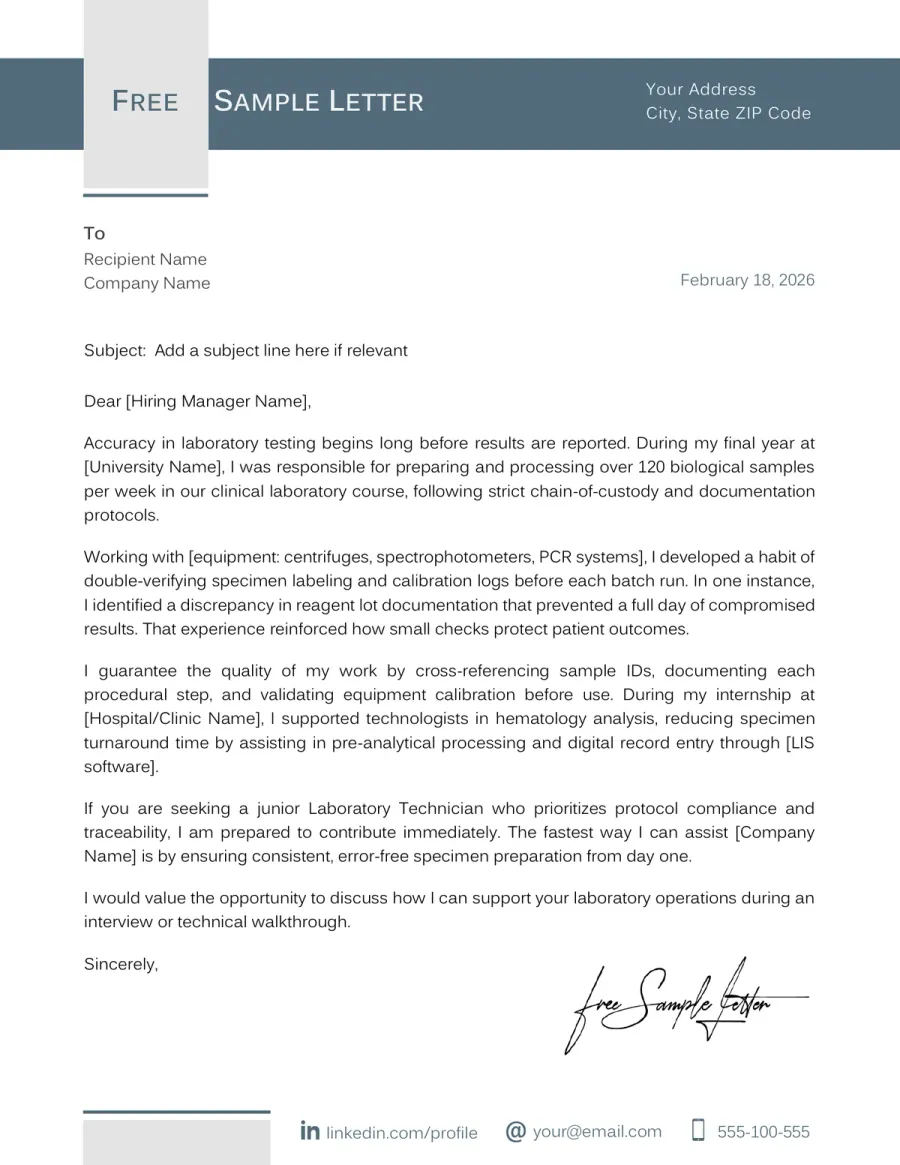
Below is a visual preview of the Laboratory Technician cover letter template before you download it. Editable files are available in Word (.docx) and PDF formats.
Turn These Templates Into Your Own Interview-Winning Letters
Copying a Laboratory Technician cover letter without adjustments is the quickest way to appear replaceable. Recruiters notice generic language right away. Customize each section to show your skills, lab experience, and specific procedures match the requirements of the role you want.
➡️ More expert insights in our article How to Write a Cover Letter That Gets Interviews
Start With the Real Lab Context
Start your cover letter with a sentence connected to the employer’s lab type, volume, or specialty. Demonstrate that you understand their testing environment before introducing your background.
See an example
“In high-volume diagnostic labs like [Company Name], turnaround time and traceability define performance. That is where my recent experience in hematology processing can contribute immediately.”
Replace Claims With Lab Proof
Avoid simply stating that you are precise or organized. Instead, describe a specific lab task and the measurable outcome you achieved. Concrete data builds credibility faster than adjectives.
See an example
“I processed 120+ weekly samples using [LIS], reducing documentation errors by double-verifying barcode entries before analysis.”
Align Your Tools With Theirs
Laboratory hiring managers quickly scan for familiarity with relevant tools. Match your equipment and software experience to those listed in the job description.
See what to include
“I regularly operated centrifuges, spectrophotometers, and maintained digital entries in [LIS software], ensuring traceable documentation.”
Adjust the Tone to Your Level
Entry-level cover letters should highlight your readiness to learn and your comfort with supervision. Senior-level letters should emphasize process control and leadership. The tone of your letter signals your level of experience.
See the difference
Junior: “Under supervision, I assisted in hematology analysis and verified sample logs.” Senior: “I implemented revised validation protocols that improved audit outcomes.”
Suggest a Professional Conversation
Avoid generic closings. Instead, propose a technical discussion, lab walkthrough, or a brief meeting to discuss workflow expectations.
See how to close
“I would welcome a brief discussion to understand your current specimen volume and how I can support processing efficiency.”
ATS & Hiring Manager Signal Map for Lab Tech Applications
- CLIA compliance
- Specimen processing workflow
- Hematology analysis
- LIS documentation accuracy
- Turnaround time optimization
- PCR contamination control protocols
- Chain-of-custody documentation
- Calibration logs
- Biosafety Level 2 handling
- Quality assurance audits
- Clinical chemistry batch validation
- CAP accreditation standards
- Microscopy
Do & Don’t: What Makes a Laboratory Technician Cover Letter Credible
Recruiters in laboratory settings look for potential risk indicators. Because lab work affects patient safety and compliance, they quickly reject anything vague, exaggerated, or careless. Precision in your writing reflects precision in your laboratory practice.
Red Flags in Laboratory Technician Cover Letters
Red Flags- Using generic phrases with no lab tools mentioned
- Claiming precision without describing verification steps
- Ignoring compliance standards (CLIA, CAP, biosafety)
- No measurable workload or results
- Overly emotional language in a technical field
What Builds Immediate Trust in a Lab Setting
Trust Signals- Reference specific equipment or software used
- Describe one real workflow improvement
- Mention quality control or calibration routines
- Align your experience with testing volume or specialty
- Propose a technical next-step discussion
FAQ - Laboratory Technician Cover Letter
The posting is vague. Who do I address and what do I write? Toggle answer
Use “Dear Hiring Manager,” and begin your letter by referencing a clear aspect of the posting, such as specimen flow, testing area, or compliance requirements. Include one reasonable assumption you can support, for example: “supporting accurate, traceable results in a high-throughput lab.”
I only have school labs/internships. How do I look job-ready? Toggle answer
Replace statements like “I’m detail-oriented” with a specific process you follow, such as labeling checks, calibration logs, contamination prevention, or documentation steps. One concrete example is more effective than a paragraph of traits. Show clearly that you respect protocols and supervision.
I don’t know their LIS. Do I mention it? Toggle answer
Yes, but present it as part of your risk management: “I’m new to [LIS], so I double-verify identifiers and follow SOPs step by step until my accuracy is consistent.” Pair this with evidence that you learned another system quickly, even if only in training.
Should I name instruments and methods? Toggle answer
Only mention equipment or methods that match the job posting. Connect each tool to an outcome, such as faster turnaround time, reduced rework, fewer labeling errors, or clean documentation. One sentence that links the tool, the routine, and the result sounds competent, not like an inventory list.
How do I reference compliance (CLIA/CAP/GLP) without sounding generic? Toggle answer
Describe the behavior rather than just naming the standard: for example, QC checks, traceability, corrective actions, or audit-ready logs. If you mention a compliance standard, connect it to a routine you actually follow, such as a calibration schedule, lot tracking, or chain-of-custody documentation.
TL;DR - Laboratory Technician Cover Letter Action Plan
In a Laboratory Technician cover letter, what separates “ok” from “interview” is proof of safe, repeatable work: traceability, QC habits, and tool-to-result clarity. Name the lab context, show one concrete process you follow, and tie it to outcomes. Fatal mistake: generic claims (“detail-oriented”) with zero workflow proof.
Hiring managers read this role through a risk lens. They trust candidates who write like they work: specific instruments only when relevant, calm language, and verification routines that reduce error. A subtle credibility move most people miss: explain how you prevent mistakes (labels, logs, checks) before you talk about ambition.