
Research Assistant Cover Letter Examples for Clinical Teams in 2026
Your Research Assistant cover letter should reflect the habits of someone who lives by protocols: accurate logs, clean data, and calm patient contact. Use our free samples, customize them quickly, and download in Word or PDF format.
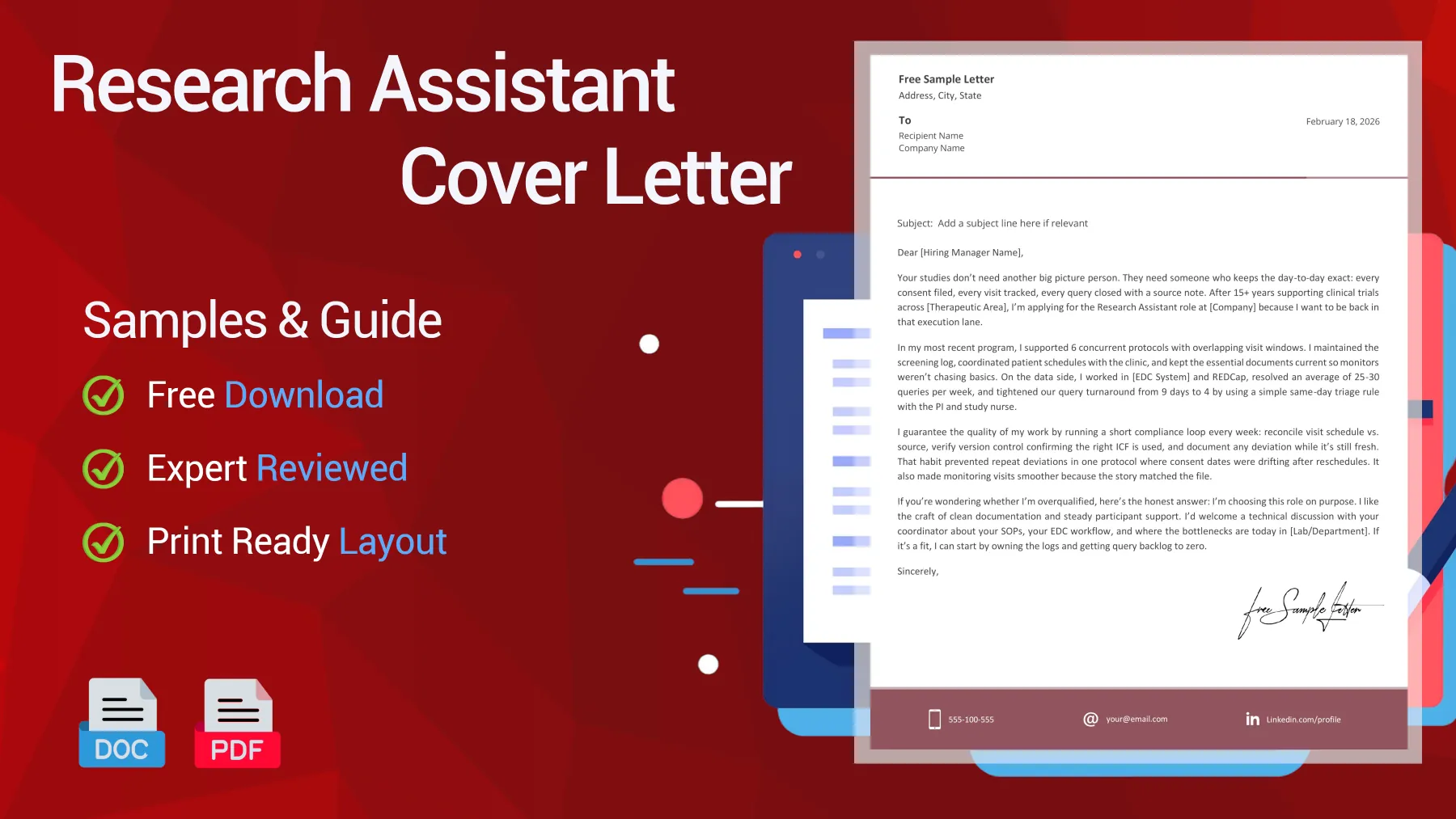
Free Samples of Research Assistant Cover Letters for Clinical Research
BLS lists biological technicians (common research assistant role) at $52,000 median pay (May 2024) and 3% growth projected for 2024-34. Expert interpretation: your letter must show audit-ready logs and error control.
Junior Research Assistant Cover Letter Sample (No Experience)
For a junior/entry-level applicant, this Research Assistant cover letter demonstrates how to frame class-based research, volunteer clinical experience, and documentation habits as practical support for a clinical environment.
Dear [Hiring Manager Name],
Your posting mentions accurate data entry and dependable follow-through. That’s the part of research work I enjoy most: the reliable habits that keep a study on track behind the scenes. I’m a recent [Degree] graduate, and I’m applying for the Research Assistant position at [Company] because I want to bring those habits into a clinical team.
In [Professor Name]’s course-based lab, I was responsible for the essential groundwork that makes analysis possible. I built a spreadsheet tracker for participant scheduling, logged contact attempts, and double-checked forms before storage. For data management, I cleaned a dataset of 950 records, documented every change in a log, and flagged outliers for review instead of quietly correcting them. Our final report was submitted ahead of schedule, and my supervisor reused my tracker the following semester.
I’ve also had my first experience with patient-facing work. While volunteering in [Clinic/Program], I set up rooms, prepared packets, and updated a basic screening list. One morning, a participant hesitated at the consent form and asked a question I couldn’t answer. Rather than guess, I noted the concern, brought in the coordinator, and supported the workflow so the participant felt comfortable and the consent process remained compliant.
I know I’m early in my career. If you need someone already familiar with your exact EDC setup, I’ll learn quickly, but I won’t pretend expertise. What I can offer from day one is careful documentation, clear communication, and a steady pace during deadlines. If you’re open to a conversation, I’d be glad to discuss how I’d support screening, data entry, and weekly study coordination for [Lab/Department].
Sincerely,
[Your Name]
Reviewed by Olivia B., HR Consultant
The paragraphs are tight and scannable. I can spot the skills fast: scheduling, data cleaning, documentation, and calm communication.
Senior Research Assistant Cover Letter Sample
For a senior candidate (15+ years), this Research Assistant cover letter works because it demonstrates hands-on trial support (screening, documentation, query resolution) without a managerial tone.
Dear [Hiring Manager Name],
Your studies don’t need another big-picture person. You need someone who keeps every detail exact: every consent filed, every visit tracked, every query closed with a source note. After more than 15 years supporting clinical trials across [Therapeutic Area], I’m applying for the Research Assistant role at [Company] because I want to focus on execution.
In my most recent position, I supported six concurrent protocols with overlapping visit windows. I maintained the screening log, coordinated patient schedules with the clinic, and kept essential documents current so monitors weren’t chasing missing items. On the data side, I worked in [EDC System] and REDCap, resolved an average of 25-30 queries per week, and reduced our query turnaround time from nine days to four by implementing a same-day triage process with the PI and study nurse.
I maintain the quality of my work by running a short compliance loop every week: reconciling the visit schedule with source documents, verifying version control to confirm the correct ICF is used, and documenting any deviations immediately. This habit prevented repeat deviations in one protocol where consent dates were drifting after reschedules and made monitoring visits run more smoothly because the documentation always matched the reality.
If you’re wondering whether I’m overqualified, I’ll be direct: I’m choosing this role intentionally. I enjoy the craft of clean documentation and steady participant support. I’d welcome a technical discussion with your coordinator about your SOPs, EDC workflow, and where the current bottlenecks are in [Lab/Department]. If it’s a fit, I can start by taking responsibility for the logs and clearing the query backlog.
Sincerely,
[Your Name]
Reviewed by Olivia B., HR Consultant
I trust this writer because the process is specific: reconcile schedule vs source, verify ICF versions, document deviations early. That’s hireable.
Research Assistant Internship Cover Letter Sample (Student-Friendly)
This Research Assistant internship cover letter sample is designed for students. It shows you understand consent, data privacy, and the small tasks that keep a study running day to day.
Dear [Hiring Manager Name],
In a busy clinic, the best intern is the one who makes the study easier to run, not harder to supervise. I’m applying for the Research Assistant internship at [Company] because I can manage detail-heavy work, follow SOPs, and learn quickly without cutting corners.
In my current [Degree] program at [University], I’ve developed a research routine that adapts well to clinical environments. For a semester-long project on [Topic], I ran literature searches in PubMed, summarized findings in a one-page table, and maintained a shared tracker to keep our group organized. For data, I used Excel and basic R to clean entries, label variables, and document assumptions so another student could reproduce the results.
Here’s a brief example of how I work: during a volunteer shift in [Clinic/Program], a coordinator asked me to update a screening list before a clinic session. Two names had conflicting dates of birth across forms. Instead of guessing, I flagged both records, checked the original source with the coordinator, and updated the sheet with a note explaining the change. It took five extra minutes and prevented a bigger mistake.
I’m looking for an internship where I can support real studies: preparing visit materials, updating logs, entering data in REDCap or [EDC System], and helping the team stay organized as schedules shift. If you’re open to a quick conversation, I’d like to hear how your team trains interns and which tasks you’d want me to own in the first month. I’m also happy to share a sample of my tracking sheet structure if that’s useful.
Sincerely,
[Your Name]
Reviewed by Olivia B., HR Consultant
This reads like a student who can follow SOPs. The work is specific (PubMed, trackers, version control) and the closing asks for real expectations.
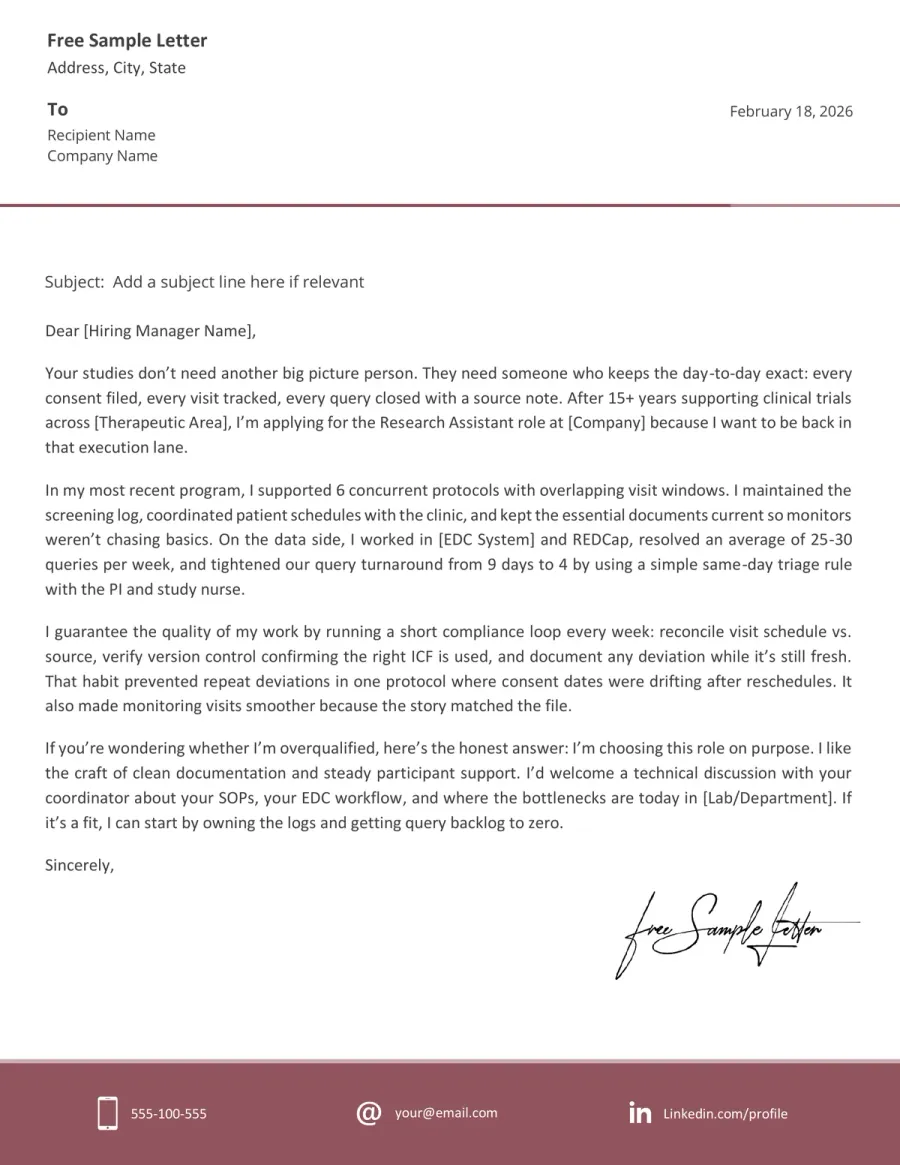
Research Assistant Cover Letter Template Preview Before Download
Preview the Research Assistant cover letter template below, then download the editable files in Word and PDF format to customize the version that fits your profile.
Customize the Samples in 5 Simple Steps
Copy-pasting a Research Assistant cover letter is the fastest way to sound generic. Instead, add your own study context, tools, and outcomes, so your letter reads like it came from your lab notebook, not a template.
➡️ More expert tips in our article How to write a cover letter: structure, proof and tone
Match the right sample to the posting
Choose the sample that matches your experience level (junior, senior, internship), then highlight three key duties from the job posting, like screening, EDC entry, or lab support. Edit your letter so your experience lines up with these responsibilities.
See what to include
“I can support screening and visit prep for [Study/Protocol], and I’m comfortable entering data in [REDCap/EDC] while keeping a clean tracker for queries and reschedules.”
Replace “claims” with proof you actually did
Replace every generic claim with a concrete task and outcome: for example, dataset cleaned, consent packets prepared, or literature table built. Add a specific metric if you can, such as the number of records, queries, or days involved.
See an example
“I cleaned 1,100 rows in [Excel/R], documented every rule in a change log, and caught duplicate entries early, which prevented rework during our final analysis week.”
Align keywords for ATS without faking tools
Mirror the systems and compliance language used in the job posting for ATS, such as REDCap, EDC, eTMF, GCP, IRB, SOPs, and source documentation. Only list tools you are prepared to discuss in an interview.
See what to include
“I’m comfortable working under SOPs, updating essential documents, and resolving EDC queries with clear source notes so monitors can verify decisions quickly.”
Address the silent objection (junior/senior/intern)
Address the main concern in one calm, direct line: juniors should show they won’t guess; seniors should clarify they chose hands-on execution; interns should demonstrate they can follow SOPs. Keep it factual and brief.
See what to write
“I’m early-career, so I won’t pretend expertise. What I bring on day one is careful documentation, clean trackers, and fast escalation when something is unclear.”
Tighten for scan-speed and end with a real next step
End with a next step connected to the job, such as offering a brief call to walk through your data-check template, your approach to query triage, or how you’d support screening. Keep your paragraphs short for easy reading on mobile devices.
See an example
“If it helps, I can share a one-page tracker I use for visits and queries and talk through how I’d keep [Protocol] on schedule without letting the file get messy.”
What Gets Spotted in 6 Seconds (Research Assistant Tag Cloud)
- REDCap
- Resolve EDC queries with clear source notes
- Consent tracking
- SOPs
- Maintain audit-ready screening and enrollment logs
- Source documentation
- PubMed
- Version control for consent form updates
- Visit windows
- Specimen chain-of-custody
- IRB
- Patient scheduling
- Data cleaning
- GCP
- eTMF
- Coordinate visits inside tight protocol windows daily
- Query triage
- Deviation documentation
- Excel
- Zotero summaries
Do & Don't: What Makes a Research Assistant Letter Feel Safe to Hire
Recruiters read these letters as a risk check. We picture you handling patient data, deadlines, and audits. One vague sentence can feel like guessing, while one specific line about your workflow brings relief.
Red Flags That Trigger a Fast “No”
Red Flags- Name-drop GCP/IRB/EDC if you can’t explain your role in them
- Claim you “fixed” data without mentioning documentation or review
- Mix up study basics (screening vs enrollment, visit windows, source notes)
- Use generic praise for the lab instead of showing what you’ll do Monday morning
- Hide behind empty traits instead of describing your workflow
Trust Signals That Make You Interviewable
Trust Signals- Tie each claim to a study task (screening log, packets, EDC entry, queries)
- Show one real quality loop (reconcile, verify versions, document deviations)
- Name tools you’ve used and what you produced with them (tracker, brief, log)
- Include one calm micro-scene where you escalated instead of guessing
- Use one metric or a clear outcome (records cleaned, queries closed, days saved)
FAQ - Research Assistant Cover Letter
Can I mention GCP/IRB if I haven’t taken formal training yet? Toggle answer
Only mention them if you can confidently explain your experience in an interview. If you haven’t had formal training, don’t name-drop. Instead, describe what you actually do: follow SOPs, protect confidentiality, document changes, escalate questions promptly, and maintain version control.
How do I turn wet-lab or academic research into a clinical Research Assistant cover letter? Toggle answer
Translate your actual tasks, not just your titles. Show that you can maintain clean documentation (logs, trackers, change notes), address errors transparently, and communicate clearly. Add one clinical-ready behavior, such as consent awareness, privacy discipline, or working calmly around participants.
Should I mention HIPAA/PHI handling, and how specific can I be? Toggle answer
Mention privacy as a professional behavior, not as a story. Never include patient details. Focus on what you control: de-identifying data, restricting access, avoiding screenshots, following secure storage rules, and asking before sharing any information. This approach signals safety and experience.
RA vs CRC vs CRA: what should my cover letter emphasize so I don’t look confused? Toggle answer
As a Research Assistant, focus on execution: screening logs, visit preparation, data entry, query follow-up, and document control. If your letter sounds like it’s about monitoring strategy or site management, it may seem misaligned. Show you are built for day-to-day operations.
If I made a protocol/IRB mistake before, do I mention it or hide it? Toggle answer
Don’t mention mistakes unless asked. If you are, focus on how you addressed the issue: you flagged it, documented it, escalated it, and changed your process to prevent it from recurring. Recruiters don’t expect perfection. They look for sound judgment during difficult situations.
TL;DR - Make Your Research Assistant Cover Letter Feel Audit-Ready
Your Research Assistant cover letter wins when it reads like you understand the risk: clean logs, careful data handling, and calm participant workflows. Prove it with one concrete process and one real outcome. The fatal mistake is sounding confident while mixing up study basics (consent, versions, queries) or name-dropping tools you can’t explain.
Recruiters aren’t dazzled by “interest in research.” They hire the person who won’t guess. One tight “quality loop” line (verify versions, reconcile logs, document deviations same day) signals maturity fast. Add a small scene where you escalated instead of improvising, and you’ll feel safer than flashier candidates.