
Administrative Assistant Cover Letter Examples Recruiters Trust in 2026
Administrative roles require precision, discretion, and reliability. The cover letter examples below demonstrate how to showcase these qualities clearly and authentically, without resorting to generic or scripted language.
Free Administrative Assistant Cover Letter Samples for Office Roles
According to the U.S. Bureau of Labor Statistics, secretaries and administrative assistants are projected to see about 358,300 openings per year from 2024 to 2034. To stand out, your cover letter should show that you can manage calendars, inboxes, and documents accurately, even when priorities shift.
Entry-Level Administrative Assistant Cover Letter Sample
This administrative assistant cover letter is designed for entry-level candidates. It focuses on structure, accuracy, and taking ownership of tasks, rather than emphasizing job titles.
Dear [Hiring Manager’s Name],
In an administrative role, what matters most isn’t seniority - it’s keeping work accurate, organized, and moving behind the scenes. That’s the approach I bring to every task, and it’s why I am applying for the Administrative Assistant position at [Company Name].
During my training and early office experience, I learned that administrative work depends on attention to detail. I managed shared calendars, coordinated meetings with multiple stakeholders, and prepared documents where accuracy was essential. While supporting a small team, I introduced a straightforward filing system that reduced document retrieval time and eliminated version errors during weekly reporting.
I am comfortable working with email, scheduling tools, and internal documentation systems. I keep inboxes actionable, meetings properly prepared, and information accessible when it is needed. When priorities shift, I reorganize tasks quickly to prevent delays and keep the day moving.
I can support [Company Name] by becoming the person your team relies on for follow-up, coordination, and consistency. I double-check schedules, confirm instructions in writing, and provide clear status updates when closing each task.
I would welcome the opportunity to discuss how I can support your daily operations and grow into a reliable part of your team.
Kind regards,
[Your Name]

Reviewed by Nina P., Senior Editor
I like the focus on process and reliability. It reassures me that this junior candidate understands the real expectations of the role.
Experienced Administrative Assistant Cover Letter Sample
This sample shows how experienced administrative assistants demonstrate impact, trust, and operational control without listing every task they’ve done.
Dear [Hiring Manager’s Name],
After several years in administrative roles, I’ve learned that real effectiveness is often measured by the problems that never arise. That principle has guided my work, and it is one reason I am applying for the Administrative Assistant position at [Company Name].
In previous positions, I supported senior managers and cross-functional teams in fast-paced office settings. I managed complex calendars, coordinated travel and meetings, and handled confidential documentation where accuracy and discretion were critical. By standardizing meeting preparation and follow-up, I reduced last-minute issues and kept communication consistent between departments.
Beyond daily tasks, I serve as a point of stability for my team. I anticipate scheduling conflicts, flag missing information early, and keep priorities aligned with business needs. When workflows became inefficient, I reviewed current processes and introduced clearer filing and tracking systems, which improved response times and reduced duplication.
I can support [Company Name] by helping your daily operations run smoothly and without unnecessary disruption. I build reliability into my work by validating details, documenting decisions, and maintaining clear communication at every stage.
I would welcome the chance to discuss how my experience can contribute to your team’s efficiency and professionalism.
Respectfully,
[Your Name]
Reviewed by Nina P., Senior Editor
This reads like someone who understands responsibility, not just tasks. It signals trust and low-risk hiring.
Administrative Assistant Cover Letter for Career Transition
This sample shows how to convert transferable experience into practical administrative value without overexplaining the career change.
Dear [Hiring Manager’s Name],
Clear processes and steady follow-up have been central to my work, even before my career path pointed directly toward administration. After building experience in coordination, communication, and task management, I am now looking to transition into an Administrative Assistant role at [Company Name].
While my background isn’t strictly administrative, it has always involved organizing information, managing requests, and supporting teams by making sure tasks were completed accurately and on time. These experiences showed me how much structure, responsiveness, and discretion matter behind the scenes.
I am comfortable managing deadlines, keeping records organized, and acting as a central point of contact. When instructions are unclear, I ask questions early. When priorities shift, I adjust quickly to keep workflows on track and prevent avoidable delays.
I am now ready to apply these skills fully at [Company Name]. I can add value quickly by supporting your team with consistency, attention to detail, and dependable execution.
I would welcome the opportunity to discuss how my experience can provide strong administrative support for your organization.
Kind regards,
[Your Name]
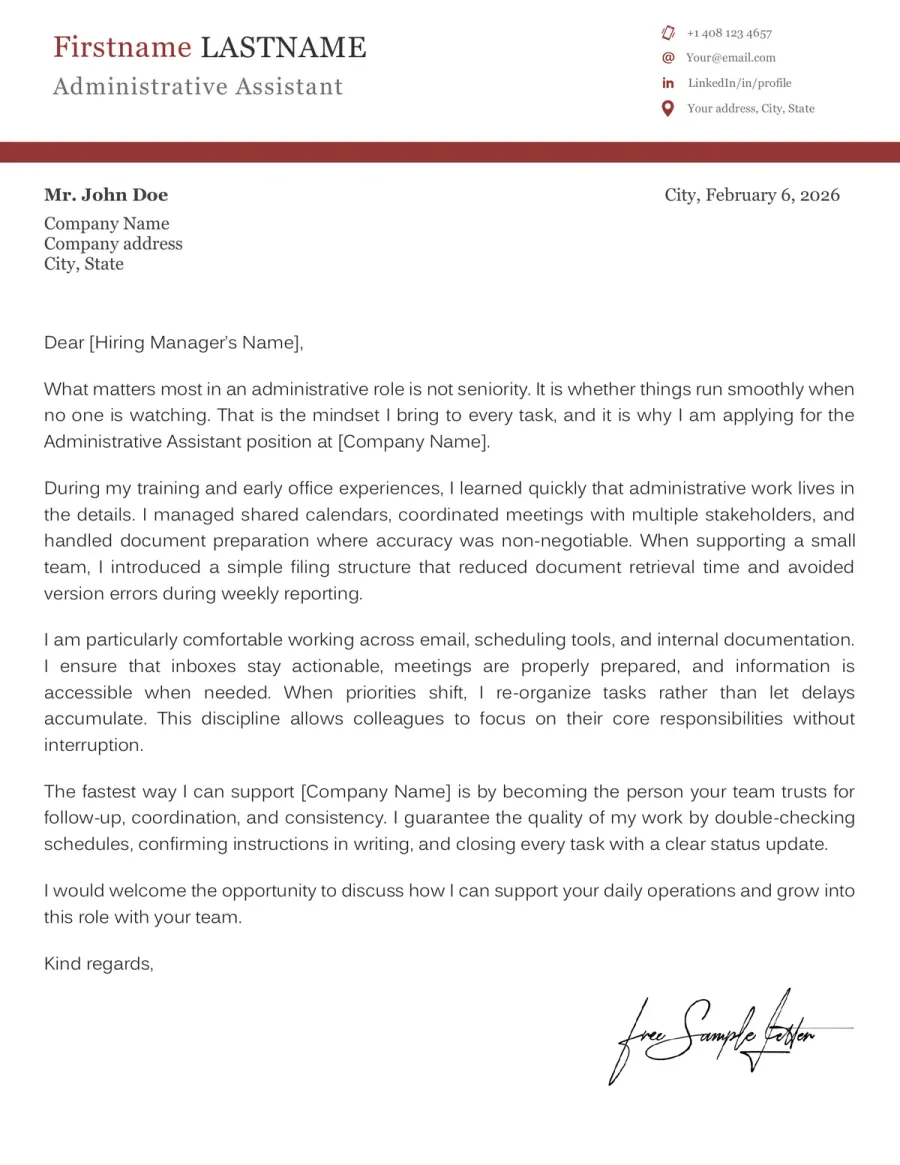
Administrative Assistant Cover Letter Template (Preview Before Download)
Preview this administrative assistant cover letter template before downloading. Available in both editable Word and ready-to-use PDF formats.
Make This Administrative Assistant Cover Letter Your Own
Copying a cover letter rarely works - recruiters notice mismatches quickly. Use these steps to adapt each sample to your experience, your target role, and the specific office you’re applying to.
➡️ For a deeper breakdown, read our step-by-step guide on how to write a cover letter.
Anchor the role in reality
Start by identifying what the administrative role actually involves day to day. Job titles vary, but responsibilities don’t.
See an example
Supporting daily operations meant managing calendars, preparing meeting files, and ensuring accurate follow-ups rather than handling general office tasks.
Replace generic skills with actions
Avoid listing traits like “organized” or “reliable.” Show how you act when details matter.
See what to include
Instead of saying I’m organized, I track tasks using shared tools and confirm priorities in writing to avoid delays.
Adapt the tone to the office culture
Administrative roles reflect company culture. A corporate office and a small team expect different communication styles.
See how to adjust tone
For a formal environment, keep language structured. For a smaller team, allow a warmer, more conversational rhythm.
Translate your experience, don’t defend it
If you’re junior or changing careers, don’t justify your profile. Translate responsibilities into admin value.
See how to reframe
Coordinating requests and tracking deadlines prepared me to manage administrative workflows effectively.
Personalize the closing step
End with a realistic next step. Avoid recycled closings that recruiters skim past.
See a better closing
I would welcome a short conversation to explain how I can support your team’s daily operations.
What Recruiters Scan in an Administrative Assistant Cover Letter
- Calendar management
- Inbox prioritization
- Meeting coordination
- Document control and version tracking
- Discreet document handling
- Internal communication flow
- Task follow-up
- Scheduling tools (Outlook, Google Calendar)
- Accuracy when priorities shift
- Office workflow reliability
- Administrative support across teams
Do & Don’t: Trust Signals vs Common Mistakes
Administrative Assistant cover letters are often scanned for reliability. Recruiters want to see that you can manage details, follow through, and support daily operations without creating extra work.
What Weakens Your Application
Common Mistakes- Listing soft skills without context
- Writing vague task descriptions
- Spending too much space explaining your background instead of showing relevant admin skills
- Using copy-paste openings and closings
- Sounding passive or overly deferential
What Builds Confidence
Trust Signals- Describe how you manage priorities when requests conflict
- Show follow-up habits instead of claiming reliability
- Reference real administrative tools or processes
- Keep structure clean and easy to scan
- Close with a clear, professional next step
FAQ – Administrative Assistant Cover Letter
Should I mention software tools in an administrative assistant cover letter? Toggle answer
Yes, when they’re relevant. Tools like calendars, document systems, or inbox management show operational readiness, not technical bragging.
How do recruiters judge reliability from a cover letter? Toggle answer
They look for process clues. Follow-up habits, task tracking, and accuracy signals matter more than personality traits.
Is indirect administrative experience acceptable? Toggle answer
Absolutely, if translated properly. Coordination, scheduling, and documentation skills are transferable when clearly framed.
What makes an admin cover letter feel junior? Toggle answer
Overuse of soft skills, vague tasks, and defensive explanations instead of concrete actions.
How formal should the tone be? Toggle answer
Match the office culture. Corporate roles expect structure; smaller teams allow warmth, but clarity always wins.
Administrative Assistant Cover Letter - What to Do Next
An effective Administrative Assistant cover letter demonstrates one thing clearly: you make daily operations easier. Choose the sample that fits your profile, adapt the actions to your real experience, and remove every generic phrase. Don’t defend your background - show how you manage details.
In the next five minutes: choose a sample, replace the placeholders, and personalize the closing. One mistake to avoid: listing traits instead of showing real processes.