
Medical-related Job Cover Letter Examples for 2026
A clear, compliant cover letter is essential for medical positions. Generic paragraphs don’t make the cut. The focused samples below are designed to help you adapt your letter quickly and apply with confidence.
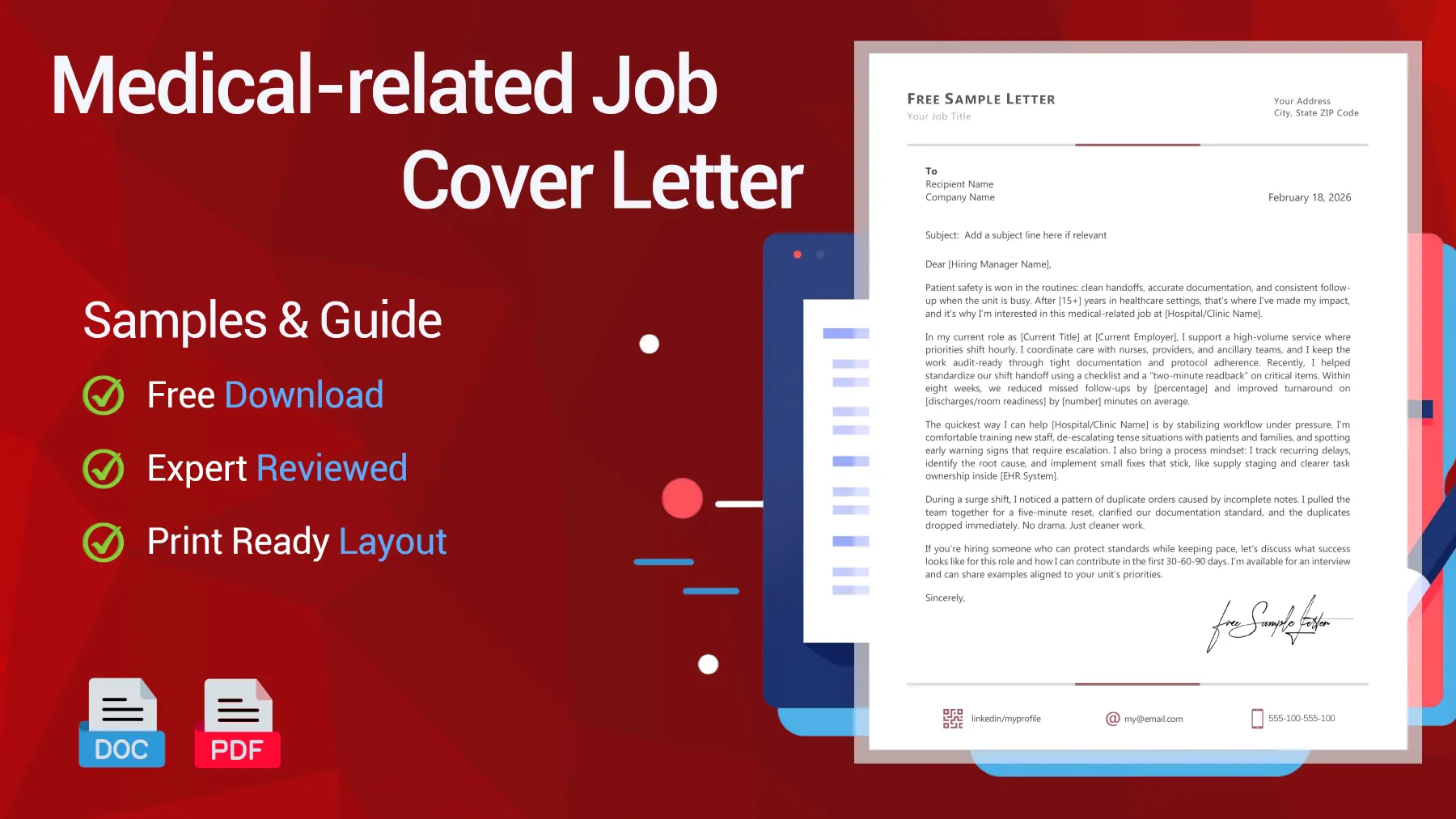
Free Samples of Medical Positions Cover Letters
According to the U.S. Bureau of Labor Statistics, healthcare occupations are projected to grow much faster than average through 2033 due to rising demand. Expert interpretation: growth increases competition, so a precise, role-aligned medical cover letter becomes a selection filter, not a formality.
Entry-Level Medical-related Job Cover Letter (New Graduate Sample)
Built for entry-level candidates in medical-related jobs: it turns clinical rotations, coursework, and patient-facing moments into proof a hiring team can trust.
Dear [Hiring Manager Name],
Healthcare teams aren’t just looking for another eager applicant. They need someone who follows protocol, even when no one is watching, and communicates to keep patients safe. That’s the mindset I bring as I apply for this medical-related position at [Hospital/Clinic Name].
Through my training in [Program/Degree] at [School], I built a foundation in patient privacy, infection prevention, and accurate documentation. In clinical settings, I performed routine care tasks under supervision, prepared basic equipment, and learned the importance of clean information flow between patients, nurses, providers, and the chart. I’m comfortable with [EHR System if known] in a student capacity, and I’ve practiced chart review to catch inconsistencies before they become problems.
I maintain high-quality work by following a consistent routine. Before any task, I confirm two patient identifiers, check the order, and clarify anything that’s unclear. During the task, I explain each step to the patient in clear terms. Afterward, I document promptly and notify the appropriate person if something isn’t right, even if the conversation is uncomfortable. For example, I once noticed a missing allergy note during intake, escalated it to my preceptor, and the team was able to update the record before medication was given.
I’m drawn to [Hospital/Clinic Name] because of its reputation for [Specific Value/Program], and I want to learn in an environment that values high standards. If you’re seeking an entry-level team member who is calm, precise, and coachable, I’d welcome the opportunity to interview. I can also bring a short list of routines I follow to help reduce errors during busy shifts.
Let’s schedule a conversation, and I’ll walk you through how I would contribute during my first weeks on your unit.
Sincerely,
[Your Name]

Reviewed by Olivia B., HR Consultant
This reads honest for entry-level: no inflated claims, just disciplined steps and one clean example that proves attention to risk.
Senior Medical-related Job Cover Letter
Designed for seasoned healthcare professionals: it highlights patient-safety outcomes, cross-team coordination, and calm decision-making without sounding like a résumé recap.
Dear [Hiring Manager Name],
Patient safety comes from disciplined routines: clean handoffs, accurate documentation, and consistent follow-up, especially when the unit is busy. After [15+] years in healthcare, that’s where I’ve made my impact, and it’s why I’m interested in this medical-related position at [Hospital/Clinic Name].
In my current role as [Current Title] at [Current Employer], I support a high-volume service where priorities change by the hour. I coordinate care with nurses, providers, and ancillary teams, maintaining audit-ready work through strict documentation and protocol adherence. Recently, I helped standardize our shift handoff process with a checklist and a “two-minute readback” on critical items. Within eight weeks, we reduced missed follow-ups by [percentage] and improved turnaround times for [discharges/room readiness] by [number] minutes on average.
I can help [Hospital/Clinic Name] by stabilizing workflow during demanding shifts. I’m experienced in training new staff, de-escalating tense situations with patients and families, and spotting early warning signs that need escalation. I also bring a process mindset: I track recurring delays, identify the root cause, and implement small, lasting improvements, like supply staging and clearer task ownership within [EHR System].
During a surge shift, I noticed a pattern of duplicate orders caused by incomplete notes. I called a quick team reset, clarified our documentation standards, and duplicate orders dropped immediately. No drama. Just cleaner work.
If you’re looking for someone who can protect standards while keeping pace, let’s discuss what success looks like for this role and how I can contribute in the first 30, 60, and 90 days. I’m available for an interview and can share examples aligned with your unit’s priorities.
Sincerely,
[Your Name]
Reviewed by Olivia B., HR Consultant
This feels senior without ego: it’s about stabilizing workflow, protecting standards, and fixing repeat issues instead of blaming others.
Medical-related Internship Cover Letter (Clinical Placement Sample)
Perfect for a student seeking a medical-related internship: it shows how to highlight supervised procedures, reflection habits, and reliability on the floor without exaggeration.
Dear [Hiring Manager Name],
In a clinical placement, being “helpful” isn’t enough. You’re trusted with time, privacy, and seemingly small tasks that carry real risk if done carelessly. I’m applying for the [Internship/Placement Title] at [Hospital/Clinic Name] because I want to learn in an environment where standards are clear and consistently enforced.
I’m currently a [Year] student in [Program] at [School], where my training has focused on patient confidentiality, infection prevention, and safe communication. In supervised practice, I’ve supported basic patient care, monitored vital signs, transported specimens, prepared rooms, and updated charts accurately within my scope. I’m comfortable with professional handoffs: repeating key details, confirming priorities, and asking for clarification before taking action.
I protect quality with a simple routine: I confirm two patient identifiers before any interaction, sanitize and stage supplies before entering the room, and check with my supervisor before escalating any concern. After tasks, I document promptly and report exceptions, not assumptions. In my last placement, I followed this process when a patient reported new dizziness during ambulation. I stopped, ensured safety, notified my preceptor, and we reassessed before continuing.
I’m drawn to [Hospital/Clinic Name] because of [Unit/Program], and I’m ready to contribute as a reliable extra set of hands while learning quickly. If selected, I’d like to discuss how interns are coached, how feedback is delivered, and what “excellent” looks like by the end of the placement. I’d appreciate the chance to share how I learn on the floor and how I approach supervision in a brief interview.
Sincerely,
[Your Name]
Reviewed by Olivia B., HR Consultant
I trust this intern because they respect the scope and have a repeatable safety routine; that’s exactly what supervisors want on day one.
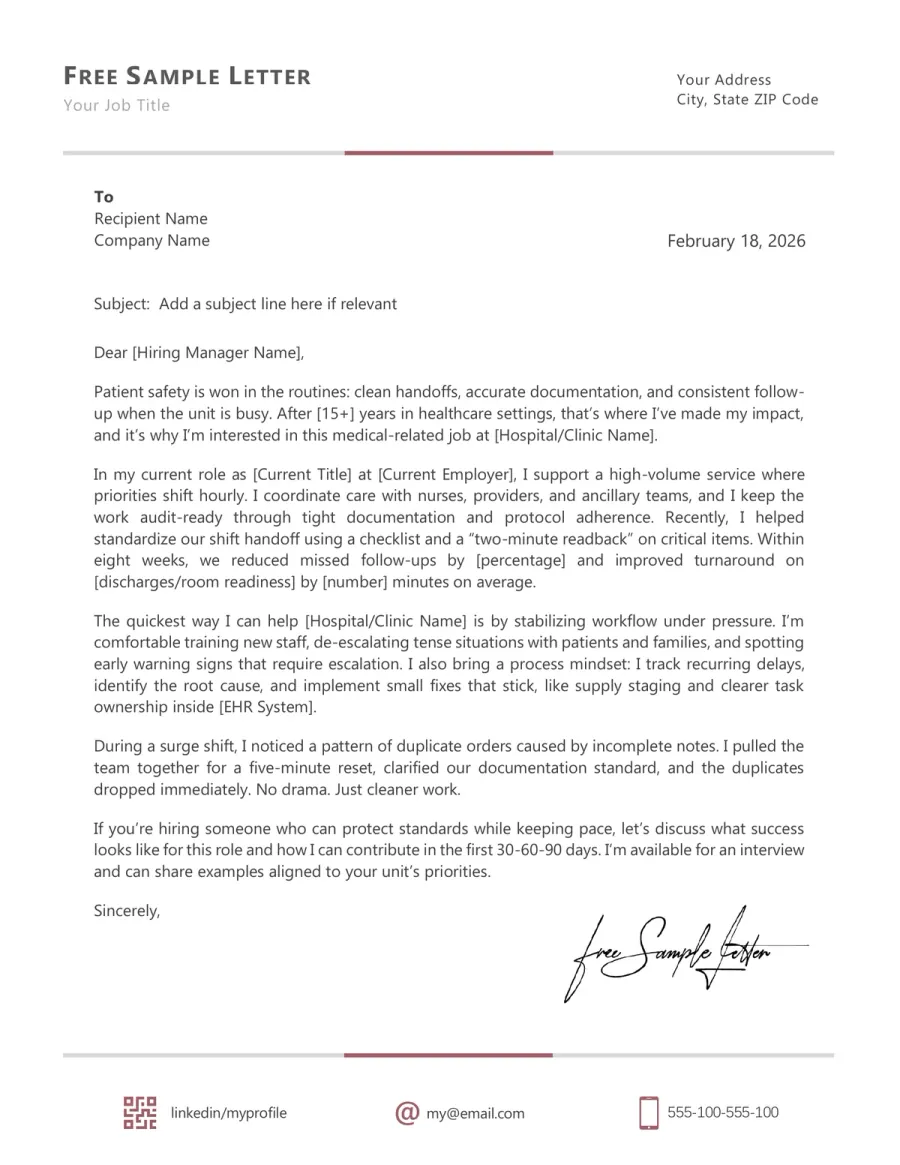
Medical-related Job Cover Letter Template Preview Before Download
Preview the document layout before downloading. Download the editable Word template or a clean PDF version for printing or sending your application.
Make These Samples Yours in 5 Steps
Copying and pasting may seem quick, but it’s the fastest way to sound unprepared or even unsafe in healthcare. Tailor each sample to the specific unit, patient flow, your scope of practice, and the tools you’ll use, so your letter sounds like authentic experience, not a school assignment.
➡️ More guidance here: how to tailor a healthcare cover letter without sounding generic
Map the Posting to Your Scope
Identify three key phrases from the job posting, such as unit, shift, or core task, and incorporate them naturally into your opening. Keep your statements within your actual scope of practice. This shows you understand the realities of the workplace.
See Show the mapping
“In [Unit Name], I support safe patient flow by keeping identifiers, documentation, and handoffs clean during [Shift] - exactly what your posting emphasizes.”
Turn Claims Into Actions
Avoid vague claims like “detail-oriented.” Instead, describe a real situation: what triggered your action, what you did, and who you communicated with. This provides clear, practical evidence of your skills.
See Open the mini template
“I tracked missing supplies during peak hours, staged the cart before rounds, and cut interruptions for nurses without skipping infection-control steps.”
Show Supervision and Escalation
If you’re entry-level or an intern, demonstrate your awareness of your scope. Specify what you do under supervision and how you escalate concerns. Recruiters notice candidates who respect boundaries.
See Open scope phrases
“Within my scope, I complete vitals and room prep, then flag abnormalities to [Preceptor Name] so the clinical team can act fast.”
Use Unit Language and Tools
Replace generic terms with unit-specific language. For example: SBAR handoffs, specimen labeling, medication reconciliation, or scheduling. Only mention a tool like an EHR if you have real experience using it.
See Show wording swaps
“I use SBAR for quick handoffs, confirm orders before specimen transport, and document updates in [EHR Name] so the next clinician has a clean picture.”
Offer One Interview Asset
End your letter with a confident, practical offer. Mention something specific you can bring to the interview, such as a safety checklist, workflow suggestion, or a supervisor reference.
See Open stronger endings
“I can share a one-page checklist I use for identifiers and documentation during busy shifts. I’d value a conversation about your team’s standards.”
ATS Tag Cloud for Medical-related Job Applications
- SBAR
- Specimen labeling and chain of custody
- Insurance verification
- Document exceptions in the EHR in real time
- Infection control protocols
- Clinic scheduling
- Vitals
- Team handoffs
- Patient transport coordination
- ICD-10 / CPT basics
- Medication reconciliation
- Chart review for missing allergies
- EHR documentation
- Medical terminology
- Specimen handling
- HIPAA
Do & Don’t: What Makes a Medical-related Job Cover Letter Feel Safe
In medical hiring, recruiters treat your cover letter as a risk assessment. They look for evidence that you respect your scope of practice, protect privacy, and stay calm when the pace increases. If your letter feels sloppy, vague, or overconfident, they’ll assume those habits will show up on the job.
Red Flags That Trigger a Fast No
Red Flags- Overclaim responsibilities you did “around” rather than did
- Use generic praise instead of naming protocols you follow
- Sound casual about privacy, consent, or patient identification
- Copy the job post without adding proof from your own work
- Hide supervision by using fuzzy wording (“handled everything”)
- Mention tools you never used (EHR systems, scanners, meds)
Trust Signals Hiring Teams Believe
Trust Signals- State your scope clearly and show how you escalate concerns
- Describe one safety catch or clean handoff you contributed to
- Use healthcare-specific language (HIPAA, SBAR, infection control) naturally
- Show disciplined habits: identifiers, documentation, follow-up loops
- Add one workflow detail that proves you help the team move faster safely
FAQ - Medical-related Job Cover Letter
Should I mention HIPAA/privacy in the letter? Toggle answer
Yes, mention HIPAA or privacy once, and do it in a concrete way. Instead of simply name-dropping HIPAA, show your habits, like using a low voice in shared spaces, double-checking patient identifiers, or documenting exceptions. This signals real safety awareness without sounding performative.
Entry-level: how do I prove I’m safe without experience? Toggle answer
Share two examples from your training: a time you caught a safety issue, calmly escalated a concern, or managed a clean handoff. Recruiters want to see you respect boundaries, use patient identifiers, and follow through reliably under supervision, not dramatic stories.
Internship: what do they want from a supervised student? Toggle answer
They’re looking for judgment and coachability. Make your scope of practice clear, show how you take feedback, and include a brief example of a time you paused, checked, and escalated an issue correctly. That’s what supervisors want to see.
Do cover letters matter for MA/medical-related roles? Toggle answer
Often, yes, especially in hospital systems where “fit” and “safety” matter. A well-written cover letter can address what a résumé can’t: how you think during busy shifts, how you communicate, and how you avoid preventable errors.
Not certified yet: how do I write that? Toggle answer
Be direct and specific: “Certification exam scheduled for [Month].” Pair this with what you can already do: your current scope, supervised skills, or routines. Avoid vague phrases like “in progress” without a date.
TL;DR - Make Your Medical-related Job Cover Letter Look Safe, Not Generic
In medical-related hiring, your letter is judged like a risk check: show one safety catch, one clean handoff, and your documentation habit in plain language. The fatal mistake is overclaiming scope or writing vague “I’m detail-oriented” filler. It reads unsafe instantly.
Strong candidates also sound coachable during busy shifts. State supervision boundaries, explain how you escalate concerns, and keep your close practical: invite a short conversation about unit priorities or a 30-60-90 contribution plan. That’s the difference between “nice” and interview-worthy.