
Nurse Cover Letter Samples That Get Noticed in 2026
Your nurse cover letter should demonstrate sound judgment, not just compassion. Use our samples to highlight safe handoffs, patient education, and shift readiness with clear, practical language. Download, personalize, and apply.
Free Samples of Nurse Cover Letters for Hospitals, Clinics, Home Care
The BLS projects 189,100 RN openings per year, with 5% job growth expected from 2024-2034. BLS RN outlook. Expert interpretation: hiring teams initially scan for evidence of safe handoffs, EHR fluency, and license-ready language.
New Graduate Nurse Cover Letter Sample (Entry-Level RN)
For an entry-level Nurse (new graduate RN), this cover letter shows how to translate preceptorship, teach-back, and SBAR into concrete value, even with no paid bedside experience yet.
Dear [Hiring Manager Name],
On a busy med-surg floor, even small misses can become big problems. During my final [Unit] preceptorship at [Clinical Site], I learned that protecting patients starts with getting the basics right: clean handoffs, careful medication checks, and clear charting in [EHR].
One shift stands out. A post-op patient’s pain score remained high despite PRN medication. Before I called the provider, I rechecked the MAR, confirmed medication timing, and asked one more question about nausea and dizziness. We adjusted the care plan, added non-pharmacological steps, and within an hour the patient was able to deep-breathe and ambulate safely. My preceptor highlighted that moment as a model for the habit I now follow every time: assess, verify, document, then escalate with a concise SBAR.
I bring structure to the parts of nursing that often get rushed. During clinicals, I managed care tasks for up to [example] patients using a simple prioritization grid: immediate safety, time-sensitive meds, then teaching. I documented in real time, closed loops with CNAs, and flagged abnormal vitals early so the RN could intervene before a situation escalated. For my capstone, I created a one-page discharge teaching checklist for [Condition], used teach-back, and tracked completion, which helped my preceptor spot gaps before patients left the unit.
My training is practical: BLS, sterile dressing changes, IV line monitoring, fall-risk precautions, and de-escalation basics. I take ownership of the “unseen” work too, like reconciling orders with the care plan and ensuring the next nurse receives a clear, timely handoff, usable at 7:05, not vague at 7:25.
If you need a new graduate who can step into [Unit] and contribute quickly, I can help [Hospital/Clinic Name] by being a calm, steady presence on every shift. I’d welcome a brief conversation about your orientation process and what “great” looks like for your team in the first 90 days.
Sincerely,
[Your Name]

Reviewed by Olivia B., HR Consultant
I like the objection-handling line about being a new grad; it disarms the doubt and replaces it with specific behaviors I can coach.
Senior Nurse Cover Letter Sample
Designed for an experienced Nurse leader, this cover letter ties bedside expertise to outcomes (falls, sepsis, line care) and shows how you coach teams while staying EHR-precise.
Dear [Hiring Manager Name],
When a unit is short-staffed, outcomes depend on the RN who can maintain calm and keep documentation precise at the same time. That’s been my focus for [15+ years], most recently as a [Role, e.g., ICU/Tele Charge RN] on a high-acuity service using [EHR] and standardized safety bundles.
In my current role at [Current Hospital], I lead bedside care for ventilated and hemodynamically unstable patients while mentoring newer nurses through the parts of practice that can’t be learned from a checklist. For example, we reduced central-line dressing reworks by [example]% in one quarter after I improved our “line touch” routine, introduced a two-person check on change days, and coached the team on consistent documentation so gaps were caught before turning into infections.
I also turn quality goals into daily habits. When sepsis screening compliance dropped on nights, I created a simple huddle script: what to watch, when to draw, who to call, and what to document. Within [example] weeks, our bundle timing improved, and providers stopped getting “late” pages without context. I work closely with RT, pharmacy, and hospitalists, and keep families updated without slowing the workflow.
I maintain the quality of my practice by running the same micro-audit every shift: verifying high-alert meds against the MAR, tracing and labeling lines and drains, checking pain and sedation goals against orders, and providing a bedside handoff that ends with one clear “watch item” for the next nurse. This prevents the silent errors that can accumulate overnight.
If [Hospital/Clinic Name] needs an experienced RN who can stabilize the shift, coach the team, and help move key metrics, I’d appreciate the chance to discuss your current priorities on [Unit] and where you’d like to see improvement next.
Sincerely,
[Your Name]
Reviewed by Olivia B., HR Consultant
This sounds senior without ego: the candidate connects bedside habits to measurable quality work and shows how standards are protected on difficult shifts.
Career Change Nurse Cover Letter Sample
For mid-career changers, this sample explains the switch without excuses and proves bedside readiness with clinical rotations, teach-back, and patient-safety habits.
Dear [Hiring Manager Name],
You can teach a new RN the routines, but calm judgment during a demanding shift is harder to train. I’m a mid-career changer who left a [Previous Industry] operations role to earn my [Nursing Degree] and pursue bedside nursing, because I wanted work where my decisions have a direct human impact.
In my previous career at [Former Company], I managed high-stakes shifts with tight staffing, competing priorities, and no room for sloppy handoffs. I led a team of [example], redesigned our shift briefs, and reduced late incident reports by [example]% by standardizing escalation protocols and documentation. That discipline carries directly into nursing: verify, communicate, document, then reassess.
During my clinical rotations at [Clinical Site], I supported med-surg and telemetry patients under RN supervision, focusing on the basics: trending vitals, helping with mobility, wound care, and clear SBAR updates. When a patient’s blood pressure dropped after diuretics, I rechecked manually, reviewed intake and output, and brought my preceptor the relevant numbers and timing so we could adjust the plan early, instead of reacting late.
I can help [Hospital/Clinic Name] most by bringing process discipline to patient safety: consistent infection control, reliable rounding habits, and clear charting that helps the next clinician in [EHR]. I’m BLS-certified, comfortable with teach-back education, and I take feedback the same way I did in operations: write it down, fix it, repeat it.
If you’re open to a brief conversation, I’d like to discuss your orientation pathway for second-career nurses and your expectations for independence in the first 60 to 90 days. I’m available on [Dates].
Sincerely,
[Your Name]
Reviewed by Olivia B., HR Consultant
I buy the career switch because it’s specific and owned; the letter doesn’t beg, it sets a clear bar and shows how trust will be earned.
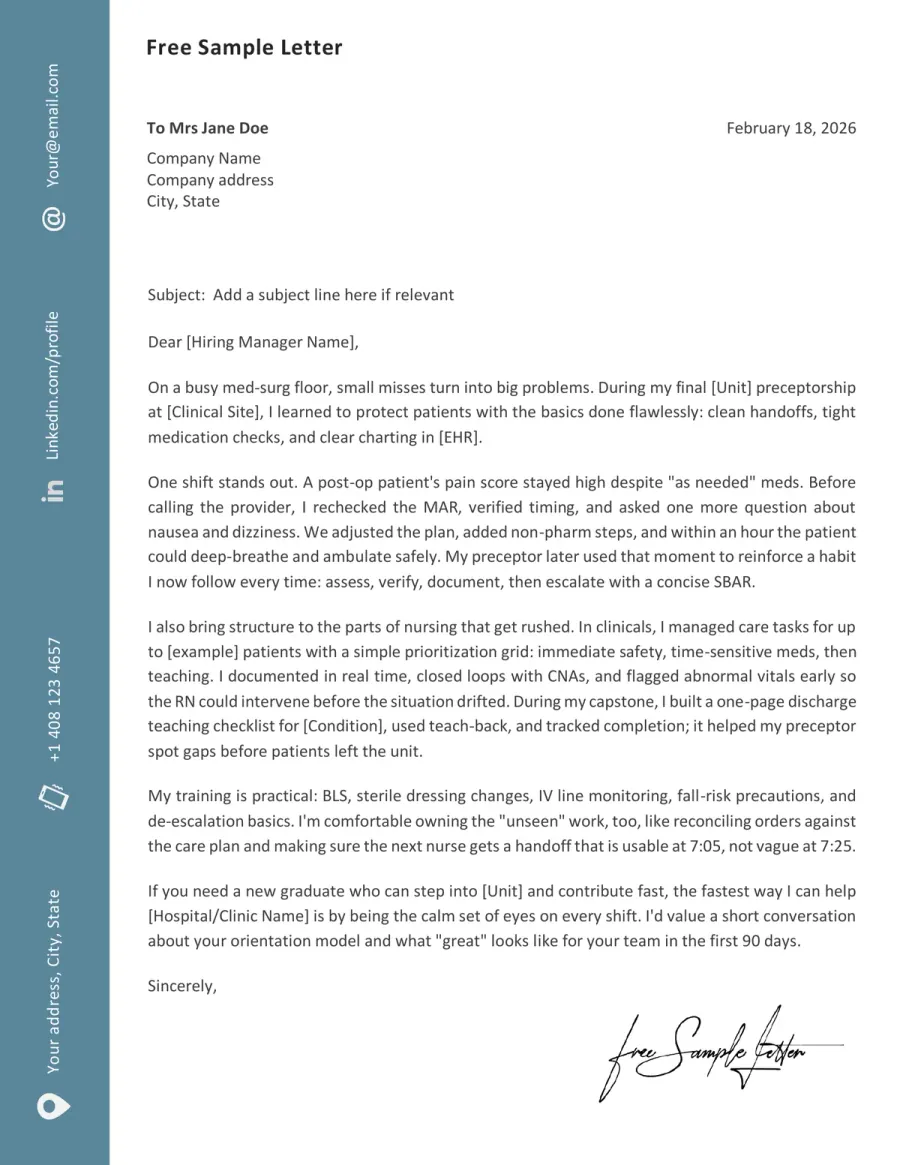
Nurse Cover Letter Template Preview Before You Download
Preview the nurse cover letter template below to see the layout before you download. Files are available in Word (.docx) and PDF formats.
Adapt the Samples: 5 Steps to Personalize Your Nurse Letters
Hiring managers can spot a copy-pasted nurse cover letter in seconds. These templates are most effective when you personalize them with your unit details, real accomplishments, and the specific RN language (SBAR, EHR, safety) your hiring team expects from day one.
➡️ More expert tactics in our article on how to write a cover letter hiring managers actually skim
Target the exact role
Choose one specific role and unit before you edit. Match the job posting’s patient population and shift demands so every line feels tailored to the position.
See an example
“I’m applying for the RN role on your Med-Surg nights team, where fast handoffs and fall prevention matter as much as meds on time here.”
Show how you think on shift
Use numbers when possible, and describe your process clearly when you can’t. Hiring managers want to understand how you approach a shift, not just see a list of adjectives.
See what to include
“I kept a running watch list for [number] patients, prioritized time-sensitive meds, then closed the loop with CNAs so rounding stayed consistent on a busy night.”
Tune language for ATS and humans
Reflect the job posting’s language without copying it directly. Include relevant clinical terms like SBAR, teach-back, and fall risk, and specify your EHR experience so both ATS and human reviewers recognize your fit.
See an example
“I chart in [Epic/Cerner], give SBAR updates, and use teach-back for discharge teaching so families leave with the plan, not just papers.”
Make it facility-specific
Demonstrate you’ve researched the facility: mention one service line, a relevant patient population, and a workflow detail unique to that organization. Be factual, not flattering.
See an example
“Your stroke unit’s focus on early mobility and family teaching fits my clinical work with neuro patients, where I tracked mobility goals and documented teach-back in [EHR].”
Run a two-minute safety audit
Before you send your letter, take two minutes to review: remove vague claims, verify every credential, and end with a specific next step, such as orientation, shift pattern, or start date.
See an example
“If it helps, I can walk you through how I prioritize a [Unit] shift and what I need from a preceptor in the first 60 days. I’m free [Day/Time].”
Nurse ATS Tag Cloud: What Gets Recognized Fast
- SBAR
- Telemetry
- High-alert meds
- Interdisciplinary rounds with RT and pharmacy
- Sterile technique
- Prioritizing care with fluctuating patient acuity
- Triage
- Medication reconciliation
- IV pump basics
- Wound care and dressing changes
- Infection control and PPE discipline
- Charting in real time to reduce errors
- Clean handoffs at change of shift
- De-escalation with anxious patients and families
Do & Don’t: Nurse Cover Letters That Read Safe in 10 Seconds
Recruiters review nurse cover letters like a risk assessment. They look for safety habits, clear scope of practice, and evidence you can prioritize during a busy shift. If your letter feels generic or exaggerated, it may raise concerns. If it’s specific and grounded, you come across as someone they can train and trust.
Red Flags That Make Your Nurse Letter Look Unsafe
Red Flags- Overclaim ICU or ER readiness without naming supervised exposure
- Write only about compassion and skip clinical actions
- Use vague soft skills instead of a real care scenario
- Ignore patient safety basics like meds, falls, infection control
- List tools and certifications you can’t defend in an interview
- Bury your best proof in long, dense paragraphs
Trust Signals That Make Your RN Letter Credible
Trust Signals- Name the unit, shift reality, and patient population you’re targeting
- Prove judgment with one short clinical moment and what you did next
- Use RN language hiring teams recognize: SBAR, teach-back, reassessment
- Show how you prioritize time-sensitive meds and safety tasks
- Clarify scope, license status, and certifications without drama
- Close with a practical next step tied to orientation or start timing
FAQ - Nurse Cover Letter
Should I mention NCLEX date or license pending in a nurse cover letter? Toggle answer
Yes - clearly, in one line. Example: “NCLEX scheduled for [Month Year], RN license pending.” Units want zero ambiguity on start-date readiness. Keep it factual, then pivot to your clinical proof.
Should I include my RN license number in the cover letter? Toggle answer
Usually no. List your license state/status (or “pending”) instead. Many nurses avoid sharing the full number widely for privacy; employers can verify once you’re in process.
New grad - how do I use clinical rotations without overclaiming? Toggle answer
Treat rotations like supervised work: name the unit, what you did, and what you learned. Avoid “managed” language. Say “under preceptor supervision, I…” and give one short scenario (handoff, escalation, teaching).
ICU/ER goal but limited exposure - what’s the smartest angle? Toggle answer
Don’t pretend you’re ICU-ready. Show you understand the reality (acuity, prioritization, tight handoffs), then anchor on transferable habits: reassessment loops, SBAR updates, calm documentation, asking early for help. That reads safe.
Is a personal story acceptable in a nurse cover letter? Toggle answer
Yes, if it stays short and professional. One sentence to explain “why this unit,” then move back to clinical actions and teamwork. Don’t trauma-dump; you’re applying as a colleague, not telling a life story.
TL;DR - Nurse Cover Letter: the “safe and specific” playbook
A strong nurse cover letter reads like you’ve already worked a shift on that unit: it highlights your license status, provides real clinical examples, and uses language that signals safety, such as handoffs, reassessment, and documentation. The most common mistake is sounding “nice” but vague, or overstating your readiness and scope.
Hiring teams don’t need big adjectives. They want judgment they can trust. One concrete scenario is more convincing than five soft-skill statements. If your closing invites a practical discussion about orientation, shift pattern, or start date, your nurse cover letter becomes a real introduction, not just an essay.