
Financial Analyst Cover Letter Examples That Work in 2026
Your resume highlights your technical skills. Your cover letter should demonstrate the real business impact you deliver. Use these Financial Analyst cover letter samples to show how your analysis leads to actionable decisions.
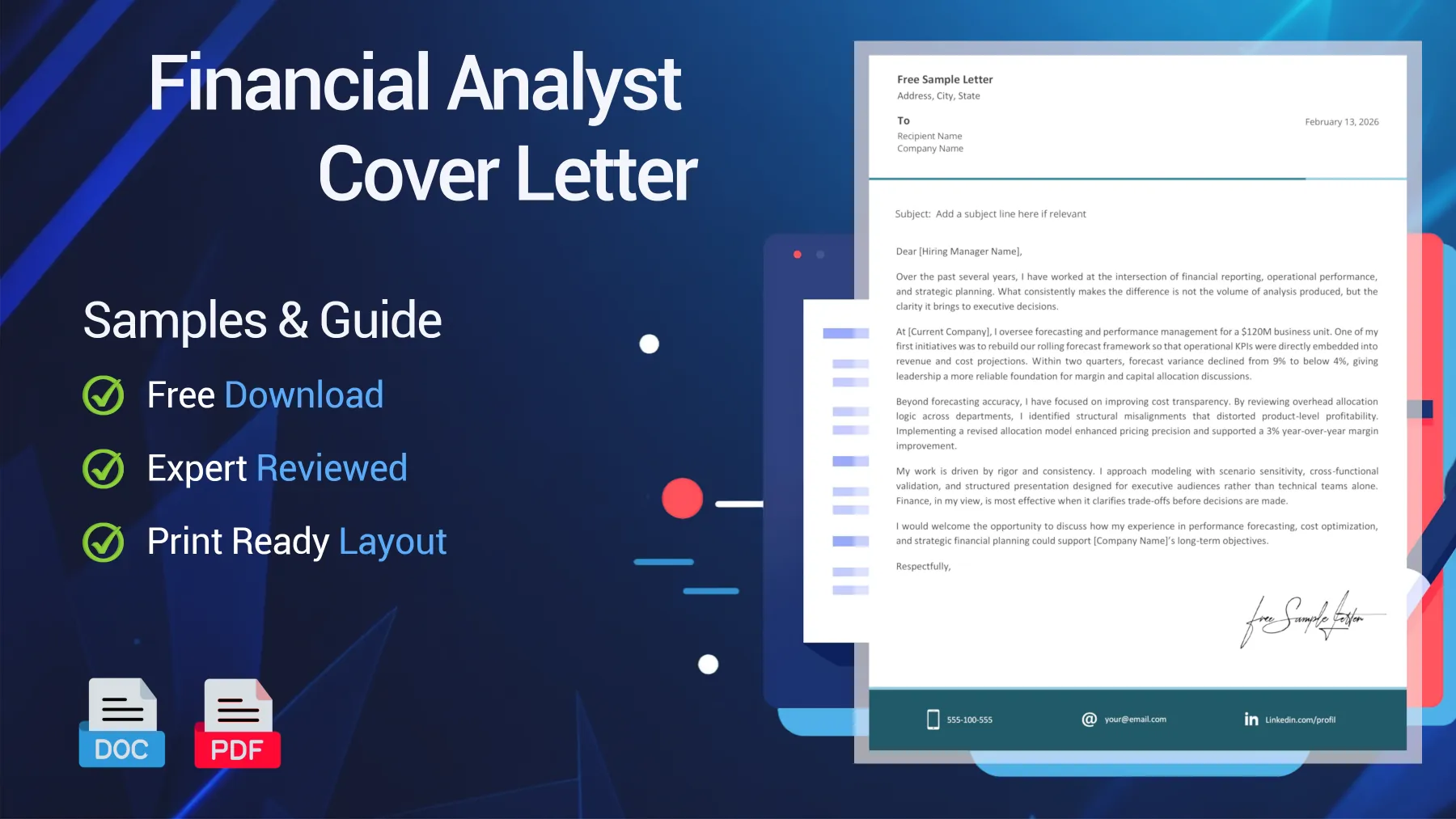
Free Financial Analyst Cover Letter Samples & Insights
According to the U.S. Bureau of Labor Statistics, employment of Financial Analysts is projected to grow 6% from 2024 to 2034, faster than the average for all occupations (BLS). Employers now look for analysts who can turn data into strategic decisions. Your cover letter should highlight your impact, not just your technical expertise.
Entry-Level Financial Analyst Cover Letter – Results Focus
This sample helps entry-level Financial Analysts present coursework, internships, and case studies as evidence of real business impact. It focuses on framing technical skills as practical business decisions.
Dear [Hiring Manager Name],
I can quickly contribute to [Company Name] by transforming financial data into clear, actionable insights for your leadership team.
In my final year at [University Name], I developed a three-statement financial model for a mid-cap manufacturing firm as part of a valuation project. By stress-testing revenue assumptions and cost structures, I identified margin compression risks in two demand scenarios. Our recommendation shifted the projected EBITDA outlook by 6% and directly influenced our simulated investment thesis.
Numbers only matter when they drive action.
During my recent internship with [Company/Organization], I supported the budgeting process for a $2.4M operational unit. I consolidated departmental forecasts in Excel, corrected inconsistencies in expense classifications, and built a variance tracking dashboard. This led to a clearer month-end review process and faster reporting cycles for the finance manager.
I am comfortable with Excel (advanced formulas and pivot tables), basic VBA, and introductory Power BI. More importantly, I approach analysis with the business question in mind, not just the spreadsheets. If a forecast changes, I ask why; if margins shift, I look for the underlying driver.
I am especially interested in how [Company Name] approaches capital allocation and performance monitoring. I would appreciate the chance to discuss how I can support your team with structured modeling, disciplined forecasting, and reliable financial reporting from day one.
Best regards,
[Your Name]

Reviewed by Nina P., Senior Editor
I like how the candidate connects modeling work to EBITDA impact. That shows business thinking, not just academic effort.
Senior Financial Analyst Cover Letter – Strategic Impact
This example positions a senior Financial Analyst as a true decision partner. It highlights ownership of forecasting, process improvements, and measurable financial outcomes.
Dear [Hiring Manager Name],
For the past several years, I have worked at the intersection of financial reporting, operational performance, and strategic planning. What consistently makes a difference is not the volume of analysis, but the clarity it brings to executive decisions.
At [Current Company], I oversee forecasting and performance management for a $120M business unit. Early on, I rebuilt our rolling forecast framework so operational KPIs were directly embedded into revenue and cost projections. Within two quarters, forecast variance declined from 9% to below 4%, giving leadership a stronger foundation for margin and capital allocation discussions.
Beyond forecasting accuracy, I have worked to improve cost transparency. By reviewing overhead allocation logic across departments, I identified structural misalignments that distorted product-level profitability. Implementing a revised allocation model improved pricing precision and supported a 3% year-over-year margin improvement.
My work is driven by rigor and consistency. I approach modeling with scenario sensitivity, cross-functional validation, and structured presentation tailored for executive audiences, not just technical teams. In my view, finance is most effective when it clarifies trade-offs before decisions are made.
I would welcome the opportunity to discuss how my experience in performance forecasting, cost optimization, and strategic financial planning could support [Company Name]’s long-term objectives.
Respectfully,
[Your Name]
Reviewed by Nina P., Senior Editor
This reads like a business partner, not a report builder. The candidate clearly understands how finance supports strategic decisions.
Financial Analyst Internship Cover Letter - Technical Potential
Built for finance students seeking an internship who must prove analytical rigor and learning speed despite limited corporate exposure.
Dear [Hiring Manager Name],
Strong financial analysis starts with disciplined assumptions. That mindset has guided my academic work and project experience, and it’s what I hope to bring to [Company Name] as a Financial Analyst Intern.
As a finance student at [University Name], I have developed financial models focused on valuation and scenario analysis. In a recent project, I built a DCF model for a listed technology company and performed sensitivity tests on revenue growth and discount rate assumptions. Documenting each assumption and testing downside cases taught me how fragile projections can be without careful validation.
I ensure the quality of my work by systematically reconciling model outputs with historical trends and double-checking calculations before presenting conclusions.
Beyond coursework, I supported a student-managed investment fund where I analyzed quarterly earnings reports and summarized risk exposure for portfolio discussions. My role involved identifying key financial drivers and translating them into clear, concise briefing notes for non-technical members.
As an intern, I know my main responsibility is to be reliable. I am ready to assist with data gathering, variance analysis, and financial reporting while continuing to build my modeling skills under your team’s guidance.
I would welcome the chance to contribute to [Company Name]’s finance team and discuss how my analytical discipline and commitment to accuracy can support your projects this internship cycle.
Sincerely,
[Your Name]
Reviewed by Nina P., Senior Editor
I like the emphasis on assumption validation. That shows maturity beyond a typical intern.
Preview the Financial Analyst Cover Letter Template Before Downloading
Below is a preview of the Financial Analyst cover letter template you can download. The fully formatted version is available in both Word and PDF formats, ready for you to edit and customize.
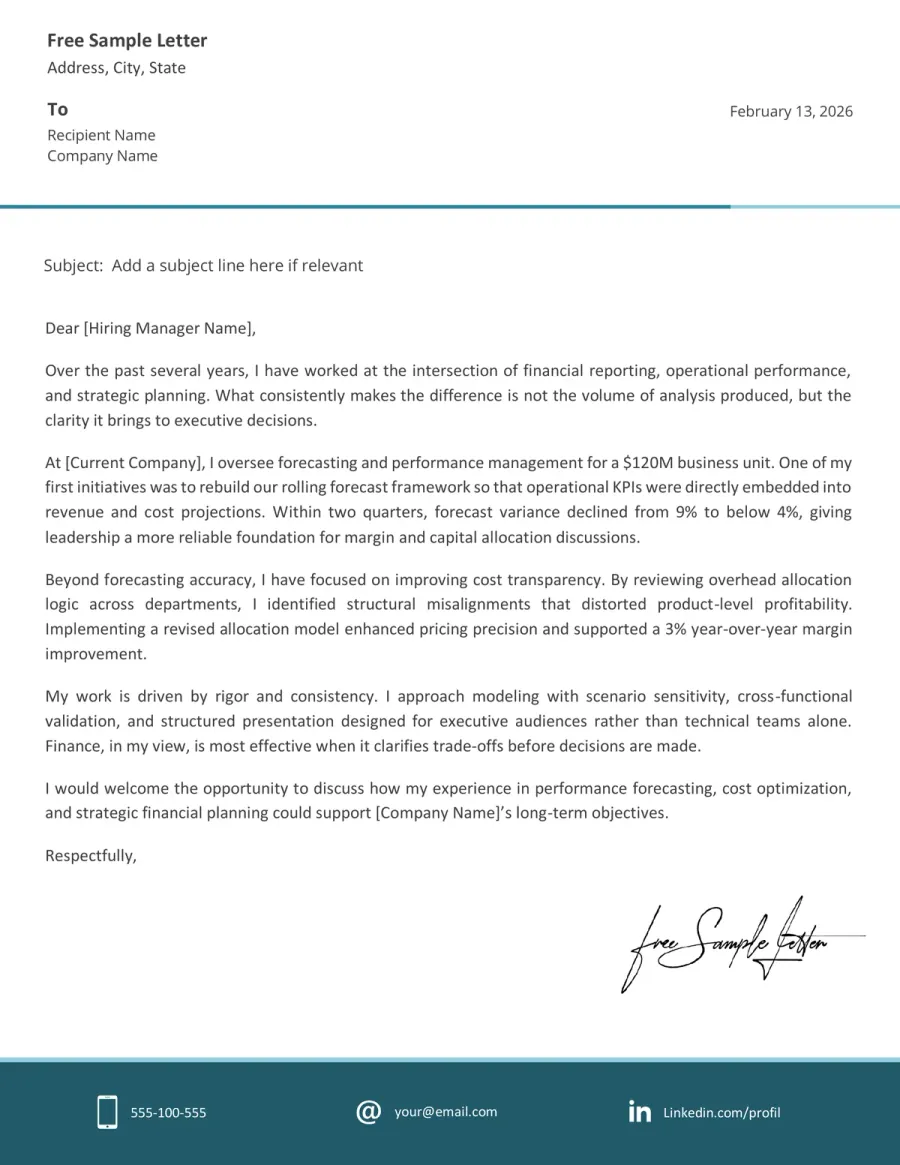
Make It Yours: Turn This Sample Into Your Own Strategy
Copying a template word for word makes your letter look generic. Recruiters can tell immediately. Instead, use the structure as a guide and add your own metrics, tools, and business experience to make it relevant.
➡️ More expert guidance in our article How to Write a Cover Letter That Gets Interviews
Define Your Financial Angle
Start by identifying your most valuable financial contribution, such as forecasting accuracy, cost control, valuation insight, or reporting reliability. Your opening should reflect this specific strength.
See an example
“I reduced forecast variance from 9% to 4% by restructuring our rolling model assumptions.”
Replace Academic or Generic Claims with Evidence
Every claim in your cover letter should be linked to a specific action and result. If you mention modeling or budgeting, explain what improved or changed as a result of your contribution.
See what to include
“I consolidated departmental forecasts and improved variance tracking clarity for month-end reporting.”
Align with the Company’s Financial Reality
Research the company’s industry, size, and financial challenges. Corporate finance teams, startups, and investment firms each expect different types of analysis and problem-solving.
See how to adapt it
“I am particularly interested in supporting cost structure optimization and margin analysis in capital-intensive environments.”
Show Your Process, Not Just Results
Recruiters value rigor. Briefly describe how you validate forecasts, test assumptions, or ensure reporting accuracy in your process.
See a process example
“I validate projections through sensitivity analysis and reconcile outputs with historical performance trends before submission.”
Rewrite the Closing Strategically
Avoid generic endings. Your closing should point to a next step and reference how you can help support the company’s financial objectives.
See what works
“I would welcome the opportunity to discuss how I can support your capital planning and performance forecasting initiatives.”
What Finance Recruiters Scan in 6 Seconds
- Forecast variance reduction
- Excel
- Budget consolidation
- Financial modeling discipline
- Scenario analysis under revenue stress cases
- Capital allocation awareness
- KPI integration into rolling forecasts
- Power BI dashboards
- EBITDA impact
- Cost driver mapping across departments
- Variance analysis
- Sensitivity testing
Do & Don't - What Makes a Financial Analyst Letter Credible or Instantly Rejected
Finance recruiters review cover letters differently than other hiring managers. They look for precision, structure, and evidence. Vague enthusiasm suggests risk, while clear metrics demonstrate reliability.
Red Flags - What Makes Your Letter Look Generic
Red Flags- Listing responsibilities without any measurable impact
- Claiming analytical skills without referencing specific tools or models
- Using broad adjectives like “motivated” instead of citing financial outcomes
- Writing long blocks of text without numerical evidence
- Repeating your resume rather than interpreting your contribution
- Mentioning technical tools without business context
Trust Signals - What Builds Financial Credibility
Trust Signals- Quantifying improvements in forecasts or reductions in variance
- Referencing specific modeling methods (DCF, sensitivity analysis, rolling forecasts)
- Explaining how your analysis influenced a pricing or investment decision
- Showing understanding of cost drivers, margins, or capital allocation in your previous work
- Demonstrating your validation process (reconciliation, scenario testing)
- Writing in a clear, structured, and executive-ready tone
FAQ - Financial Analyst Cover Letter
What should I include in a Financial Analyst cover letter? Toggle answer
Include measurable financial outcomes, such as variance reduction or margin impact, specific tools like Excel or Power BI, and clear business reasoning that shows how your analysis influenced decisions. Avoid listing generic skills without context.
How long should my cover letter be? Toggle answer
Aim for 275–325 words. This is long enough to demonstrate your impact and process, but concise enough to respect recruiters’ scanning preferences.
Should I repeat my resume in the letter? Toggle answer
No. A cover letter should interpret your resume, explaining how your work created value, not just listing your job history.
How can a student or intern stand out with limited experience? Toggle answer
Use academic case projects that demonstrate concrete analytical results, the tools you used, and clear reasoning. Show how you validate assumptions and test scenarios.
What if the job description emphasizes forecasting or modeling? Toggle answer
Use the same terminology as the job description. If forecasting experience is emphasized, reference forecast variance, rolling models, scenario testing, or other similar language used in the posting.
TL;DR - Your Financial Analyst Cover Letter Plan for the Next 5 Minutes
A Financial Analyst cover letter is effective when it quickly proves one thing: your analysis leads to business decisions. Choose one measurable outcome, such as forecast variance, margin impact, or cost clarity, name the tool and method behind it, such as modeling, scenario testing, or KPI linkage, and connect it to the employer’s reality using clear finance language. The biggest mistake is sounding “capable” without providing evidence.
Take one of your achievements and rewrite it as a decision story: identify the business question, describe what you built or evaluated, and explain what changed after your analysis. Then, revise your opening so it leads with impact rather than intent, and close by suggesting a specific discussion around forecasting, performance tracking, or cost drivers at [Company Name].