
Payment Plan Request Letter Examples for Suppliers and Creditors
A payment plan request should maintain a positive supplier relationship while being transparent about cash flow. These examples show how to propose specific terms, payment dates and a clear next step.
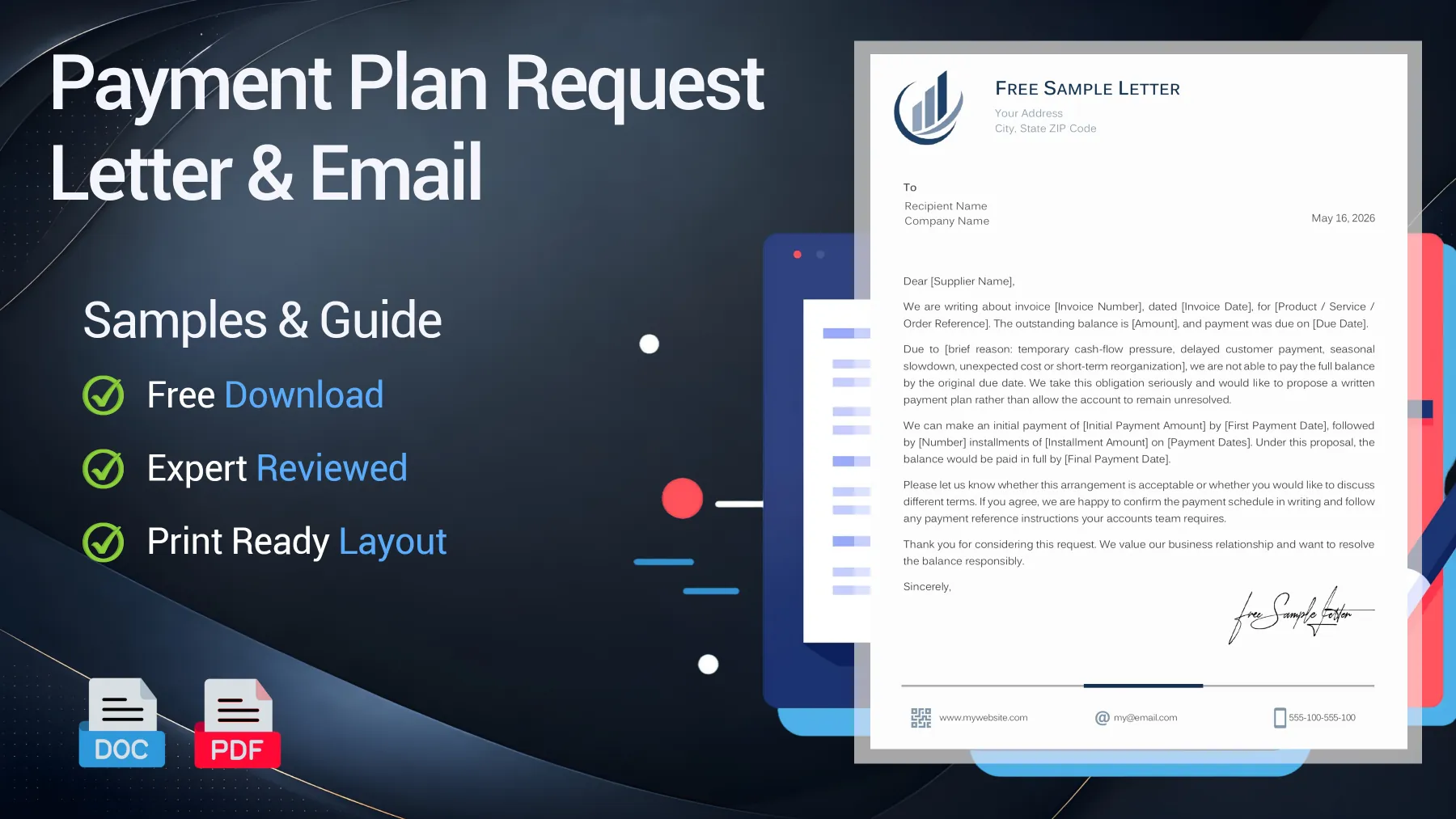
Before You Send a Payment Plan Request Letter
A payment plan request is a negotiation, not an automatic right to delay payment. Before sending your request, review the invoice amount, due date, current payment terms, supplier contract, any prior payment commitments, your cash-flow forecast and the precise installment schedule you can realistically follow.
Be specific. Suppliers are more likely to consider your request if you clearly explain the reason for the delay, the amount you can pay now, when the remaining balance will be paid and how the arrangement will be confirmed. Avoid vague phrases such as “as soon as possible” when you can propose actual dates.
If your business needs new financing rather than a supplier arrangement, a business bank loan request may be more appropriate. If the money is private and the agreement must be recorded between two parties, use an IOU template or promissory note instead of a supplier payment plan letter.
Payment Plan Request Letter to a Supplier
Use this payment plan request letter to a supplier when your business needs more time to pay an invoice while preserving the business relationship.
Dear [Supplier Name],
We are writing about invoice [Invoice Number], dated [Invoice Date], for [Product / Service / Order Reference]. The outstanding balance is [Amount], and payment was due on [Due Date].
Due to [brief reason: temporary cash-flow pressure, delayed customer payment, seasonal slowdown, unexpected cost or short-term reorganization], we are unable to pay the full balance by the original due date. We take this obligation seriously and would like to propose a written payment plan to resolve the account responsibly.
We can make an initial payment of [Initial Payment Amount] by [First Payment Date], followed by [Number] installments of [Installment Amount] on [Payment Dates]. Under this proposal, the balance would be paid in full by [Final Payment Date].
Please let us know whether this arrangement is acceptable or whether you would prefer to discuss alternative terms. If you agree, we are happy to confirm the payment schedule in writing and follow any payment reference instructions your accounts team requires.
Thank you for considering our request. We value our business relationship and are committed to resolving the balance responsibly.
Sincerely,
[Your Name]
[Your Position] [Company Name]

Reviewed by Michael T., Business Communications Consultant
This version is credible because it goes beyond simply asking for patience. It identifies the invoice, explains the reason for the delay and proposes a repayment schedule with clear dates.
Request to Renegotiate Payment Terms With a Creditor
Use this payment terms renegotiation letter when a creditor or service provider needs a formal proposal for reduced or extended payments.
Dear [Creditor Name],
I am writing on behalf of [Company Name] to request a temporary adjustment to the payment terms for account [Account Number / Contract Number].
The current balance due is [Amount], with payment scheduled under the existing terms of [Current Terms]. Due to [brief reason: reduced cash flow, delayed receivables, unexpected operating cost or short-term financial pressure], we would like to discuss an alternative payment arrangement.
Our proposal is to pay [Proposed Amount] every [week / month] beginning on [Start Date] and continuing until [Final Payment Date]. We believe this schedule would allow us to keep the account active while making consistent progress toward the full balance.
We understand that any change to the current terms must be reviewed and approved by your team. We are prepared to provide [cash-flow summary / payment forecast / recent statement / supporting document] if that would help you assess the proposal.
Please let us know whether you would be willing to review this arrangement or would prefer to schedule a call to discuss a workable solution.
Sincerely,
[Your Name]
[Your Position] [Company Name] [Contact Details]
Reviewed by Michael T., Business Communications Consultant
This model is effective because it treats the creditor as a business partner in the negotiation, not as someone expected to accept vague promises.
Short Email Asking for More Time to Pay an Invoice
Use this concise email asking for more time to pay an invoice when you need a quick conversation with the supplier before the account becomes overdue.
Subject: Request to discuss payment terms for invoice [Invoice Number]
Hello [Supplier Name],
I am contacting you regarding invoice [Invoice Number] for [Amount], currently due on [Due Date]. We are experiencing a short-term cash-flow delay and would like to discuss a revised payment schedule.
We can pay [Initial Amount] by [Date], then clear the remaining balance in [Number] payments of [Amount] on [Payment Dates].
Please let me know if this proposal can be reviewed by your accounts team, or if you would prefer to schedule a short call.
Thank you for considering this request.
Best regards,
[Your Name]
[Company Name]
Reviewed by Michael T., Business Communications Consultant
This email is useful before the situation becomes tense. It is short, honest, and specific enough for the supplier to respond quickly.
Follow-Up Email After Sending a Payment Plan Proposal
Use this practical payment plan follow-up email when you have already proposed installments and need written confirmation from the supplier.
Subject: Follow-up on proposed payment plan for invoice [Invoice Number]
Hello [Supplier Name],
I am following up on my message dated [Previous Message Date] regarding a proposed payment plan for invoice [Invoice Number].
As mentioned, the outstanding balance is [Amount]. We proposed paying [Initial Payment Amount] by [First Payment Date], followed by [Number] installments of [Installment Amount] on [Payment Dates], with the full balance paid by [Final Payment Date].
Could you please confirm whether this proposal has been reviewed and whether it can be accepted, adjusted, or discussed with your accounts team?
We would like to keep the account in good standing and avoid further delay, so a response by [Response Date] would be appreciated.
Thank you,
[Your Name]
[Company Name]
Reviewed by Michael T., Business Communications Consultant
This follow-up keeps the negotiation organized. It restates the proposed dates and asks for approval, an adjustment, or a conversation.
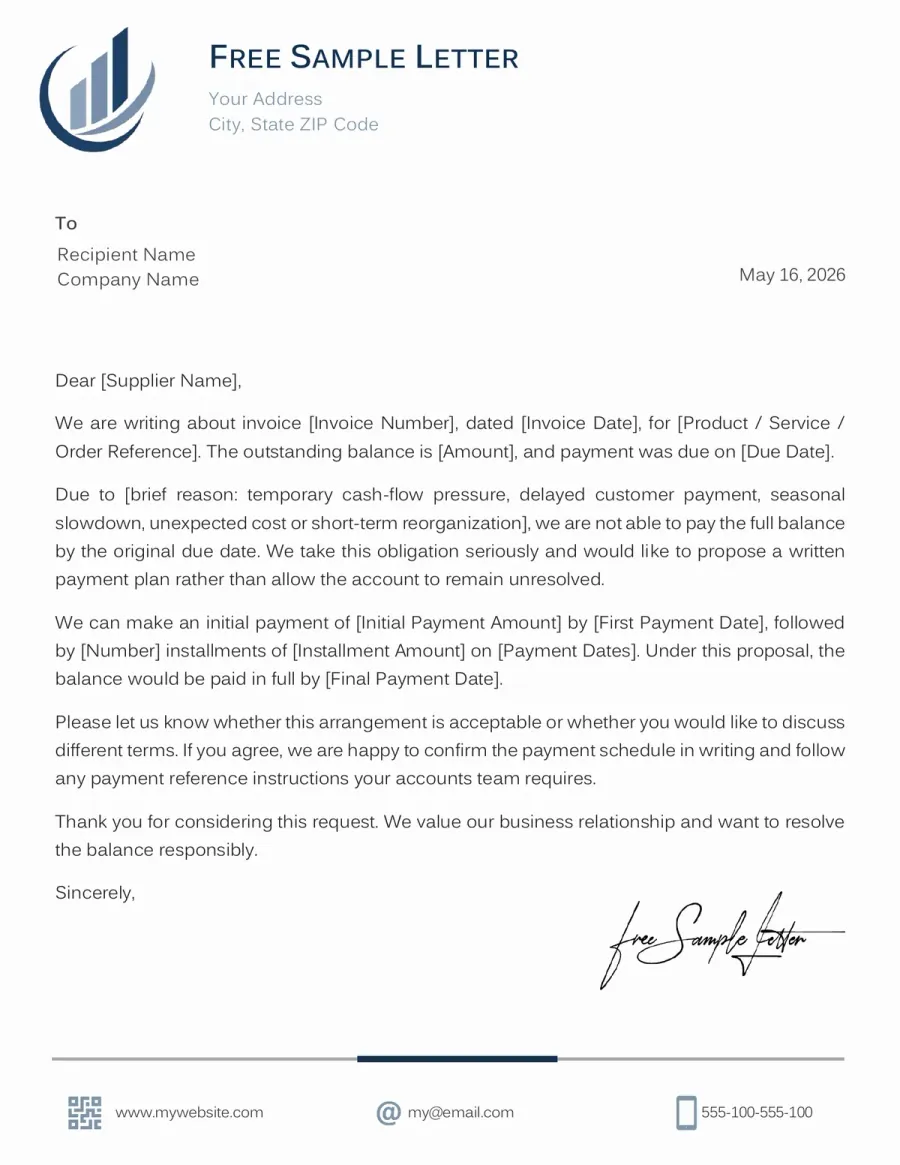
Preview of the Free Payment Plan Request Letter Template
Use the preview to check the structure before downloading the editable version. The template keeps the invoice reference, amount owed, reason for delay and proposed payment schedule easy to scan.
How to Write a Payment Plan Request Letter
A strong payment plan request letter should sound honest, well-prepared and realistic. Instead of simply stating that payment is difficult, explain the invoice details, the reason for the delay, the amount you can pay now and the specific payment schedule you are proposing.
➡️ More practical help in our guide how to write a professional letter that supports a business request
Start with the invoice and balance
State the relevant invoice, account, contract or order involved in your request. If you are a creditor seeking payment from a client, use a late invoice follow-up letter instead.
See a precise opening
We are writing about invoice [Invoice Number], dated [Invoice Date], with an outstanding balance of [Amount].
Explain the reason without over-sharing
Provide a brief business reason for your request, such as delayed receivables or temporary cash-flow pressure. Do not share confidential financial information that is unnecessary for the supplier to understand the situation.
See a balanced explanation
Due to a temporary cash-flow delay caused by [brief reason], we are requesting a short payment arrangement for this invoice.
Propose a payment schedule with dates
A supplier cannot evaluate a vague promise. Specify the initial payment, each installment amount, payment frequency and final payment date.
See a clear schedule
We can pay [Initial Amount] by [Date], followed by [Number] payments of [Amount] on [Payment Dates].
Separate the payment plan from other disputes
If the invoice amount is incorrect, resolve that issue with the supplier before proposing a payment plan. In that case, use an invoice billing error correction letter first.
See Why this helps
A payment plan assumes the balance is accepted. A billing correction letter asks the supplier to revise the invoice before payment is scheduled.
Ask for written agreement
End your letter by asking the supplier to confirm the arrangement in writing. Written confirmation protects both parties and reduces confusion about dates, amounts and account status.
See a clean closing
If you agree to this schedule, please confirm the arrangement in writing so we can update our payment file.
What to Include in a Payment Plan Request
- Supplier Name
- Invoice Number
- Outstanding Balance
- Original Due Date
- Reason for Delay
- Initial Payment Amount
- Installment Amount
- Payment Dates
- Final Payment Date
- Payment Method
- Written Confirmation Request
- Contact Person
Do & Don’t - Payment Plan Request Letter
A payment plan request is easier for a supplier to accept when it is organized, honest and financially realistic. Suppliers need clear dates and amounts, not general reassurance.
What Weakens the Request
Red Flags- Ask for more time without proposing a schedule
- Promise a payment date you are unlikely to keep
- Hide the invoice number or amount due
- Blame the supplier for your cash-flow problem
- Mix a billing dispute with a payment plan request
- Assume the supplier must accept your proposal
What Makes the Request More Credible
Trust Signals- State the invoice and balance clearly
- Give a short, factual reason for the delay
- Offer an initial payment when possible
- List installment dates and amounts
- Ask for written confirmation of the plan
- Keep the tone respectful and accountable
FAQ - Payment Plan Request Letter
What is a payment plan request letter? Toggle answer
A payment plan request letter asks a supplier, creditor, or service provider to accept payment in installments rather than requiring the full balance immediately. It should include the invoice details, amount due, reason for the delay, proposed payment schedule, and a request for written confirmation of the agreement.
Should I explain why my business cannot pay on time? Toggle answer
Yes, but keep your explanation brief and factual. State a practical business reason, such as temporary cash-flow pressure or delayed receivables, without revealing unnecessary confidential details. The supplier primarily needs to know whether your proposed payment schedule is realistic.
What should the payment plan include? Toggle answer
Include the initial payment, installment amounts, payment frequency, due dates, final payment date, and payment method. If the supplier agrees, request written confirmation so both parties have an accurate record.
Can a supplier refuse a payment plan? Toggle answer
Yes. Unless the contract or local rules say otherwise, a supplier may refuse different payment terms. Present the request as a proposal, not a demand, and be prepared to discuss an alternative arrangement.
Should I offer a partial payment first? Toggle answer
If possible, yes. Offering a partial payment shows good faith and may make the proposal easier for the supplier to accept. However, only offer an amount you can realistically pay to avoid another missed commitment.
What if the invoice amount is wrong? Toggle answer
Do not negotiate a payment plan for an amount you dispute. First, request a corrected invoice, credit note, or written explanation from the supplier. Once the correct balance is confirmed, you can propose installments if you still need a payment plan.
TL;DR - Make the Payment Plan Realistic and Written
A strong payment plan request letter does more than ask for patience. It identifies the invoice, amount due, reason for the delay, proposed installment dates and final payment date.
Before sending your letter, make sure the proposed schedule is realistic and one you can keep. Offer a partial payment when possible, request written confirmation and use an accountable tone. Suppliers are more likely to consider a plan that protects the relationship and provides a clear path to full payment.