
Bad Check Notice Letter Examples for Returned Checks
A returned check affects payment records and trust. These examples help you identify the check, amount, bank return reason and next step without sounding careless or escalating too soon.
Before You Send a Bad Check Notice Letter
A returned check notice is a payment record, not just a reminder. Before sending it, confirm the check number, date, bank return reason, invoice or account reference, amount due and any returned check fee allowed by your agreement or local rules.
Do not automatically assume fraud. In some places, bad-check rules depend on the payer’s knowledge, intent, notice, payment deadline, transaction type and whether the check was returned for insufficient funds, a closed account, a stop payment or another reason. For example, the California Attorney General explains that writing a bad check is a crime only when the check writer knew there were insufficient funds and intended to defraud (California Department of Justice).
If the payment problem is not a returned check but an unpaid client invoice, a separate professional overdue invoice reminder may be a better fit. Before using statutory demand wording, a fixed legal deadline, collection fees, certified mail, criminal referral wording, small claims language or a debt collection process, check the rules in your country, state, province, contract or business policy.
First Bad Check Notice Letter to a Customer
A straightforward first bad check notice for a customer or client when the payment may have failed because of an oversight, bank error or insufficient funds.
Dear [Customer Name],
We are writing regarding the check payment we received from you on [Payment Date]. The check was returned unpaid by [Bank Name], with the return reason listed as [Reason: insufficient funds / account closed / stop payment / other reason].
The returned check details are as follows:
Check number: [Check Number] Check date: [Check Date] Amount: [Amount] Invoice or account reference: [Invoice Number / Account Number]
Please arrange payment of the outstanding amount by [Response Date]. At this stage, we consider this a payment issue that can be resolved quickly. You may pay by [accepted payment methods: bank transfer, certified check, cashier’s check, money order, card payment, or online payment link].
If you believe the check was returned in error, please contact [Contact Name / Department] at [Phone Number / Email Address] so we can review the matter with you.
Thank you for your prompt attention to this payment.
Sincerely,
[Your Name]
[Your Position] [Company Name]

Reviewed by Michael T., Business Communications Consultant
This first notice works because it does not assume bad intent. It provides the check details, identifies the payment issue and asks for correction before escalating the tone.
Formal Demand Letter for a Returned NSF Check
Use this formal returned check demand letter when the payment is overdue, the amount is clear and a stronger written record is needed.
Dear [Customer Name],
This letter is a formal request for payment of a returned check received by [Company Name].
Our records show that check number [Check Number], dated [Check Date], in the amount of [Amount], was returned unpaid by [Bank Name] on [Return Date]. The reason provided was [Reason: non-sufficient funds / account closed / stop payment / other reason].
The returned payment relates to [Invoice Number / Account Number / Product or Service], originally due on [Due Date]. As of today, the balance due is [Amount], plus any returned check fee or bank charge that applies under our agreement or local rules.
Please make payment by [Response Date] using one of the following accepted methods: [Payment Method 1], [Payment Method 2], or [Payment Method 3]. For security and record-keeping reasons, we cannot accept another personal check for this balance unless agreed in writing.
If payment has already been made, please send proof of payment to [Email Address] so we can update the account. If you need to discuss the payment, contact [Contact Name] before the deadline above.
We would prefer to resolve this directly and avoid further action. Please treat this letter as a formal request to correct the returned payment.
Sincerely,
[Your Name]
[Your Position] [Company Name]
Reviewed by Michael T., Business Communications Consultant
This version is firm but measured. It creates a useful record by clearly stating the check, invoice, bank reason, payment method and deadline.
Bad Check Email to a Long-Term Client
A more relationship-aware bad check email to a client when you want to correct the payment quickly without making the message sound hostile.
Subject: Returned check for invoice [Invoice Number]
Hello [Client Name],
I’m writing to let you know that the check we received for invoice [Invoice Number] was returned unpaid by [Bank Name]. The returned check was number [Check Number], dated [Check Date], in the amount of [Amount].
This may simply be a banking issue, so I wanted to let you know before it creates a larger account problem. Could you please arrange replacement payment by [Response Date] using [accepted payment method]?
If your bank has already corrected the issue or if payment has been resent, please send the payment confirmation to [Email Address], and I’ll update our records.
Thank you for taking care of this.
Best regards,
[Your Name]
[Company Name]
Reviewed by Michael T., Business Communications Consultant
This email is useful when the business relationship matters. It stays brief, avoids accusation and gives the client everything needed to resolve the payment.
Final Notice Before Escalating a Returned Check
A controlled final bad check notice for situations where earlier reminders have not resolved the returned payment and a firmer deadline is needed.
Dear [Customer Name],
We are following up regarding the returned check associated with [Invoice Number / Account Number].
Check number [Check Number], dated [Check Date], in the amount of [Amount], was returned unpaid by [Bank Name] on [Return Date] for [Reason]. We previously contacted you about this payment on [Previous Contact Date], but our records do not show that the balance has been corrected.
Please pay the outstanding amount of [Amount] by [Final Response Date]. If a returned check fee, bank charge or administrative charge applies under our agreement or local rules, the total balance due is [Total Amount].
Payment must be made by [Accepted Payment Methods]. Please include [Invoice Number / Account Number] with the payment so it can be applied correctly.
If we do not receive payment or written proof of payment by [Final Response Date], we may review the account for the next step available under our contract, business policy and applicable rules. This may include placing the account on hold, using a collection process or seeking advice on further recovery options.
If you believe our records are incorrect, contact [Contact Name] immediately at [Phone Number / Email Address].
Sincerely,
[Your Name]
[Your Position] [Company Name]
Reviewed by Michael T., Business Communications Consultant
This notice is firmer but avoids unsupported legal threats. It provides one final opportunity to pay, correct the record or discuss the issue before escalation.
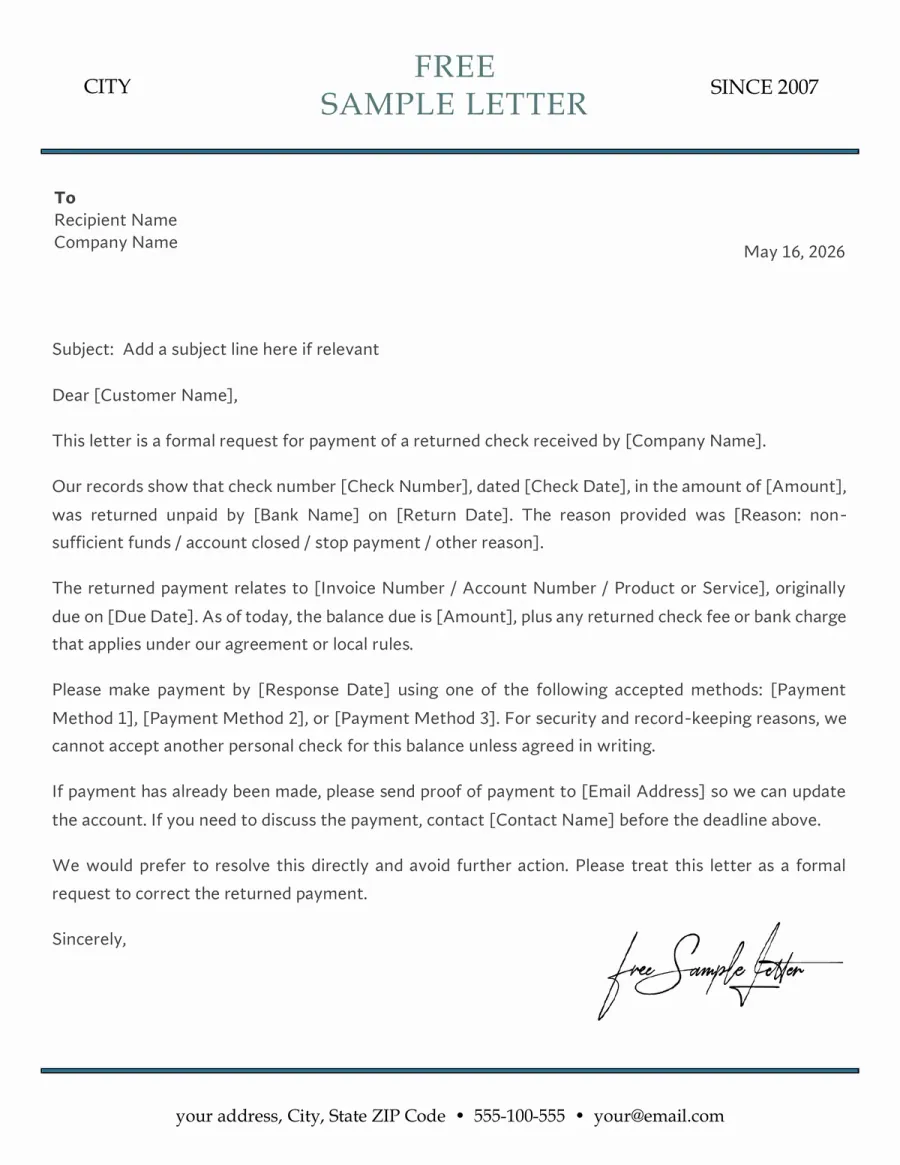
Preview of the Free Bad Check Notice Letter Template
Use the preview to review the structure before downloading the editable version. The template keeps the check details, invoice reference, amount due and payment deadline easy to verify.
How to Write a Bad Check Notice Letter
A strong bad check notice letter should be factual before it becomes firm. Begin with the returned check details, connect the payment to the invoice or account and then request replacement payment by a clear date.
Avoid accusations unless you have reviewed the facts and the rules that apply. A returned check may result from insufficient funds, a closed account, a stop payment, bank processing issues or a genuine dispute.
➡️ For broader writing structure, see our guide on how to write a business letter that makes the next step clear.
Verify the returned check details first
Before writing, confirm the check number, date, amount, bank name, account or invoice reference, return date and return reason.
See what to verify
Check number [Check Number], dated [Check Date], in the amount of [Amount], was returned by [Bank Name] on [Return Date].
Separate the payment issue from the order record
If the returned check relates to a purchase, order or delivery, keep the payment notice focused on the failed payment. The order record should remain separate, especially if you also need a business order acknowledgement sample for the transaction.
See Why this helps
The bad check notice should ask for replacement payment. The order acknowledgement should confirm what was ordered, accepted, shipped, billed or scheduled.
Choose the right tone for the stage
A first notice can assume the issue was an oversight. A formal demand can be firmer. A final notice should stay controlled and avoid legal wording unless you have checked the applicable rules.
See the difference
First notice: Please arrange replacement payment. Final notice: If payment is not received by [Date], we may review the account for the next step available.
State the amount and accepted payment methods
Make it easy for the recipient to complete the replacement payment. If you no longer accept personal checks for this balance, clearly state which payment methods are accepted instead.
See a useful line
You may pay by bank transfer, certified check, cashier’s check, money order, card payment, or online payment link.
Be careful with fees and deadlines
Only include returned check fees, bank charges, collection costs or statutory deadlines when your agreement, policy or local rules support them.
See safer wording
The balance due is [Amount], plus any returned check fee or bank charge that applies under our agreement or local rules.
Keep a copy of the notice and proof
For sensitive payment issues, keep copies of the returned check notice, invoice, bank return information, previous reminders, proof of delivery and any replies.
See Why it matters
If the issue later moves to collection, account hold, small claims, or legal review, the written record matters more than the tone of the letter.
What to Include in a Bad Check Notice
- Check Number
- Check Date
- Returned Amount
- Bank Name
- Return Reason
- Invoice or Account Reference
- Payment Deadline
- Accepted Payment Methods
- Returned Check Fee If Allowed
- Contact Person
- Proof of Payment Request
- Escalation Wording Only When Justified
Do & Don’t - Bad Check Notice Letter
A bad check notice needs enough detail for the recipient to take action. The common mistakes are sounding too casual, so the payer ignores it, or sounding too legal before you have checked the facts.
What Weakens the Notice
Red Flags- Accuse the payer of fraud in a first notice
- Mention legal action before checking local rules
- Leave out the check number, amount, date or invoice reference
- Ask for payment without naming accepted payment methods
- Add returned check fees that your policy or local rules do not support
- Accept another personal check without considering the payment risk
What Makes the Notice Stronger
Trust Signals- State the returned check details clearly
- Connect the check to the invoice, account or purchase
- Ask for replacement payment by a specific date
- Keep the first notice firm but not accusatory
- Use a stronger final notice only after previous contact
- Keep copies of the bank notice, invoice, letter and replies
FAQ - Bad Check Notice Letter
What is a bad check notice letter? Toggle answer
A bad check notice letter informs the payer that a check was returned unpaid and requests replacement payment. It usually includes the check number, amount, date, bank return reason, invoice or account reference, accepted payment methods and response deadline.
Should I call it a bad check, bounced check or NSF check? Toggle answer
Use the wording that matches the bank’s return reason. “NSF check” means non-sufficient funds. “Returned check” or “bounced check” can refer to several reasons, including a closed account, stop payment or processing issues.
Can I charge a returned check fee? Toggle answer
Only include a returned check fee if your agreement, posted policy, invoice terms or local rules allow it. Fees and notice requirements vary, so do not add a charge automatically without confirming the basis for it.
Should the first notice threaten legal action? Toggle answer
Usually not. A first notice should identify the check and request replacement payment. Legal or collection language should appear only in a later notice when the facts, contract, policy and local rules support that step.
What payment methods should I request after a bad check? Toggle answer
Many businesses request a bank transfer, certified check, cashier’s check, money order, card payment or another verified method. If the first check failed, it is reasonable not to accept another personal check for the same balance.
Is a bad check always fraud? Toggle answer
No. A check may be returned for insufficient funds, a closed account, a stop payment, bank error or a dispute. Fraud depends on the facts and local law, so keep the letter factual unless you have professional advice.
TL;DR - Keep the Bad Check Notice Firm and Verifiable
A strong bad check notice letter should clearly identify the check, amount, invoice or account, bank return reason and replacement payment deadline. Make it easy for the payer to correct the issue, and avoid accusations or escalation unless the facts and local rules support it.
The main risk is unnecessary escalation. A returned check can become a collection, contract or legal issue, but the first useful step is creating a clear written record. Keep copies of the bank notice, invoice, message history and payment response. Use firmer wording only when supported by the facts, your agreement and local rules.