
Claims Representative Cover Letter Examples Recruiters Respect in 2026
Hiring teams look for sound judgment, policy awareness, and professionalism when dealing with clients. This page shows how to address those expectations in a cover letter that feels grounded and credible.
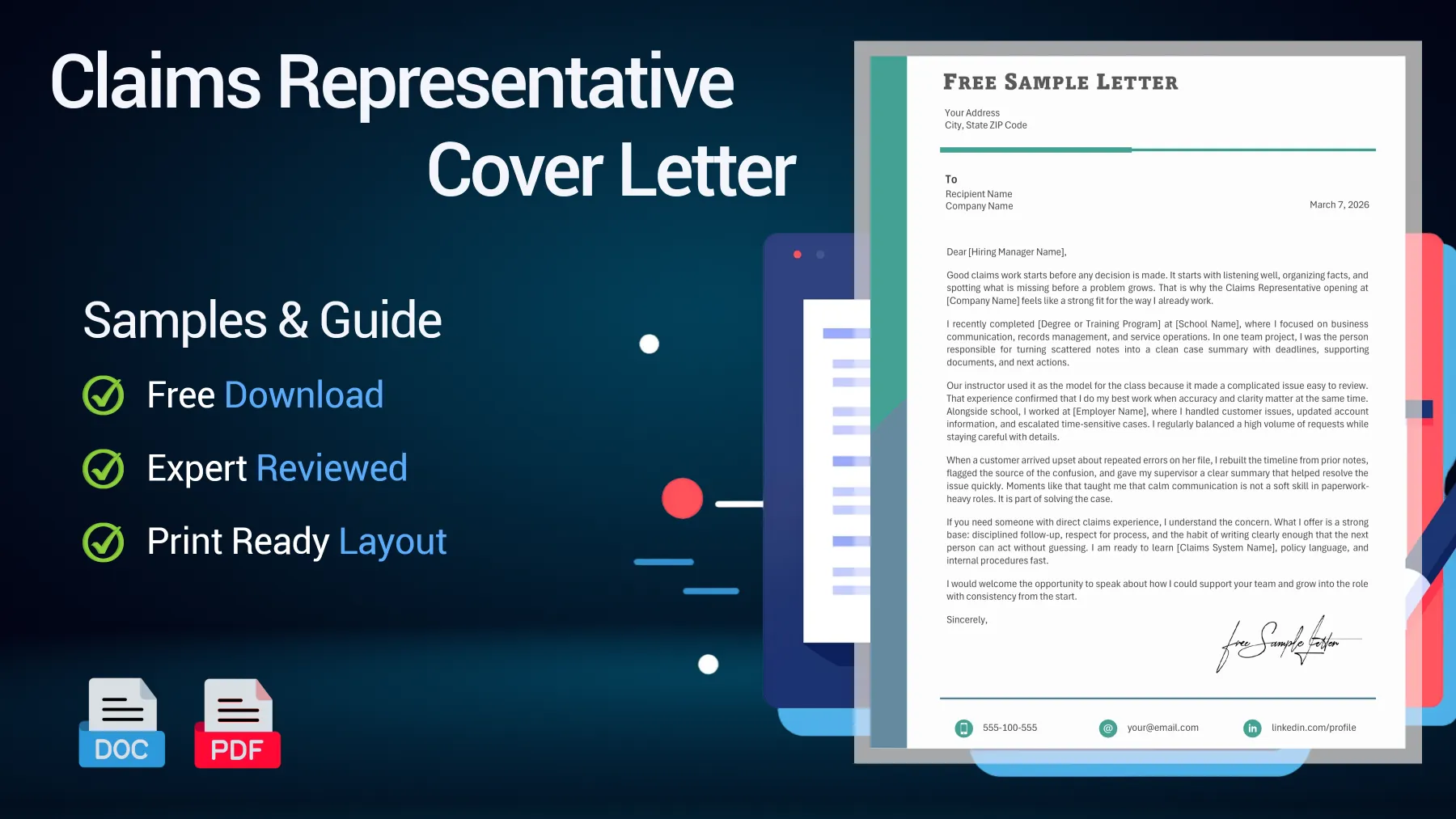
Free Claims Representative Cover Letter Samples for Your Application
According to the BLS, adaptability, problem-solving, and strong writing are top skills for claims adjusters and examiners from 2024 to 2034. In practical terms, your cover letter should demonstrate calm judgment, clear writing, and disciplined case management.
Junior Claims Representative Cover Letter
This junior claims representative cover letter works for a recent graduate who needs to sell structure, writing clarity, and follow-up discipline instead of direct claims history.
Dear [Hiring Manager Name],
Effective claims work begins long before any decision is made. It requires careful listening, organizing facts, and identifying what is missing before problems escalate. That’s why the Claims Representative opening at [Company Name] aligns well with how I approach my work.
I recently completed [Degree or Training Program] at [School Name], focusing on business communication, records management, and service operations. In a team project, I took the lead in turning scattered notes into a clear case summary, outlining deadlines, supporting documents, and next steps.
Our instructor chose my summary as the model for the class because it made a complicated issue easy to review. That experience confirmed that I do my best work when both accuracy and clarity are required.
While in school, I worked at [Employer Name], handling customer issues, updating account information, and escalating time-sensitive cases. I consistently managed a high volume of requests while maintaining attention to detail.
When a customer was frustrated by repeated errors on her file, I rebuilt the timeline from previous notes, identified the source of confusion, and provided my supervisor with a clear summary that helped resolve the issue quickly. Experiences like this taught me that calm communication is essential in paperwork-heavy roles. It’s a key part of solving the case.
If direct claims experience is your priority, I understand. What I offer is a strong foundation: disciplined follow-up, respect for process, and clear written communication so the next person can act without uncertainty. I am eager to learn [Claims System Name], policy language, and your internal procedures quickly.
I would welcome the opportunity to discuss how I can support your team and grow into the role with consistency from the beginning.
Sincerely,
[Your Name]

Reviewed by Nina P., Senior Editor
I trust this sample because it answers the experience gap directly and replaces weak adjectives with real proof of structure, judgment, and follow-up.
Senior Claims Representative Cover Letter
Use this sample when you already manage claims at pace and need a stronger application letter. It proves judgment with numbers, service impact, and decision-ready documentation.
Dear [Hiring Manager Name],
Claims teams build credibility when files move forward with speed, accuracy, and sound judgment. That has been my standard for the past [number] years, and it is why I am interested in the Claims Representative role at [Company Name].
My background includes high-volume claim handling, effective claimant communication, documentation review, settlement coordination, and the daily discipline needed to maintain service levels.
At [Current Company Name], I manage a caseload of approximately [number] active claims across [line of business]. Over the last year, I reduced average cycle time by [number]% by tightening my intake review, requesting missing documentation earlier, and setting clearer expectations with claimants and providers. This resulted in not only faster closures but also lower reopen rates and fewer supervisor escalations related to unclear notes or inconsistent follow-up.
I’ve learned that strong claims work often happens in unscripted moments. A claimant might expect an immediate answer when the file isn’t ready for one. In those cases, I don’t rely on policy language alone. I explain what’s confirmed, what requires further review, and what actions I’ll take by a specific time. This approach has helped me maintain a customer satisfaction score above [number]% while upholding file quality and company standards.
The fastest way I can help [Company Name] is by bringing that blend of pace, composure, and decision-ready documentation from day one.
What attracts me to your opening is the expectation that claims representatives do more than process transactions. They manage trust, protect timelines, and make complex situations easier to understand without cutting corners.
I would appreciate the chance to discuss your team’s current priorities and how my experience can support stronger outcomes in both service and file performance.
Sincerely,
[Your Name]
Reviewed by Nina P., Senior Editor
I trust this letter because it sounds like someone who owns files, protects timelines, and understands that claimant communication affects outcomes.
Mid-Career Switch to Claims Representative Cover Letter
This career change claims representative cover letter works because it treats the transition seriously and links transferable case-handling habits to claims work with zero fluff.
Dear [Hiring Manager Name],
My best preparation for claims work didn’t happen in an insurance office. It came from [number] years in hotel operations, where upset guests expected quick answers, documentation had to be accurate, and every decision impacted cost, trust, and follow-through.
That experience is why I am pursuing the Claims Representative role at [Company Name] with genuine intent, not casual curiosity.
At [Former Employer Name], I managed escalated service issues, incident reports, refunds, and cross-department coordination in a fast-paced environment. When disputes involved conflicting accounts, I gathered facts, reviewed records, spoke with those involved, and produced a written summary that management could act on.
In one quarter, I helped reduce repeat complaints by [number]% by standardizing follow-up notes and ensuring each case had a clear owner and deadline. The setting was different from insurance, but the core discipline was the same: get the facts right, keep records usable, and communicate calmly when emotions run high.
To make this career change credible, I completed [Insurance Course or Certificate] and developed a working understanding of claim lifecycles, coverage language, and documentation standards. I know I’m not applying as a finished claims professional, but as someone who has spent years handling sensitive cases, making judgment calls, and maintaining process under pressure.
I protect the quality of my work by documenting timelines as I go, verifying the source behind each key fact, and confirming next steps in writing so nothing relies on memory alone. That habit has followed me across roles and is one reason I am confident I can transition successfully into claims.
I would welcome the opportunity to discuss how my background, training, and case-handling discipline could support your team and help me grow quickly in a claims environment.
Sincerely,
[Your Name]
Reviewed by Nina P., Senior Editor
I believe this career change because the letter does not hide the transition. It shows process discipline first, then explains why claims makes sense now.
Claims Representative Template Preview Before Downloading Word or PDF
Preview this claims representative cover letter template before downloading it as a Word or PDF file. This quick view lets you check the structure, tone, and layout before saving.
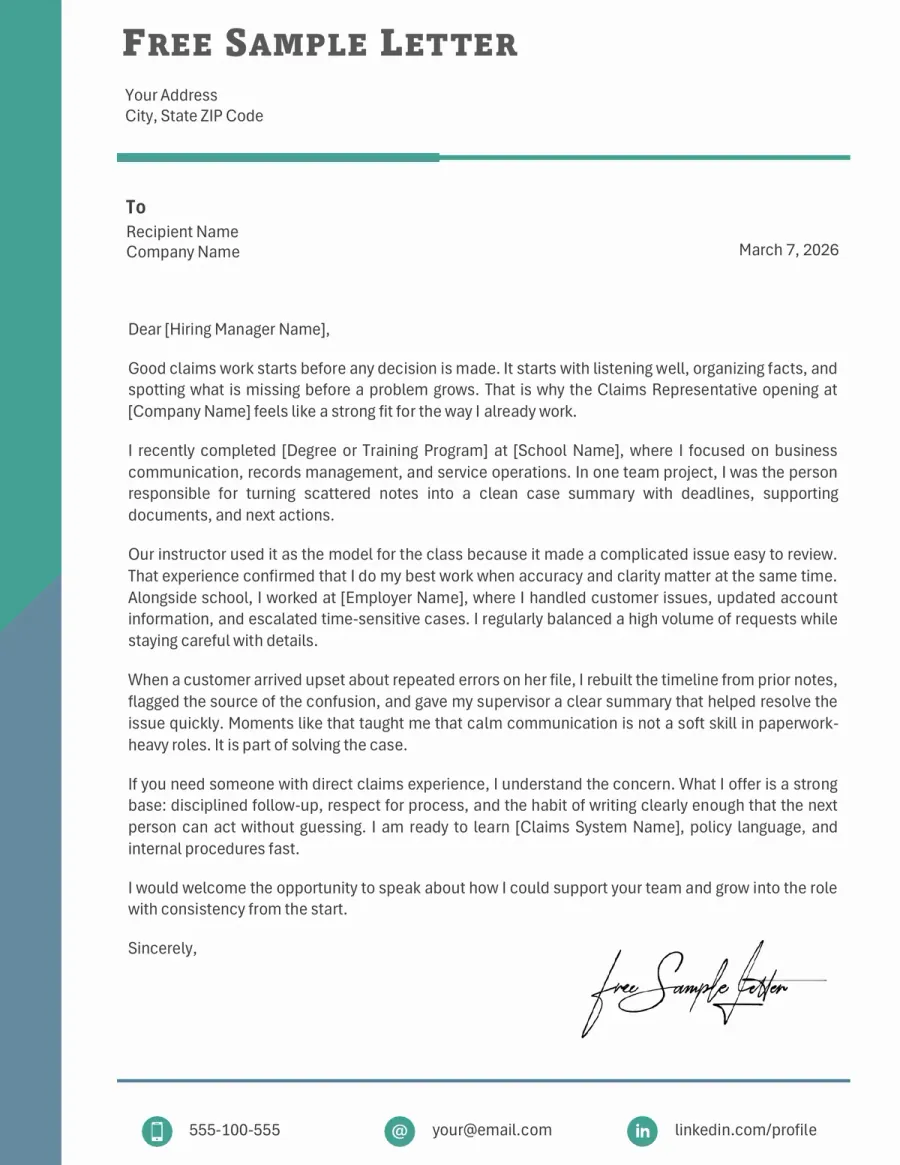
Turn These Samples Into Your Own Application Letter
Copied letters rarely succeed in claims roles because generic details stand out quickly. Adjust these samples to reflect your own caseload, claimant communication style, and your approach to documentation, timelines, and follow-up.
➡️ More expert guidance in our article how to tailor a cover letter to the real job you want
Match the claims reality
Start by tailoring your opening line to match the realities of the employer’s claims work. Reference the types of files, claimant interactions, or service standards the role will focus on.
See an example
Instead of saying you "handle customers well," write something like: In claim-facing roles, I keep conversations calm, confirm missing documents early, and leave clear notes for the next action.
Replace soft claims with process proof
Replace broad statements about being organized with a specific work habit. Recruiters trust concrete process details, such as diary follow-ups, document reviews, escalation timing, or summary notes after a call.
See Open the example
I review each file for missing dates, supporting records, and contact gaps before I move it forward, which keeps avoidable delays from building later.
Add one result that changed something
Include a result that demonstrates your judgment under pressure. In this role, a strong example might be a faster resolution, fewer repeat contacts, cleaner files, or clearer communication with claimants.
See the result
By requesting the missing repair estimate on day one and setting a callback time, I reduced repeat follow-ups and helped the file move without confusion.
Tune the tone to the desk
Match your tone to the type of claims desk you’re targeting. A high-volume intake role may require a quicker pace, while complex cases call for more measured, formal language.
See the contrast
For a fast-paced team, say: I keep claim notes clear and concise. For a technical desk, try: I document facts carefully so each file stands up to review.
Close with practical value
Close with a next step that fits the job. Claims recruiters respond better to a practical closing tied to file quality, customer communication, or team contribution than to a generic thank-you.
See a closing
I would welcome the chance to discuss how I could support accurate claim handling, clearer claimant updates, and steady follow-through across open files.
Keyword Radar for a Claims Representative Hiring Desk
- Claim notes
- Coverage basics
- Written summaries
- Escalation judgment
- Clear next-step communication
- Documentation follow-through
- Claimant empathy
- File ownership
- Policyholder communication
- Deadline control
Do & Don’t: The Signals That Make a Claims Letter Credible
Claims hiring moves quickly, but recruiters don’t scan letters at random. In just a few lines, they look for evidence that you can manage difficult claimants, protect file quality, and advance a case without relying on vague language.
What Makes Your Letter Look Generic
Red Flags- Describe the role like a generic customer service job
- Sound warm but say nothing about judgment
- Forget policyholders, claimants, or file documentation
What Makes Your Letter Look Credible
Trust Signals- Show how you keep notes usable for the next action
- Prove you can balance service tone with process discipline
- Close by linking your value to claim handling
FAQ - Claims Representative Cover Letter
Can I apply for a claims representative job if I only have customer service experience? Toggle answer
Yes, for many entry-level or trainee roles. Your letter should translate your customer service experience into skills like claimant communication, accurate documentation, disciplined follow-up, and staying calm when files become complicated.
Should I call myself a claims representative or a claims adjuster in the letter? Toggle answer
Use the exact job title from the job posting first. If the company uses both terms, mention the second one once. More important than the title is whether your letter aligns with the actual work.
Do I need an insurance license or certificate before I apply? Toggle answer
Not always. Some trainee roles hire first and provide training later. If you’re studying for a license or pursuing insurance coursework, mention it briefly. It shows commitment and signals you’ll learn quickly.
Should my letter sound empathetic, technical, or both? Toggle answer
Both, but not in equal measure. If your letter is only warm, it sounds like generic customer service. If it’s only technical, it can feel stiff. Claims hiring favors calm empathy supported by process discipline.
How do I make a career change into claims look credible? Toggle answer
Share a case-handling example from your previous field. Complaint resolution, incident reporting, timeline tracking, or fact-checking all apply. Recruiters want proof that your approach already fits claims logic, not just that you want to change fields.
TL;DR - What Makes a Claims Representative Cover Letter Work
A strong claims representative cover letter quickly demonstrates three things: you can handle tense claimant interactions, keep files moving with accurate follow-up, and make sound decisions even when information is incomplete. The biggest mistake is writing a generic customer service letter without real evidence of documentation, investigation, or claim-handling discipline.
Recruiters often read between the lines: would this person be reliable on a messy file? That’s why a concrete example, such as timeline control, following up on missing documents, or calmly resolving a case, matters more than broad statements about being organized or motivated.