
Aeronautical Engineer Cover Letter Examples for Real Aerospace Roles in 2026
Hiring managers look for engineers who can explain their decisions: balancing weight and strength, optimizing noise against efficiency, or managing schedule versus risk. These cover letter examples show how to communicate that reasoning clearly for aeronautical roles.
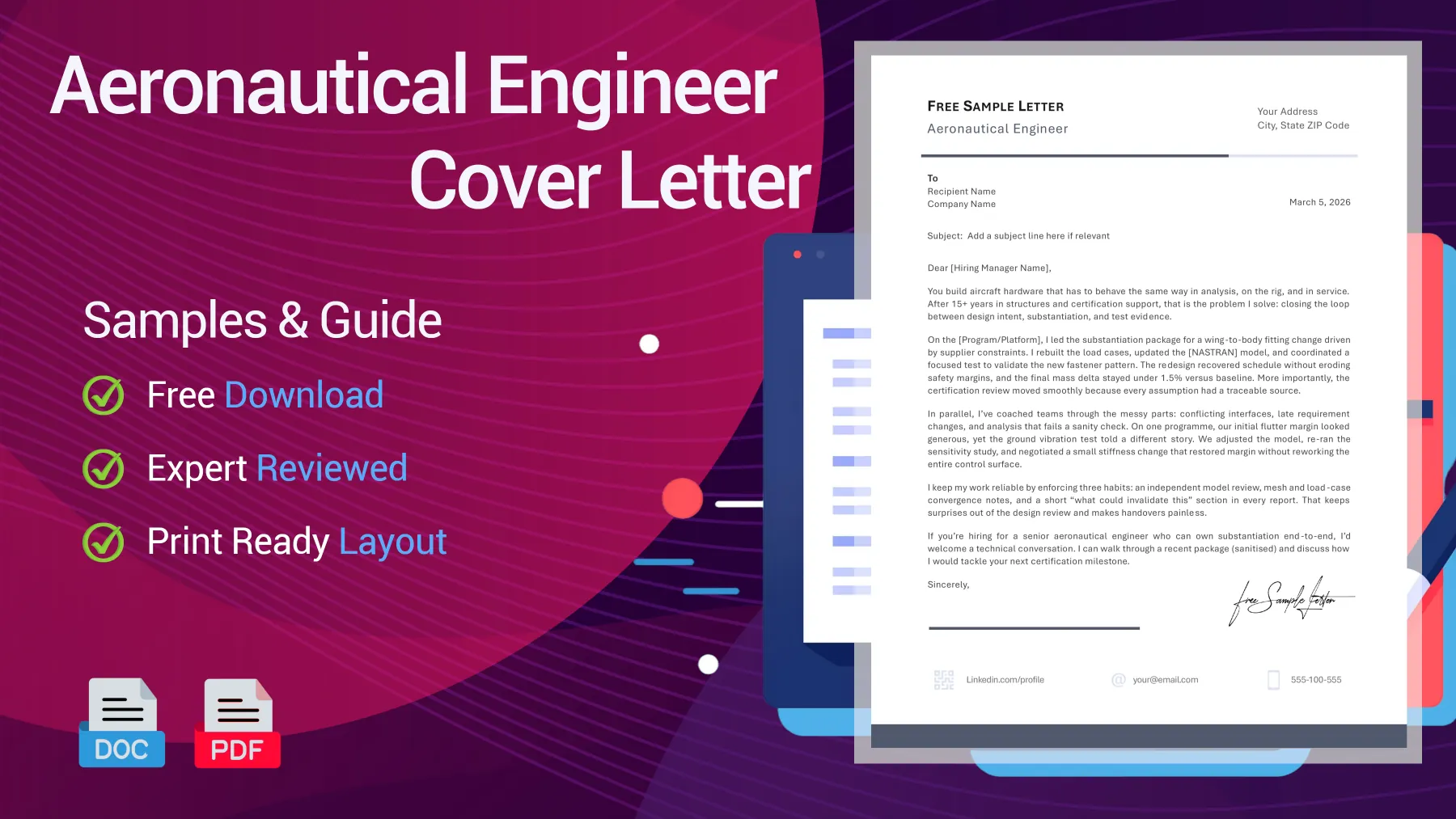
Free Aeronautical Engineer Application Letter Samples
BLS projects about 4,500 aerospace engineer openings per year (2024–2034), with a $134,830 median wage as of May 2024. Expert tip: focus your application letter on test results, safety trade-offs, and specific design tools - not just your interest in the field.
Entry-Level Aeronautical Engineer Cover Letter (Junior or New Graduate)
For a junior or recent graduate, this sample shows how to translate coursework, labs, and an internship into aeronautical engineering evidence: tools, assumptions, and measurable outcomes.
Dear [Hiring Manager Name],
Your job posting describes a real engineering challenge: you need someone who can translate requirements into accurate loads, reliable models, and documentation ready for testing. That’s the same approach I used in my final-year design work and during my [duration]-month aerostructures internship.
On my capstone, I owned the primary bracket design for a UAV payload bay. I built the load cases from the mission profile, ran FEA in [ANSYS/NASTRAN], and iterated the geometry with [CAD tool] until we met margin targets. The last revision cut mass by 12% while keeping a positive margin on the critical fastener row. I documented the assumptions, the boundary conditions, and the verification steps so another teammate could reproduce the result in one sitting.
During my internship at [Previous Company], I supported a test campaign for composite panels. I prepared strain-gauge layouts, cleaned sensor data in [MATLAB/Python], and wrote a short script that flagged drift and outliers before the daily review. It saved the team about 30 minutes per test day and avoided two reruns when a connector fault started creeping in.
To ensure quality, I always run the same checklist before sharing results: units, load path validation, mesh convergence, and a one-page note explaining what could invalidate the conclusion. If you need a junior aeronautical engineer you can rely on for signable analysis, I’m ready to start.
If you have 20 minutes, I’d be glad to walk you through a design loop and a test data cleanup, so you can see how I work under time constraints.
Sincerely,
[Your Name]

Reviewed by Olivia B., HR Consultant
I can see real engineering discipline here: the candidate explains assumptions, convergence, and why a result is trustworthy, not just what tools they used.
Senior Aeronautical Engineer Cover Letter
Built for experienced candidates: it highlights certification support, cross-team decisions, and how you keep analysis, rig testing, and documentation aligned under deadline.
Dear [Hiring Manager Name],
You build aircraft hardware that must perform consistently in analysis, on the rig, and in service. With over 15 years of experience in structures and certification support, my focus has been closing the loop between design intent, substantiation, and test results.
On [Program/Platform], I led the substantiation package for a wing-to-body fitting change prompted by supplier constraints. I rebuilt the load cases, updated the [NASTRAN] model, and coordinated a targeted test to validate the new fastener pattern. The redesign kept us on schedule without compromising safety margins, and the final mass change was under 1.5% from baseline. Most importantly, the certification review progressed smoothly because every assumption was traceable.
At the same time, I’ve guided teams through challenges like conflicting interfaces, late requirement changes, and analysis that doesn’t pass a sanity check. On one program, our initial flutter margin seemed sufficient, but the ground vibration test revealed otherwise. We adjusted the model, repeated the sensitivity study, and negotiated a minor stiffness change that restored the margin without reworking the entire control surface.
I maintain reliability through three habits: independent model reviews, mesh and load-case convergence notes, and a brief “what could invalidate this” section in every report. This approach prevents last-minute surprises and ensures smooth handovers.
If you need a senior aeronautical engineer who can manage substantiation from start to finish, I’d welcome a technical discussion. I can walk through a recent sanitized package and explain how I would approach your next certification milestone.
Sincerely,
[Your Name]
Reviewed by Olivia B., HR Consultant
The best part is the quality routine: independent review, convergence notes, and invalidation risks. That tells me the candidate prevents late surprises.
Aeronautical Engineering Internship Cover Letter
Built for a placement or summer intern: this letter translates coursework into usable evidence (mesh strategy, validation steps, data cleanup) and keeps a clean, professional tone.
Dear [Hiring Manager Name],
Your internship description is clear: you need someone who can handle the essential engineering work - setting up models accurately, documenting decisions, and delivering results that busy engineers can use. That’s the kind of work I’ve prepared for in my aeronautical engineering degree, and I’m ready to contribute to your team this summer.
For my [course/lab] project, I conducted a CFD study of a wing section in [OpenFOAM/Fluent]. I set the mesh strategy, performed a grid-independence check, and compared pressure coefficients with published data for the same profile. The focus wasn’t on producing attractive contours, but on achieving trustworthy trends. Our final report demonstrated a consistent lift curve and pinpointed where separation began as the angle of attack increased.
I also have hands-on experience with test data. In a wind-tunnel lab, I processed force-balance readings in [Python/MATLAB], corrected for tare, and wrote a brief “what changed and why” note for the lab supervisor. This made debriefs faster, since everyone could see the assumptions summarized clearly.
To ensure quality, I follow a simple routine before sharing results: units check, boundary condition validation, convergence evidence, and a brief note on limitations. This keeps me accountable and makes feedback easy to address.
If you’re open to a quick conversation, I can bring a project file and walk you through the setup, the checks, and what I would improve with more time. That discussion will show how I can support your engineers from day one.
Sincerely,
[Your Name]
Reviewed by Olivia B., HR Consultant
The tone fits an intern: confident but not inflated. The one-page assumptions note signals the candidate will be easy to supervise, review, and coach fast.
Preview the Aeronautical Engineer Cover Letter Template Before Download (Word/PDF)
This preview offers an aeronautical engineer application letter template you can customize in Word or download as a PDF. Use it to build an evidence-driven cover letter tailored to aerospace roles.
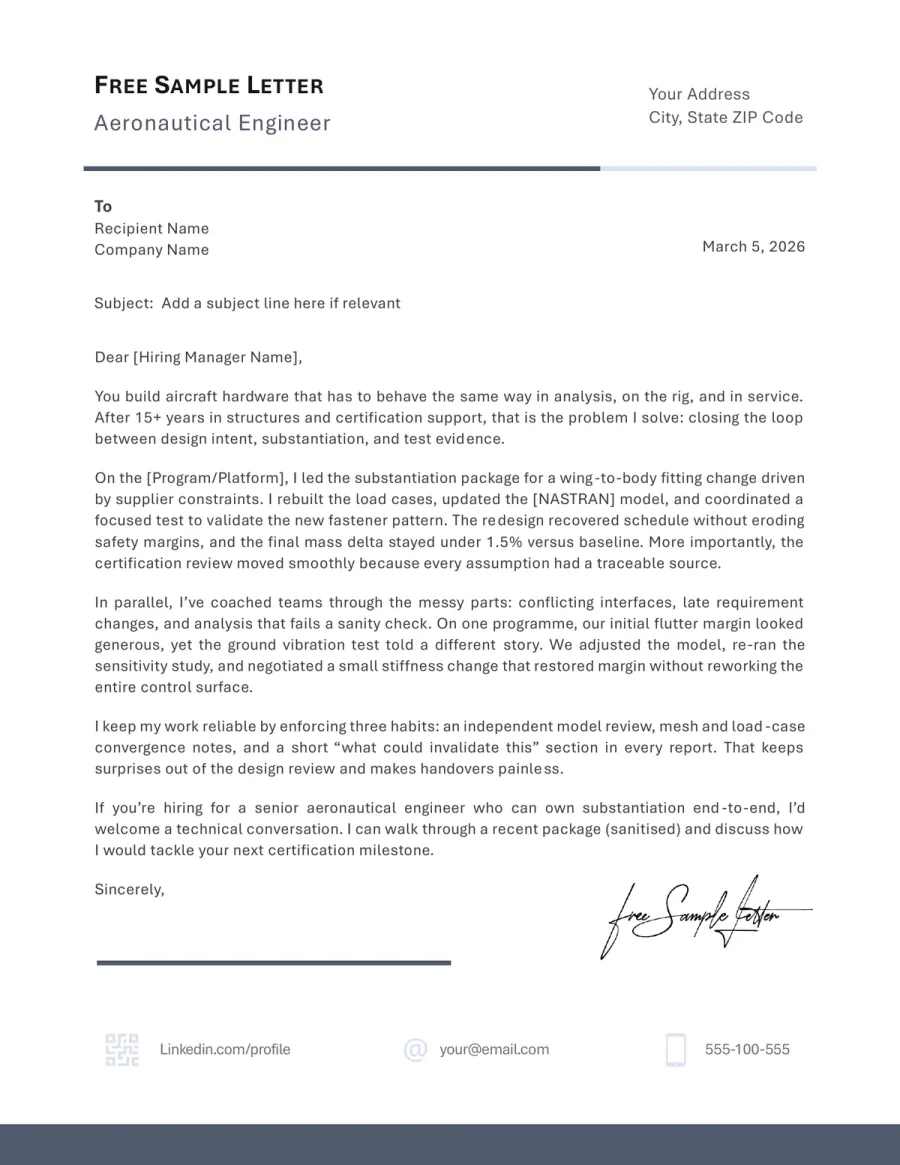
Turn the Samples Into Your Own Application Letter in 5 Steps
Copy-pasting generic content rarely works in aerospace hiring: reviewers quickly notice recycled claims and mismatched tools. Keep the structure, but update it with your own projects, test results, metrics, and the exact certification details from the job posting. Connect each paragraph to a concrete deliverable you can discuss in a technical interview.
➡️ More expert guidance in our article: The Only Cover Letter Writing Guide You Will Ever Need
Pick the closest role angle
Pick the sample that closely matches your target area - structures, CFD, or systems - and reflect the job post’s specific terms and deliverables. Remove any claims you cannot directly support.
See an example
I aligned my [Program] capstone to your need for [deliverable] by naming the exact output (loads summary + [Tool] model) and the decision it supported on [aircraft/system].
Hook them with a decision
Open with a decision you made under real constraints, not just a personal trait. Use one sentence to state the need, one to show your evidence, and keep it concise and specific. Avoid filler.
See an example
You need faster test closure. I shipped a daily script in [Python] that flagged sensor drift before the 9am review, so the team avoided reruns and kept the test plan on schedule.
Swap in two proof blocks
Include two concise proof paragraphs: one highlighting an analysis or design achievement, and another showcasing a win in testing, manufacturing, or cross-team collaboration. Add at least one metric or a clear before-and-after result.
See an example
Cut bracket mass by [number]% while keeping positive margins; later, I cleaned strain data in [Python] to catch drift early and prevent a rerun during daily test reviews.
Match the posting’s language, lightly
If the job posting uses terms like “substantiation” or “correlation,” use those exact words once in your letter, then demonstrate what you delivered using them. ATS systems value keyword matches, and engineers appreciate traceable context - just avoid repeating the job posting verbatim.
See what to include
I improved test-to-model correlation to within [number]% on critical gauges by aligning coordinate systems and re-checking boundary conditions with the test engineer.
Close like an engineer
Close by proposing a next step relevant to the role, such as a brief walkthrough of a model, a plot, and what you would improve next. Skip generic thank-yous and suggest a specific 15-20 minute conversation.
See Try this
I can bring a sanitized pack (loads summary, FEA setup, correlation plot) and discuss how I’d de-risk your next [milestone] in the first [number] weeks, including the checks I’d run before sign-off.
Keyword Radar for Aeronautical Engineers
- MRB nonconformance closure
- CATIA part modelling
- wind-tunnel data cleanup
- NASTRAN
- strain-gauge layout plan
- CS-25 compliance file
- test-to-model correlation notes
- FEA
- trade studies with constraints
- boundary conditions sanity check
- Python scripts for plots
- flutter margin check
- tolerance stack-up review
- grid independence check
- interface control document
- mass properties tracking
- thermal loads assessment
- MATLAB signal filtering
- static strength margins
- tooling constraints from suppliers
- airworthiness mindset in reviews
- composite panel test notes
- design review minutes that last
- root cause in test anomalies
- CFD
Do & Don't: Aeronautical Engineer Cover Letters That Read Review-Ready
Recruiters look for engineering evidence they can rely on during a review. They reject letters that simply list tools, and they trust candidates who demonstrate constraint management, traceability, and test-ready thinking in four concise sections. The lists below are designed to help you signal these strengths.
Red Flags: what reads like a recycled template
Red Flags- Claim certification knowledge without naming the standard you worked under
- Write “worked on aircraft projects” without scope, interface, or ownership
- Hide the check step (no validation, no correlation, no convergence note)
- Pad paragraphs with traits instead of decisions and outcomes
- Ignore the job post’s nouns (aircraft type, domain, outputs)
Trust Signals: what looks solid to engineering managers
Trust Signals- Name the system boundary you owned on [Program]
- Write traceable assumptions and call out what would invalidate them
- Reference the artifact you produced (report, model, test note, CR)
- Use the posting’s keywords once, inside sentences about real work
- Bring one micro-scene that sounds like the shop or lab
FAQ - Aeronautical Engineer Cover Letter
Do aerospace teams even read cover letters, or is it a waste of time? Toggle answer
If a cover letter isn’t required, keep it brief. Use one when you’re a borderline match, switching domains, or need to explain your context quickly. Remember, a single inconsistency can hurt - don’t submit a rushed or careless letter.
How do I prove “certification mindset” without faking CS-25/FAR-25 experience? Toggle answer
Mention a standard or verification habit you have actually used, such as traceability, review notes, test correlation, or checklist routines. Then describe the deliverable: what you wrote, checked, or completed. Avoid listing acronyms if you can’t confidently explain them in an interview.
Should I mention ITAR, citizenship, or security clearance in my cover letter? Toggle answer
Only mention ITAR, citizenship, or security clearance if the job posting makes it relevant. One clear line is enough: “Eligible to work under [ITAR/export-control] requirements” or “Current [level] clearance.” Don’t include unnecessary personal details - let HR request more information if needed.
My work is proprietary. How can I show impact without sharing sensitive details? Toggle answer
Discuss your work using “sanitized artifacts” such as a load-case summary, correlation plot, change request, or test note. Use relative figures - percentages, time saved, or reruns avoided - and explain your process and validation steps. Your goal is to demonstrate your approach, not to reveal sensitive program data.
I’m applying to many roles. How do I tailor fast without rewriting everything? Toggle answer
Maintain one core story in your letter, but personalize three things: the opening constraint, two proof paragraphs, and 8-12 job-specific keywords incorporated into real sentences. Just adding company praise isn’t enough - your letter will still sound generic.
TL;DR - Aeronautical engineer cover letter: make it review-ready
An aeronautical engineer cover letter wins when it reads like engineering, not enthusiasm: constraints, trade-offs, test reality, traceable outputs. The fatal mistake is listing tools and “love of aviation” with no decision, no check step, and nothing you can defend.
The quiet signal recruiters trust is discipline: you name what would invalidate your conclusion, you show how you verify work, and you offer a short walkthrough of one artifact. That’s what separates a “nice applicant” from someone they can put in a design review next week.